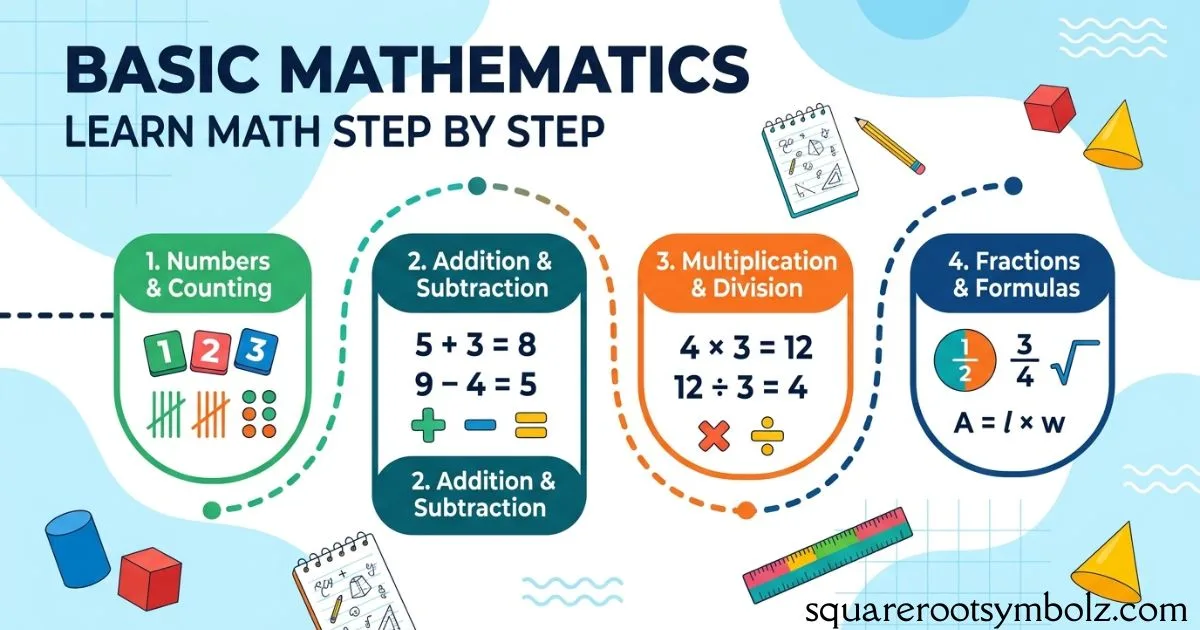
Learn basic mathematics with clear explanations, worked examples, formulas, and practice questions. Explore arithmetic, fractions, percentages, square roots, algebra, geometry, and mathematical symbols in one place.
Whether you are learning a new concept or reviewing a skill, start with the topic you need and follow each calculation from beginning to end.

What Is Basic Mathematics?
Basic mathematics is the study of numbers, arithmetic operations, fractions, decimals, percentages, measurement, and other foundational math concepts. It also introduces topics such as algebra, geometry, and statistics that help you solve problems at school, at work, and in everyday life.
Basic math helps you compare prices, calculate discounts, measure spaces, understand data, and work with unknown values. Learning the ideas behind the calculations makes it easier to apply them to new problems.
Explore Basic Math Topics
Number Systems and Basic Mathematical Concepts
Learn how numbers are classified and used. Explore whole numbers, integers, negative numbers, rational and real numbers, place value, rounding, factors, multiples, and prime numbers.
Example: In 4,782, the digit 7 represents 700 because it is in the hundreds place.
Explore: Number Systems · Place Value · Factors and Multiples
Basic Arithmetic Operations
Addition combines quantities, subtraction finds a difference, multiplication calculates a product, and division splits a quantity into equal groups or measures how many groups fit.
Example: Three notebooks cost $4 each.
3 × $4 = $12
The total cost is $12 before any applicable tax.
Explore: Addition and Subtraction · Multiplication · Division
Order of Operations: BODMAS and PEMDAS
BODMAS and PEMDAS help you decide which operations to perform first. Work through grouping symbols, exponents, multiplication and division from left to right, then addition and subtraction from left to right.
Example:
4 + 3 × 5 = 4 + 15 = 19
Multiplication comes before addition, so the answer is 19, not 35.
Explore: Order of Operations
Fractions, Decimals, and Percentages
Fractions represent parts of a whole. Decimals use a decimal point, and percentages express a value out of 100. Learn to compare these forms, simplify fractions, find common denominators, and convert between them.
Example: Convert 3/4 to a percentage.
3 ÷ 4 = 0.75
0.75 × 100 = 75%
Explore: Fractions · Decimals · Percentage Formula
Ratios, Proportions, Factors, and Multiples
Ratios compare quantities. Proportions show when two ratios are equal. Factors divide a number exactly, while multiples result from multiplying a number by whole numbers.
Example: A recipe uses 2 cups of flour for 4 servings. For 8 servings, double the ingredients: 2 × 2 = 4 cups.
Explore: Ratios and Proportions · Greatest Common Factor · Least Common Multiple
Exponents, Powers, and Square Roots
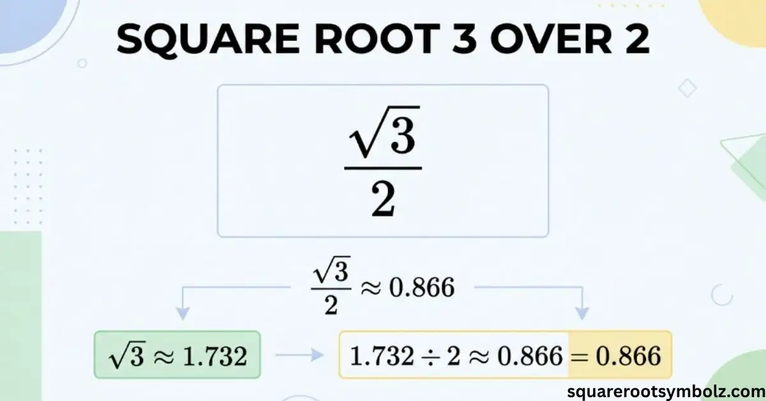
Exponents show repeated multiplication. A square root undoes squaring for nonnegative numbers (the principal square root).
Example:
3² = 3 × 3 = 9
Going the other way, √9 = 3.
Explore squares, perfect squares, exponent rules, and radical expressions.
Explore: Exponents · Perfect Squares · Square Root Formula · Square Root of 16
Basic Algebra and Equations
Algebra uses letters to represent unknown values. Equations describe relationships that can be solved using mathematical rules.
Example: Solve x + 5 = 12.
Subtract 5 from both sides:
x = 12 − 5 = 7
Check: 7 + 5 = 12. The solution is correct.
Explore: Algebra Basics · Variables and Expressions · Solving Equations
Basic Geometry and Measurement
Geometry studies shapes, lines, angles, and space. Measurement describes quantities such as length, area, volume, mass, and time.
Example: A rectangle is 8 inches long and 3 inches wide.
Area = Length × Width = 8 × 3 = 24 square inches.
Area measures the space inside a shape, while perimeter measures the distance around it.
Explore: Geometry Basics · Area Formulas · Perimeter Formulas · Volume Formulas
Basic Statistics and Data
Statistics helps you summarize information and identify patterns. Learn how to calculate the mean, median, mode, and range, and how to read tables and graphs.
Example: Find the mean of 2, 4, and 6.
(2 + 4 + 6) ÷ 3 = 12 ÷ 3 = 4
Explore: Mean, Median, and Mode · Range in Math · Probability Basics
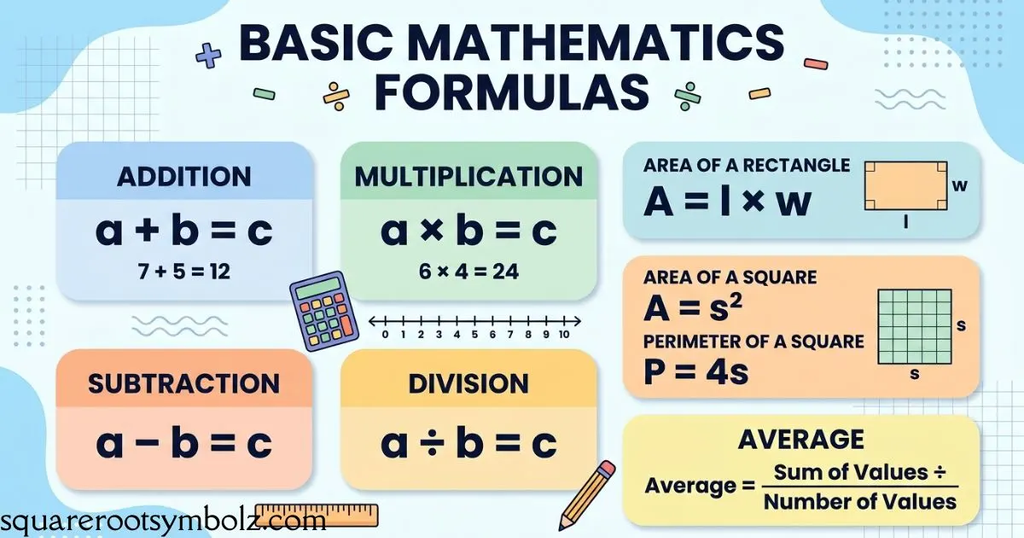
Basic Mathematics Formulas
Use this reference to review common formulas. Check the relevant lesson for worked examples and special cases.
| Concept | Formula |
| Mean | Sum of values ÷ Number of values |
| Percentage | (Part ÷ Whole) × 100% |
| Percentage change | ((New − Original) ÷ Original) × 100% |
| Square area | Side × Side |
| Rectangle area | Length × Width |
| Rectangle perimeter | 2 × (Length + Width) |
| Triangle area | ½ × Base × Perpendicular height |
| Circle area | πr² |
| Circle circumference | 2πr |
| Rectangular prism volume | Length × Width × Height |
| Pythagorean theorem | a² + b² = c² |
The percentage-change formula requires a nonzero original value. A positive result indicates an increase and a negative result indicates a decrease. The Pythagorean theorem applies to right triangles, where c is the hypotenuse.
Mathematical Symbols and Their Meanings
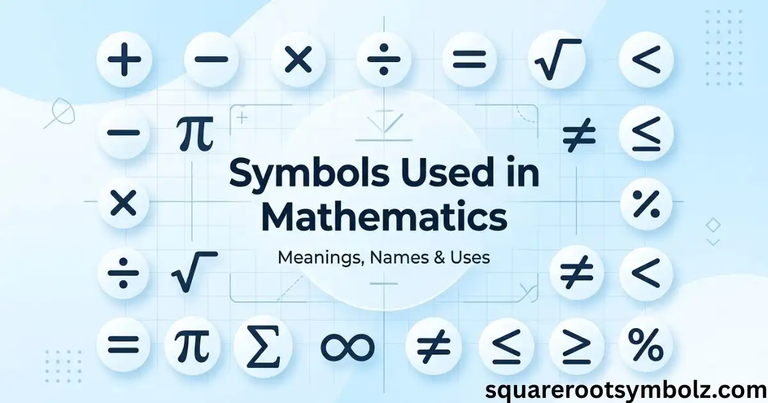
Math symbols represent operations, relationships, and mathematical concepts. Learn their names and meanings before using them in equations.
| Symbol | Name | Meaning |
| + | Plus | Addition |
| − | Minus | Subtraction or negative value |
| × | Multiplication sign | Multiplication |
| ÷ | Division sign | Division |
| = | Equals | Two expressions have equal values |
| ≠ | Not equal to | Values are different |
| < | Less than | The left value is smaller |
| > | Greater than | The left value is larger |
| √ | Square root sign | Indicates a square root |
| π | Pi | A constant used in circle calculations |
| ² | Superscript two | Often indicates a square |
For example, 4² = 16 means 4 squared equals 16. The symbol ² is different from the square root symbol √.
Need to copy or type a symbol? Visit the square symbol guide for square type symbols, related characters, and ways to use them. Explore Mathematical Signs and Meanings, Not Equal Symbol, and Square Root Symbol.
Test Your Basic Math Skills
Try these ten questions before checking the answer key.
- What is 36 + 27?
- What is 84 ÷ 7?
- Calculate 5 + 2 × 6.
- Simplify 6/8.
- Convert 0.35 to a percentage.
- Find 20% of 80.
- Solve x − 4 = 11.
- Find the area of a square with a side length of 5 cm.
- What is √81?
- Find the mean of 3, 5, 7, and 9.
Answer key
- 63
- 12
- 17
- 3/4
- 35%
- 16
- x = 15
- 25 cm²
- 9
- 6
For a better self-test, place the answer key inside a collapsible section on the live page. This lets readers attempt the questions before revealing the answers.
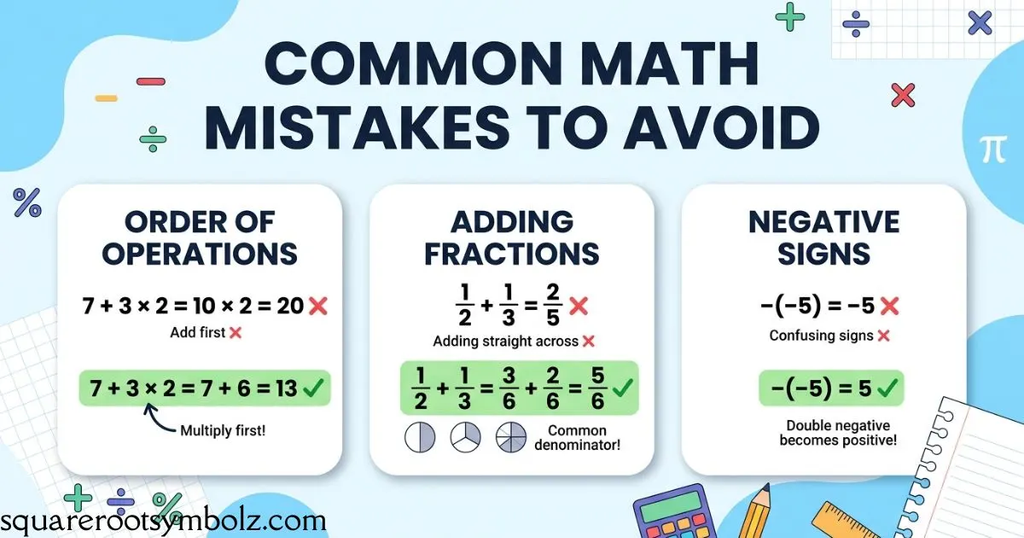
Common Math Mistakes to Avoid
Ignoring the order of operations: Multiplication and division come before addition and subtraction, with equal-priority operations evaluated from left to right.
Adding fractions without a common denominator: Convert fractions to equivalent fractions with a common denominator before adding or subtracting them.
Confusing area and perimeter: Area measures the space inside a shape; perimeter measures the distance around its boundary.
Forgetting units: Length uses units such as inches or centimeters. Area uses square units, and volume uses cubic units.
Skipping the answer check: Substitute a solution into the original equation or estimate the result to see whether it makes sense.
How to Learn Basic Mathematics
- Begin with place value and the four arithmetic operations.
- Practice fractions, decimals, percentages, and negative numbers.
- Learn the order of operations before moving into algebra.
- Follow worked examples and write down each step.
- Solve practice questions without looking at the answers.
- Review mistakes and repeat the problems that need more work.
A useful routine is to understand the problem, choose a method, show the steps, and check the result. These habits are consistent with the problem-solving, reasoning, and precision emphasized in the Common Core Standards for Mathematical Practice. These standards are relevant to US education but are not followed by every school or curriculum.
FAQs
What are the four basic mathematical operations?
Addition, subtraction, multiplication, and division are the four basic operations. They form the foundation for many calculations involving fractions, decimals, percentages, and algebra.
What does basic mathematics include?
Basic mathematics commonly includes number systems, arithmetic, fractions, decimals, percentages, ratios, order of operations, exponents, square roots, introductory algebra, geometry, measurement, and basic statistics. The exact topics depend on the learner’s grade and course.
Is basic math the same as arithmetic?
No. Arithmetic focuses on numbers and operations. Basic mathematics is broader and often includes fractions, percentages, measurement, geometry, and introductory algebra.
What basic math should everyone know?
Useful skills include the four operations, fractions, percentages, estimation, measurement, basic geometry, averages, and understanding common mathematical symbols.
How can I learn basic mathematics from the beginning?
Start with place value and arithmetic, then progress to fractions, decimals, percentages, and the order of operations. Move into algebra and geometry when you feel comfortable with the earlier topics.
Why is basic mathematics important?
Basic math helps with everyday calculations, budgeting, measurement, comparing prices, interpreting data, and learning more advanced subjects. It also supports logical reasoning and problem solving.
Start Learning Basic Math Today
Choose a topic, follow the worked examples, and test your understanding with practice questions. Whether you need help with a calculation, a square root, an algebra equation, a geometry formula, or a mathematical symbol, start with the lesson that answers your question.
Build your skills one concept at a time.

I’m the creator of SquareRootSymbolz.com, where I publish easy-to-understand guides on symbols, Unicode characters, Alt codes, keyboard shortcuts, and copy-and-paste text symbols. My goal is to provide accurate, well-researched, and user-friendly content that helps readers quickly find the information they need.