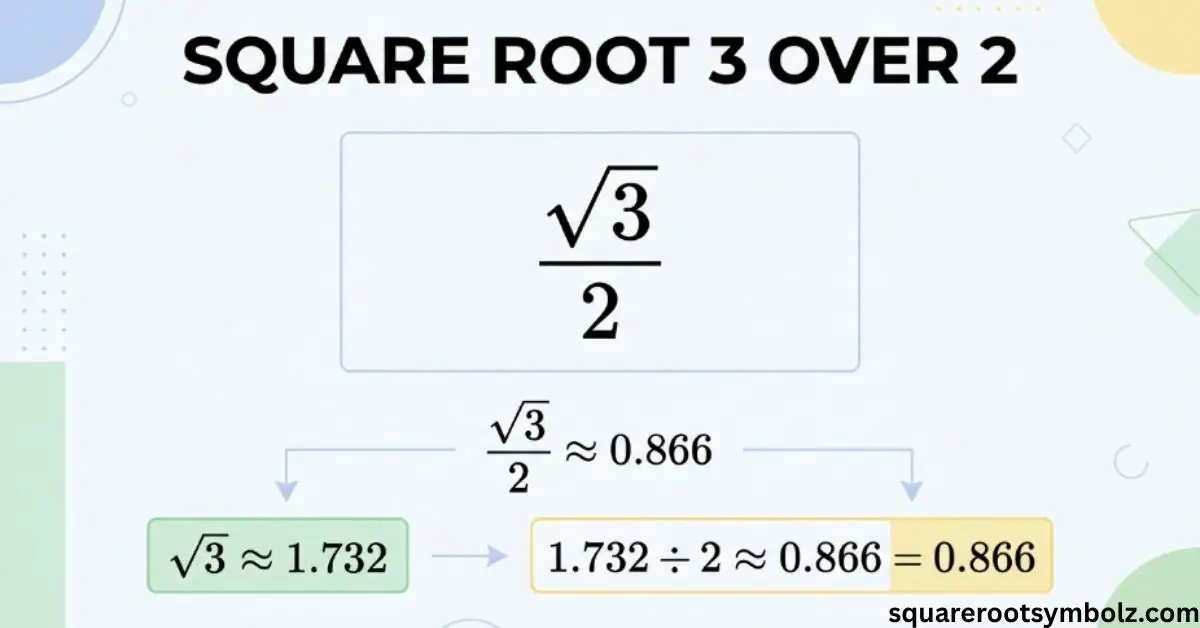
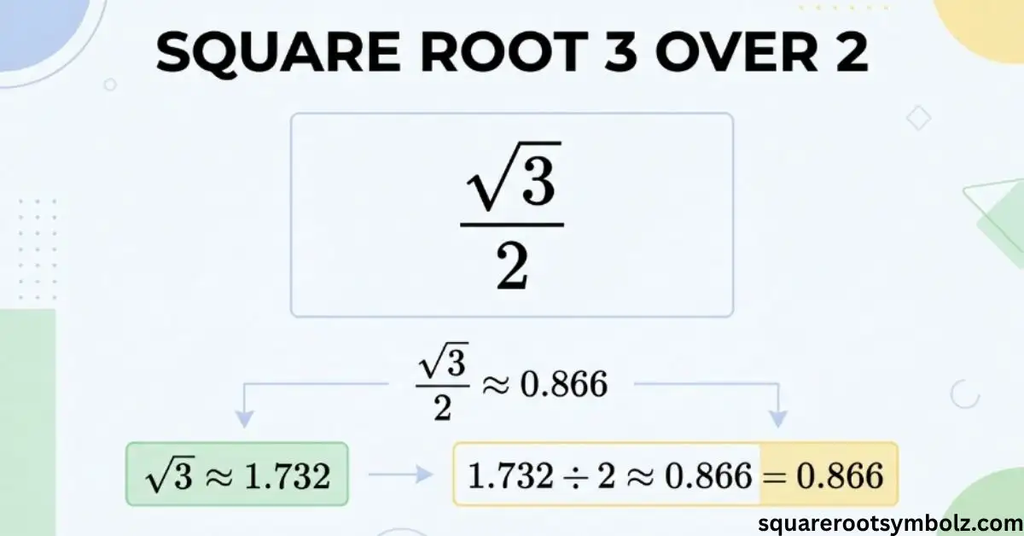
The square root 3 over 2, written as √3/2, equals approximately 0.8660254038. In trigonometry, it is one of the most important exact values because sin 60° = √3/2 and cos 30° = √3/2. You can derive it directly from a 30-60-90 triangle instead of simply memorizing it.
If you have ever seen √3/2 in a unit-circle table or trigonometry problem and wondered where it came from, the answer is surprisingly simple. A 30-60-90 triangle has side lengths in the ratio 1 : √3 : 2. Once that relationship is understood, the square root of 3 over 2 becomes a natural result of geometry, not a mysterious number.
Square Root 3 Over 2: 30-60-90 Triangle Sides
A 30-60-90 triangle is a special right triangle with angles of 30°, 60°, and 90°. Its side lengths always follow the ratio 1 : √3 : 2. The shortest side is opposite 30°, the longer leg is opposite 60°, and the hypotenuse is opposite 90°.
If the shortest side is 1, the longer leg is √3 and the hypotenuse is 2. Dividing the longer leg by the hypotenuse gives:
√3 / 2
That is the geometric source of the value. The expression is not an arbitrary fraction; it represents the ratio of the long leg to the hypotenuse in this special triangle.
| Triangle Part | Length |
| Short leg | 1 |
| Long leg | √3 |
| Hypotenuse | 2 |
| Long leg ÷ hypotenuse | √3/2 |
The same relationship works for any scale. If the hypotenuse is 10, the long leg is 5√3, because √3/2 × 10 = 5√3. Khan Academy derives this relationship by applying the Pythagorean theorem to the triangle.
Square Root 3 Over 2: 30-60-90 Triangle Formula
The standard 30-60-90 side formula can be written as:
x : x√3 : 2x
Here, x represents the shortest side. Therefore, the long leg is x√3 and the hypotenuse is 2x. Dividing those two lengths gives x√3 / 2x = √3/2, so the scale factor cancels.
This explains why the ratio remains the same no matter how large or small the triangle becomes. A triangle with sides 2, 2√3, and 4 still has the same long-leg-to-hypotenuse ratio:
2√3 / 4 = √3/2
The actual side lengths change, but the trigonometric ratio does not.
Square Root 3 Over 2 in a Triangle
Suppose the hypotenuse is 12 and you need the long leg. Multiply the hypotenuse by √3/2:
12 × √3/2 = 6√3
So the long leg is 6√3.
This is the same formula used when solving right-triangle problems involving a 30° or 60° angle.
Square Root 3 Over 2: 30-60-90 Triangle Proof
You can derive √3/2 without memorizing it. Start with an equilateral triangle of side length 1 and draw an altitude from one vertex to the opposite side. The altitude divides the triangle into two congruent 30-60-90 right triangles.
Each resulting triangle has a hypotenuse of 1 and a short leg of 1/2. Using the Pythagorean theorem:
x² + (1/2)² = 1²
Therefore:
x² = 1 − 1/4
x² = 3/4
Taking the positive square root:
x = √3/2
That gives the long leg directly.
Why the denominator is 2
The denominator 2 comes from cutting the equilateral triangle in half. Each half has a short leg equal to half the original side, while the hypotenuse remains the original side length. The Pythagorean theorem then produces the √3 term.
This geometric construction is one of the cleanest ways to understand the expression. Instead of treating √3/2 as a number to memorize, you can reconstruct it whenever you remember the 30-60-90 triangle.
Square Root 3 Over 2: 30-60-90 Triangle Rule
The 30-60-90 triangle rule states that the sides have the ratio:
1 : √3 : 2
The smallest side is opposite 30°, the √3 side is opposite 60°, and the hypotenuse is opposite 90°. Cuemath uses this fixed ratio to calculate missing side lengths when one side is known.
For example, if the shortest side is 7:
- Short leg = 7
- Long leg = 7√3
- Hypotenuse = 14
If the hypotenuse is 20:
- Short leg = 10
- Long leg = 10√3
So the √3/2 ratio can be used in either direction depending on which side is known.
Square Root 3 Over 2 and Trigonometric Ratios
For a 60° angle:
sin 60° = opposite/hypotenuse
The opposite side has relative length √3, while the hypotenuse has length 2. Therefore:
sin 60° = √3/2
For a 30° angle, the same ratio appears through cosine:
cos 30° = adjacent/hypotenuse = √3/2
These relationships are standard exact values for special angles.
Square Root 3 Over 2 Find the Reference Angle
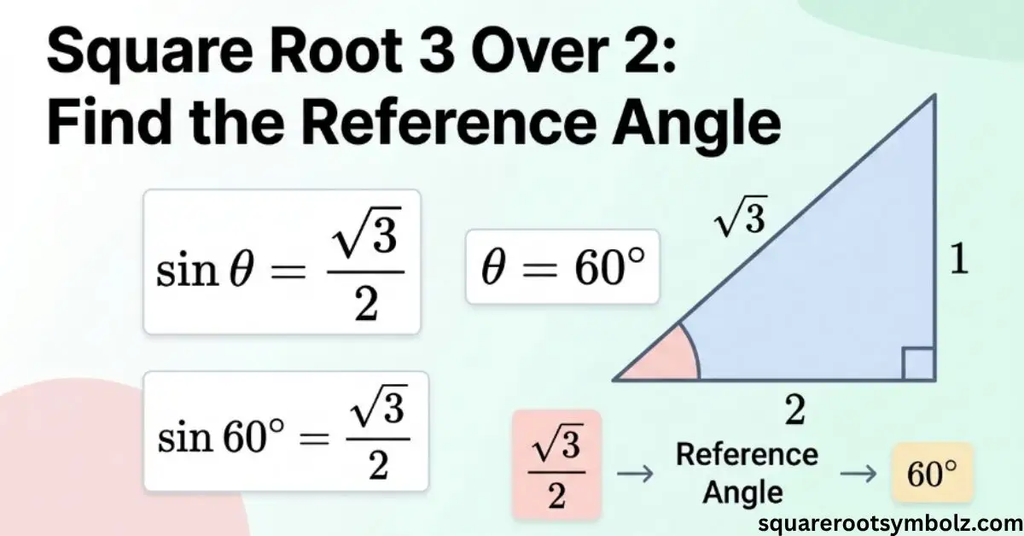
The expression √3/2 frequently appears when working backward from a trigonometric value. If:
sin θ = √3/2
the familiar acute reference angle is 60°.
Likewise, if:
cos θ = √3/2
the acute reference angle is 30°.
The reason is that sin 60° = √3/2 and cos 30° = √3/2. Mathway’s related problems also treat √3/2 in the context of reference angles and trigonometric expressions.
Square Root 3 Over 2 on the Unit Circle
On the unit circle, cosine represents the x-coordinate and sine represents the y-coordinate. At 60°, the coordinate is:
(1/2, √3/2)
Therefore:
cos 60° = 1/2
and:
sin 60° = √3/2
At 30°, the coordinates switch:
(√3/2, 1/2)
so:
cos 30° = √3/2
and:
sin 30° = 1/2
This makes the two appearances of √3/2 easy to remember.
Square Root 3 Over 2: Convert to a Decimal
The exact form of √3/2 is preferable in most mathematics and trigonometry problems, but you may sometimes need a decimal approximation. Since:
√3 ≈ 1.7320508076
divide by 2:
√3/2 ≈ 0.8660254038
So:
√3/2 ≈ 0.8660
Mathway also gives approximately 0.86602540 for the decimal representation.
| Form | Value |
| Exact form | √3/2 |
| Decimal approximation | 0.8660254038… |
| Percentage | 86.60254038…% |
The exact radical form should generally be kept until the final step because rounding too early can introduce unnecessary error.
Square Root 3 Over 2: Solved Examples
Example 1: Find sin 60°
From the special-angle values:
sin 60° = √3/2
Therefore:
Answer: √3/2
This is an exact value, so there is no need to convert it into a decimal unless the problem specifically asks for one.
Example 2: Find cos 30°
Using the 30-60-90 triangle:
cos 30° = adjacent/hypotenuse
The adjacent side is √3 and the hypotenuse is 2.
Therefore:
cos 30° = √3/2
Example 3: Find the long leg
A 30-60-90 triangle has a hypotenuse of 14. Find its long leg.
The long leg equals √3/2 times the hypotenuse:
(√3/2)(14) = 7√3
Therefore:
Long leg = 7√3
Example 4: Find the decimal value
Convert √3/2 to a decimal:
√3/2 ≈ 0.8660254038
Rounded to three decimal places:
0.866
Example 5: Find the missing side
Suppose a 30-60-90 triangle has a short leg of 5. Its long leg is:
5√3
and its hypotenuse is:
10
The ratio remains:
5√3/10 = √3/2
This confirms that scaling the triangle does not change the trigonometric ratio.
Square Root 3 Over 2: Practice Questions
Try these without looking at the answers first.
- What is sin 60°?
- What is cos 30°?
- What is the decimal approximation of √3/2?
- What is the side ratio of a 30-60-90 triangle?
- If the hypotenuse is 16, what is the long leg?
- If the short leg is 9, what is the long leg?
- What angle has sin θ = √3/2 as its acute reference angle?
- What angle has cos θ = √3/2?
Answers
- √3/2
- √3/2
- 0.8660254038…
- 1 : √3 : 2
- 8√3
- 9√3
- 60°
- 30°
Conclusion
The square root 3 over 2, written √3/2, is one of the most useful exact values in elementary trigonometry. Its decimal value is approximately 0.8660254038, but its exact radical form is usually more useful in mathematical work.
The easiest way to understand it is through the 30-60-90 triangle, whose sides follow the ratio 1 : √3 : 2. From that single relationship, you can see why sin 60° = √3/2 and cos 30° = √3/2. The same value also appears naturally on the unit circle at 60° and as the x-coordinate at 30°. Once you understand the triangle behind the number, √3/2 becomes much easier to remember and use.
FAQs
What is the square root 3 over 2?
√3/2 is approximately 0.8660254038. It is an important exact trigonometric value equal to both sin 60° and cos 30°.
Why is sin 60 equal to √3/2?
A 30-60-90 triangle has side lengths in the ratio 1 : √3 : 2. For the 60° angle, the opposite side is √3 and the hypotenuse is 2, giving sin 60° = √3/2.
Why is cos 30 equal to √3/2?
For a 30° angle, the adjacent side in a 30-60-90 triangle is √3 and the hypotenuse is 2. Therefore, cos 30° = √3/2.
Is √3/2 irrational?
Yes. Since √3 is irrational, dividing it by the nonzero rational number 2 produces an irrational number. Its decimal expansion is nonterminating and nonrepeating.
What is √3/2 as a decimal?
√3/2 ≈ 0.8660254038.
What is √3/2 as a percentage?
Multiply by 100:
(√3/2) × 100 ≈ 86.6025%
What is √3/2 on the unit circle?
At 60°, the unit-circle coordinate is (1/2, √3/2). Thus √3/2 is the y-coordinate and equals sin 60°.
Is √3/2 the same as 1/√3?
No. They are different values:
√3/2 ≈ 0.8660
while:
1/√3 = √3/3 ≈ 0.5774
They should not be treated as equivalent.
What is the reference angle for sin θ = √3/2?
The acute reference angle is 60° because sin 60° = √3/2.
What is the reference angle for cos θ = √3/2?
The acute reference angle is 30° because cos 30° = √3/2.

I’m the creator of SquareRootSymbolz.com, where I publish easy-to-understand guides on symbols, Unicode characters, Alt codes, keyboard shortcuts, and copy-and-paste text symbols. My goal is to provide accurate, well-researched, and user-friendly content that helps readers quickly find the information they need.