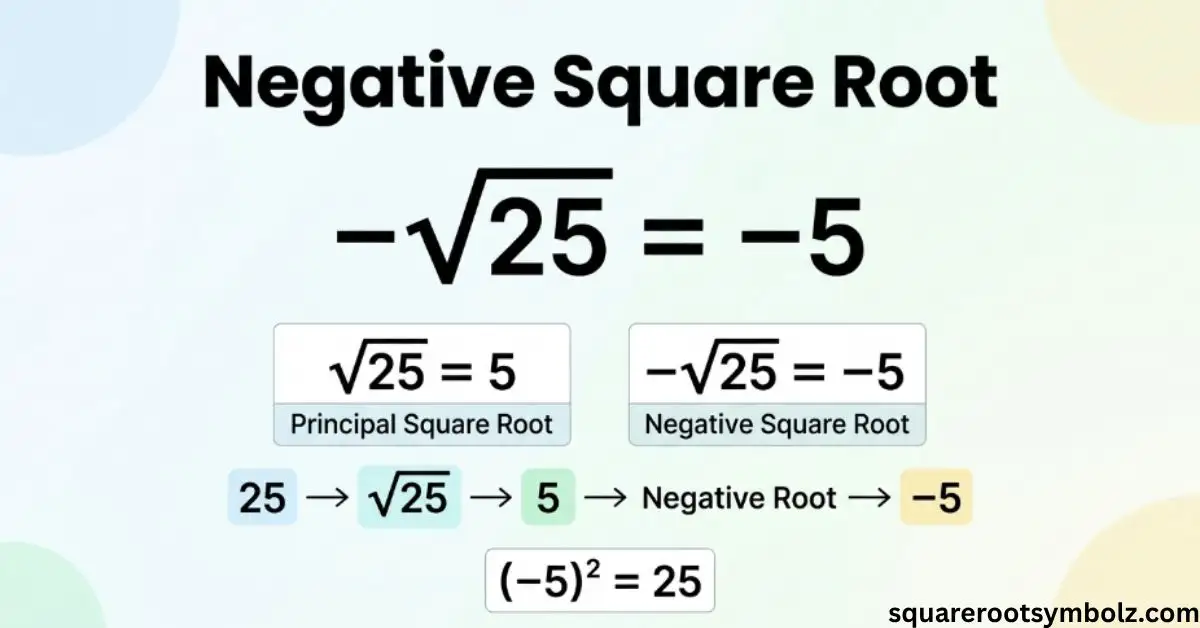
A negative square root is written by placing a minus sign in front of the radical, such as −√25 = −5. The key is knowing that the radical symbol √ itself represents the principal square root, which is nonnegative. This small notation difference causes many students to confuse −√25 with √−25.
If you’ve ever wondered why a positive number can have both a positive and negative square root, you’re not alone. The idea becomes much easier when you connect square numbers, radical notation, principal roots, and the ± sign. Let’s break it down with simple examples and clear rules.
Negative Numbers
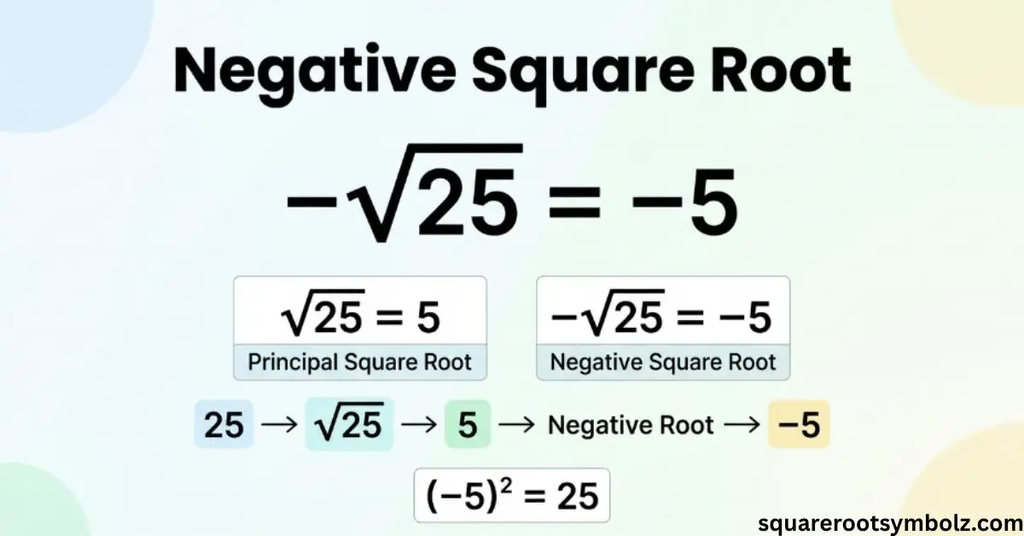
A negative number can be squared, and the result is positive. For example, (-5)² = 25. This happens because multiplying two negative numbers gives a positive result. Therefore, both 5 and −5 produce 25 when squared.
This distinction matters when working with a negative square root. The expression −√25 means the negative of the square root of 25, so the answer is −5. It does not mean that the number 25 is negative under the radical.
| Expression | Meaning | Answer |
| √25 | Principal square root of 25 | 5 |
| −√25 | Negative of the square root | −5 |
| √−25 | Square root of negative 25 | Not real |
| ±√25 | Both square roots | ±5 |
That final distinction is one of the most important ideas on this topic.
Two Square Roots
Every positive real number has two square roots. For example, both 4 and −4 square to 16 because 4² = 16 and (-4)² = 16. Therefore, the two square roots of 16 are 4 and −4.
When solving an equation such as x² = 16, you need both possibilities:
x = ±√16
So:
x = ±4
This gives:
x = 4 or x = −4
The negative solution is not an error. It is required because a negative number can produce the same positive square when multiplied by itself.
Principal Square Root
The principal square root is the nonnegative square root represented by the radical symbol. Therefore, √36 = 6, not −6. The number −6 is still a square root of 36, but it is not the principal square root.
This is why −√36 and √36 have different meanings:
- √36 = 6
- −√36 = −6
OpenStax similarly explains that a negative square root is formed by putting the negative sign in front of the radical sign.
Why the Radical Is Not Automatically Negative
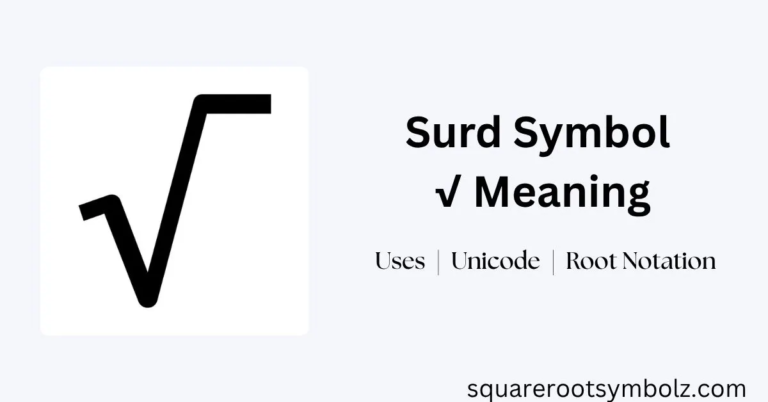
The radical symbol √ has a specific convention: for a nonnegative real number, it identifies the principal, nonnegative square root. If you want the negative value, you explicitly place − before the radical.
For example:
√81 = 9
but
−√81 = −9
That one symbol changes the result.
Plus-Minus Sign
The plus-minus sign, ±, is useful when an equation has two square-root solutions. Instead of writing x = √25 and x = −√25 separately, you can write:
x = ±√25
which means:
x = 5 or x = −5.
The important point is that ± does not mean that the principal square root itself is simultaneously positive and negative. It tells you to consider both signs when solving an equation.
Example: Solve x² = 49
Start with:
x² = 49
Take the square roots of both sides:
x = ±√49
Since:
√49 = 7
the solutions are:
x = ±7
Therefore:
x = 7 or x = −7
This is why forgetting the negative solution can produce an incomplete answer.
How About the Square Root of Negatives?
A negative square root and a square root of a negative number are not the same thing.
Compare:
−√25 = −5
with:
√−25
The first expression has a negative sign outside the radical and has the real answer −5. The second has a negative number inside the radical. In the real-number system, √−25 has no real value.
This is one of the most common mistakes students make. The location of the minus sign matters:
| Expression | Result in real numbers |
| −√25 | −5 |
| √−25 | Not a real number |
| −√−25 | Not a real number |
| √25 | 5 |
So, if the question asks for the negative square root of 25, the correct answer is −5, not √−25.
Square roots of negative and complex numbers
In the real-number system, a negative number has no square root because the square of every real number is nonnegative. For example, no real number multiplied by itself equals −9.
Mathematics can extend beyond real numbers using complex numbers. The imaginary unit is defined by:
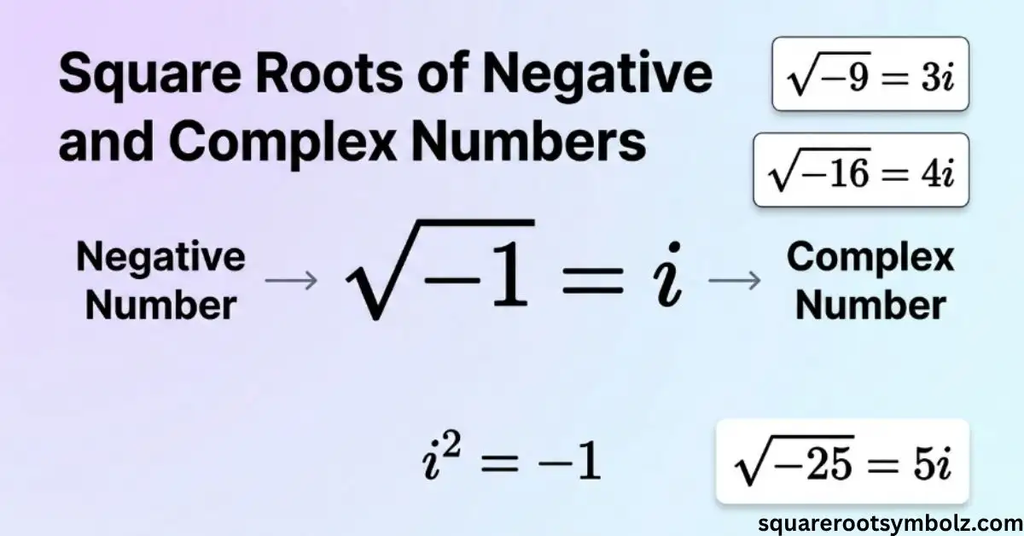
i² = −1
Therefore:
√−25 = 5i
because:
(5i)² = 25i² = −25.
This is different from −√25, which equals −5. The first involves the imaginary unit i; the second is an ordinary negative real number.
Negative Square Root vs. Negative Radicand
The easiest way to remember the difference is to look at where the negative sign appears.
Negative outside:
−√36 = −6
Negative inside:
√−36 = 6i
The first is a real number. The second is a complex number when working beyond the real-number system. OpenStax gives the general relationship √−b = √b · i for positive real b.
Square Root Notation
Square root notation uses the radical sign √ together with a radicand, the number or expression underneath the radical. For example, in √64, the number 64 is the radicand and 8 is the principal square root.
A negative square root simply places the minus sign before the radical:
−√64 = −8
The negative sign is not part of the radicand. That distinction becomes especially important when expressions become more complicated.
Common Notation Examples
| Notation | Interpretation | Result |
| √9 | Principal square root | 3 |
| −√9 | Negative square root | −3 |
| ±√9 | Both square roots | ±3 |
| √−9 | Square root of a negative | 3i |
| (−3)² | Square of negative 3 | 9 |
Understanding these forms prevents many algebra mistakes.
Square and Square Root of a number
A square and a square root reverse each other. If 5² = 25, then 5 is a square root of 25. Because (-5)² = 25 as well, −5 is also a square root of 25.
The difference appears when using the radical symbol. The expression √25 selects the principal value 5, while −√25 explicitly selects the negative value −5.
For equations, however, both values may be needed:
x² = 25
x = ±√25
x = ±5
So always consider whether you’re evaluating a radical or solving an equation.
Conclusion
A negative square root can mean two different things depending on the expression. For a positive number such as 9, the principal square root is √9 = 3, while −√9 = −3 is the negative of that root. However, the square root of a negative number, such as √−9, is not a real number; it is expressed using imaginary numbers, giving 3i. Understanding this distinction makes equations, radicals, and complex numbers much easier to work with. Once you separate the principal square root from its negative counterpart, solving square-root problems becomes far more straightforward and less confusing.
FAQ Section
What is a negative square root?
A negative square root is the negative value of a principal square root. For example, −√49 = −7.
Is the square root of a number always positive?
The radical symbol √ represents the principal, nonnegative square root. However, a positive number has both a positive and a negative square root.
What is the negative square root of 25?
The negative square root of 25 is −5, because −√25 = −5.
Is −√25 the same as √−25?
No. −√25 = −5, while √−25 is not a real number and equals 5i in the complex number system.
Why does x² = 16 have two answers?
Both 4² and (-4)² equal 16, so the solutions are x = 4 and x = −4.
What does ±√x mean?
The symbol ± means both the positive and negative square-root values: +√x and −√x.
What is the principal square root?
The principal square root is the nonnegative value represented by the radical symbol. For example, √64 = 8.

I’m the creator of SquareRootSymbolz.com, where I publish easy-to-understand guides on symbols, Unicode characters, Alt codes, keyboard shortcuts, and copy-and-paste text symbols. My goal is to provide accurate, well-researched, and user-friendly content that helps readers quickly find the information they need.