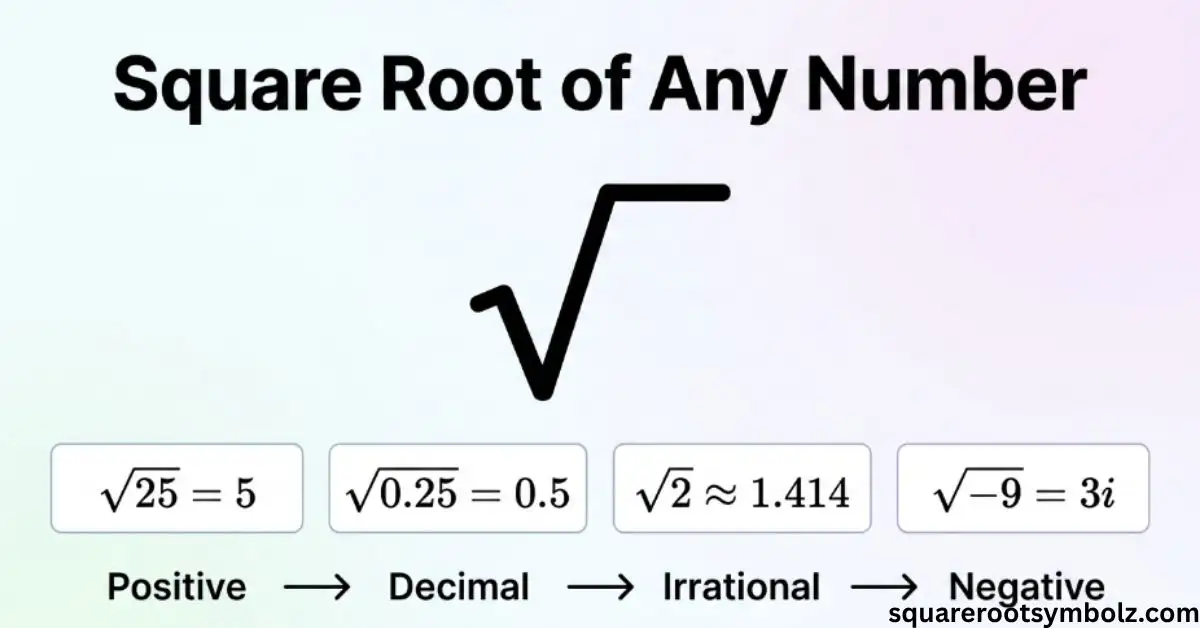
The square root of any number is the value that, when multiplied by itself, produces the original number. For example, √25 = 5 because 5 × 5 = 25. If you are struggling with perfect squares, decimals, irrational roots, or finding a root without a calculator, the key is choosing the right method. This guide explains square roots through radicals, radicands, perfect squares, prime factorization, estimation, and long division.
Once you understand how the principal square root works, the topic becomes much less intimidating. You can quickly recognize simple roots, estimate non-perfect squares, simplify radical expressions, and verify your answers by squaring the result. These same ideas also appear in algebra, geometry, statistics, and everyday measurement.
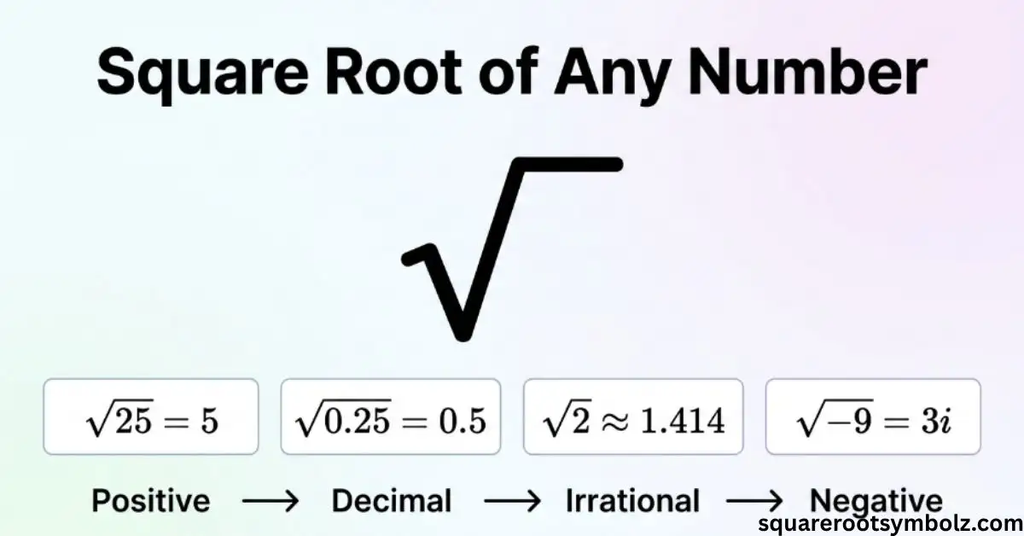
What Is a Square Root?
A square root reverses the operation of squaring. If a number x is squared to produce n, then x is a square root of n. For example, 7² = 49, so 7 is a square root of 49. In radical notation, this is written as √49 = 7.
The symbol √ is called the radical symbol, while the number underneath it is the radicand. The expression √49 is therefore a radical expression. In standard mathematics, √49 means the principal square root, which is the nonnegative value 7.
The relationship can also be written using a fractional exponent:
√x = x¹ᐟ²
These two forms represent the same operation. For example:
√64 = 64¹ᐟ² = 8
A useful way to check any answer is to multiply the result by itself. If you claim √81 = 9, verify it with 9 × 9 = 81.
Perfect Squares and Non-Perfect Squares
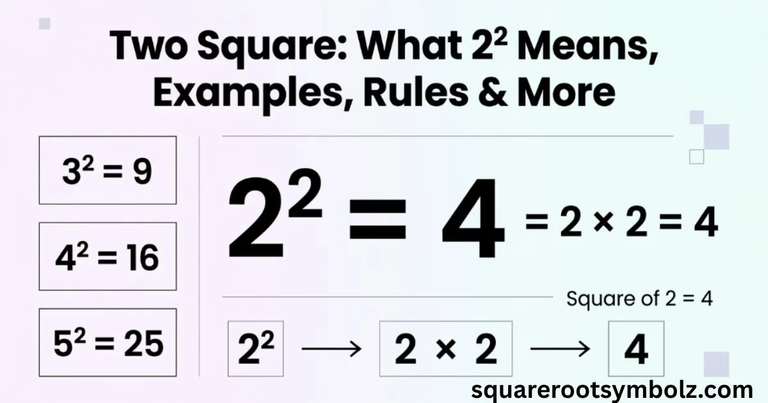
A perfect square is a number whose square root is an integer. Common examples include 1, 4, 9, 16, 25, 36, 49, 64, 81, and 100. Their roots are easy to recognize because they come directly from squaring whole numbers.
For example:
- √1 = 1
- √4 = 2
- √9 = 3
- √16 = 4
- √25 = 5
- √100 = 10
A non-perfect square does not have a whole-number square root. For example, √2, √3, √5, and √7 produce irrational numbers. Their decimal expansions continue indefinitely without repeating.
This distinction matters because your calculation method may change. A perfect square can often be solved mentally or through prime factorization. A non-perfect square may require estimation, long division, a calculator, or an exact radical form.
For example:
√49 = 7
but
√50 ≈ 7.071
The second result is an approximation because 50 is not a perfect square.
5 Methods to Calculate a Square Root
There is no single method that is best for every problem. The easiest approach depends on whether the number is a perfect square, whether you have a calculator, and whether you need an exact answer or an approximation.
For a simple value such as 144, recognizing the perfect square is fastest because 12 × 12 = 144. For a number such as 50, estimation gives a quick answer, while long division can produce additional decimal places. Prime factorization is especially useful when simplifying perfect-square factors.
Method 1: Using a Calculator (Easiest)
A calculator is the quickest way to find the decimal value of a square root. Enter the number, press the √ or sqrt button, and read the result.
For example:
√144 = 12
For a non-perfect square:
√50 ≈ 7.0710678119
The calculator gives an approximation because √50 is irrational. When a problem asks for a certain number of decimal places, round the calculator result only after obtaining enough digits.
Method 2: The Repeated Subtraction Method
Repeated subtraction works particularly well for understanding perfect squares. Start with the number and subtract consecutive odd numbers: 1, 3, 5, 7, and so on. The number of successful subtractions needed to reach zero gives the square root.
For √16:
16 − 1 = 15
15 − 3 = 12
12 − 5 = 7
7 − 7 = 0
Four subtractions were required, so:
√16 = 4
This method illustrates an important pattern: perfect squares can be formed by adding consecutive odd numbers. It is excellent for learning the concept, although it becomes inefficient for large numbers.
Method 3: The Prime Factorization Method
Prime factorization is useful when the number can be broken into pairs of identical prime factors. The basic process is to factor the number, group identical factors into pairs, take one factor from each pair, and multiply the selected factors.
Consider √144:
144 = 2 × 2 × 2 × 2 × 3 × 3
Create pairs:
(2 × 2)(2 × 2)(3 × 3)
Take one factor from each pair:
2 × 2 × 3 = 12
Therefore:
√144 = 12
This method is particularly useful for perfect squares and for simplifying radicals. Vedantu and Tutorax both emphasize prime factorization as a practical square-root method.
Method 4: The Estimation Method
Estimation is useful when the number is not a perfect square and you want a quick answer without immediately reaching for a calculator.
Suppose you need √50. First identify the closest perfect squares:
49 < 50 < 64
Therefore:
7 < √50 < 8
Because 50 is very close to 49, its square root should be much closer to 7 than 8.
Try 7.1:
7.1 × 7.1 = 50.41
That is slightly high. Try 7.07:
7.07 × 7.07 ≈ 49.9849
So:
√50 ≈ 7.07
Estimation is especially useful for checking whether a calculator answer makes sense.
Method 5: The Long Division Method (Most Accurate)
The long division method allows you to calculate square roots by hand, including non-perfect squares. It is more involved than estimation but can produce as many decimal places as needed.
For √529, group the digits from right to left:
5 | 29
The largest square less than or equal to 5 is 4:
2² = 4
Write 2 as the first digit of the answer and subtract:
5 − 4 = 1
Bring down 29 to create 129. Double the current answer:
2 × 2 = 4
Now find a digit that makes:
43 × 3 = 129
Therefore the next digit is 3.
So:
√529 = 23
The long-division method is especially useful when a teacher asks for a manual calculation rather than a calculator result. Both Vedantu and Tutorax present it as an important method for calculating square roots by hand.
Square Roots Reference Table
Knowing common perfect squares makes finding a square root much faster.
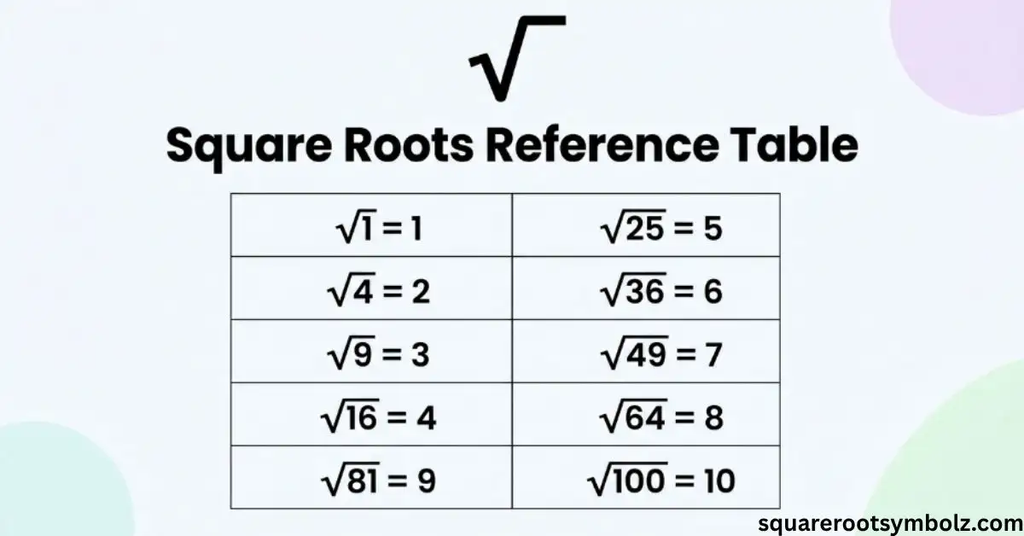
| Number | Square Root |
| 1 | 1 |
| 4 | 2 |
| 9 | 3 |
| 16 | 4 |
| 25 | 5 |
| 36 | 6 |
| 49 | 7 |
| 64 | 8 |
| 81 | 9 |
| 100 | 10 |
| 121 | 11 |
| 144 | 12 |
| 169 | 13 |
| 196 | 14 |
| 225 | 15 |
Memorizing these common perfect squares helps you estimate unfamiliar roots quickly. For example, if you need √170, you immediately know that 169 = 13², so √170 must be slightly greater than 13.
How to Simplify a Square Root
Finding a decimal answer is not always the goal. In algebra, you may be asked to simplify a radical instead.
For example:
√50
Look for a perfect-square factor:
50 = 25 × 2
Therefore:
√50 = √(25 × 2)
Separate the square root:
√50 = √25 × √2
Since √25 = 5:
√50 = 5√2
This is the simplified radical form. It is exact, while 7.071… is only a decimal approximation.
Another example is:
√72 = √(36 × 2) = 6√2
The general strategy is simple: find the largest useful perfect-square factor, take its square root outside the radical, and leave the remaining factor inside.
Positive and Negative Square Roots
A common source of confusion is the difference between the square root symbol and the complete set of solutions to a squared equation.
For a positive number such as 25, both 5 and −5 square to 25:
5² = 25
(−5)² = 25
Therefore, 25 has two square roots: 5 and −5.
However, the radical expression:
√25
means the principal, nonnegative square root:
√25 = 5
If you specifically want the negative root, write:
−√25 = −5
This distinction becomes especially important when solving equations. The radical symbol represents the principal square root, while an equation such as x² = 25 has two solutions:
x = ±5
OpenStax makes this principal-root distinction explicit in its treatment of square roots and radicals.
There is another important case: the square root of a negative number. In the real number system, √−9 has no real value. In complex numbers, it can be written as:
√−9 = 3i
where i = √−1.
Real-World Applications of Square Roots
Square roots are not limited to textbook exercises. They appear whenever a calculation involves reversing a squared quantity.
In geometry, the Pythagorean theorem uses square roots to calculate an unknown side of a right triangle:
a² + b² = c²
If a triangle has legs of 3 and 4:
c = √(3² + 4²)
c = √25 = 5
The same idea can help calculate diagonal distances in construction and measurement.
Square roots also appear in statistics. Standard deviation is defined as the square root of variance, so the operation helps describe how widely data values are spread around their average.
In finance, science, engineering, and computer science, square-root relationships appear in formulas and algorithms. Understanding the basic operation therefore provides a foundation for more advanced mathematics.
Evaluating Square Roots
To evaluate a square root, first determine whether the radicand is a perfect square. If it is, the result may be an integer. If it is not, decide whether the problem requires an exact radical, an approximation, or a decimal calculated with technology.
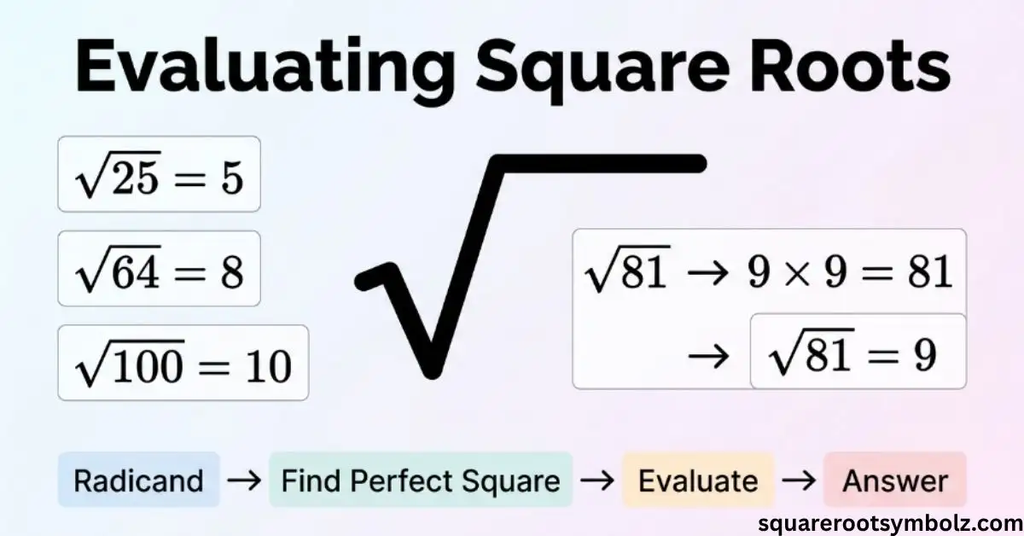
For example:
√36 = 6
because:
6² = 36
For √20, identify nearby perfect squares:
16 < 20 < 25
Therefore:
4 < √20 < 5
A calculator gives approximately:
√20 ≈ 4.4721
But if the problem asks for simplified radical form, the exact answer remains:
√20 = 2√5
This difference between an exact radical and a decimal approximation is one of the most useful habits to develop when working with square roots.
Quick Examples
| Expression | Answer | Type |
| √4 | 2 | Perfect square |
| √9 | 3 | Perfect square |
| √25 | 5 | Perfect square |
| √50 | 5√2 ≈ 7.071 | Non-perfect square |
| √72 | 6√2 ≈ 8.485 | Non-perfect square |
| √100 | 10 | Perfect square |
| √144 | 12 | Perfect square |
| √200 | 10√2 ≈ 14.142 | Non-perfect square |
A good final check is always to square your answer. If your answer is 12 for √144, verify that 12 × 12 = 144. This simple check catches many arithmetic mistakes.
Conclusion
Finding the square root of any number becomes much easier once you know which method fits the problem. Perfect squares can often be recognized immediately, while prime factorization helps simplify exact roots, estimation provides quick approximations, and long division lets you calculate roots by hand with greater precision. Remember that √x represents the principal square root, while equations such as x² = 25 can have both positive and negative solutions. Whether you are working with radicals, decimals, algebra, geometry, or statistics, the same core idea applies: find the value that squares back to the original number.
FAQ Section
What is the square root of any number?
The square root of a nonnegative number is the value that, when multiplied by itself, gives the original number. For example, √36 = 6 because 6 × 6 = 36.
How do you find the square root of a number?
You can use a calculator, recognize perfect squares, use prime factorization, estimate between nearby perfect squares, or apply the long-division method.
What is the formula for a square root?
The square root can be written as:
√x = x¹ᐟ²
This means taking a square root is equivalent to raising a number to the power of one-half.
Does every positive number have two square roots?
Yes. A positive number has a positive and a negative square root. For example, 25 has roots 5 and −5. However, √25 specifically means the principal root, 5.
Can you find the square root of a negative number?
Not within the real number system. In complex numbers, √−9 = 3i, where i represents the imaginary unit.
How do you find the square root of a non-perfect square?
Find the two closest perfect squares to estimate its range, use long division for a manual approximation, or use a calculator for a decimal result.
What is the difference between a square and a square root?
Squaring multiplies a number by itself, while taking a square root reverses that operation. For example, 8² = 64, while √64 = 8.
What is the square root of 50?
The exact simplified form is 5√2, while the decimal approximation is 7.0710678.
What is the easiest way to find a square root?
For everyday calculations, a calculator is usually fastest. For schoolwork, recognizing perfect squares and using estimation can often provide a quick mental answer.

I’m the creator of SquareRootSymbolz.com, where I publish easy-to-understand guides on symbols, Unicode characters, Alt codes, keyboard shortcuts, and copy-and-paste text symbols. My goal is to provide accurate, well-researched, and user-friendly content that helps readers quickly find the information they need.