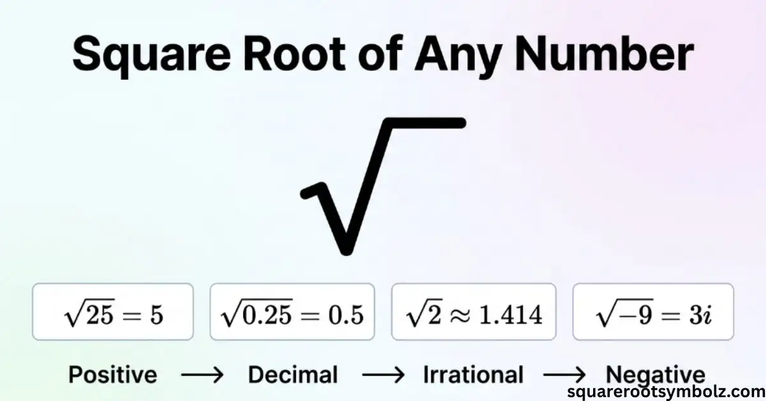
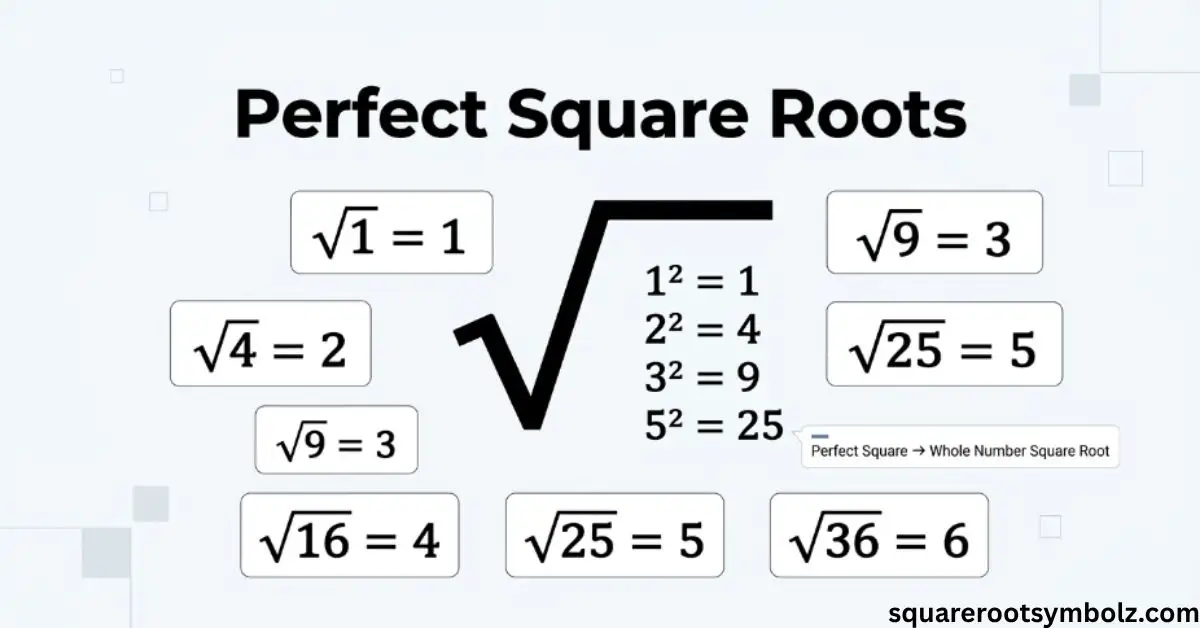
The perfect square roots are the whole-number or integer answers you get when a number is a perfect square. For example, √25 = 5 because 5 × 5 = 25. Learning the connection between squares, square roots, integers, factors, and the radical symbol makes this topic much easier.
If square roots have ever felt confusing, start with one simple question: “What number multiplied by itself gives me this number?” That approach works beautifully for perfect squares. In this guide, we’ll use clear examples, square-root tables, radical notation, and practical checks to help you recognize and calculate exact roots confidently. The key is understanding the relationship rather than memorizing isolated answers.
Square Roots
A square root is a number that produces the original value when multiplied by itself. For example, because 6 × 6 = 36, the principal square root of 36 is 6. In notation, we write √36 = 6. This is the inverse operation of squaring.
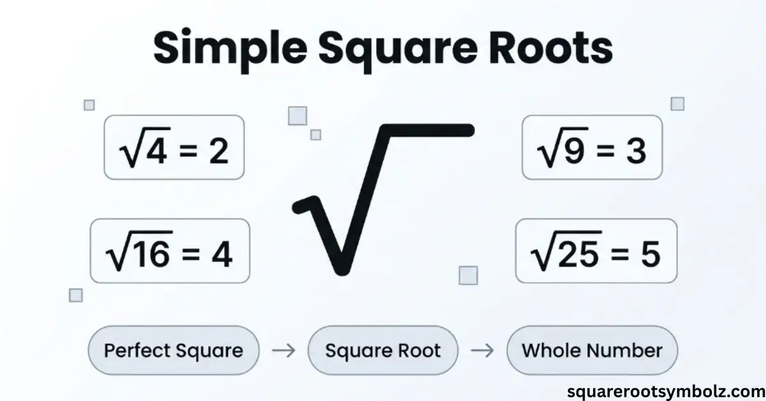
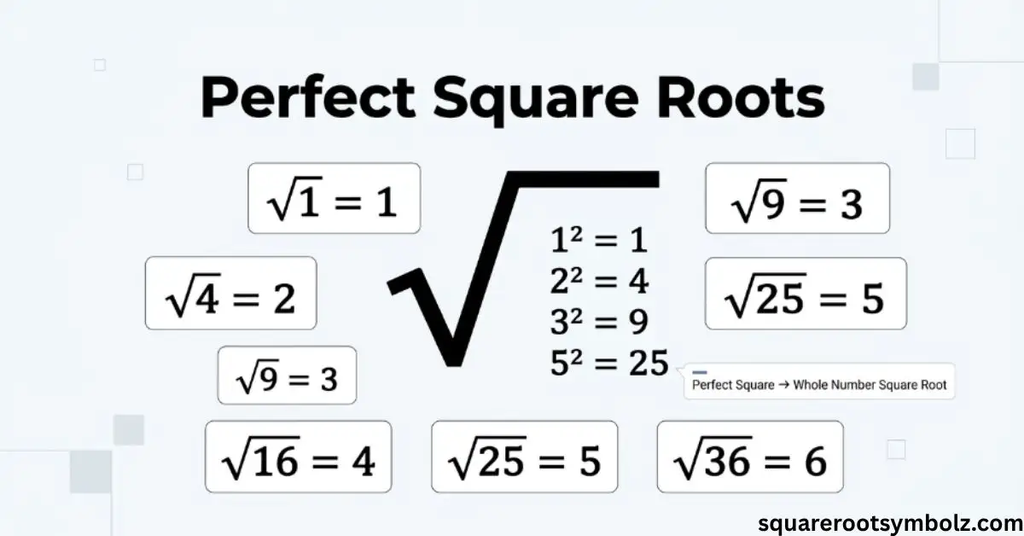
Perfect square roots are especially easy because their answers are whole numbers. For example, √4 = 2, √9 = 3, √16 = 4, and √25 = 5. When you see one of these numbers under a radical, think backward: identify the integer that was multiplied by itself to create the radicand.
A quick way to think about a square root
Ask: “What number times itself gives the number under the radical?” For √49, the answer is 7 because 7 × 7 = 49. This simple question works for every perfect square and provides a reliable mental check before using a calculator.
Perfect Squares
A perfect square is a number that can be written as the square of an integer or whole number. Examples include 1, 4, 9, 16, 25, 36, 49, 64, 81, and 100. Their square roots are exact integers, which makes them the easiest square roots to calculate.
A useful table is worth memorizing because it makes perfect square roots almost automatic:
| Number | Square | Square Root |
| 1 | 1² | √1 = 1 |
| 2 | 2² = 4 | √4 = 2 |
| 3 | 3² = 9 | √9 = 3 |
| 4 | 4² = 16 | √16 = 4 |
| 5 | 5² = 25 | √25 = 5 |
| 6 | 6² = 36 | √36 = 6 |
| 7 | 7² = 49 | √49 = 7 |
| 8 | 8² = 64 | √64 = 8 |
| 9 | 9² = 81 | √81 = 9 |
| 10 | 10² = 100 | √100 = 10 |
| 11 | 11² = 121 | √121 = 11 |
| 12 | 12² = 144 | √144 = 12 |
| 13 | 13² = 169 | √169 = 13 |
| 14 | 14² = 196 | √196 = 14 |
| 15 | 15² = 225 | √225 = 15 |
The pattern is straightforward: square an integer, and the result is a perfect square. Reverse that operation, and you find its principal square root. Math Is Fun and Mometrix both emphasize this square-to-root relationship as a foundation for learning the topic.
Calculating Square Roots
To calculate a perfect square root, first identify the number under the radical. Then ask which integer multiplied by itself equals that number. For √81, you need a number whose square is 81. Since 9 × 9 = 81, the principal square root is 9.
You can verify every answer by squaring it. Suppose you calculate √144 = 12. Multiply 12 × 12 and you get 144, confirming the result. This verification habit is useful in homework, tests, and calculator work because it catches simple mistakes immediately.
Examples of perfect square roots
Consider these examples:
- √16 = 4 because 4² = 16
- √25 = 5 because 5² = 25
- √36 = 6 because 6² = 36
- √49 = 7 because 7² = 49
- √64 = 8 because 8² = 64
- √81 = 9 because 9² = 81
- √100 = 10 because 10² = 100
The important idea is not the radical itself; it is the multiplication relationship behind it.
Finding the Square Root
Finding the square root of a perfect square becomes much easier when you know common squares. If you remember that 12² = 144, then √144 immediately equals 12. If you do not remember it, factor the number or search for the integer whose square produces the target.
For larger numbers, prime factorization can help. For example, 144 can be written as 2 × 2 × 2 × 2 × 3 × 3. Pairing equal prime factors gives 2 × 2 × 3 = 12, so √144 = 12. This approach becomes especially useful when the number is less familiar.
What if the number is not a perfect square?
A number such as 10 does not have an integer square root. Its root lies between 3 and 4 because 3² = 9 and 4² = 16. Its square root is approximately 3.1623, an irrational value rather than an exact whole number.
Simplifying Square Roots
Not every radical contains a perfect square. When a number has a perfect-square factor, you can separate that factor and take its square root outside the radical. For example, 40 = 4 × 10, so √40 = √4 × √10 = 2√10.
This technique is called simplifying a square root. The goal is to remove every possible perfect-square factor while leaving the remaining factor under the radical. For example, √96 simplifies to 4√6 because 96 contains two pairs of 2s that can be taken outside the radical.
| Radical | Perfect-square factor | Simplified form |
| √12 | 4 | 2√3 |
| √18 | 9 | 3√2 |
| √20 | 4 | 2√5 |
| √27 | 9 | 3√3 |
| √40 | 4 | 2√10 |
| √50 | 25 | 5√2 |
| √72 | 36 | 6√2 |
| √98 | 49 | 7√2 |
This is where understanding perfect squares becomes more powerful than simply memorizing a table. You can use the same idea to simplify many larger radicals.
Negative Numbers
There is an important distinction between a square root and the solutions to a square equation. For example, both 5 and −5 become 25 when squared: 5² = 25 and (−5)² = 25. Therefore, the equation x² = 25 has two solutions, x = 5 and x = −5.
However, the radical symbol √ normally represents the principal square root, which is the nonnegative root. Therefore, √25 = 5, not −5. If you specifically want the negative root, you write −√25 = −5. This distinction prevents one of the most common square-root mistakes.
Why negative numbers matter
A real number squared can never be negative. For example, 4² = 16 and (−4)² = 16. Therefore, there is no real number whose square equals −16. Negative radicands require a different number system involving imaginary numbers.
The Square Root Symbol
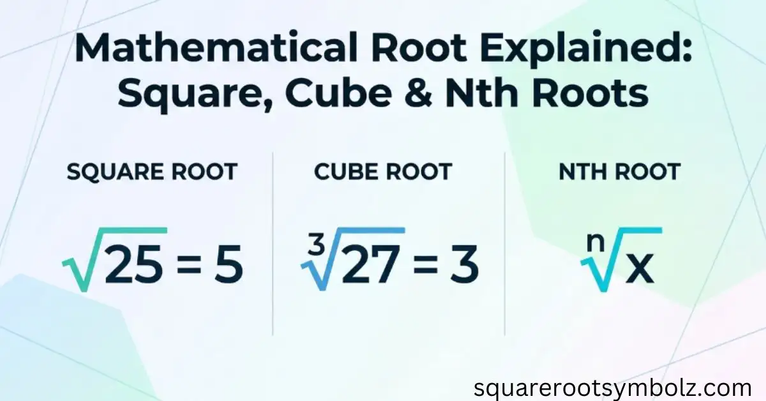
The square root symbol is called the radical sign or radical symbol: √. The number beneath the radical is called the radicand. In √25, the radical is √ and 25 is the radicand. Mometrix also explains that an unwritten index of 2 indicates a square root.
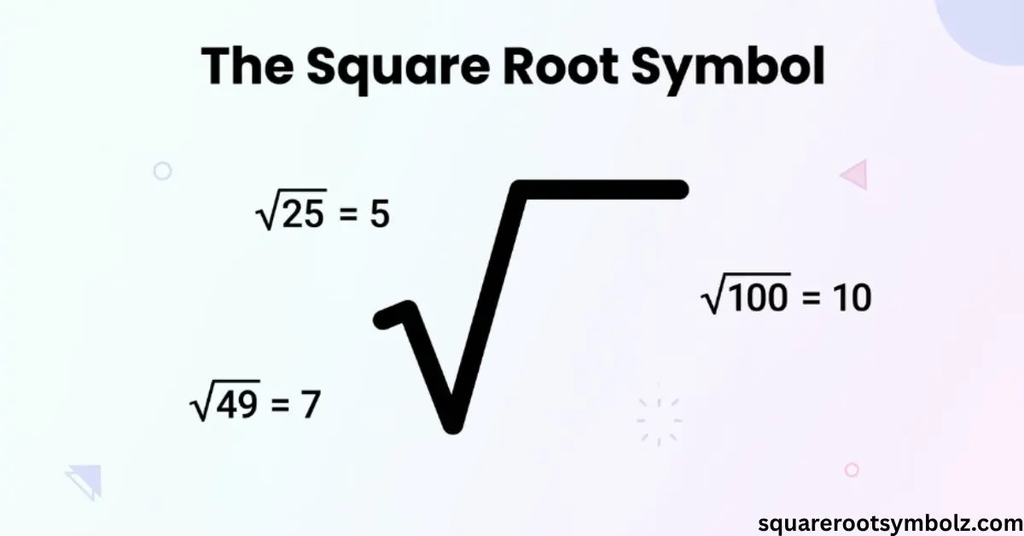
For example:
√36 = 6
Here, 36 is the radicand, √ is the radical symbol, and 6 is the principal square root. The radical notation gives you a compact way to ask which number, multiplied by itself, produces the value underneath it.
Square root notation
You may see square roots written in several equivalent ways:
- √25
- 25^(1/2)
- the square root of 25
All three represent the same mathematical concept. In basic arithmetic, the radical form √25 is usually the clearest and most familiar.
Conclusion
Understanding perfect square roots becomes much easier once you see the relationship between squaring and taking a square root. A perfect square is produced by multiplying an integer by itself, while its principal square root reverses that operation. Remember key squares such as 1, 4, 9, 16, 25, 36, 49, 64, 81, and 100, and use multiplication to verify your answers.
For numbers that are not perfect squares, do not force a whole-number answer. Instead, estimate between nearby perfect squares, use a calculator for a decimal approximation, or simplify the radical by extracting perfect-square factors. With these methods, perfect square roots become a predictable skill rather than a memorization exercise.
FAQs
How do I find a square root?
For a perfect square, find the integer that produces the number when multiplied by itself. For example, √64 = 8 because 8 × 8 = 64.
What are the whole number square roots from 1 to 20?
Among the numbers 1 through 20, the perfect squares are 1, 4, 9, and 16. Their principal square roots are 1, 2, 3, and 4.
What are numbers with integer square roots?
Numbers with integer square roots are called perfect squares. Examples include 1, 4, 9, 16, 25, and 36.
What are the first 20 perfect squares?
The first 20 positive perfect squares are 1, 4, 9, 16, 25, 36, 49, 64, 81, 100, 121, 144, 169, 196, 225, 256, 289, 324, 361, and 400.
Are perfect square roots always whole numbers?
When the radicand is a perfect square of an integer, its principal square root is a whole number or integer. For example, √121 = 11. Non-perfect squares generally produce irrational square roots.
Is 50 a perfect square?
No. There is no integer that can be multiplied by itself to produce 50. Therefore, √50 is not an integer and can instead be simplified to 5√2.
Perfect Squares and Square Root Practice Questions
Practice makes recognizing perfect square roots much faster. Try these without a calculator:
| Question | Answer |
| √9 | 3 |
| √16 | 4 |
| √25 | 5 |
| √49 | 7 |
| √64 | 8 |
| √100 | 10 |
| √121 | 11 |
| √144 | 12 |
| √169 | 13 |
| √196 | 14 |
Practice challenge: Which of these are perfect squares: 18, 25, 36, 45, 64, 81, and 90?
The answers are 25, 36, 64, and 81 because each can be produced by multiplying an integer by itself. Mometrix uses similar recognition and matching exercises to reinforce the connection between a perfect square and its integer square root.
Quick self-check
Before accepting a perfect square root answer, square it again. If your answer is 12 for √144, calculate 12 × 12. Because the result is 144, your answer is confirmed. This simple reverse-check is one of the easiest ways to avoid careless errors.

I’m the creator of SquareRootSymbolz.com, where I publish easy-to-understand guides on symbols, Unicode characters, Alt codes, keyboard shortcuts, and copy-and-paste text symbols. My goal is to provide accurate, well-researched, and user-friendly content that helps readers quickly find the information they need.