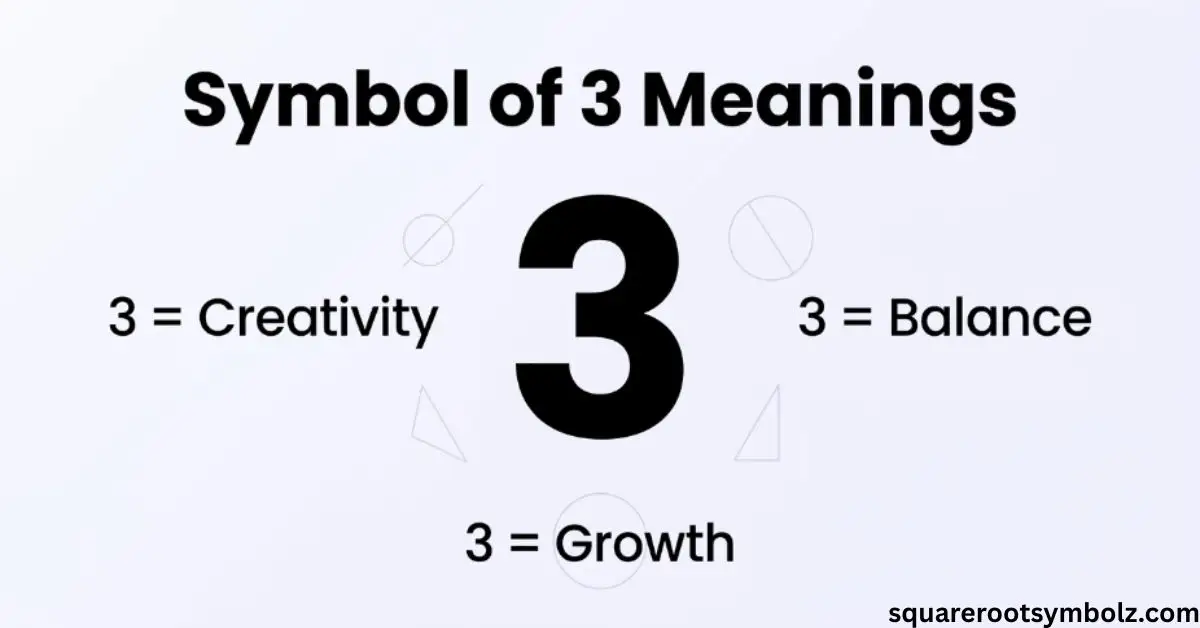
The symbol of 3 is 3, the familiar digit used to represent the number three. If you need a styled version, you can also copy ③, ⑶, Ⅲ, ٣, ³, or ₃. These characters may look similar, but they have different Unicode identities and uses.
After working with mathematical notation and digital symbols, I’ve found that the confusing part is rarely finding the character it is knowing which version actually fits the job. A student may need ³ for an exponent, a designer may want ③ for a label, and someone writing multilingual text may need ٣. This guide separates those uses clearly.
How to Copy and Paste 3 Number Symbols
If you simply need a symbol of 3 for copying, the standard digit is 3. For a different appearance, you can use ③ ⑶ Ⅲ ٣ ³ ₃. Select the character you need, copy it, and paste it into a document, message, website, username, or other supported text field.
The important point is that these are not all interchangeable. 3 is the ordinary digit, while ³ is a superscript character and ₃ is a subscript character. Likewise, Ⅲ is a Roman numeral, and ٣ is an Arabic-Indic digit. Unicode gives each character its own identity.
Quick Copy Table
| Symbol | Common name | Unicode |
| 3 | Digit Three | U+0033 |
| ³ | Superscript Three | U+00B3 |
| ₃ | Subscript Three | U+2083 |
| ③ | Circled Digit Three | U+2462 |
| ⑶ | Parenthesized Digit Three | U+2476 |
| Ⅲ | Roman Numeral Three | U+2162 |
| ⅲ | Small Roman Numeral Three | U+2172 |
| ٣ | Arabic-Indic Digit Three | U+0663 |
| 3 | Fullwidth Digit Three | U+FF13 |
Unicode identifies the ordinary 3 as DIGIT THREE at U+0033 and separately defines characters such as superscript three and circled digit three.
What Are 3 Number Symbols?
A symbol of 3 can refer to the ordinary digit 3 or to a Unicode character that visually represents three in another form. The distinction matters because a character’s appearance does not automatically tell you its technical identity. Unicode treats different representations as separate characters even when they communicate the same basic number.
The ordinary digit 3 belongs to the Basic Latin/ASCII digit set and represents the value three. Other forms add typography or numbering conventions around that value. Unicode’s data, for example, identifies ③ as CIRCLED DIGIT THREE and ³ as SUPERSCRIPT THREE.
This explains why searches for “symbol of 3” can produce several different answers. Someone asking for a mathematical exponent may mean ³, while someone searching for a decorative number may want ③ or ➂.
Popular 3 Number Symbols
The most useful number-three characters depend on context. For ordinary writing, 3 is the correct choice. For Roman numbering, Ⅲ works naturally, while ③ is useful for labels and numbered points. The superscript ³ is especially important in mathematics, science, units, and exponent notation.
Unicode confirms that Ⅲ is ROMAN NUMERAL THREE at U+2162 and ⅲ is SMALL ROMAN NUMERAL THREE at U+2172.
| Symbol | Best use | Example |
| 3 | Normal number | 3 books |
| ³ | Exponent/cube | 2³ |
| ₃ | Subscript | x₃ |
| ③ | Label or list marker | ③ Step |
| ⑶ | Parenthesized numbering | ⑶ |
| Ⅲ | Roman numbering | Chapter Ⅲ |
| ⅲ | Lowercase Roman numbering | section ⅲ |
| ٣ | Arabic-Indic writing | ٣ |
The distinction between 3 and ³ is particularly important. Unicode identifies superscript three as equivalent in meaning to a raised form of the ordinary digit and notes its use as “cubed.”
Types of Number 3 Symbols
Number-three characters can be grouped according to their visual or writing-system function. Some are enclosed numbers, some belong to Roman numerals, and others come from different numeral systems. This makes the symbol of 3 a useful example of how Unicode separates appearance, language, and typographic purpose.
Enclosed Number 3 Symbols
Enclosed forms place three inside or alongside a visual enclosure. Examples include ③, ➂, ➌, and ⑶. They can work well for labels, steps, lists, tables, badges, or decorative text. Unicode identifies ③ specifically as CIRCLED DIGIT THREE at U+2462.
Roman Numeral Symbols
The Roman numeral representation of three is Ⅲ, traditionally formed from three I characters. Unicode has a dedicated character named ROMAN NUMERAL THREE at U+2162 and also provides the lowercase form ⅲ at U+2172. These forms commonly appear in chapters, outlines, historical references, and formal numbering.
Arabic-Indic Number Symbols
The Arabic-Indic form ٣ represents three in the Arabic-Indic digit system. It is distinct from the ordinary Western 3, even though both represent the same numerical value. Unicode assigns Arabic-Indic digits to their own character range, making them useful when text follows the appropriate writing system.
Number 3 Symbol Usage Examples
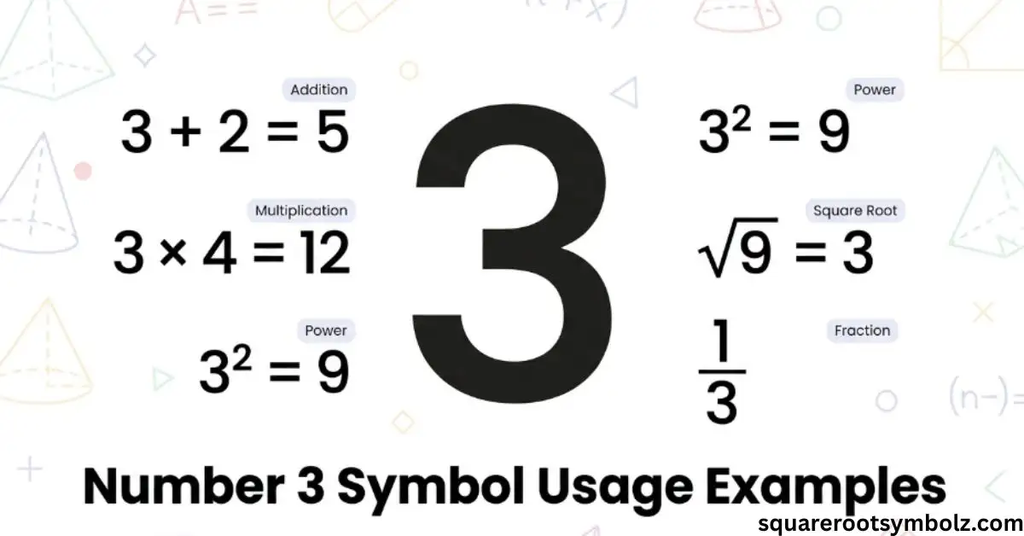
In everyday writing, the simplest symbol of 3 is still 3. You might write “three apples,” “3 apples,” or use 3 in a calculation. The choice changes when the number needs a specific typographic role, such as an exponent, subscript, Roman numeral, enclosed label, or multilingual numeral.
For example, 2³ = 8 uses superscript three to show that 2 is raised to the third power. In a document outline, Ⅲ may identify a third section. In a step-by-step graphic, ③ can visually distinguish the third step from ordinary paragraph text.
Username or Handle
Stylized forms such as ③, ➂, Ⅲ, and mathematical-style digits can make usernames visually distinctive. However, appearance and compatibility vary between fonts and platforms, so a character that looks perfect on one device may appear differently elsewhere. The safest choice is a widely supported Unicode character.
Decorative Text
Decorative versions of three can add visual variety to short text, headings, profiles, or social posts. For example, ③ Quick Tips looks different from 3 Quick Tips without requiring an image. This is primarily a typographic choice rather than a change in numerical meaning.
List or Outline
Enclosed and Roman forms can make numbered material easier to scan. For instance, ③ Method works as a visual label, while Ⅲ. Methods provides a formal Roman-numbered style. Choose the format that matches the rest of the document instead of mixing styles without a reason.
Multilingual Numbering
When writing multilingual material, the correct numeral system can improve consistency. For example, Arabic-Indic ٣ can fit naturally within text using Arabic-script numerals, while Western 3 is appropriate for English. Unicode supports both because they are distinct characters serving different writing contexts.
Using Number 3 Symbols on Social Media and Online Platforms
Styled number characters are frequently used in usernames, bios, captions, gaming handles, short posts, and decorative text. Unicode characters can be copied directly into many platforms, although the exact visual appearance depends on the application’s font support and rendering system.
For social media, decorative characters should remain readable. A heavily styled profile may look interesting, but unusual Unicode characters can sometimes affect searchability, accessibility, copying, or display. For important names or professional profiles, the ordinary 3 is often the safest option.
How to Type Number 3 Symbols on Any Device
The standard symbol of 3, 3, is already available on virtually every modern keyboard. For specialized versions such as ³, ₃, ③, or Ⅲ, copying the character is often the fastest method. Windows users can also use Character Map or application-specific symbol insertion tools when a character is difficult to locate.
On macOS, character selection tools can provide access to Unicode characters. On mobile devices, the quickest approach is usually copy and paste unless the desired character is already available through the keyboard. i2Symbol similarly recommends copying the selected number character and pasting it into a supported application.
For web development, Unicode code points can also be represented through HTML, CSS, JavaScript, or other encoding methods. The correct implementation depends on the character and the environment in which it will be displayed.
Unicode Number 3 Symbols and Compatibility
Unicode gives digital text a standardized way to represent characters across systems. The ordinary 3 is U+0033, while ³ is U+00B3, ₃ is U+2083, ③ is U+2462, and Ⅲ is U+2162. These code points help computers distinguish characters that may look related but serve different purposes.
Compatibility is not identical for every character. Modern browsers and operating systems generally support common Unicode characters, but the displayed glyph depends on the available font. Unicode’s keyboard charts show support for several number-three characters across Android, ChromeOS, macOS, and Windows keyboard systems.
A useful rule is simple: Unicode identity and visual appearance are separate things. Two characters can look similar while having different code points, and one character can look slightly different across fonts without changing its Unicode identity.
3 Number Symbols List and Meanings
The table below brings the most useful forms together so you can quickly choose the right symbol of 3 for your purpose.
| Symbol | Unicode | Meaning / role | Common context |
| 3 | U+0033 | Digit Three | General numbers |
| ³ | U+00B3 | Superscript Three | Cubes, exponents |
| ₃ | U+2083 | Subscript Three | Math, science |
| ③ | U+2462 | Circled Digit Three | Labels, lists |
| ⑶ | U+2476 | Parenthesized Digit Three | Numbering |
| ⒊ | U+248A | Digit Three Full Stop | Numbered text |
| Ⅲ | U+2162 | Roman Numeral Three | Chapters, outlines |
| ⅲ | U+2172 | Small Roman Numeral Three | Roman numbering |
| ٣ | U+0663 | Arabic-Indic Digit Three | Arabic-script contexts |
| 3 | U+FF13 | Fullwidth Digit Three | East Asian typography |
Unicode’s current character data confirms the standard identities for 3, ³, ₃, ③, and Roman numeral Ⅲ.
One useful detail is that Unicode normalization can relate some compatibility characters to the ordinary digit three. Unicode’s character fallback data, for example, maps superscript three and circled digit three back to the base digit 3 under compatibility normalization.
That does not mean you should substitute them freely in every situation. In mathematical notation, ³ has a specific visual role that plain 3 does not. Likewise, Ⅲ communicates Roman-numbering style rather than simply being a decorative replacement.
Conclusion
The symbol of 3 is 3, but modern digital text gives you many specialized forms, including ³, ₃, ③, ⑶, Ⅲ, ⅲ, ٣, and 3. The right choice depends on whether you need an ordinary digit, exponent, subscript, enclosed label, Roman numeral, or another numeral-system representation.
For everyday English, use 3. For a cube or exponent, use ³; for a Roman numeral, use Ⅲ; and for a visual label, ③ can be useful. Understanding those distinctions makes the simple number three much easier to use correctly across mathematics, typography, websites, documents, and social platforms.
FAQ Section
What is the symbol of 3?
The standard symbol of 3 is 3, officially named DIGIT THREE in Unicode and assigned the code point U+0033.
What are some symbols that look like 3?
Common Unicode forms include ³, ₃, ③, ⑶, Ⅲ, ⅲ, ٣, and 3. Each has its own character identity and purpose.
What is the Unicode for the number 3?
The Unicode code point for the ordinary digit three is U+0033.
What does ³ mean?
³ is the superscript three character. In mathematics, it commonly indicates that a number or variable is raised to the third power, such as 2³ = 8. Unicode names it SUPERSCRIPT THREE.
What is the Roman numeral for 3?
The Roman numeral for three is III. Unicode also provides the single character Ⅲ, named ROMAN NUMERAL THREE, at U+2162.
What is the circled number 3?
The circled number-three character is ③, officially named CIRCLED DIGIT THREE and assigned Unicode code point U+2462.
What is the Arabic symbol for 3?
The Arabic-Indic digit for three is ٣. It belongs to the Arabic-Indic digit system used in Arabic-script contexts.
Is ³ the same as 3?
No. Both represent the value three, but ³ is a superscript character with a specific typographic role, while 3 is the ordinary digit.
Can I copy and paste the symbol of 3?
Yes. You can copy 3, ³, ₃, ③, ⑶, Ⅲ, or another Unicode form and paste it into applications that support the character.

I’m the creator of SquareRootSymbolz.com, where I publish easy-to-understand guides on symbols, Unicode characters, Alt codes, keyboard shortcuts, and copy-and-paste text symbols. My goal is to provide accurate, well-researched, and user-friendly content that helps readers quickly find the information they need.