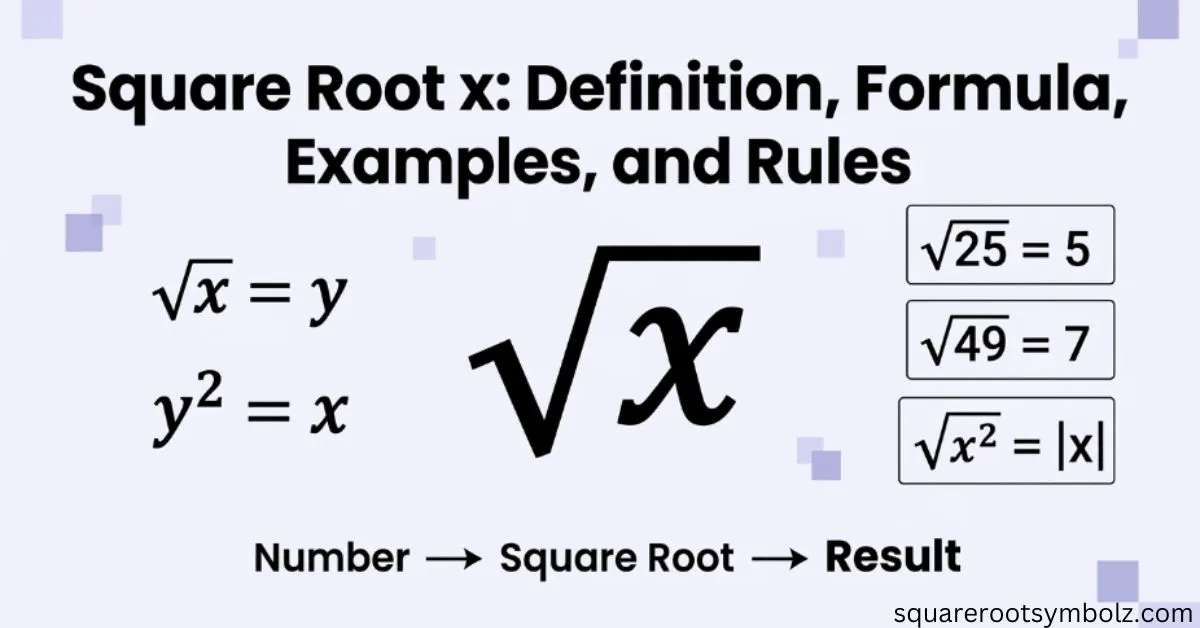
Square root x means √x, the nonnegative number that produces x when multiplied by itself. In other words, if y² = x, then y is a square root of x. For students, the confusing part is often the difference between √x and ±√x, especially when solving equations. This guide explains the square root function, principal square root, radical symbol, radicand, and fractional exponent in a simple way. The same ideas appear in algebra, geometry, equations, and real-world measurements.
If you have ever looked at √x and wondered whether x should be positive, whether there are two answers, or why √x equals x^(1/2), you are not alone. We will work through perfect squares, negative numbers, complex numbers, and practical examples so the notation becomes something you understand rather than something you simply memorize.
Square Root x Square Root
A square root reverses the operation of squaring. If 6² = 36, then √36 = 6. More generally, a square root of x is a number r satisfying r² = x. The idea connects square numbers, multiplication, radicals, and the inverse operation of squaring.
For example, √49 = 7 because 7 × 7 = 49. But −7 also produces 49 when squared. This is why mathematics distinguishes the principal square root from the complete set of square roots. That small distinction becomes especially important when solving algebraic equations.
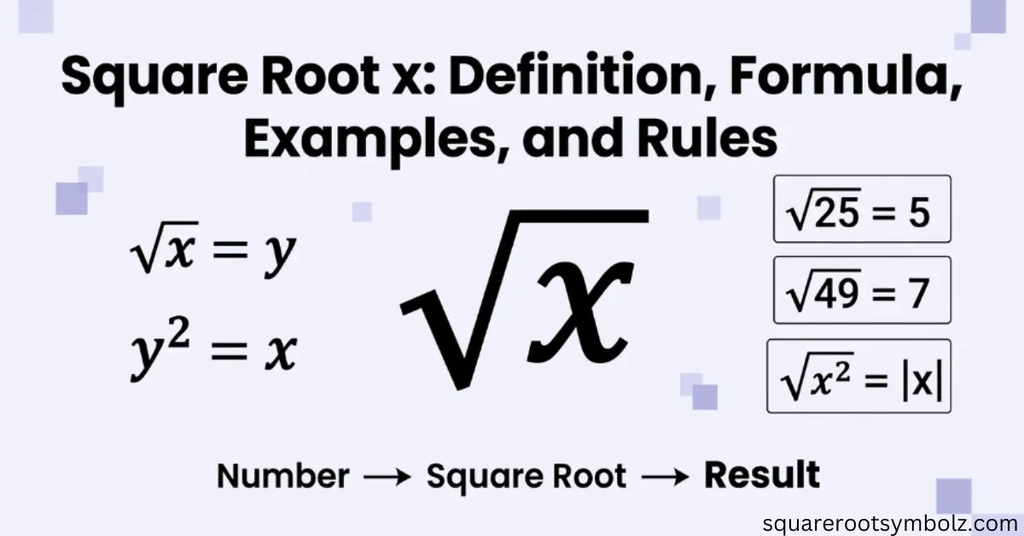
Square Root x Definition
The basic definition is:
r² = x
This means that r is a square root of x when multiplying r by itself produces x. For example, 5² = 25, so 5 is a square root of 25. For a positive real number, both 5 and −5 square to 25.
For the expression √x, however, the radical symbol represents the principal square root, which is the nonnegative value. Therefore, √25 = 5, while the two solutions to the equation x² = 25 are x = ±5. Keeping those statements separate prevents one of the most common square-root mistakes.
Quick examples
| Expression | Result | Reason |
| √1 | 1 | 1 × 1 = 1 |
| √4 | 2 | 2 × 2 = 4 |
| √9 | 3 | 3 × 3 = 9 |
| √16 | 4 | 4 × 4 = 16 |
| √25 | 5 | 5 × 5 = 25 |
| √36 | 6 | 6 × 6 = 36 |
| √49 | 7 | 7 × 7 = 49 |
| √64 | 8 | 8 × 8 = 64 |
| √81 | 9 | 9 × 9 = 81 |
| √100 | 10 | 10 × 10 = 100 |
Square Root x The Square Root Symbol
The symbol √ is called the radical symbol. In √x, the x underneath the radical is called the radicand. The radical notation provides a compact way to ask for the principal square root of x. For example, √36 means the nonnegative number whose square equals 36.
You may also see square root x written as x^(1/2). These forms are equivalent for nonnegative real x:
√x = x^(1/2)
That relationship is especially useful in algebra and calculus because fractional exponents make it easier to apply exponent rules.
Square Root x Two Square Roots
A positive number has two real square roots. For example:
√25 = 5
and
−√25 = −5
Both values square to 25 because:
5² = 25
(−5)² = 25
The important detail is that √25 itself means 5, not both values. When an equation requires both possible solutions, the ± symbol is used. This distinction is emphasized by both elementary and advanced mathematical references.
Example: Solve x² = 36
Start with:
x² = 36
Take the square root of both sides:
x = ±√36
Therefore:
x = ±6
So the two solutions are:
x = 6 or x = −6
The ± is not decoration it tells you that both solutions must be considered.
Square Root x Principal Square Root
The principal square root is the unique nonnegative square root of a nonnegative real number. Thus:
√36 = 6
not −6.
The number −6 is still a square root of 36, but it is the negative or secondary root. This convention allows the square-root function to have one clearly defined output for each nonnegative input.
This becomes especially important when working with functions. The principal square-root function is:
f(x) = √x
Its real-number domain is:
x ≥ 0
and its range is also:
f(x) ≥ 0
So the graph begins at (0, 0) and extends to the right.
Square Root x Plus-Minus Sign
The symbol ± means “plus or minus.” It is used when an equation has two possible real solutions. For example:
x² = 9
Taking square roots gives:
x = ±√9
Therefore:
x = ±3
or:
x = 3 and x = −3
Math Is Fun specifically uses this idea to show why the ± sign matters when solving equations.
A useful rule to remember is:
If x² = a, then x = ±√a
But if you are simply evaluating a radical such as √a, use the principal nonnegative value.
Square Root x Square Root of xy
For nonnegative real numbers, square roots follow the product property:
√(xy) = √x × √y
For example:
√(100 × 4)
can be separated:
√100 × √4
Then:
10 × 2 = 20
So:
√400 = 20
This property is useful for simplifying radical expressions, but it has conditions. You should not blindly split square roots involving negative quantities when working only within the real-number system.
Example: Simplify √72
Find a perfect-square factor:
72 = 36 × 2
Therefore:
√72 = √(36 × 2)
Separate the factors:
√36 × √2
So:
√72 = 6√2
This is often more useful than converting everything into a decimal because the exact radical form preserves the mathematical value.
Square Root x An Exponent of a Half
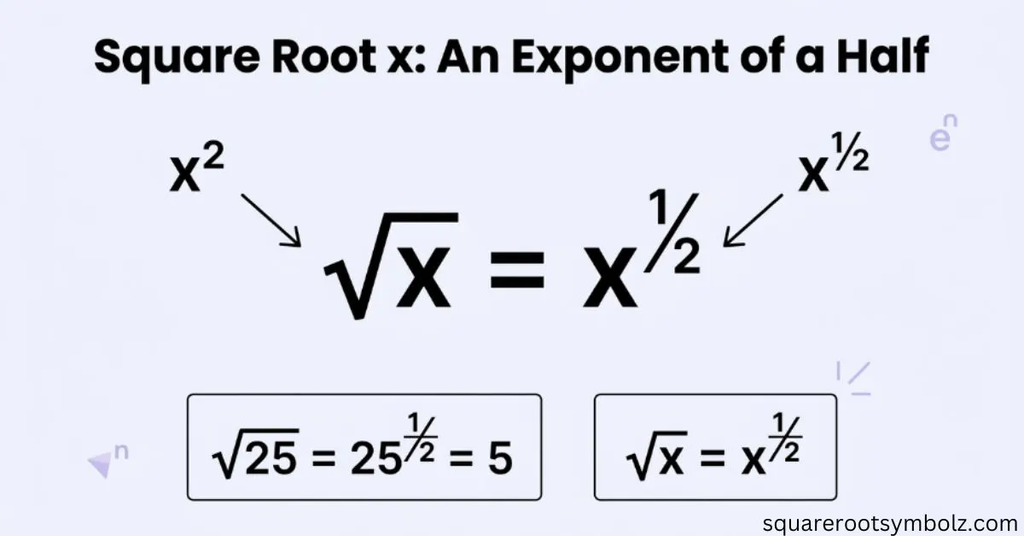
One of the most useful identities is:
√x = x^(1/2)
The exponent 1/2 means “take the square root.” For example:
√25 = 25^(1/2) = 5
This connection becomes powerful when simplifying algebraic expressions. Instead of treating a radical as a completely separate operation, you can rewrite it as a fractional exponent and apply exponent rules.
For example:
x^(1/2) × x^(1/2) = x^1 = x
for x ≥ 0.
That explains algebraically why:
√x × √x = x
The two half-exponents add to one.
Square Root x Properties and Uses
The square-root function has important properties beyond basic arithmetic. It connects algebra, geometry, statistics, and other areas of mathematics. Geometrically, √x can represent the side length of a square whose area is x. The function also appears in distance formulas, quadratic equations, and statistical calculations.
For example, if a square has an area of 64 square units, each side has length:
√64 = 8
This simple geometric interpretation is one reason the term “square root” makes sense. You are essentially reversing the process of finding a square’s area from its side length.
A useful property
For nonnegative x:
√(x²) = |x|
Notice the absolute-value symbol. If x = −5, then:
√((-5)²) = √25 = 5
not −5.
That is another reason the principal-root convention matters.
Square Root x Computation
Perfect squares are easy to evaluate mentally because their roots are whole numbers. But values such as √2, √3, or √50 do not have simple integer roots. These can be estimated using calculators, approximation methods, or numerical algorithms. MathWorld discusses methods such as Newton’s iteration for approximating square roots.
For example:
√2 ≈ 1.41421356
The decimal continues indefinitely because √2 is irrational. A calculator displays only a finite approximation, while the radical √2 represents the exact value.
Estimating √50
We know:
√49 = 7
and:
√64 = 8
Therefore:
7 < √50 < 8
Because 50 is very close to 49:
√50 ≈ 7.071
This is a practical way to estimate a square root when you do not have a calculator.
Square Root x Square Roots of Negative and Complex Numbers
In the real-number system, a negative number does not have a real square root. No real number multiplied by itself produces a negative result. For example, neither 5² nor (−5)² equals −25; both equal 25.
Complex numbers extend the system by introducing the imaginary unit:
i = √(−1)
Therefore:
√(−9) = 3i
and the two complex square roots of −9 are:
±3i
This is where square root x moves beyond elementary arithmetic into complex-number mathematics.
Square Root x Geometric Construction of the Square Root
Square roots have a natural geometric meaning. If a square has area x, its side length is √x. This gives a visual interpretation of the operation instead of treating it as an abstract symbol. The square-root function therefore connects numerical calculations directly to geometry.
For example, suppose a square garden has an area of 225 square feet. Its side length is:
√225 = 15 feet
because:
15 × 15 = 225
The same idea appears in geometric constructions and explains why square roots are important in measurements, distances, and the Pythagorean theorem.
FAQ Section
What does square root x mean?
Square root x usually means √x, the principal square root of x. It is the nonnegative number that produces x when multiplied by itself.
What is the formula for square root x?
The standard relationship is:
√x = x^(1/2)
Equivalently, if y² = x, then y is a square root of x.
Does square root x have two answers?
The equation y² = x has two real solutions when x > 0: y = ±√x. However, the symbol √x itself represents only the principal nonnegative root.
What is √x when x = 25?
√25 = 5, because 5 × 5 = 25.
If solving x² = 25, the answers are x = ±5.
Can x be negative in √x?
Not if you are restricting the answer to real numbers. A negative radicand produces a complex result, such as √(−1) = i.
Is √x the same as x^(1/2)?
Yes. For nonnegative real x:
√x = x^(1/2)
Both notations represent the principal square root.
What is the domain of √x?
For the real-valued square-root function f(x) = √x, the domain is:
x ≥ 0
The range is also y ≥ 0.
What is the difference between √x and ±√x?
√x means the principal nonnegative root. ±√x represents both the positive and negative roots when solving an equation.

I’m the creator of SquareRootSymbolz.com, where I publish easy-to-understand guides on symbols, Unicode characters, Alt codes, keyboard shortcuts, and copy-and-paste text symbols. My goal is to provide accurate, well-researched, and user-friendly content that helps readers quickly find the information they need.