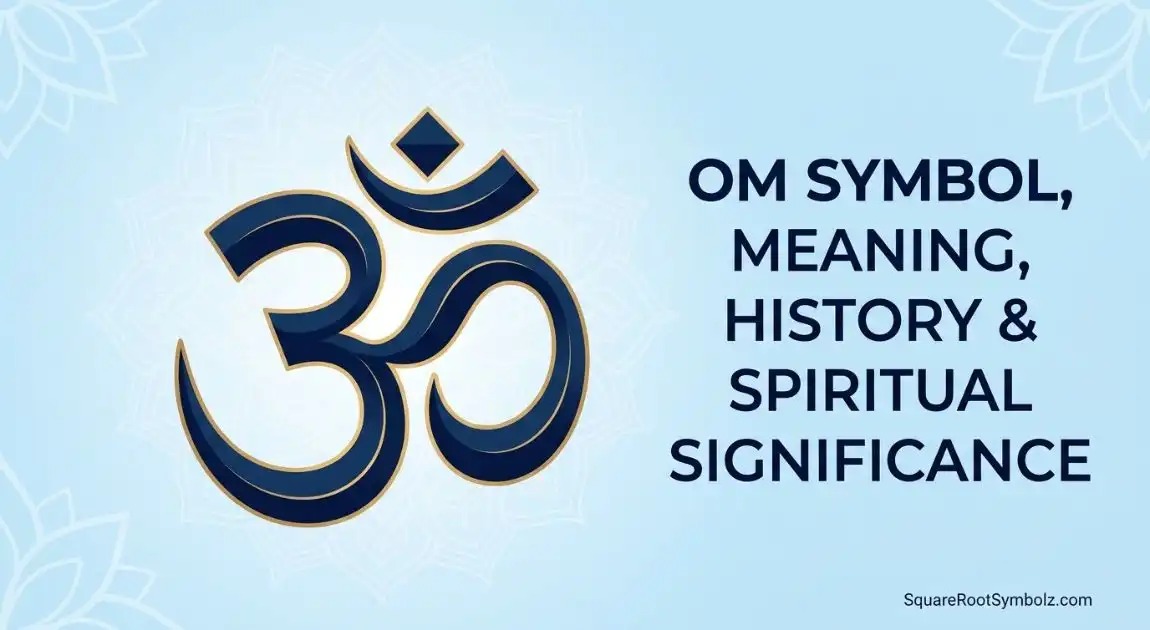
Discover the true Om symbol meaning, history, symbolism, and spiritual significance. Learn why Om is sacred and how to chant it correctly.
The Om symbol (ॐ), also written as Aum, is one of the world’s oldest and most sacred spiritual symbols. In Hindu philosophy, it represents the primordial sound of the universe, the essence of Brahman, and the cycle of creation, preservation, and transformation. Today, Om is revered in Hinduism, Buddhism, Jainism, yoga, and meditation as a symbol of unity, consciousness, and inner peace.
The Om symbol (ॐ) is one of the oldest and most sacred symbols in the world, representing the universal sound believed to be the source of all creation. Deeply rooted in Hindu philosophy, it is also respected in Buddhism and Jainism as a symbol of spiritual wisdom and inner peace.
More than just a sacred icon, Om reflects the connection between the individual self and the universe through meditation, mantra chanting, and mindful living. Whether you’ve seen the Om symbol in yoga studios or ancient temples, understanding its true meaning reveals a rich history, profound symbolism, and timeless teachings that continue to inspire millions across the world.
What Is the Om Symbol?
The Om symbol (ॐ) is a sacred Sanskrit character representing the sound Aum. It is considered the most fundamental mantra in Hindu philosophy and is widely used in meditation, yoga, and spiritual practices.
Unlike ordinary words, Om is believed to be a vibration rather than simply a spoken sound. Ancient texts describe it as the audible expression of the universal consciousness that connects all living beings.
Quick Facts About Om
| Feature | Description |
| Sanskrit Name | Om (Aum) |
| Script | ॐ |
| Meaning | Primordial sound of the universe |
| Associated With | Hinduism, Buddhism, Jainism, Yoga |
| Represents | Unity, consciousness, divine reality |
What Does Om (Aum) Mean?
The word Om comes from Sanskrit and is often written as Aum because it consists of three distinct sounds:
- A – the beginning
- U – continuity
- M – completion
Together, these sounds symbolize the entire process of existence.
In Hindu philosophy, Om represents the infinite Brahman, the universal reality underlying all creation. It also reflects the relationship between Atman (the individual self) and Brahman (the universal self), a central teaching in the Upanishads.
Rather than having a single translation, Om conveys the idea that all life, energy, and consciousness arise from one eternal source.
Why Is Om Considered Sacred?
Om is revered because ancient Hindu scriptures describe it as the first vibration from which the universe manifested.
Many traditions believe that chanting Om aligns the mind with this universal vibration, helping practitioners cultivate:
- Inner peace
- Mindfulness
- Mental clarity
- Spiritual awareness
- Concentration
- Self-realization
It is commonly recited before prayers, meditation sessions, and yoga classes to create a sense of focus and reverence.
Om vs. Aum
Many people wonder whether Om and Aum are different. In practice, they refer to the same sacred sound.
| Om | Aum |
| Modern spelling | Traditional phonetic spelling |
| Common in yoga and meditation | Highlights the three distinct sounds |
| Easier to pronounce | Reflects original Sanskrit pronunciation |
The pronunciation naturally flows from A to U and ends with M, gradually dissolving into silence.
That final silence is considered just as meaningful as the sound itself.
The History and Origin of the Om Symbol
The origins of Om date back more than 3,000 years, making it one of humanity’s oldest continuously used spiritual symbols.
Its significance developed gradually through sacred literature, philosophical inquiry, and meditation traditions.
Om in Ancient Hindu Scriptures
The earliest references to Om appear in the Vedas, particularly within hymns and ritual recitations.
Priests used Om as an invocation before chanting sacred verses, believing it purified speech and prepared the mind for spiritual practice.
Over time, Om evolved from a ritual sound into one of the most important philosophical concepts in Indian spirituality.
Om in the Upanishads
The Upanishads expanded the meaning of Om far beyond ritual.
Among them, the Mandukya Upanishad is entirely devoted to explaining the significance of Om.
there are a few symbol of down arrow symbol .
It teaches that Om encompasses every aspect of reality:
- The physical universe
- The mind
- Consciousness
- Ultimate truth
According to this teaching, understanding Om is equivalent to understanding the nature of existence itself.
Evolution Through the Centuries
As Indian philosophy evolved, Om became integrated into multiple spiritual traditions.
Today, it appears in:
- Temple architecture
- Sacred manuscripts
- Meditation practices
- Yoga traditions
- Buddhist mantras
- Jain prayers
- Spiritual artwork
Its meaning has remained remarkably consistent despite centuries of cultural evolution.
What Does the Om Symbol Represent?
Although the Om symbol appears simple, every curve carries symbolic meaning rooted in ancient philosophy.
It represents far more than a sacred sound it illustrates the journey of consciousness.
Creation, Preservation, and Transformation
One of the most common interpretations connects Om with the cosmic cycle.
| Sound | Represents |
| A | Creation |
| U | Preservation |
| M | Transformation or dissolution |
These stages correspond to the continuous rhythm of life, where beginnings, growth, and endings naturally give rise to renewal.
The Four States of Consciousness
According to the Mandukya Upanishad, Om represents four levels of consciousness.
| State | Description |
| Waking | Awareness of the external world |
| Dreaming | Inner experiences through the mind |
| Deep Sleep | Rest without dreams |
| Turiya | Pure consciousness beyond ordinary awareness |
The silent pause after chanting Om symbolizes Turiya, the transcendent state beyond thought and duality.
Meaning of Each Part of the Om Symbol
The written symbol (ॐ) contains several distinct elements, each with philosophical significance.
| Part of Symbol | Meaning |
| Large lower curve | Waking state |
| Middle curve | Dream state |
| Upper curve | Deep sleep |
| Crescent | Maya (illusion) |
| Dot | Turiya, the highest consciousness |
Together, these elements remind practitioners that ultimate awareness lies beyond the distractions of ordinary perception.
Om as the Universal Sound
Many spiritual teachers describe Om as the cosmic vibration underlying all existence.
Whether interpreted literally or symbolically, it serves as a reminder of the interconnectedness of life.
Rather than belonging exclusively to one community, Om has inspired seekers, philosophers, and meditators for thousands of years because it points toward unity, awareness, and inner stillness.
Why Is Om So Important in Hinduism, Buddhism & Other Religions?
Although the Om symbol originated in ancient Hindu traditions, its spiritual influence extends to several Indian religions. Each tradition interprets Om through its own teachings while recognizing it as a sacred expression of truth, consciousness, or the divine.
Om in Hinduism
In Hinduism, Om is regarded as the most sacred mantra and is often called Pranava or Omkara. It symbolizes Brahman, the ultimate reality from which all existence arises.
Om is traditionally chanted:
- Before and after prayers
- During meditation and yoga
- At the beginning of Vedic recitations
- During religious ceremonies and rituals
Many Hindu scriptures teach that meditating on Om helps practitioners deepen their connection with the divine and cultivate self-awareness.
Om in Buddhism
While Buddhism does not center on a creator deity, Om remains an important sacred syllable in many Buddhist traditions, especially Tibetan Buddhism.
It is best known as the opening sound of the famous mantra:
Om Mani Padme Hum
In this context, Om symbolizes purity, compassion, and the aspiration to awaken one’s true nature. Rather than worship, chanting serves as a mindfulness practice that calms the mind and develops wisdom.
Om in Jainism
In Jainism, Om is a condensed representation of reverence for the Five Supreme Beings (Panch Parmeshthi):
- Arihants
- Siddhas
- Acharyas
- Upadhyayas
- Sadhus
For Jains, chanting Om is an expression of respect, humility, and the pursuit of spiritual liberation through ethical living.
Om in Sikh Philosophy (Ik Onkar)
Although Sikhs do not use Om as a mantra in the same way as Hindu traditions, Sikh philosophy begins with Ik Onkar, meaning “One Supreme Reality.”
Ik Onkar emphasizes that there is one eternal Creator who is beyond form and present in all creation. While distinct from Om, both concepts express the unity and oneness underlying existence.
Why Do People Chant Om?
Chanting Om is practiced by millions of people worldwide, not only for religious devotion but also for meditation, mindfulness, and emotional well-being.
Spiritual Benefits
Many practitioners believe chanting Om helps:
- Deepen meditation
- Increase spiritual awareness
- Improve concentration
- Develop inner peace
- Strengthen the connection between mind and body
- Cultivate compassion and gratitude
Because the sound gradually fades into silence, it naturally encourages stillness and self-reflection.
Mental & Emotional Benefits
Beyond its spiritual significance, many people report that chanting Om helps them:
- Relax after stressful situations
- Slow racing thoughts
- Improve emotional balance
- Enhance focus during meditation
- Create a sense of calm before yoga or prayer
While individual experiences vary, the rhythmic breathing involved in chanting may contribute to relaxation.
Scientific Research on Om Chanting
Researchers have explored how chanting Om affects the body and mind. Although more studies are needed, early findings suggest that chanting may:
| Potential Benefit | Explanation |
| Reduced stress | Controlled breathing may activate the body’s relaxation response. |
| Better focus | Repetition can improve attention during meditation. |
| Calm nervous system | Slow vocalization may support parasympathetic activity. |
| Improved mindfulness | Chanting encourages present-moment awareness. |
These findings should be viewed as supportive rather than conclusive. Om chanting is best understood as a complementary mindfulness practice, not a medical treatment.
How to Chant Om Correctly
Learning the correct pronunciation enhances both the experience and the traditional practice.
Proper Pronunciation (A-U-M)
Om is traditionally pronounced as three connected sounds:
- A – begins in the throat.
- U – rolls through the mouth.
- M – ends with a gentle humming vibration on closed lips.
Allow the sound to fade naturally into a few moments of silence before taking the next breath.
Best Time to Chant
You can chant Om at any time, but many practitioners prefer:
- Early morning (Brahma Muhurta)
- Before meditation
- Before yoga practice
- During quiet evening reflection
- Before prayer
The key is choosing a peaceful environment where you can focus without distractions.
Common Mistakes to Avoid
Avoid these common errors:
- Rushing through the sound
- Saying only “Om” without the full A-U-M vibration
- Treating it as background noise
- Chanting without mindful breathing
- Using it casually without understanding its cultural significance
Slow, intentional chanting is generally considered more meaningful than speed or volume.
How to Use the Om Symbol Respectfully
Because Om is sacred to millions of people, using it thoughtfully demonstrates cultural awareness and respect.
In Yoga Practice
Many yoga classes begin or end with Om to help students transition into a mindful state. Participation is a personal choice, and understanding its significance can make the practice more meaningful.
During Meditation
Displaying the Om symbol in a meditation space can serve as a visual reminder of focus, unity, and inner awareness. It should support mindfulness rather than become a decorative trend.
Wearing Om Jewelry
Many people wear Om pendants or bracelets as symbols of spirituality or personal values. If you choose to wear the symbol:
- Understand its meaning.
- Treat it respectfully.
- Avoid placing it on items likely to be discarded or stepped on.
Cultural Respect and Awareness
The growing popularity of yoga has introduced Om to people around the world. Appreciating the symbol also means recognizing its deep roots in Indian spiritual traditions rather than viewing it only as a fashionable design.
Common Myths and Misconceptions About the Om Symbol
Is Om only a yoga symbol? No. Yoga popularized Om internationally, but the symbol has been central to Hindu philosophy and spirituality for thousands of years.
Is Om religious or spiritual? It can be both. For many people, Om is part of religious worship, while others use it as a symbol of mindfulness and meditation.
Can anyone chant Om? Yes. People from many backgrounds choose to chant Om respectfully. Understanding its origins and significance is encouraged.
Om vs. Mandala
| Om | Mandala |
| Sacred sound and symbol | Sacred geometric design |
| Represents consciousness | Represents the universe or wholeness |
| Used in chanting | Used in meditation and visualization |
Although both appear in spiritual traditions, they serve different purposes.
Final Thoughts
The Om symbol is far more than a familiar icon found in yoga studios or meditation spaces. It represents centuries of philosophical thought, spiritual exploration, and the search for inner awareness.
Whether you approach Om through Hindu philosophy, Buddhist meditation, Jain teachings, or simply as a mindfulness practice, its enduring message is one of unity, balance, and conscious living.
Understanding the history and symbolism behind Om allows us to appreciate it not merely as a design or sound, but as one of humanity’s most profound spiritual symbols.
Key Takeaways
- Om (Aum) is one of the world’s oldest sacred symbols.
- It represents the primordial sound and universal consciousness.
- The sounds A-U-M symbolize creation, preservation, and transformation.
- The Om symbol also illustrates the four states of consciousness described in the Mandukya Upanishad.
- Om plays an important role in Hinduism, Buddhism, Jainism, and has philosophical parallels in Sikhism’s Ik Onkar.
- Chanting Om may support meditation, mindfulness, and relaxation when practiced with intention.
- Respecting the symbol’s cultural and spiritual heritage is just as important as understanding its meaning.
FAQs
What is the real meaning of Om?
Om represents the primordial sound of the universe and symbolizes ultimate reality, consciousness, and the unity of all existence.
Why do yogis say Om?
Many yogis chant Om to cultivate focus, calm the mind, and begin or end meditation and yoga with mindful intention.
Is Om the same as Aum?
Yes. Aum reflects the traditional Sanskrit pronunciation, while Om is the simplified spelling commonly used today.
Can beginners chant Om?
Yes. Beginners can chant Om by focusing on slow breathing, correct pronunciation, and mindful awareness.
Is wearing the Om symbol disrespectful?
Not necessarily. Wearing the Om symbol respectfully and with an understanding of its cultural and spiritual significance is generally considered appropriate.

I’m the creator of SquareRootSymbolz.com, where I publish easy-to-understand guides on symbols, Unicode characters, Alt codes, keyboard shortcuts, and copy-and-paste text symbols. My goal is to provide accurate, well-researched, and user-friendly content that helps readers quickly find the information they need.