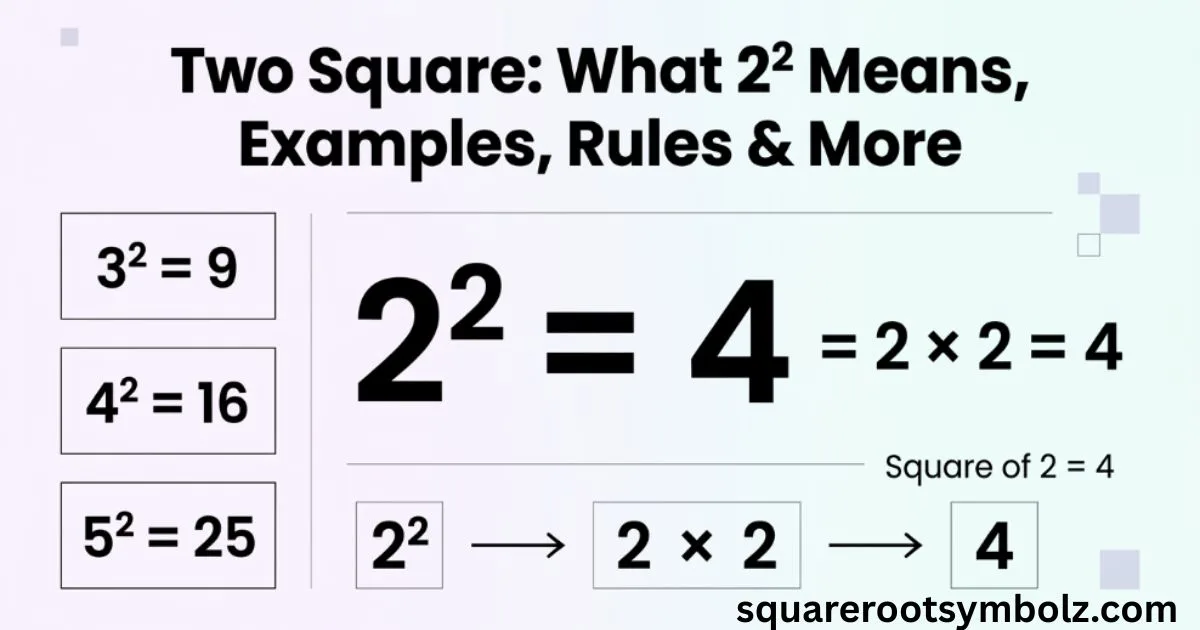
Two square usually points to 2², or two squared, which equals 4. Squaring means multiplying a number by itself, so 2² = 2 × 2 = 4. If you are confused by the wording, you’re not alone: “two square” can also lead to questions about square numbers and square roots. This guide makes the distinction simple.
When students first meet exponents, the small 2 can look like a complicated new rule. It is actually straightforward. The square of a number, second power, perfect square, square root, and multiplication all connect to the same basic idea. Once you see that relationship, expressions such as 2², 4², √4, and √16 become much easier to understand.
Squares
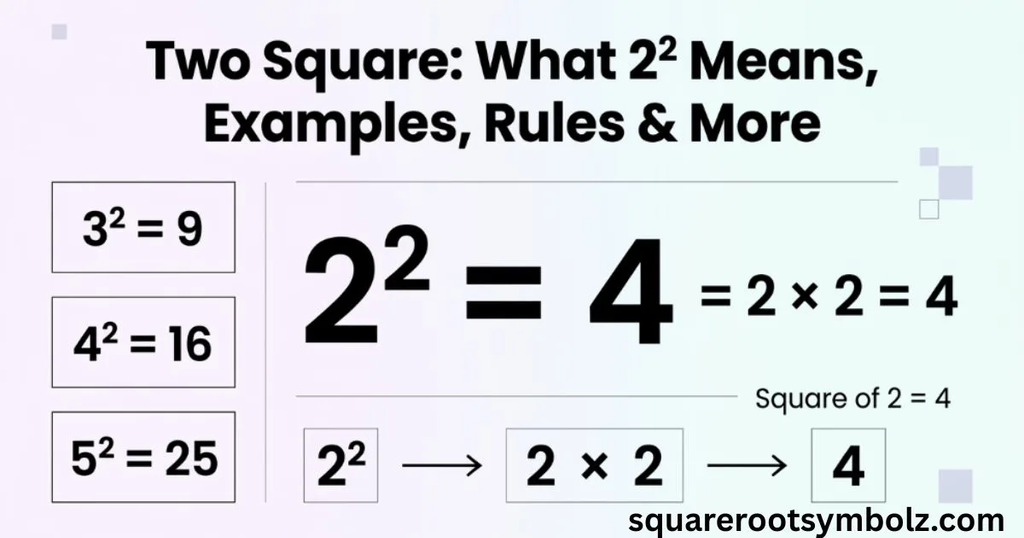
To square a number, multiply it by itself. Therefore, two squared is written as 2² and calculated as 2 × 2 = 4. The small 2 is the exponent, while 2 is the base. The expression tells us that the base appears twice in the multiplication.
The word “square” comes from geometry. A square with side length 2 has an area of 2 × 2 = 4 square units. That same calculation gives 2² = 4. This connection between area, side length, multiplication, and square numbers explains why the mathematical term is called a square.
Example: What’s 3 squared?
Three squared means 3 × 3, so 3² = 9. The exponent does not mean 3 × 2; instead, it tells you to use 3 as a factor twice. The same pattern works for 4² = 16, 5² = 25, and 10² = 100.
Properties of Square Numbers
A square number is produced when a number is multiplied by itself. Examples include 1, 4, 9, 16, 25, and 36. In algebra, the square of n is written n². These numbers also appear naturally as the areas of squares with whole-number side lengths.
Squaring has useful patterns. A positive number squared is positive, zero squared is zero, and a negative number squared is also positive. For example, 2² = 4 and (−2)² = 4. These patterns become especially useful when working with integers, algebraic expressions, and square roots.
Squares of Negative Numbers
A negative number becomes positive when it is squared because two negative factors produce a positive product. Thus, (−5)² = (−5)(−5) = 25. Parentheses matter: −5² normally means −(5²), which equals −25, while (−5)² equals +25.
Numbers between Squares
Consecutive square numbers have a predictable gap. For example, 3² = 9 and 4² = 16, with 10 through 15 between them. The number of integers strictly between n² and (n + 1)² is 2n, making square-number patterns useful for estimating roots and comparing nearby values.
Square Root
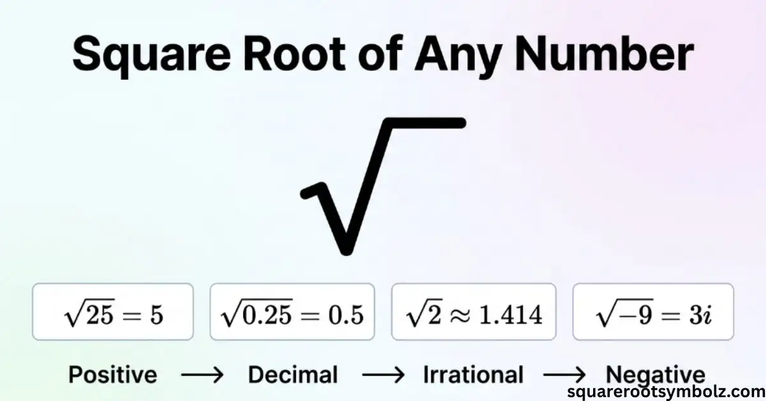
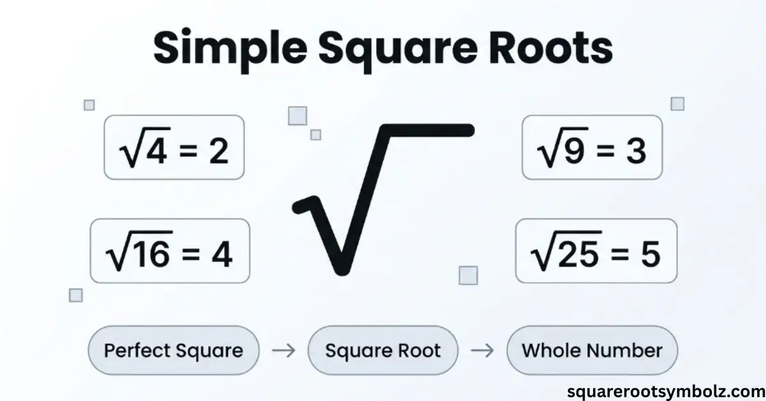
A square root reverses the operation of squaring. Since 2² = 4, the principal square root of 4 is 2. In symbols, √4 = 2. This inverse relationship is why squaring and square roots are often taught together.
There is an important detail: a positive number has two numbers whose squares equal it. For 4, both 2² and (−2)² equal 4. However, the radical symbol √ represents the principal, nonnegative square root, so √4 means 2 rather than ±2.
Squaring a Number
Squaring a number simply means multiplying it by itself. For 2, the calculation is 2 × 2 = 4, or 2² = 4. For 5, it is 5 × 5 = 25, or 5² = 25. The process is the same regardless of whether the number is an integer, decimal, fraction, or algebraic expression.
For larger values, you can use ordinary multiplication. For example, 15² = 15 × 15 = 225. You can also use algebraic patterns to calculate quickly. Understanding this basic operation makes later work with powers, polynomials, quadratic equations, and square roots much easier.
Square Numbers 1 to 50
The following table shows the first 50 whole-number squares. It is useful for mental math, estimating square roots, checking calculations, and recognizing perfect squares quickly.
| Number | Square | Number | Square |
| 1 | 1 | 26 | 676 |
| 2 | 4 | 27 | 729 |
| 3 | 9 | 28 | 784 |
| 4 | 16 | 29 | 841 |
| 5 | 25 | 30 | 900 |
| 6 | 36 | 31 | 961 |
| 7 | 49 | 32 | 1024 |
| 8 | 64 | 33 | 1089 |
| 9 | 81 | 34 | 1156 |
| 10 | 100 | 35 | 1225 |
| 11 | 121 | 36 | 1296 |
| 12 | 144 | 37 | 1369 |
| 13 | 169 | 38 | 1444 |
| 14 | 196 | 39 | 1521 |
| 15 | 225 | 40 | 1600 |
| 16 | 256 | 41 | 1681 |
| 17 | 289 | 42 | 1764 |
| 18 | 324 | 43 | 1849 |
| 19 | 361 | 44 | 1936 |
| 20 | 400 | 45 | 2025 |
| 21 | 441 | 46 | 2116 |
| 22 | 484 | 47 | 2209 |
| 23 | 529 | 48 | 2304 |
| 24 | 576 | 49 | 2401 |
| 25 | 625 | 50 | 2500 |
From this table, you can immediately see that 2² = 4 is one of the earliest perfect squares. The sequence grows because each successive square adds the next odd number: 1, 4, 9, 16, 25, and so on.
What are squares and square roots?
A square is the result of multiplying a number by itself, while a square root asks which number was multiplied by itself to produce a given value. For example, 6² = 36, while √36 = 6. They are inverse operations that move in opposite directions.
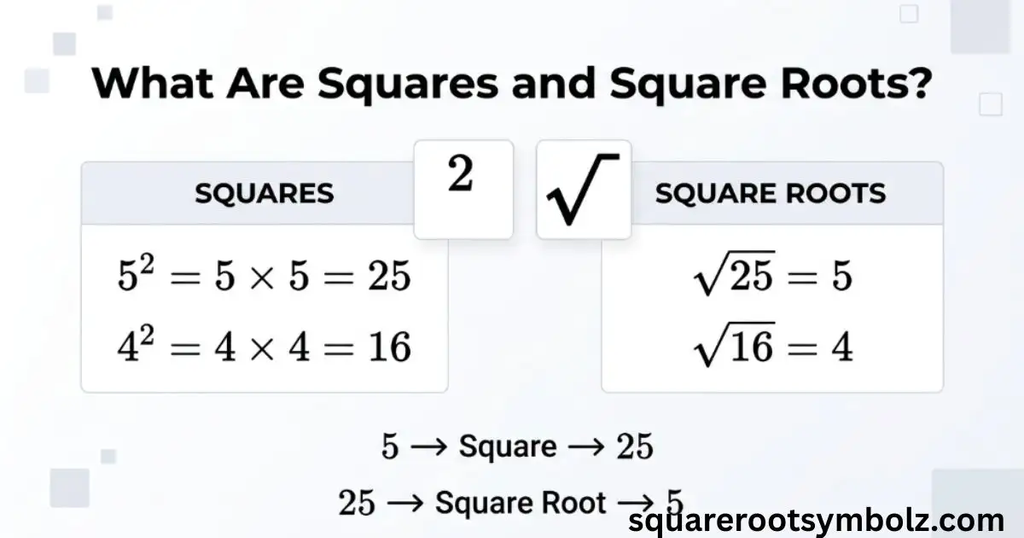
This relationship is useful far beyond simple arithmetic. In geometry, squaring calculates the area of a square. In algebra, powers appear in equations and functions. In practical mathematics, square roots help find unknown side lengths when an area is known.
What is the difference between a square and square roots?
The square operation starts with a number and produces a result: 2² = 4. A square root starts with that result and works backward: √4 = 2. The two operations are therefore closely connected, but they answer different questions.
A helpful memory trick is to think forward versus backward. “What is two squared?” asks you to calculate 2 × 2. “What is the square root of 4?” asks which nonnegative number multiplied by itself gives 4. Once that distinction is clear, many beginner errors disappear.
Conclusion
Two square, when intended as two squared, means 2², and the answer is 4. The calculation is simply 2 × 2 = 4. This is a basic example of squaring, where a number is multiplied by itself.
The important connection is that squaring and square roots work in opposite directions. Because 2² = 4, √4 = 2. Learning this relationship provides a strong foundation for square numbers, exponents, algebra, geometry, perfect squares, and square-root problems.
FAQ Section
What is two square?
“Two square” usually means two squared, written as 2². It equals 4 because 2 × 2 = 4.
What is 2 squared?
2 squared is 4. In mathematical notation, 2² = 2 × 2 = 4.
Is two square the same as two squared?
In casual wording, “two square” may be intended to mean two squared. The standard mathematical phrase is “two squared.”
What is the square of 2?
The square of 2 is 4, because 2 × 2 = 4.
What is the square root of 4?
The principal square root of 4 is 2 because 2 × 2 = 4. The equation x² = 4 has two solutions: x = 2 and x = −2.
What are square numbers?
Square numbers are values obtained by multiplying a number by itself. Examples include 1, 4, 9, 16, 25, and 36.
Why is 2² equal to 4 instead of 2?
The exponent 2 tells you to use 2 as a factor twice. Therefore, 2² means 2 × 2, which equals 4.
Does a negative number have a positive square?
Yes. When a negative number is squared, the result is positive. For example, (−2)² = 4 because (−2)(−2) = 4.

I’m the creator of SquareRootSymbolz.com, where I publish easy-to-understand guides on symbols, Unicode characters, Alt codes, keyboard shortcuts, and copy-and-paste text symbols. My goal is to provide accurate, well-researched, and user-friendly content that helps readers quickly find the information they need.