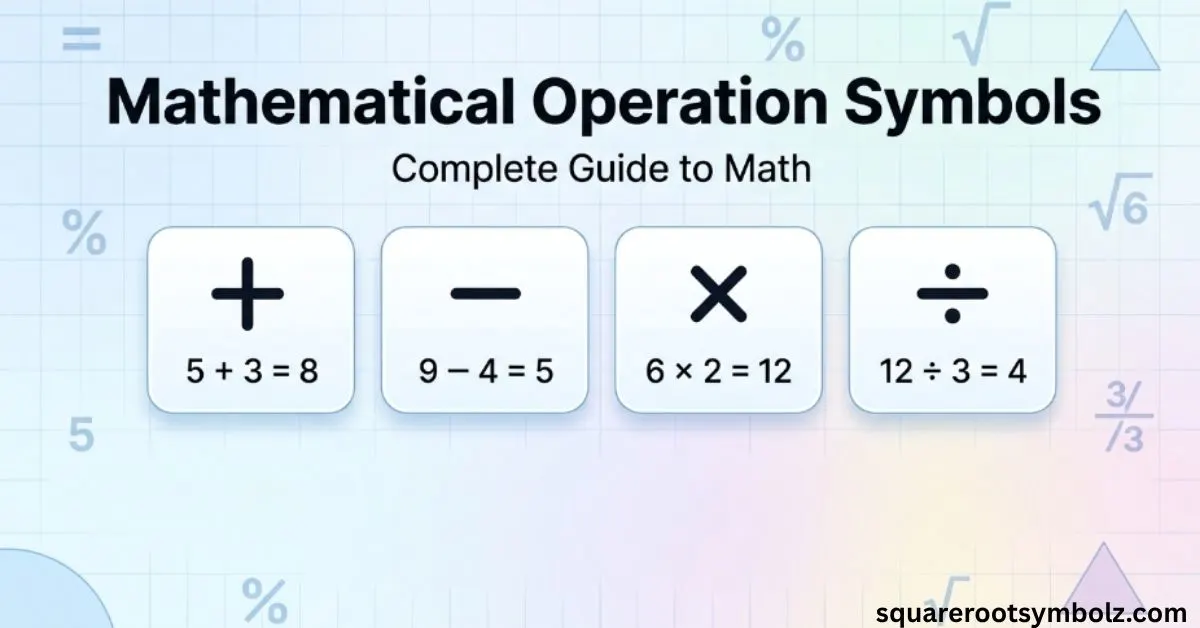
Mathematical operation symbols are signs such as +, −, ×, and ÷ that tell us what calculation to perform. In simple arithmetic, these symbols make numbers easier to read and solve; in algebra, they connect variables, constants, expressions, and equations. The four basic operations are addition, subtraction, multiplication, and division.
If math notation has ever looked confusing because the same operation can appear in different forms, you are not alone. A multiplication operation, for example, may use ×, ·, parentheses, or no visible symbol at all. Understanding these relationships makes expressions easier to translate, simplify, and evaluate correctly.
The Symbols
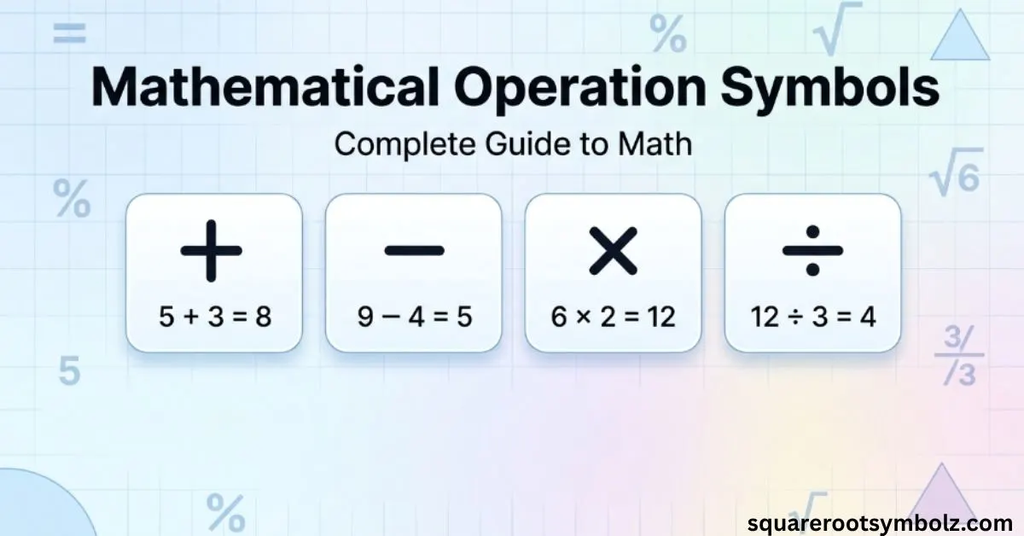
The most familiar mathematical operation symbols represent the four basic arithmetic operations. The plus sign + means addition, the minus sign − means subtraction, the multiplication sign × means multiplication, and the division sign ÷ means division. Each symbol connects numbers or expressions and tells you what mathematical action to perform.
| Operation | Common Symbol | Example | Result |
| Addition | + | 7 + 3 | 10 |
| Subtraction | − | 9 − 4 | 5 |
| Multiplication | × | 6 × 2 | 12 |
| Division | ÷ | 20 ÷ 5 | 4 |
| Equality | = | 5 + 2 = 7 | True |
Mathematical notation can use more than one representation for certain operations. Multiplication may appear as ×, ·, *, (a)(b), or simply ab. Division can appear as ÷, /, or a fraction bar. OpenStax specifically notes that the multiplication cross can create confusion in algebra, where a dot, parentheses, or implied multiplication is often clearer.
Addition and subtraction
Addition combines quantities, while subtraction finds a difference between quantities. For example, 8 + 5 = 13 shows addition, while 13 − 5 = 8 shows subtraction. In mathematical language, addition produces a sum, whereas subtraction produces a difference.
Multiplication and division
Multiplication represents repeated groups or scaling, while division separates a quantity into equal groups or determines a quotient. For example, 4 × 6 = 24 gives a product, while 24 ÷ 6 = 4 gives a quotient. These meanings remain important when operation symbols appear inside algebraic expressions.
Algebraic Expressions and Equations
An algebraic expression combines numbers, variables, and mathematical operation symbols. For example, 3x + 7 contains a coefficient, variable, addition symbol, and constant. An equation goes one step further by connecting two expressions with an equal sign, such as 3x + 7 = 19.
The equal sign = has a special role because it states that two quantities have the same value. In 6 × 7 = 42, the expression on the left and the number on the right represent equal quantities. This distinction helps separate an expression, which represents a mathematical quantity, from an equation, which makes a statement about equality.
Translating mathematical language
Words often provide clues about which operation symbol to use. “Sum” usually indicates addition, “difference” indicates subtraction, “product” indicates multiplication, and “quotient” indicates division. For example, “the product of 4 and 8” becomes 4 × 8, while “the quotient of 20 and 5” becomes 20 ÷ 5.
Why notation matters
A small symbol can completely change a calculation. Compare 8 + 2 × 3 with (8 + 2) × 3. The first expression gives 14 under the standard order of operations, while the second gives 30 because the parentheses change which operation happens first.
Simplifying and Evaluating Algebraic Expressions
To simplify an expression means to perform the mathematical operations that can be completed and rewrite the expression in an equivalent, simpler form. For example, 4 × 2 + 1 becomes 8 + 1, and then 9. The order in which the symbols are handled matters.
To evaluate an algebraic expression, replace its variables with known values and then calculate. For example, if x = 5, the expression 3x + 2 becomes 3(5) + 2, which equals 17. Evaluation therefore connects symbolic notation with an actual numerical result.
Example: simplifying a numerical expression
Consider:
12 + 4 × 2
Multiplication comes before addition, so first calculate:
4 × 2 = 8
Then:
12 + 8 = 20
The answer is 20, not 32. This is exactly why mathematical operation symbols cannot always be handled simply from left to right. Standard order-of-operations rules establish a consistent procedure.
Example: evaluating an algebraic expression
Suppose:
2x² + 3x + 1
and x = 2.
Substitute 2 for x:
2(2²) + 3(2) + 1
Then evaluate the exponent:
2(4) + 6 + 1
Multiply:
8 + 6 + 1 = 15
So the value of the expression is 15.
How to use BEDMAS
BEDMAS is one common way to remember the order in which operations are performed: Brackets, Exponents, Division, Multiplication, Addition, Subtraction. The key point is that multiplication and division share the same priority and are evaluated from left to right; addition and subtraction work the same way.
A common American convention is PEMDAS, meaning Parentheses, Exponents, Multiplication, Division, Addition, and Subtraction. Although the acronyms differ, the underlying rule is the same: grouping symbols first, then exponents, then multiplication and division from left to right, followed by addition and subtraction from left to right.
| Priority | Operation | Example |
| 1 | Parentheses / brackets | (5 + 3) |
| 2 | Exponents | 2³ |
| 3 | Multiplication & division | 6 × 4 ÷ 2 |
| 4 | Addition & subtraction | 10 + 5 − 3 |
A quick BEDMAS example
Take:
3 + 4 × 2
There are no brackets or exponents. Multiplication comes next:
4 × 2 = 8
Then addition:
3 + 8 = 11
Therefore:
3 + 4 × 2 = 11
The multiplication symbol changes the calculation because it has higher priority than addition.
Things to Watch For
Operation symbols can cause mistakes when a sign is confused with the number or when an expression contains implied notation. A negative sign, for example, may indicate a negative number rather than subtraction. Similarly, a fraction bar can imply grouping that is not visually written with parentheses.
Another common problem occurs when multiplication is implied. In algebra, 3x means 3 × x, even though no multiplication symbol is visibly present. Likewise, 3(x + 2) means 3 × (x + 2). Recognizing these hidden relationships prevents errors when reading equations or entering expressions into calculators.
Negative signs
A negative number such as −5 is different from a subtraction operation. In 8 − 5, the minus symbol tells us to subtract 5 from 8. In 8 + (−5), the negative sign belongs to the number −5. The numerical result happens to be the same, but the mathematical structure is different.
Horizontal divisor line
A fraction bar represents division while also grouping the numerator and denominator. For example:
(4 + 6) / (2 + 3)
can be written as a fraction with 4 + 6 above the line and 2 + 3 below it. The grouping is important because both the numerator and denominator must be evaluated as complete expressions.
Hidden and implied symbols
In 4(3 + 2), multiplication is implied between 4 and the parentheses. In 3x, multiplication is implied between 3 and x. When using a calculator, however, it may be necessary to enter the multiplication explicitly. Pressing 3 × (4 + 2) makes the intended calculation clear.
Translate Words to Algebraic Expressions
Mathematical operation symbols are also a bridge between ordinary language and algebra. Words such as sum, difference, product, and quotient communicate operations that can be represented with symbols. Learning these relationships makes word problems much easier to convert into mathematical expressions.
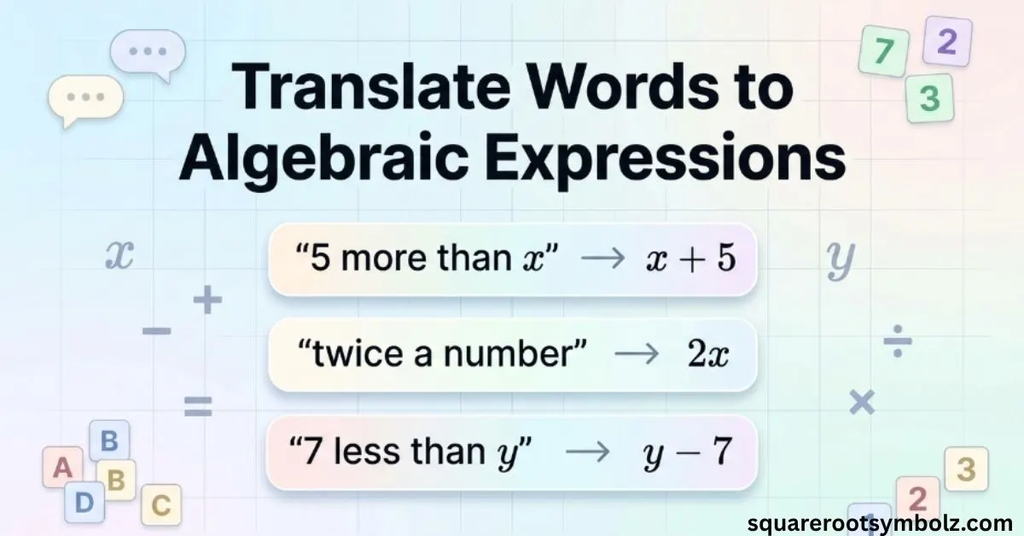
| Words | Operation | Symbolic Form |
| sum of a and b | Addition | a + b |
| difference of a and b | Subtraction | a − b |
| product of a and b | Multiplication | a × b |
| quotient of a and b | Division | a ÷ b |
For example, “the difference of 20 and 4” becomes 20 − 4. “The quotient of 10x and 3” becomes 10x ÷ 3. The important skill is recognizing the mathematical relationship hidden inside the words.
From symbols to words
The process also works in reverse. The expression 7 + 9 can be read as “seven plus nine” or “the sum of seven and nine.” Similarly, 6 × 5 can be described as “six times five” or “the product of six and five.”
Identify Terms, Coefficients, & Like Terms
In algebra, operation symbols help organize terms within an expression. A term can be a constant or a product involving a constant and variables. In 5x + 7, the terms are 5x and 7, while 5 is the coefficient of x. Understanding these parts makes symbolic manipulation much easier.
Like terms have the same variables raised to the same exponents. For example, 5x and 3x are like terms, while 5x and 3x² are not. Like terms can be combined by adding or subtracting their coefficients, giving 5x + 3x = 8x.
Example with like terms
Consider:
7x + 4 + 2x + 5
Group the like terms:
7x + 2x + 4 + 5
Combine them:
9x + 9
The operation symbols help preserve the structure while the coefficients determine how the like terms are combined.
Common Mathematical Operation Symbols at a Glance
| Symbol | Name | Meaning | Example |
| + | Plus | Addition | 5 + 4 = 9 |
| − | Minus | Subtraction | 9 − 4 = 5 |
| × | Multiplication | Multiplication | 6 × 3 = 18 |
| · | Dot product/multiplication sign | Multiplication | 4 · 5 = 20 |
| ÷ | Division | Division | 20 ÷ 4 = 5 |
| / | Slash | Division | 20 / 4 = 5 |
| = | Equals | Equality | 5 + 5 = 10 |
| ^ | Caret | Exponent on computers | 2^3 = 8 |
| ( ) | Parentheses | Grouping | (4 + 2) × 3 |
| ± | Plus-minus | Two possible signs | x = ±4 |
The four basic operations addition, subtraction, multiplication, and division form the foundation of arithmetic and algebra. More advanced notation builds on these ideas by adding exponents, grouping symbols, fractions, roots, inequalities, functions, and other mathematical operators.
Conclusion
Mathematical operation symbols are the compact language that tells us how numbers and algebraic expressions interact. The most important symbols to know are + for addition, − for subtraction, × or · for multiplication, ÷ or / for division, and = for equality. Once these signs become familiar, reading mathematical expressions becomes much less intimidating.
The real skill is not simply memorizing symbols. It is understanding the relationship between an operation, its notation, its mathematical meaning, and its position within an expression. When you combine that understanding with order-of-operations rules, algebraic translation, and careful attention to implied symbols, even complicated expressions become easier to read and solve.
FAQs
What are the four basic mathematical operation symbols?
The four basic operation symbols are + for addition, − for subtraction, × for multiplication, and ÷ for division.
What does the symbol + mean in math?
The + symbol means addition. It tells you to combine two or more quantities.
What does − mean in mathematics?
The − symbol can represent subtraction or indicate that a number is negative, depending on where it appears.
What does × mean in math?
The × symbol represents multiplication. In algebra, multiplication can also be written with a dot, parentheses, or by placing factors next to each other.
What is the division symbol?
The common division symbol is ÷, although division can also be written using / or a fraction bar.
What is the difference between an expression and an equation?
An expression represents a mathematical quantity, while an equation states that two expressions have equal values using the = symbol.
What order should mathematical operations be performed?
Use grouping symbols first, then exponents, multiplication and division from left to right, and finally addition and subtraction from left to right. This is commonly remembered with PEMDAS or BEDMAS.
Why is multiplication sometimes written without a symbol?
In algebra, multiplication is often implied. For example, 3x means 3 × x, and 4(a + 2) means 4 × (a + 2).

I’m the creator of SquareRootSymbolz.com, where I publish easy-to-understand guides on symbols, Unicode characters, Alt codes, keyboard shortcuts, and copy-and-paste text symbols. My goal is to provide accurate, well-researched, and user-friendly content that helps readers quickly find the information they need.

One Comment