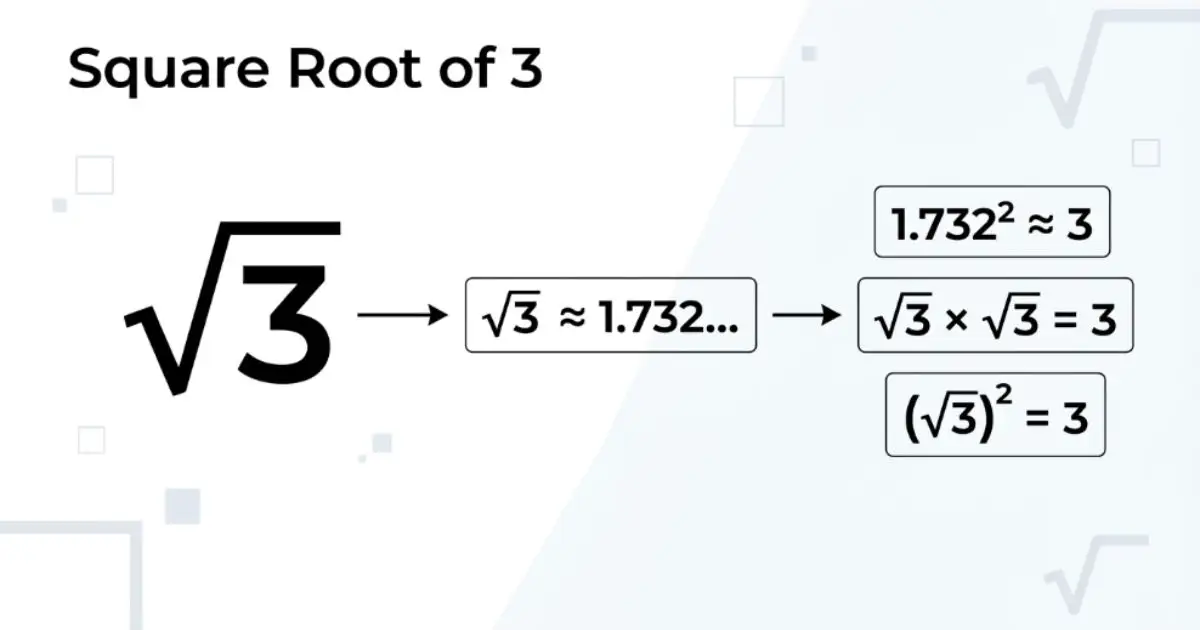
sqrt 3 is approximately 1.73205080757, the positive number whose square equals 3. If you are looking for the square root of 3 value, decimal form, simplest radical form, or a reliable way to calculate it, the key ideas are irrational numbers, perfect squares, radical notation, estimation, and long division.
After working through many square-root problems, I have found that students rarely struggle with the number itself. The real confusion usually comes from rounding, simplification, rational numbers, exact values, and negative roots. This guide connects those ideas with clear examples so you can understand √3 rather than simply memorize 1.732.
The Answer at a Glance
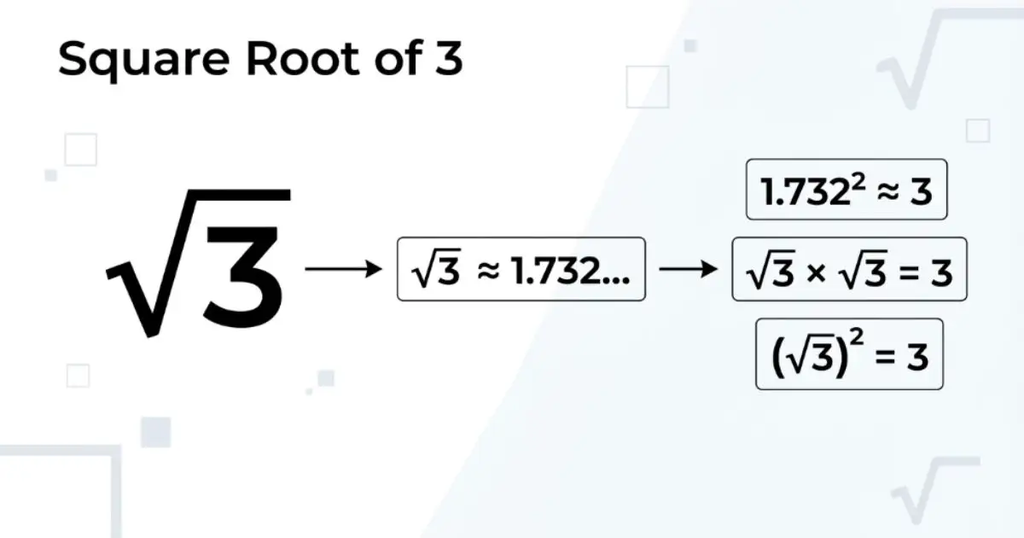
The exact form of sqrt 3 is simply √3, because 3 has no perfect-square factor greater than 1. Its decimal approximation is 1.73205080757…, and the digits continue without terminating or repeating. Since 1² = 1 and 2² = 4, √3 must lie between 1 and 2.
| Property | √3 |
| Radical form | √3 |
| Decimal value | 1.73205080757… |
| Rounded to 2 decimals | 1.73 |
| Rounded to 3 decimals | 1.732 |
| Rounded to 4 decimals | 1.7321 |
| Perfect square? | No |
| Rational or irrational? | Irrational |
| Simplest radical form | √3 |
| Square of √3 | 3 |
The exact form is preferable when you are doing algebra because rounding too early introduces a small error. For example, 1.73² equals 2.9929, not exactly 3. Keeping √3 until the final step preserves the exact mathematical relationship.
Where √3 Appears
sqrt 3 appears naturally in geometry, trigonometry, and three-dimensional measurement. In an equilateral triangle with side length 2, dropping an altitude creates a right triangle with legs 1 and √3, so the height issqrt 3. The same constant appears in a unit cube’s space diagonal.
Trigonometry provides another familiar appearance. In a 30-60-90 triangle, the side ratio is 1 : √3 : 2, which gives tan 60° = √3. √3 also occurs in regular hexagons and several distance relationships. These examples show why the number is more than a decimal approximation: it is built into important geometric relationships.
What “square root of 3” Means
A square root is a number that produces the original value when multiplied by itself. Therefore, √3 represents the positive number x for which x × x = 3. Because 1 × 1 = 1 and 2 × 2 = 4, √3 is between 1 and 2.
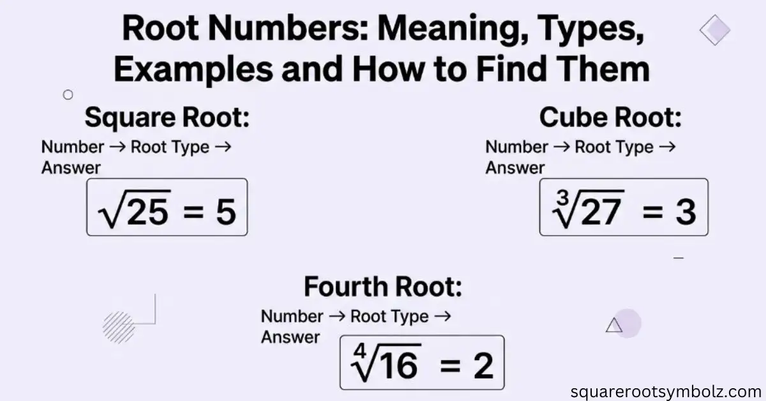
The notation sqrt 3 is called radical form, while 3^(1/2) is its equivalent fractional-exponent form. The √ symbol is officially named SQUARE ROOT by Unicode and is assigned code point U+221A. Unicode also identifies radical sign as an equivalent description.
Is The Square Root of 3 Rational or Irrational?
sqrt 3 is irrational. A rational number can be expressed as a ratio of two integers, but √3 cannot be represented exactly as a fraction of integers. Its decimal representation continues indefinitely without repeating. The reason begins with the fact that 3 is prime and therefore is not a perfect square.
You can also prove the result formally. Assume √3 could equal a reduced fraction a/b. Squaring gives 3b² = a². This forces a divisibility relationship that contradicts the assumption that a/b was already reduced. NASA presents this contradiction proof directly, establishing that √3 cannot be rational.
Why 3 Is Not a Perfect Square
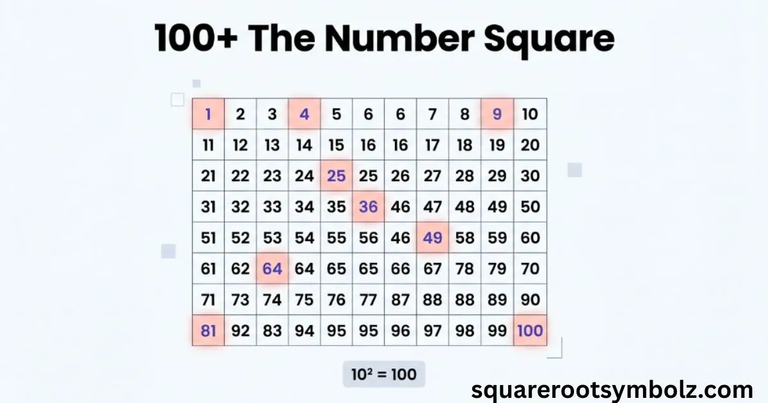
A perfect square is produced by multiplying an integer by itself, such as 1, 4, 9, 16, or 25. There is no integer whose square equals 3. Since 3 is prime and has no repeated prime factor, it has no square factor that can be removed from the radical.
Why sqrt 3 Cannot Be Simplified
To simplify a radical, look for a perfect-square factor inside the radicand. For example, √12 becomes √(4 × 3), which simplifies to 2√3. But 3 has no perfect-square factor greater than 1, so there is nothing to take outside the radical. √3 is already simplest.
How To Find √3 Two Methods
There are several numerical methods for finding √3, but two particularly useful approaches are long division and estimation between perfect squares. Both methods begin with the same observation: sqrt 3 lies between 1 and 2 because 1² = 1 and 2² = 4.
For everyday calculations, estimation is usually faster. For schoolwork where you must show a calculation process, long division gives a systematic way to produce more decimal places. A calculator is the quickest option when only a numerical approximation is needed.
Method 1 Long division (digit by digit)
Write 3 as 3.000000 and begin with 1 because 1² is the largest whole-number square below 3. Subtracting 1 from 3 leaves 2. Bring down a pair of zeros to make 200, double the current answer, and find the next digit that keeps the product below 200. This produces 1.7.
Continue the same process to obtain additional digits. The next digit is 3, giving 1.73, and continued calculation produces 1.732050807…. The important idea is that each new digit makes the approximation more precise. This method is useful when a calculator is unavailable or when a class assignment requires the working.
Method 2 Estimation between perfect squares
Start by locating sqrt 3 between √1 and √4, which means the answer is between 1 and 2. Try 1.7: its square is 2.89, slightly below 3. Try 1.73: its square is 2.9929, much closer. Then 1.732² gives 2.999824, an even closer result.
This simple process teaches an important mathematical habit: check an approximation by squaring it. Each improvement moves closer to 3. For a quick classroom estimate, 1.73 is usually enough. For greater precision, use 1.73205 or retain √3 in exact form.
What Are The Most Common Mistakes With √3?
One common mistake is trying to simplify √3 when there is nothing to simplify. Because 3 is prime, sqrt 3 is already in simplest radical form. Another error is treating the radical like an ordinary multiplication symbol and incorrectly splitting a square root across addition.
A third mistake is rounding too early. If an expression contains √3, keeping the exact radical during intermediate calculations usually gives a more accurate final result. Replace it with 1.732 or another decimal only when the problem asks for an approximation or when the final numerical answer is required.
Mistake 1: Treating √3 as if it can be simplified
The radical cannot be reduced because 3 has no perfect-square factor greater than 1. For comparison, √12 can become 2√3 because 12 contains the factor 4. But √3 contains only 3, so the radical stays unchanged.
Mistake 2: Splitting the root over addition
A square root does not generally distribute across addition. For example, √(1 + 2) equals √3, approximately 1.732. It does not equal √1 + √2, which would be about 2.414. This distinction is essential when simplifying radical expressions.
Mistake 3: Rounding too early
Suppose a calculation contains sqrt 3 and you immediately replace it with 1.73. You have now introduced rounding error before finishing the calculation. Since √3 is an exact value, keep the radical symbol through the algebra and convert to a decimal only at the end.
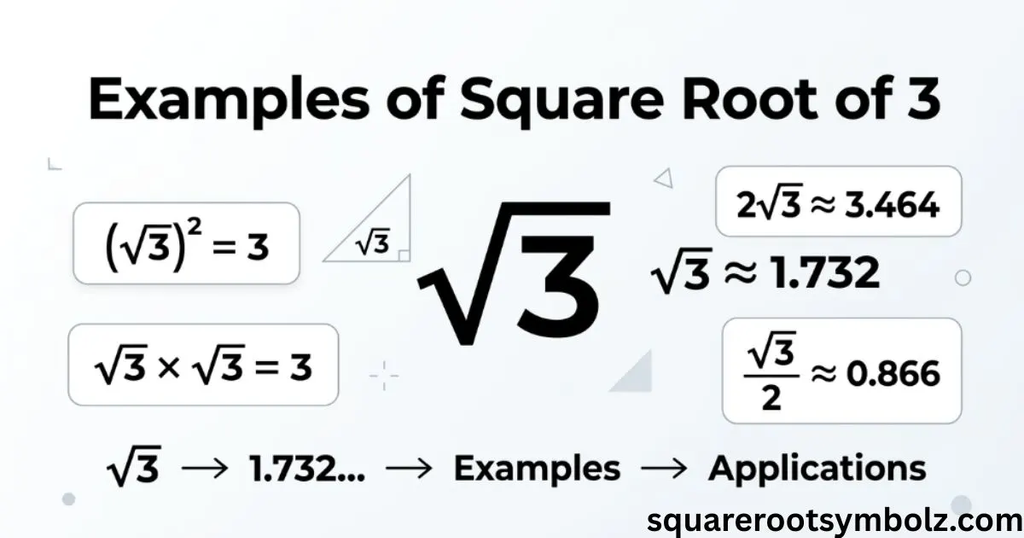
Examples of Square Root of 3
sqrt 3 becomes easier to recognize when you see it inside different mathematical settings. It can appear after simplifying another radical, inside a trigonometric ratio, in geometry, or as the diagonal of a three-dimensional object. These examples connect the same constant to several branches of mathematics.
Example 1
Simplify √12 using √3.
Since 12 = 4 × 3:
√12 = √(4 × 3) = 2√3
Using the decimal approximation:
2√3 ≈ 3.4641
The 4 becomes 2 outside the radical, while the 3 remains under the radical because it has no square factor.
Example 2 (Wrong path first)
Find the height of an equilateral triangle with side length 2.
Dropping the altitude divides the base into two sections of length 1. Applying the Pythagorean theorem gives:
height² = 2² − 1² = 4 − 1 = 3
Therefore:
height = √3 ≈ 1.732
This is one of the clearest geometric reasons √3 appears in mathematics.
Example 3
Evaluate tan 60°.
In a 30-60-90 triangle, the side opposite 60° has length √3 when the shortest side has length 1. Therefore:
tan 60° = √3 ≈ 1.732
This is an exact trigonometric value, so √3 is preferable to a rounded decimal when writing the exact answer.
Example 4
Rationalize 1/√3.
Multiply the numerator and denominator by √3:
1/√3 = √3/3
As a decimal:
√3/3 ≈ 0.57735
This form is often preferred because the denominator no longer contains a radical.
Example 5
Find the space diagonal of a cube with side length 1.
Using the three-dimensional distance relationship:
diagonal = √(1² + 1² + 1²)
Therefore:
diagonal = √3 ≈ 1.732
Wolfram MathWorld also identifies √3 as the length of the space diagonal of a unit cube.
Conclusion
sqrt 3 is the exact square root of 3 and has the decimal approximation 1.73205080757…. It is an irrational number, so its decimal expansion never terminates or repeats, and it cannot be written exactly as a fraction of two integers.
Because 3 is prime and has no perfect-square factor, sqrt 3 is already in its simplest radical form. You can estimate it between 1 and 2, calculate it by long division, or obtain a decimal approximation with a calculator. In geometry and trigonometry, √3 appears naturally in equilateral triangles, 30-60-90 triangles, and cube diagonals.
FAQs
What is the Value of the Square Root of 3?
The exact value is √3. Its decimal approximation is 1.7320508075688772, commonly rounded to 1.732 or 1.73 depending on the required precision.
Why is the Square Root of 3 an Irrational Number?
sqrt 3 is irrational because 3 is prime and is not a perfect square. A formal contradiction proof also shows that √3 cannot be represented as a fraction of two integers.
Is the number 3 a Perfect Square?
No. A perfect square is the result of squaring an integer, such as 1, 4, 9, or 16. No integer multiplied by itself equals 3, so 3 is not a perfect square.
What is the Square Root of 3 in Simplest Radical Form?
The simplest radical form is √3. There is no further simplification because 3 has no perfect-square factor greater than 1.
What is √3 to Two Decimal Places?
√3 rounded to two decimal places is 1.73. The next digit after 1.73 is 2, so the hundredths digit remains unchanged.
How Do You Find the Square Root of 3 Without a Calculator?
You can estimate √3 between 1 and 2 or use the long-division square-root method. For example, 1.73² = 2.9929 and 1.732² = 2.999824, showing how the approximation approaches 3.

I’m the creator of SquareRootSymbolz.com, where I publish easy-to-understand guides on symbols, Unicode characters, Alt codes, keyboard shortcuts, and copy-and-paste text symbols. My goal is to provide accurate, well-researched, and user-friendly content that helps readers quickly find the information they need.