
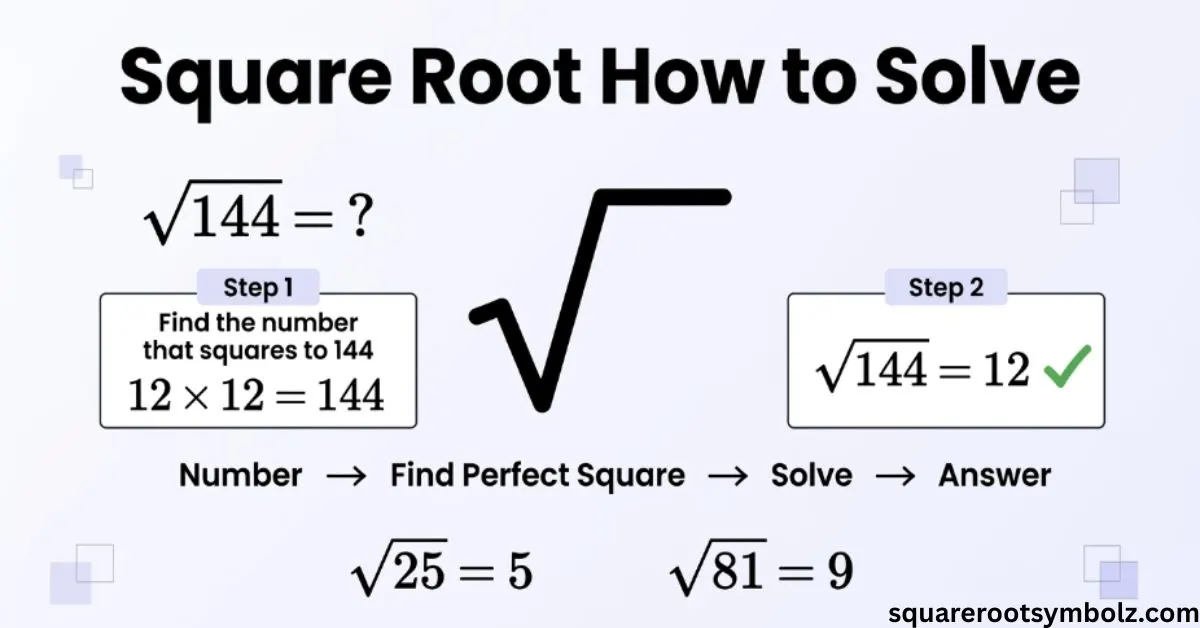
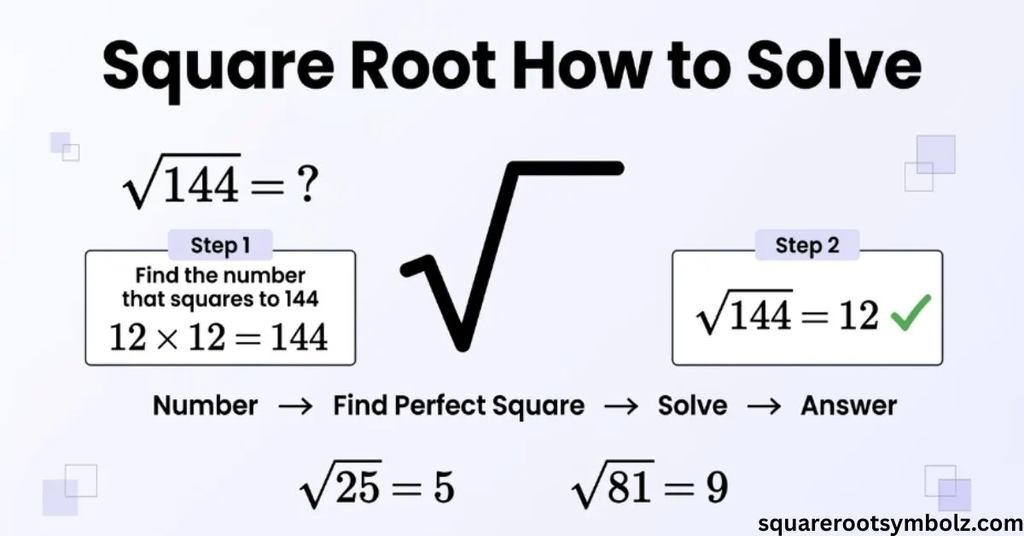
If you want to know square root how to solve, start by asking one simple question: what number multiplied by itself gives the number under the √ symbol? For example, √49 = 7 because 7 × 7 = 49. From there, you can use perfect squares, prime factorization, estimation, or long division depending on the problem.
I have found that most square-root mistakes happen because students jump into calculations before identifying the type of square root, radical, or radicand they are dealing with. This guide makes the process practical: you will learn how to find a root by hand, simplify radical expressions, solve square root equations, and check your answer so you do not lose an easy point on a math problem.
Finding Square Root of Number By Hand
Finding a square root by hand becomes much easier when you first recognize the relationship between squaring and taking a square root. Squaring multiplies a number by itself, while a square root reverses that process. For example, 8² = 64, so √64 = 8. This inverse relationship is the foundation.
For a perfect square, you can often recall the answer immediately. The common sequence begins 1, 4, 9, 16, 25, 36, 49, 64, 81, and 100. If the number is not a perfect square, do not panic. You can estimate between two known squares or simplify the radical using factors.
A quick perfect-square check
| Number | Square root | Why |
| 25 | 5 | 5 × 5 = 25 |
| 36 | 6 | 6 × 6 = 36 |
| 49 | 7 | 7 × 7 = 49 |
| 64 | 8 | 8 × 8 = 64 |
| 81 | 9 | 9 × 9 = 81 |
| 100 | 10 | 10 × 10 = 100 |
Remember that √49 means the principal square root, which is 7. If the question instead asks you to solve x² = 49, there are two real solutions: x = 7 and x = −7.
How to Find Square Root?
The best method depends on the number. If it is a perfect square, recognizing the matching square is fastest. If it has useful factors, prime factorization can simplify it. For a large non-perfect square, long division gives a systematic manual method, while estimation is usually faster when an approximate answer is acceptable.
For example, suppose you need √180. Because 13² = 169 and 14² = 196, you already know the answer must be between 13 and 14. That simple range check is powerful: it prevents an unreasonable answer before you even calculate the decimal.
Square Root by Prime Factorization Method
Prime factorization works especially well when the number contains repeated factors. For example, 144 can be written as 2 × 2 × 2 × 2 × 3 × 3. Pair the identical factors: (2 × 2), (2 × 2), and (3 × 3). One number from each pair comes outside the radical, giving 2 × 2 × 3 = 12.
So:
√144 = 12
The key idea is simple: every pair of identical prime factors produces one factor outside the square root. For √72, factor 72 as 2 × 2 × 2 × 3 × 3. The pairs give 2 and 3 outside, leaving one 2 inside:
√72 = 6√2
This method is useful for simplifying square roots, not just finding whole-number answers.
Square Root by Repeated Subtraction Method
The repeated-subtraction method uses a surprising pattern involving consecutive odd numbers. Start with the number and subtract 1, then 3, then 5, then 7, continuing until you reach zero. If the number reaches zero after n subtractions, its square root is n.
For 81:
81 − 1 = 80
80 − 3 = 77
77 − 5 = 72
72 − 7 = 65
65 − 9 = 56
56 − 11 = 45
45 − 13 = 32
32 − 15 = 17
17 − 17 = 0
There were 9 subtractions, so:
√81 = 9
This method is excellent for understanding why perfect squares work, although it is usually slower than recognizing familiar square numbers.
Square Root by Long Division Method
The long division method is useful when the number is large or is not a perfect square and you need a decimal approximation without relying on a calculator. The digits are grouped into pairs from right to left, then a root digit is selected at each stage.
For example, √180 lies between 13 and 14. The long-division process can continue beyond the decimal point by bringing down pairs of zeros. This produces an approximation of about 13.416.
The advantage is precision: unlike guessing, the method gives you a controlled process for extending the answer to additional decimal places. It is especially useful when a teacher asks you to show your work.
Square Root by Estimation Method
Estimation is often the quickest way to solve a non-perfect square when an exact radical is unnecessary. Find the two nearby perfect squares first. For √15, the neighboring squares are 9 and 16, so the answer must be between 3 and 4.
Next, test nearby decimals. Since 3.8² = 14.44 and 3.9² = 15.21, √15 falls between 3.8 and 3.9. A more precise value is about 3.873.
This method teaches an important habit: always bracket the square root before estimating it. If √15 were written as 6.2, you would immediately know something went wrong because 6² is already 36.
How to Simplify Square Roots?
To simplify a square root, look for a perfect-square factor inside the radicand. For example, 50 contains the perfect-square factor 25. Rewrite 50 as 25 × 2, take √25 outside, and leave √2 inside. The result is √50 = 5√2.
The same idea works with larger numbers. For √12, use 4 × 3, so √12 = 2√3. The goal is not necessarily to turn every radical into a whole number. Sometimes the simplest correct answer still contains a radical.
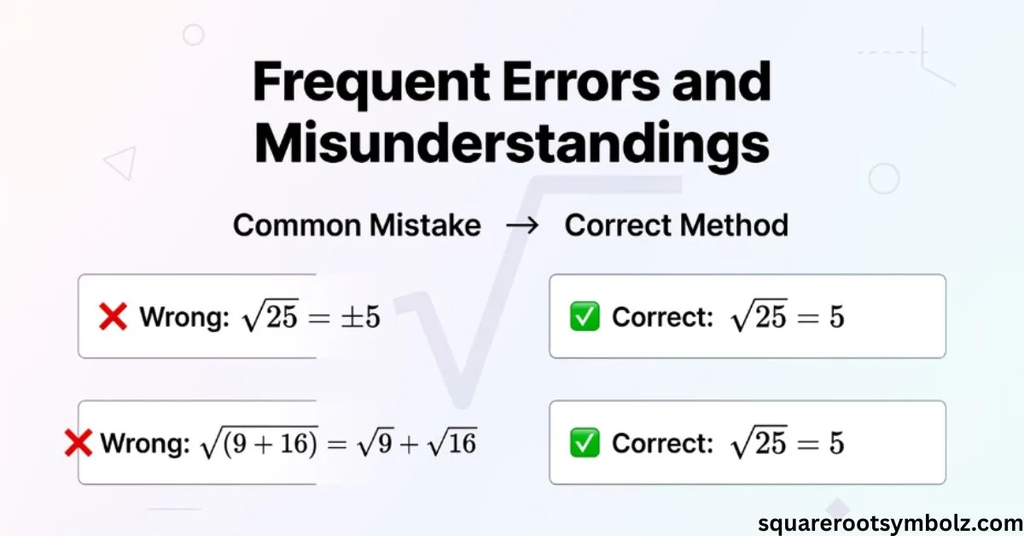
A common mistake is assuming that √(a + b) = √a + √b. That rule does not generally work. For example, √(9 + 16) = √25 = 5, while √9 + √16 = 3 + 4 = 7. The two expressions are different.
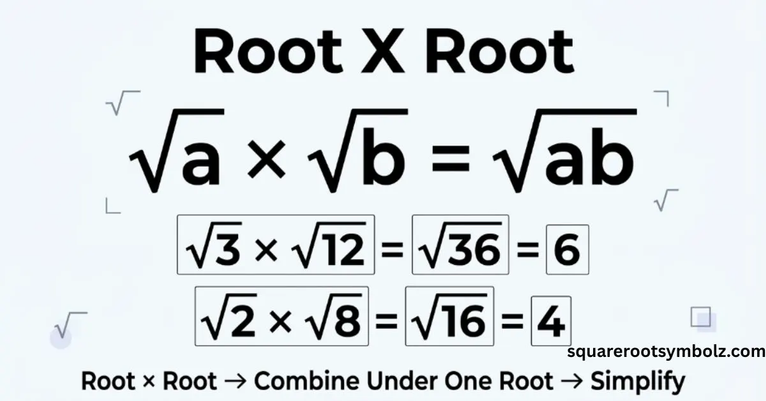
A safer approach is to simplify the entire radicand first, then apply valid square-root properties. When multiplying suitable nonnegative quantities, √(ab) can be separated as √a × √b, which is one reason factorization is so useful.
How to solve Square root equations?
A square root equation has a variable inside a square root. The standard strategy is to isolate the radical, square both sides, solve the resulting equation, and then check the answer in the original equation. This last step matters because squaring can create an extraneous solution.
Consider:
√(x + 1) = 9
Square both sides:
x + 1 = 81
Then:
x = 80
Check:
√(80 + 1) = √81 = 9
So x = 80 is valid.
The most important rule is to isolate the square root before squaring whenever possible. For example, if you have 3 + √(5x + 6) = 12, first subtract 3. Then you have √(5x + 6) = 9, which can be squared cleanly. Squaring the original mixed expression too early leaves extra radical terms and makes the problem harder. Khan Academy also emphasizes isolating the radical and checking solutions for this reason.
What if the equation has a square on x?
If the problem looks like:
x² = 49
take the square root of both sides, but remember that both positive and negative numbers square to 49:
x = ±7
So the solutions are:
x = 7 or x = −7
This is different from writing √49 = 7, because the radical symbol itself represents the principal, nonnegative square root. OpenStax describes this distinction through the Square Root Property.
What if there are two square roots?
Some equations contain radicals on both sides or more than one radical. The same basic idea applies: isolate one radical, square both sides, simplify, and repeat if another radical remains.
But every time you square, remember to check the final answers in the original equation. A value can satisfy the squared equation while failing the original radical equation. That is called an extraneous solution.
Square Root Solved Examples
Here are several examples that cover the most common versions of square root problems.
Example 1: Perfect square
Find √225.
Since:
15 × 15 = 225
the answer is:
√225 = 15
This is the fastest situation because 225 is a perfect square.
Example 2: Simplify a radical
Simplify √48.
Find a perfect-square factor:
48 = 16 × 3
Therefore:
√48 = √16 × √3
So:
√48 = 4√3
The radical cannot be reduced further because 3 has no perfect-square factor other than 1.
Example 3: Estimate a non-perfect square
Find √30 approximately.
The nearby perfect squares are:
25 < 30 < 36
Therefore:
5 < √30 < 6
Because 5.5² = 30.25, the answer is slightly less than 5.5:
√30 ≈ 5.477
This range-first method is much safer than randomly guessing a decimal.
Example 4: Solve a square-root equation
Solve:
√(2x + 1) = 7
Square both sides:
2x + 1 = 49
Subtract 1:
2x = 48
Divide by 2:
x = 24
Check:
√(2 × 24 + 1) = √49 = 7
Therefore:
x = 24
Example 5: Solve an equation with a squared variable
Solve:
x² = 36
Take both square roots:
x = ±√36
Therefore:
x = 6 or x = −6
Check both:
6² = 36
and
(−6)² = 36
Both solutions work.
Example 6: A radical equation that needs checking
Consider:
√(x + 2) = x
Squaring gives:
x + 2 = x²
Rearrange:
x² − x − 2 = 0
Factor:
(x − 2)(x + 1) = 0
So the candidates are:
x = 2 or x = −1
Now check the original equation.
For x = 2:
√4 = 2
Valid.
For x = −1:
√1 = −1
False, because √1 = 1.
Therefore:
x = −1 is extraneous
and the only solution is:
x = 2
This is exactly why checking is not optional in more complicated radical equations.
Quick method comparison
| Method | Best for | Main advantage |
| Perfect-square recognition | Familiar square numbers | Fastest |
| Prime factorization | Simplifying radicals | Exact |
| Repeated subtraction | Understanding perfect squares | Pattern-based |
| Estimation | Non-perfect roots | Quick approximation |
| Long division | Large or non-perfect roots | Detailed manual answer |
| Squaring both sides | Radical equations | Removes an isolated square root |
Frequent Errors and Misunderstandings
One of the most common errors is confusing √16 = 4 with the solutions of x² = 16. The first statement asks for the principal square root and gives 4. The second asks which values square to 16, so both 4 and −4 work. Keeping those two ideas separate prevents many algebra mistakes.
Another common mistake is squaring before isolating the radical. If you square an expression such as 3 + √x, you create additional terms rather than simply removing the radical. Isolate first, square second, solve third, and check fourth. This simple order makes square root equations far more manageable.
Students also sometimes assume every square root must be a whole number. That is not true. Numbers such as 2, 3, 5, and 10 have irrational square roots. In those cases, you may leave the answer in radical form, such as √10, or use a decimal approximation when the question asks for one.
Finally, never ignore the domain. In the real number system, the square root of a negative number is not a real number. For example, √(−4) is not a real value; in the complex number system it can be written as 2i.
Conclusion
Learning square root how to solve problems becomes much easier once you recognize which type of problem you have. Use perfect-square recognition for quick answers, prime factorization to simplify radicals, estimation for approximate values, and long division when you need a detailed manual calculation.
For algebraic square root equations, remember the winning sequence: isolate the radical, square both sides, solve the resulting equation, and check every answer in the original problem. That final check is what protects you from extraneous solutions.
The deeper idea is simple: squaring and taking a square root are closely connected inverse operations. Once that relationship feels natural, square roots stop looking like a strange symbol and start becoming another practical tool for solving math problems.
FAQs
How do you solve a square root?
For a perfect square, find the number that multiplied by itself gives the radicand. For example, √81 = 9 because 9 × 9 = 81.
How do you solve square root equations?
Isolate the square root, square both sides, solve the resulting equation, and substitute the answer back into the original equation to check it.
What is the easiest way to find a square root?
For familiar perfect squares, recognition is fastest. For non-perfect squares, estimation between two nearby perfect squares is often the quickest approach.
How do you solve √x = 5?
Square both sides: x = 25. Checking gives √25 = 5, so x = 25.
How do you solve x² = 25?
Take both square roots: x = ±√25. Therefore, x = 5 or x = −5.
How do you simplify √50?
Factor 50 as 25 × 2. Then √50 = √25 × √2 = 5√2.
How do you solve a square root without a calculator?
Use perfect-square recognition, prime factorization, estimation, repeated subtraction, or the long division method depending on the number and the required accuracy.
Why must you check a square-root equation after solving it?
Squaring both sides can introduce an extraneous solution. Substituting each candidate into the original equation confirms whether it is actually valid.
Can a square root be negative?
The symbol √ represents the principal, nonnegative square root. However, a positive number has both positive and negative square roots when solving an equation such as x² = 36.
What happens when the number under the square root is negative?
A negative radicand has no real square root. In the complex number system, √(−1) is represented by i, so √(−9) = 3i.

I’m the creator of SquareRootSymbolz.com, where I publish easy-to-understand guides on symbols, Unicode characters, Alt codes, keyboard shortcuts, and copy-and-paste text symbols. My goal is to provide accurate, well-researched, and user-friendly content that helps readers quickly find the information they need.



One Comment