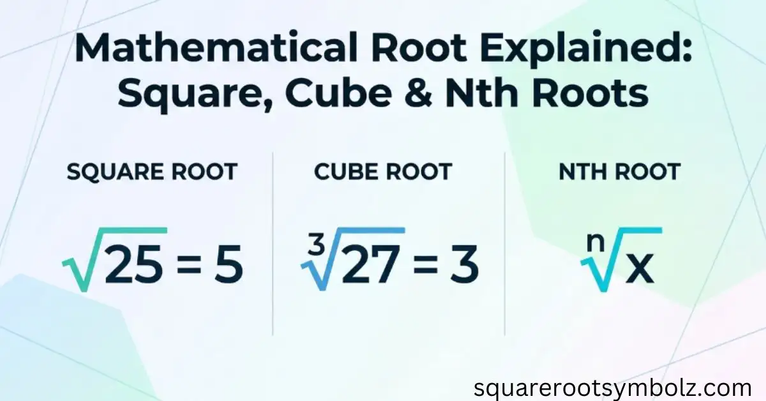
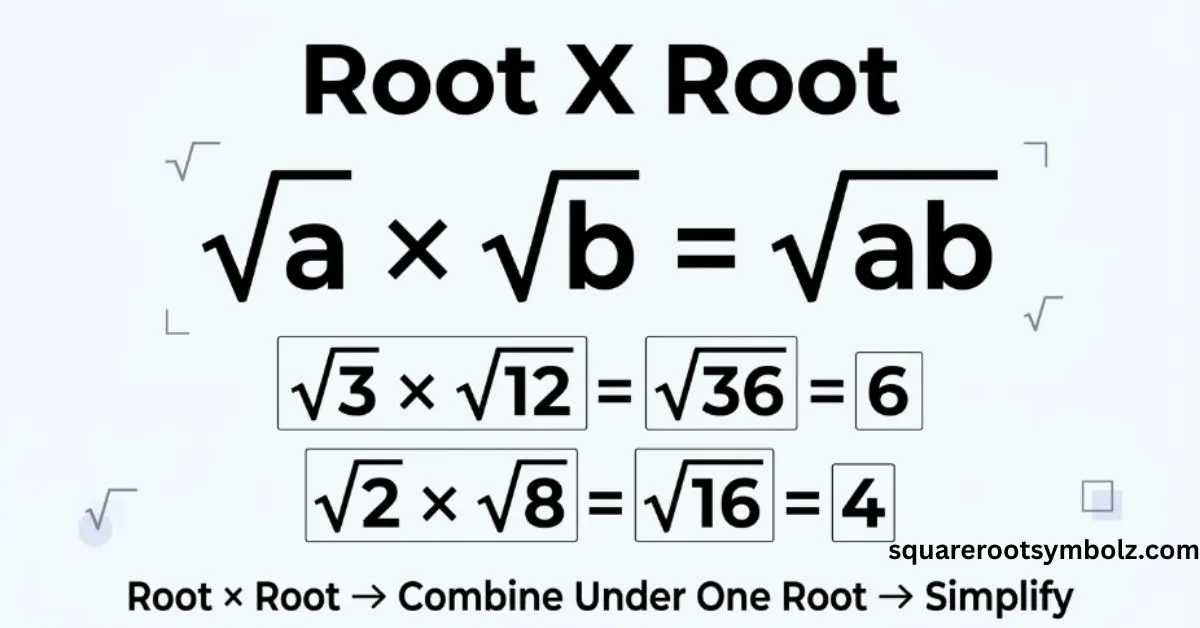
If by root x root you mean √x × √x, the answer is x, as long as x is a nonnegative real number. The reason is simple: multiplying √x by itself means squaring √x. Since the square and square-root operations undo each other, √x × √x becomes x.
This small algebra rule is useful when working with square roots, radical expressions, multiplication, fractional exponents, and simplifying expressions. If you have ever wondered why two identical square roots suddenly become a variable without the radical sign, this guide explains exactly what is happening, with simple examples and common mistakes to avoid.
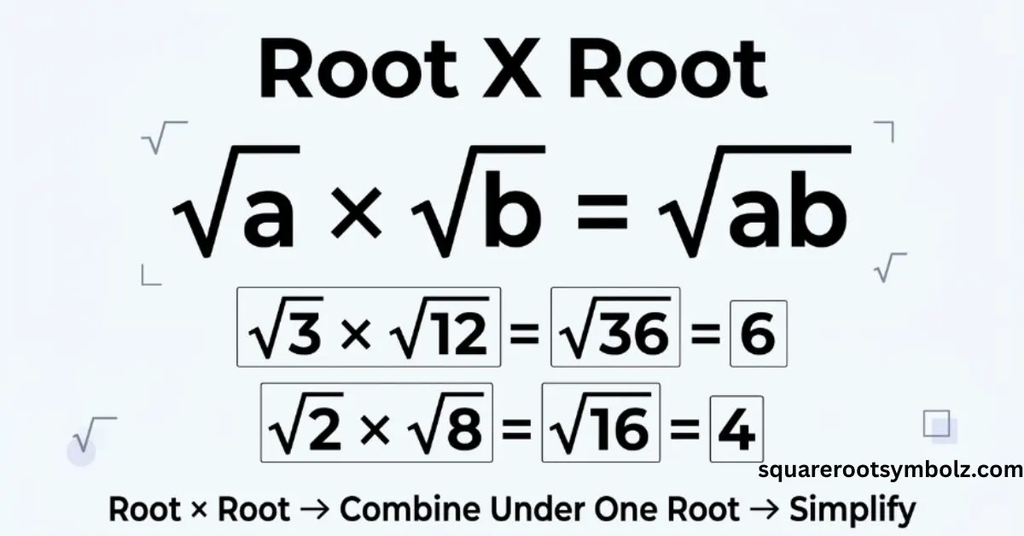
Solution
The expression √x × √x simplifies to:
√x × √x = x
This works because multiplying a number by itself means raising that number to the second power:
√x × √x = (√x)²
The square of the square root of x is x:
(√x)² = x
Therefore:
√x × √x = x
For example:
√9 × √9 = 3 × 3 = 9
And:
√25 × √25 = 5 × 5 = 25
The radical disappears because the square root is being multiplied by itself. In other words, the repeated square root creates a square.
Short Answer
The short answer to root x root is:
√x × √x = x
This rule applies when x ≥ 0 in the real-number system.
You can understand it by thinking about what a square root means. √x is the nonnegative number that produces x when multiplied by itself.
For example, √16 = 4 because:
4 × 4 = 16
Therefore:
√16 × √16 = 4 × 4 = 16
The important point is that multiplication and addition behave differently. If you multiply √x by √x, you get x. But if you add √x to √x, you get 2√x:
√x + √x = 2√x
So do not confuse multiplying identical radicals with adding them.
Step-by-step solution
Start with the original expression:
√x × √x
Both factors are exactly the same. Whenever a quantity is multiplied by itself, it can be written as a square:
√x × √x = (√x)²
Now apply the basic square-root property:
(√x)² = x
Therefore:
√x × √x = x
That is the entire process.
Step 1: Identify the repeated radical
Look at:
√x × √x
The same square-root expression appears twice. This is the key pattern to recognize.
Step 2: Rewrite multiplication as a square
Because the same quantity is multiplied by itself:
√x × √x = (√x)²
Step 3: Simplify
The square cancels the square root:
(√x)² = x
So the final answer is:
x
Another method using exponents
You can also rewrite a square root using a fractional exponent:
√x = x^(1/2)
Now multiply:
x^(1/2) × x^(1/2)
When powers with the same base are multiplied, their exponents are added:
x^(1/2 + 1/2) = x¹
And:
x¹ = x
So again:
√x × √x = x
This method becomes especially useful when you study rational exponents, algebraic expressions, and more advanced mathematics.
Key Concepts
Understanding root x root becomes much easier when you understand the relationship between a square, a square root, and a radical expression.
A square root asks: “What nonnegative number multiplied by itself gives this value?”
For example:
√36 = 6
because:
6 × 6 = 36
The number inside the radical is called the radicand. In √36, the number 36 is the radicand.
For √x, x is the radicand.
The square-root symbol is called a radical symbol, and the complete expression √x is a radical expression.
The standard real square root requires:
x ≥ 0
This condition is important because negative numbers do not have real square roots.
simplifying expressions
Simplifying an expression means rewriting it in an equivalent form that is easier to understand or work with.
For example:
√x × √x
can be simplified to:
x
Similarly:
√36 × √36
becomes:
6 × 6 = 36
Recognizing repeated radicals can save time because you do not always need to calculate the square root first. You can identify the algebraic pattern and simplify it directly.
This becomes particularly helpful when expressions contain variables rather than simple numbers.
For example:
3√x × 2√x
First multiply the coefficients:
3 × 2 = 6
Then multiply the radicals:
√x × √x = x
So:
3√x × 2√x = 6x
That is a useful application of the same rule.
multiplying radicals
When multiplying square roots with nonnegative real radicands, you can use the product property:
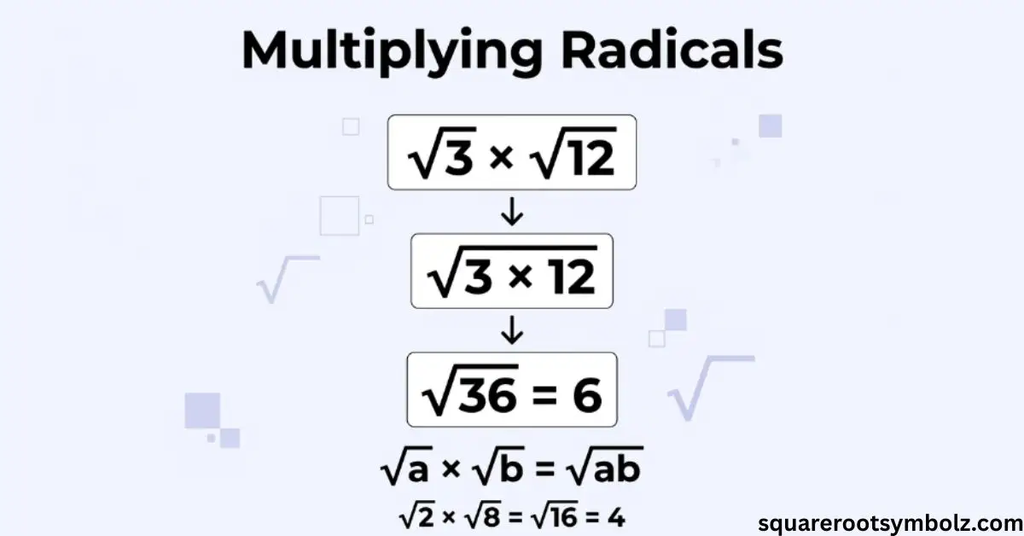
√a × √b = √(ab)
For example:
√3 × √12 = √36 = 6
Using the same idea:
√x × √x = √(x × x)
which gives:
√x × √x = √x²
Because x is nonnegative in the real-number setting of √x:
√x² = x
So the result is again:
x
There are therefore several ways to reach the same answer:
√x × √x = (√x)² = x
or:
√x × √x = √(x²) = x
The first method is usually the simplest.
properties of square roots
One of the most important square-root properties is:
(√x)² = x, when x ≥ 0
This is why the expression √x × √x simplifies to x.
However, there is an important distinction:
√(x²) = |x|
This is true for every real number x.
For example, if x = -5:
√((-5)²) = √25 = 5
The answer is 5, not -5.
That happens because the principal square root is always nonnegative.
But in the expression:
√x × √x
x must already be nonnegative if we are working with real numbers. Therefore:
√x × √x = x
This distinction between (√x)² and √(x²) is one of the most common sources of confusion in algebra.
Conclusion
The answer to root x root is simple:
√x × √x = x
as long as x ≥ 0 in the real-number system.
The easiest explanation is that multiplying √x by itself creates its square:
√x × √x = (√x)² = x
You can also reach the same answer through fractional exponents:
x^(1/2) × x^(1/2) = x¹ = x
Just remember the important distinction:
(√x)² = x
while:
√(x²) = |x|
Understanding that difference will help you avoid sign errors and handle more advanced radical expressions with confidence.
FAQs
What is sqrt(x)*sqrt(x)?
√x × √x = x, provided x ≥ 0 in the real-number system.
Multiplying √x by itself is the same as squaring √x, which gives x.
Why does √x × √x equal x?
Because:
√x × √x = (√x)²
and:
(√x)² = x
The square reverses the square-root operation for a nonnegative real number.
Is √x + √x equal to x?
No.
When two identical square roots are added, they combine as like terms:
√x + √x = 2√x
Multiplication gives a different result:
√x × √x = x
Is √x × √y equal to √xy?
For nonnegative real numbers x and y, yes:
√x × √y = √(xy)
For example:
√4 × √9 = √36 = 6
The product property is commonly used when multiplying radical expressions.
What is √x × √x × √x × √x?
There are four square-root factors:
√x × √x × √x × √x
Pair them:
(√x × √x)(√x × √x)
Each pair equals x:
x × x = x²
Therefore:
√x × √x × √x × √x = x²
What happens if x is negative?
In the real-number system, √x is not defined when x is negative.
Therefore, the real expression:
√x × √x
requires:
x ≥ 0
Complex numbers allow square roots of negative numbers, but those involve a different mathematical setting.
Is √(x²) the same as x?
Not always.
The correct identity for real numbers is:
√(x²) = |x|
If x is positive, this equals x.
If x is negative, it equals -x.
For example:
√((-8)²) = √64 = 8
not -8.
What is the difference between (√x)² and √(x²)?
For x ≥ 0:
(√x)² = x
For every real x:
√(x²) = |x|
The order of the operations matters. In the first expression, you take the square root first and then square it. In the second, you square x first and then take the principal square root.
Why is √X × √X = X?
The easiest way to understand this is to start with the definition of a square root.
Suppose:
√x = a
This means that a is the nonnegative number whose square is x.
Therefore:
a × a = x
Since a represents √x:
√x × √x = x
There is no special trick involved. The result follows directly from what a square root means.
For example, consider 49.
The square root of 49 is 7:
√49 = 7
Therefore:
√49 × √49 = 7 × 7 = 49
The exact same relationship works with a variable.
If:
√x = a
then:
a² = x
so:
√x × √x = x
A simple memory trick
When you see:
√x × √x
think:
same factor × same factor = that factor squared
Therefore:
√x × √x = (√x)² = x
This shortcut can make radical problems much easier, especially when you are working under time pressure.
Common mistake: confusing multiplication with addition
One of the most common mistakes is treating these two expressions as though they work the same way:
√x × √x
and:
√x + √x
They do not.
Here is the difference:
| Expression | Simplified result | ||
| √x × √x | x | ||
| √x + √x | 2√x | ||
| √x − √x | 0 | ||
| (√x)² | x | ||
| √(x²) | x |
This table captures an important algebra idea: the operation between the terms determines how they simplify.
More examples
Let’s try a few values.
If x = 4:
√4 × √4 = 2 × 2 = 4
If x = 9:
√9 × √9 = 3 × 3 = 9
If x = 64:
√64 × √64 = 8 × 8 = 64
If x = 121:
√121 × √121 = 11 × 11 = 121
The pattern remains the same.
Example with coefficients
Suppose you have:
5√x × 2√x
Multiply the coefficients:
5 × 2 = 10
Now multiply the radicals:
√x × √x = x
Therefore:
5√x × 2√x = 10x
This demonstrates why understanding the basic root-times-root rule is useful beyond a single expression.
Example with different radicands
Now consider:
√x × √y
The two radicands are different, so you cannot simplify the expression to x or y.
Instead:
√x × √y = √(xy)
For example:
√5 × √20 = √100 = 10
This is different from √x × √x because the two factors do not contain the same variable expression.
The exponent shortcut
There is another elegant way to understand the rule:
√x = x^(1/2)
Therefore:
√x × √x = x^(1/2) × x^(1/2)
Add the exponents:
x^(1/2 + 1/2) = x¹
So:
x¹ = x
Therefore:
√x × √x = x
This connection becomes increasingly useful as algebra becomes more advanced.
Why this rule matters
At first, √x × √x = x may look like a tiny rule that only applies to one type of problem. In reality, it appears throughout algebra.
You may use it when:
- simplifying radical expressions
- multiplying radicals
- solving equations
- working with rational exponents
- simplifying variable expressions
- reducing algebraic fractions
- studying functions
- preparing for higher-level mathematics
Once you recognize the pattern, many apparently complicated expressions become much easier to simplify.

I’m the creator of SquareRootSymbolz.com, where I publish easy-to-understand guides on symbols, Unicode characters, Alt codes, keyboard shortcuts, and copy-and-paste text symbols. My goal is to provide accurate, well-researched, and user-friendly content that helps readers quickly find the information they need.