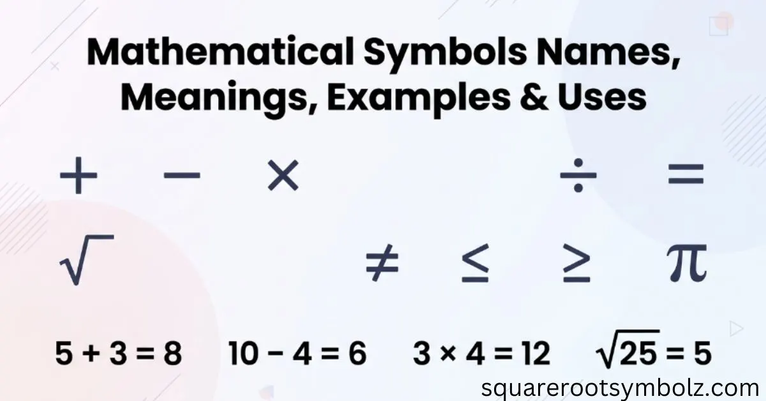
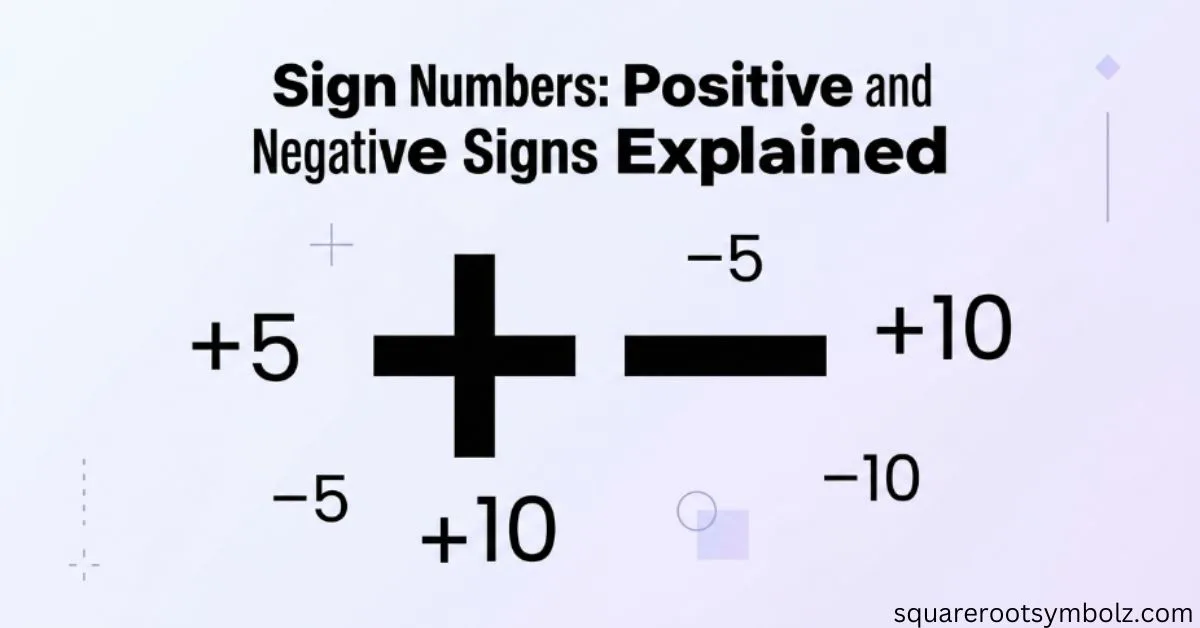
Sign numbers tell you whether a value is positive, negative, or zero. A plus sign (+) shows a positive number, while a minus sign (−) shows a negative number. Understanding these signs is essential for integers, the number line, arithmetic, and everyday calculations.
Many students understand numbers until a negative sign appears in front of one. I have seen this simple symbol create confusion because a minus sign can represent either a negative value or subtraction. Once you understand signed numbers, zero, opposite values, and the basic sign rules, calculations become much easier.
How Sign Numbers Work
Sign numbers work by showing a number’s position relative to zero. A positive number is greater than zero, while a negative number is less than zero. On a number line, positive values move to the right and negative values move to the left.
For example, +8 is positive because it is greater than zero, while −8 is negative because it is less than zero. The sign changes the direction and meaning of the number. The values 8 and −8 have the same distance from zero but represent opposite numbers.
A positive sign is often invisible in everyday mathematics. The number 7 normally means +7, even when the plus sign is not written. A negative number, however, needs its minus sign because removing it would completely change the value.
Zero sits between positive and negative numbers on the number line. In standard elementary mathematics, zero is neither positive nor negative. It acts as the dividing point between numbers greater than zero and numbers less than zero.
What Do Positive and Negative Sign Numbers Mean?
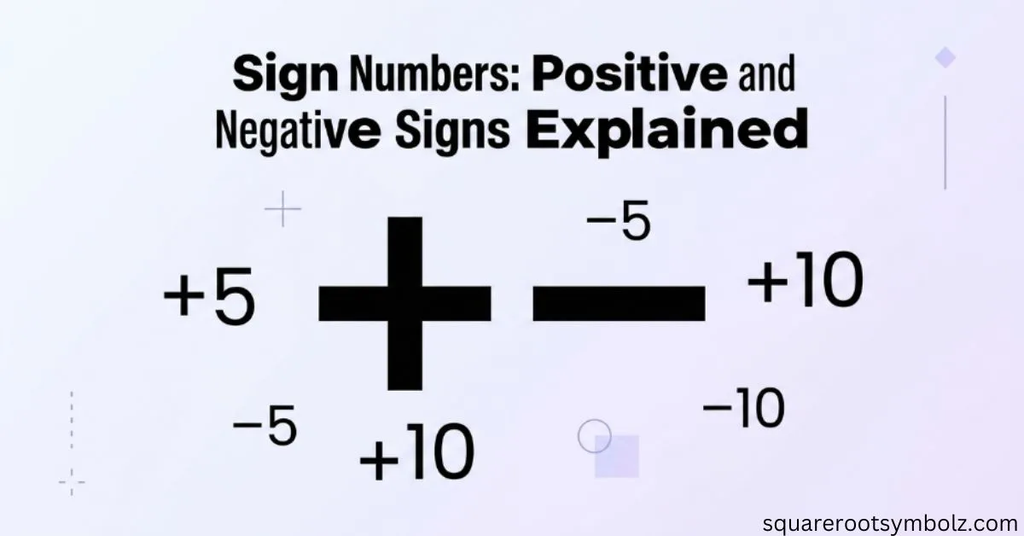
Positive sign numbers represent values above zero. For example, +10 can describe ten dollars earned, ten degrees above zero, or a location ten units above a reference point. Positive values generally represent movement or quantity in the forward direction.
Negative sign numbers represent values below zero. For example, −10 can describe debt, a temperature below freezing, or a location below sea level. The minus sign tells you that the number lies on the opposite side of zero.
This idea becomes easier when you imagine a number line. Moving right represents increasing positive values, while moving left represents increasing negative values. The signs therefore give mathematical direction, not just decoration.
Rules for Signed Numbers
Signed numbers follow different patterns depending on whether you are adding, subtracting, multiplying, or dividing. The first step is always to identify each number’s sign. A positive value has +, while a negative value has −.
For addition and subtraction, the size of the numbers matters. For multiplication and division, the sign combination determines whether the final answer is positive or negative. Learning these patterns separately prevents many common arithmetic mistakes.
A useful starting point is to remember that same signs and different signs do not always follow the same rule across every operation. Addition requires one type of reasoning, while multiplication and division use a more direct sign pattern.
The most important habit is to separate the operation from the sign of the number. For example, in 5 + (−3), the first plus is an addition operation, while the minus sign belongs to the number −3.
Addition: Same Signs, Add the Numbers
When two sign numbers have the same sign, add their absolute values and keep that sign. For two positive numbers, the answer is positive. For two negative numbers, the answer is negative.
For example:
5 + 3 = 8
Both values are positive, so the result is positive.
Now look at:
−5 + (−3) = −8
Both values are negative. Add 5 and 3, then keep the negative sign. The number line also confirms this because moving left five units and then left three more units ends at −8.
The key idea is simple: when adding values that already point in the same direction, the total distance from zero becomes larger. Two positive values move right, while two negative values move farther left.
Addition: Different Signs, Subtract the Numbers
When sign numbers have different signs, compare their absolute values. Subtract the smaller absolute value from the larger one, then give the answer the sign of the number with the larger absolute value.
For example:
8 + (−3) = 5
Subtract 3 from 8 because the signs are different. Since positive 8 has the larger absolute value, the final answer is positive.
Another example is:
−9 + 4 = −5
Subtract 4 from 9, which gives 5. Because the negative number has the larger absolute value, the answer is −5. This rule helps you understand addition instead of blindly memorizing signs.
Think of different signs as two forces moving in opposite directions. The larger value wins, and its sign determines the direction of the final result.
Multiplication and Division: Opposite Sign, Negative Result
For multiplication and division, the sign rules are more predictable. When two numbers have the same sign, the result is positive. When the numbers have different signs, the result is negative.
Here is the basic pattern:
| First Number | Second Number | Result |
| Positive | Positive | Positive |
| Negative | Negative | Positive |
| Positive | Negative | Negative |
| Negative | Positive | Negative |
For example:
6 × (−4) = −24
The signs are different, so the product is negative.
But:
(−6) × (−4) = 24
Both signs are negative, so the product is positive.
The same pattern works for division. Same signs produce a positive quotient, while different signs produce a negative quotient.
Like and Unlike Signs in Addition and Subtraction
Like signs are signs that match, such as ++ or −−. Unlike signs are different combinations, such as +− or −+. This idea is particularly useful when an expression contains several signs close together.
For example:
7 + (+2) = 9
The signs match, so the expression behaves as ordinary addition.
Now consider:
7 − (−2) = 9
Subtracting a negative is equivalent to adding a positive. The two negative signs effectively change the operation into addition.
Unlike sign combinations behave differently. For example:
7 + (−2) = 5
Here, the positive and negative values oppose each other. The calculation therefore compares the absolute values and follows the sign of the larger value.
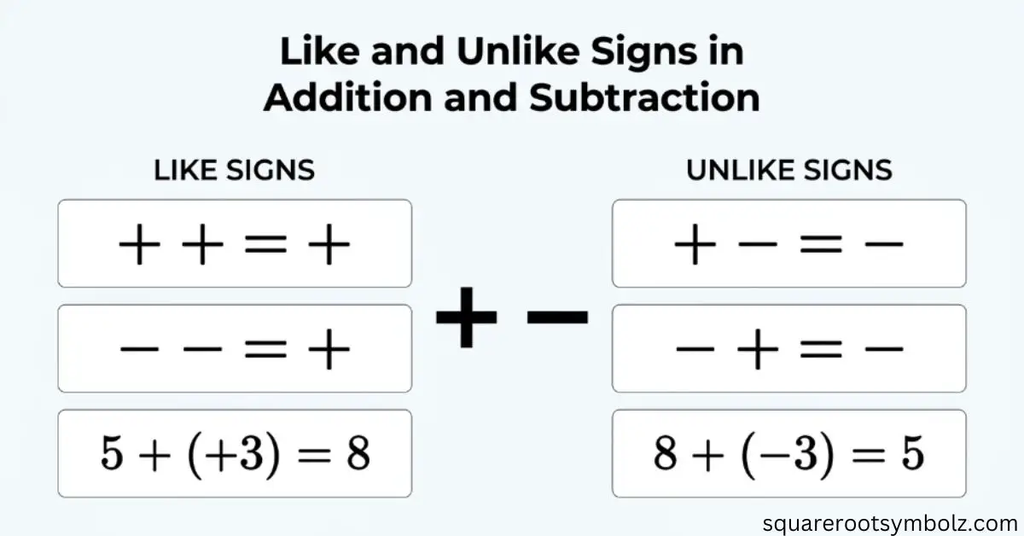
A helpful way to avoid confusion is to use parentheses whenever a negative number follows another operation. This makes it easier to see which sign belongs to the operation and which sign belongs to the number.
Worked Example
Consider these sign numbers:
12, −6, 0, −15, +4
First, identify their relationship to zero.
12 is positive because it is greater than zero. −6 is negative because it is less than zero. Zero is neither positive nor negative. −15 is negative, while +4 is positive.
Now try an arithmetic example:
−12 + 7
The signs are different, so subtract the smaller absolute value from the larger:
12 − 7 = 5
The larger absolute value belongs to −12, so the answer is:
−5
For multiplication:
−12 × 7 = −84
The signs are different, so the product is negative. This demonstrates why identifying the signs before calculating can make signed-number problems much easier.
Common Mistakes
One common mistake is thinking that zero is positive or negative. In standard mathematics, zero is neither. It separates positive values from negative values on the number line.
Another mistake is treating every plus or minus sign as an arithmetic operation. A sign directly attached to a number describes its value. For example, −5 is a negative number, while 8 − 5 uses the minus sign as subtraction.
Students also often confuse the rules for addition with the rules for multiplication. Same signs do not always mean the same procedure. In addition, you combine or compare absolute values. In multiplication and division, same signs directly give a positive result.
Finally, remember that a positive sign is often omitted. The number 6 means +6 unless the context says otherwise. A missing minus sign, however, changes the actual number and can produce a completely different answer.
Conclusion
Sign numbers are numbers identified by a positive (+) or negative (−) sign. Positive numbers are greater than zero, negative numbers are less than zero, and zero is neither positive nor negative.
The easiest way to master sign numbers is to first identify the sign, then choose the correct rule for the operation. Once you understand the number line, opposite values, same signs, and different signs, positive and negative number problems become far less confusing.
FAQ Section
What are sign numbers?
Sign numbers are positive and negative numbers identified by a plus sign (+) or minus sign (−). The sign shows whether the value is greater than or less than zero.
Is 0 positive or negative?
Zero is neither positive nor negative. It sits between positive and negative numbers on the number line.
What happens when two negative signs are together?
In expressions such as a − (−b), subtracting a negative is equivalent to adding a positive value. This is why 7 − (−3) equals 10.
Do same signs always give a positive answer?
No. In multiplication and division, same signs produce a positive result. In addition, two negative numbers produce a negative sum.
What is the rule for different signs?
For multiplication and division, different signs produce a negative result. For addition, subtract the smaller absolute value from the larger and keep the sign of the larger absolute value.
Why is +5 usually written as 5?
The plus sign for positive numbers is normally understood. Therefore, 5 and +5 represent the same positive value.

I’m the creator of SquareRootSymbolz.com, where I publish easy-to-understand guides on symbols, Unicode characters, Alt codes, keyboard shortcuts, and copy-and-paste text symbols. My goal is to provide accurate, well-researched, and user-friendly content that helps readers quickly find the information they need.