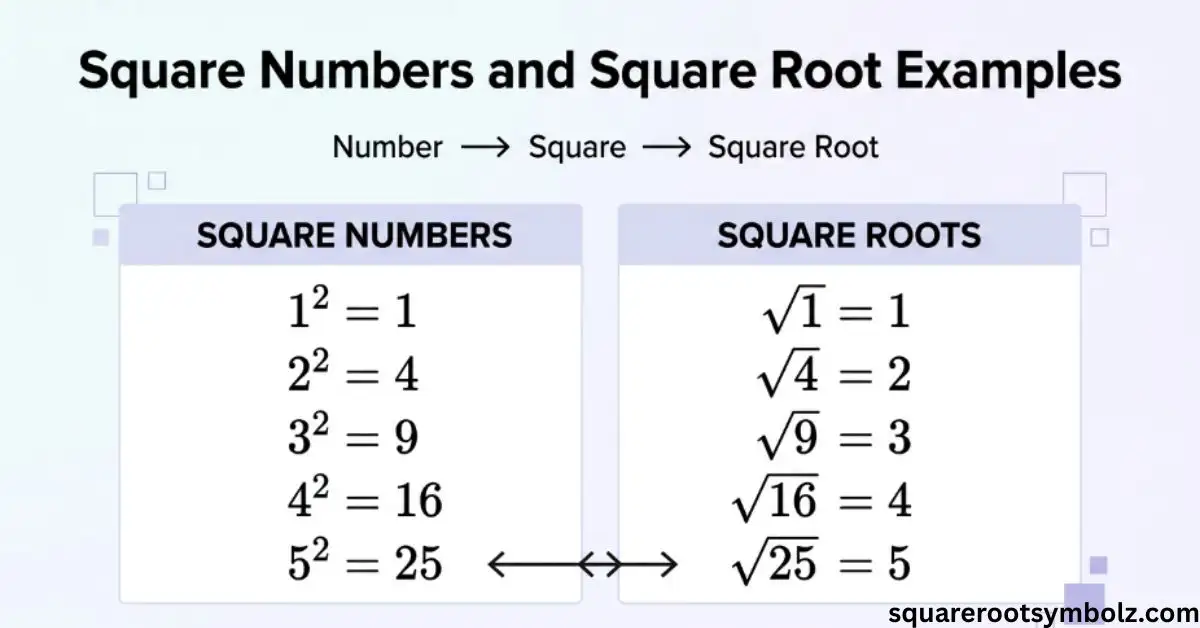
If you need a quick answer, square numbers are made by multiplying a number by itself, while square roots work backward to find that number. For example, 7 × 7 = 49, so 49 is a square number and √49 = 7. Understanding this connection makes many problems in algebra, geometry, and pre-algebra much easier.
When students first meet square numbers and square roots, the symbols can seem more complicated than the idea itself. They are not. Once you connect a number, its square, its square root, and the area of a square, the pattern becomes much easier to remember. This guide explains the relationship with tables, examples, estimation, and common mistakes.
How to Square A Number
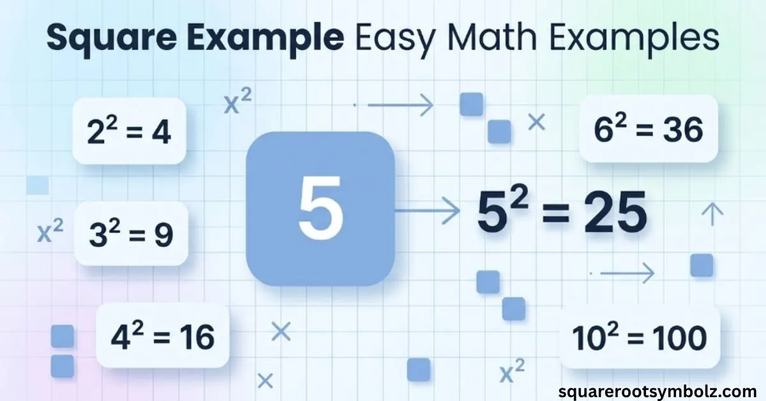
To square a number, multiply it by itself. The small 2 in an expression such as 6² tells you to use 6 as a factor twice:
6² = 6 × 6 = 36
So 36 is the square of 6. The same idea works for any integer. For example, 10² = 100 and 12² = 144. This simple multiplication rule is the foundation for understanding square numbers and square roots.
The word “square” has a geometric connection, too. Imagine arranging objects in equal rows and columns. Six rows of six objects create a 6-by-6 square containing 36 objects. That is why 36 is called a square number. The arithmetic and geometry are describing the same relationship from two different angles.
Squares From 0² to 5²
Here are the first small square numbers:
| Number | Squared | Square number |
| 0 | 0² | 0 |
| 1 | 1² | 1 |
| 2 | 2² | 4 |
| 3 | 3² | 9 |
| 4 | 4² | 16 |
| 5 | 5² | 25 |
Notice the pattern: each result comes from multiplying the number by itself. The sequence begins 0, 1, 4, 9, 16, 25. Learning these small squares gives you a useful mental reference when finding square roots or estimating roots that are not whole numbers.
A helpful way to remember them is to connect each result to a multiplication fact. Instead of memorizing 8² = 64 as an isolated fact, think “8 times 8 is 64.” This makes the relationship between multiplication, powers, square numbers, and square roots much more natural.
The first 20 square numbers
For quick reference, here are the first 20 nonnegative square numbers:
| Number | Square |
| 0 | 0 |
| 1 | 1 |
| 2 | 4 |
| 3 | 9 |
| 4 | 16 |
| 5 | 25 |
| 6 | 36 |
| 7 | 49 |
| 8 | 64 |
| 9 | 81 |
| 10 | 100 |
| 11 | 121 |
| 12 | 144 |
| 13 | 169 |
| 14 | 196 |
| 15 | 225 |
| 16 | 256 |
| 17 | 289 |
| 18 | 324 |
| 19 | 361 |
| 20 | 400 |
K20 Center’s current U.S. middle-school lesson similarly emphasizes identifying the first 20 square numbers and their square roots, extending the relationship through 400.
What is a square number?
A square number is a number that can be written as an integer multiplied by itself. For example:
8 × 8 = 64
Therefore, 64 is a square number, also called a perfect square.
Other examples include 1, 4, 9, 16, 25, 36, 49, 81, and 100. The important test is simple: ask whether some whole number or integer multiplied by itself produces the number. If the answer is yes, you have a square number.
There is also a useful geometric interpretation. A square with side length 8 units has an area of 8 × 8 = 64 square units. So a square number can represent the area of a square whose side length is an integer. K20 Center uses this side-length and area relationship as a central learning question.
How to recognize a square number
You can check a number by comparing it with nearby known squares.
Suppose you want to know whether 50 is a square number.
You know:
7² = 49
and:
8² = 64
Because there is no whole number between 7 and 8, there is no integer whose square is 50. Therefore, 50 is not a perfect square. This comparison method is especially useful before estimating a square root.
What is a square root?
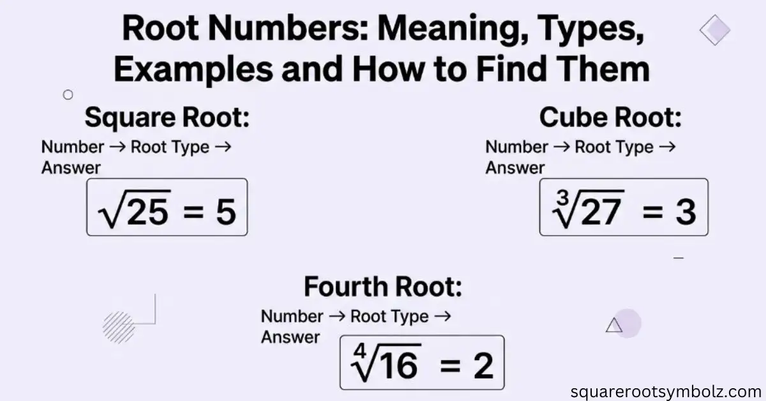
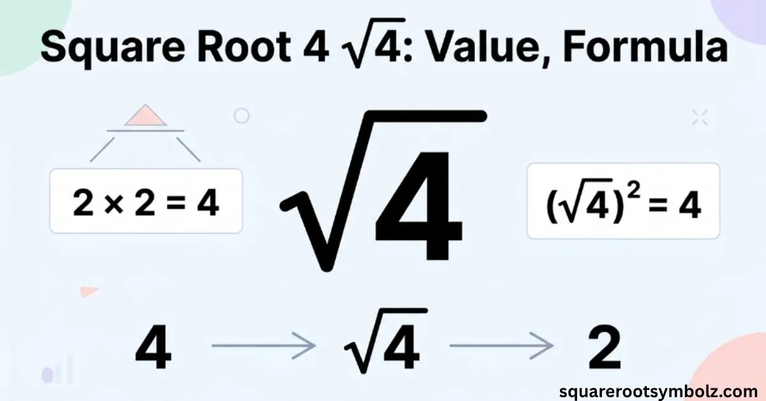
A square root is a number that produces the original number when multiplied by itself. For example:
7 × 7 = 49
so:
√49 = 7
The square root operation works in the opposite direction from squaring. If squaring takes 7 to 49, taking the square root takes 49 back to 7. That inverse relationship is the central idea connecting square numbers and square roots.
The symbol √ is called the radical symbol. When you see √49, the question is essentially: “What number multiplied by itself equals 49?” The answer is 7.
Square number vs. square root
| Concept | Meaning | Example |
| Square | Multiply a number by itself | 7² = 49 |
| Square number | Result of squaring | 49 |
| Square root | Number that produces the result | √49 = 7 |
| Principal square root | Nonnegative value represented by √ | √49 = 7 |
There is one subtle point worth remembering. The equation x² = 49 has two solutions, 7 and −7, because both numbers square to 49. But the radical symbol √49 represents the principal square root, which is 7.
Negative Numbers
Negative numbers become interesting when you square them. A negative number multiplied by another negative number produces a positive result:
(−5) × (−5) = 25
Therefore:
(−5)² = 25
The same is true for positive 5:
5 × 5 = 25
So both 5 and −5 have a square of 25. This explains why an equation such as x² = 25 has two solutions, while √25 itself refers to the positive principal root.
This is one of those places where a small notation detail matters. The expression −5² means the negative of 5², which is −25. But (−5)² means the entire negative number is squared, producing 25. Parentheses remove the ambiguity.
Why negative numbers can have positive squares
Think about multiplication rather than memorization:
(−4) × (−4) = 16
The two negative signs produce a positive result. Consequently, negative integers can create positive square numbers.
This is why both +4 and −4 are square roots of 16 in an equation. However, when the radical symbol is written, √16 means the principal square root, +4.
Squaring negative numbers
Squaring a negative number does not leave the result negative. For example:
(−2)² = 4
(−3)² = 9
(−10)² = 100
The reason is multiplication:
(−10) × (−10) = 100
A common mistake is to forget the parentheses. The expression −10² means −(10²), which equals −100. The expression (−10)² equals +100. Third Space Learning specifically identifies this sign issue as a common misconception when teaching square numbers.
Perfect Squares
A perfect square is a number whose square root is an integer. Examples include:
1, 4, 9, 16, 25, 36, 49, 64, 81, 100
For example:
√81 = 9
because:
9 × 9 = 81
But √80 is not an integer, so 80 is not a perfect square. The distinction becomes important when deciding whether a square root can be written exactly as a whole number or must be estimated or left in radical form.
Perfect squares from 1 to 100
| Number | Square root |
| 1 | 1 |
| 4 | 2 |
| 9 | 3 |
| 16 | 4 |
| 25 | 5 |
| 36 | 6 |
| 49 | 7 |
| 64 | 8 |
| 81 | 9 |
| 100 | 10 |
A quick visual trick is to imagine the number as the area of a square. If an area of 64 square units can form an 8-by-8 square, then 64 is a perfect square and 8 is its principal square root.
Calculating Square Roots
For a perfect square, finding the square root is usually a matter of recalling the corresponding square.
For example:
√144 = 12
because:
12 × 12 = 144
Similarly:
√169 = 13
because:
13 × 13 = 169.
Knowing common square numbers makes these questions much faster. Current educational resources commonly emphasize recalling small square numbers because they provide the reference points needed for both exact roots and estimates.
Finding a non-perfect square root
Not every number has a whole-number square root.
Consider:
√70
You know:
8² = 64
and:
9² = 81
Therefore:
8 < √70 < 9
The square root of 70 is approximately 8.37, so to one decimal place:
√70 ≈ 8.4
K20 Center uses the same idea of locating irrational square roots between consecutive perfect squares on a number line.
Estimating square roots
The quickest estimation strategy is to find the two perfect squares surrounding the number.
For example, estimate √150.
You know:
12² = 144
13² = 169
Therefore:
12 < √150 < 13
Since 150 is much closer to 144 than 169, its square root should be closer to 12 than 13. In fact, √150 is about 12.25.
This “between two squares” technique is extremely useful because it gives you a reasonable estimate before you ever touch a calculator. K20’s current lesson explicitly teaches students to estimate irrational square roots this way.
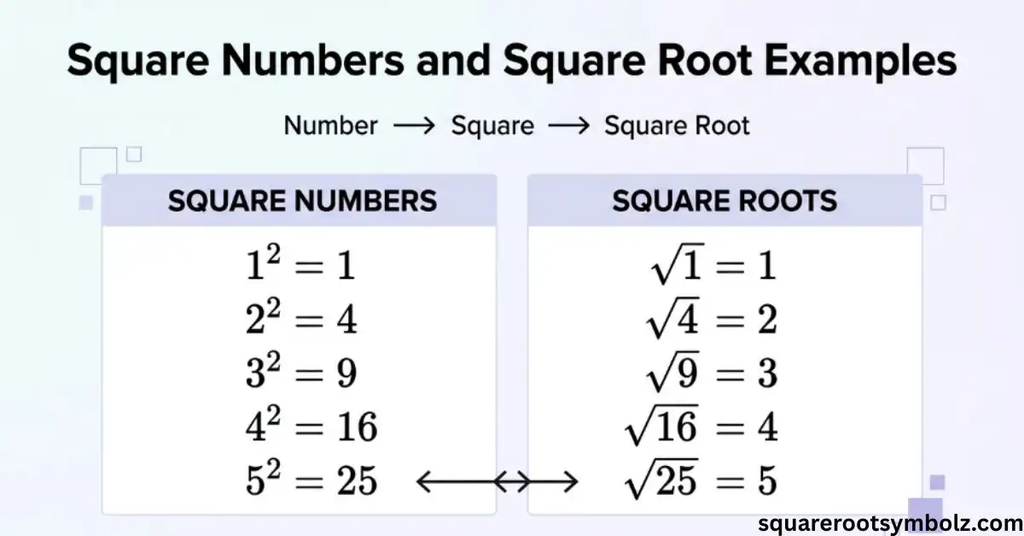
Square numbers and square root examples
Example 1: Find the square of 9
Multiply 9 by itself:
9 × 9 = 81
Therefore:
9² = 81
So 81 is a square number.
Example 2: Find the square root of 81
Ask which number multiplied by itself gives 81.
9 × 9 = 81
Therefore:
√81 = 9
Example 3: Is 121 a square number?
Check the nearby square:
11 × 11 = 121
Therefore:
121 is a square number, and √121 = 11.
Example 4: Is 90 a perfect square?
Look at nearby squares:
9² = 81
10² = 100
Because 90 lies between 81 and 100, it is not a perfect square.
Its square root lies between 9 and 10.
Example 5: Find √225
Ask:
What number multiplied by itself gives 225?
15 × 15 = 225
Therefore:
√225 = 15
These examples follow the same basic relationship: squaring moves from a number to its square, while taking the square root moves from the square back toward its side length.
How to solve problem involving square numbers and square roots
When a problem contains a square or square root, first identify which direction you need to move.
If the problem gives a number such as 12 and asks for its square:
12² = 144
If it gives 144 and asks for its principal square root:
√144 = 12
If the number is not a perfect square, locate it between two consecutive square numbers. For example, 50 is between 49 and 64, so:
7 < √50 < 8
This immediately tells you the approximate size of the answer.
Geometry application
Suppose a square has an area of 196 square inches.
The side length is the square root of the area:
√196 = 14
So each side is 14 inches long.
This is one of the most useful real-world connections. When you know the side length, squaring finds the area. When you know the area and need the side length, a square root reverses the process.
Pythagorean theorem application
Squares and square roots also appear in the Pythagorean theorem:
a² + b² = c²
For a right triangle with legs of 6 and 8:
6² + 8² = c²
36 + 64 = c²
100 = c²
Therefore:
c = 10
So the triangle has side lengths 6, 8, and 10.
Square numbers are therefore more than a memorization exercise. They become tools for finding distances, solving geometry problems, and working with algebraic relationships. Educational resources also connect squares with Pythagorean triples and geometric applications.
Common misconceptions
One of the biggest mistakes is thinking that a square root always has two answers. In an equation, x² = 49 has two solutions, +7 and −7. But √49 means the principal square root, which is +7. Keeping those two ideas separate prevents many sign errors.
Another common mistake is assuming that every number has a whole-number square root. Numbers such as 2, 3, 5, 10, and 50 are not perfect squares. Their square roots are irrational and cannot be written as terminating or repeating decimals. Instead, they can be estimated or represented using the radical symbol.
A third mistake is confusing a square with a square root. If:
7² = 49
then 49 is the square number, while 7 is its principal square root.
Think of it as a two-way relationship:
7 → square → 49
and:
49 → square root → 7
Once that connection becomes familiar, the terminology becomes much easier.
A useful last-digit check
A positive perfect square can end in only:
0, 1, 4, 5, 6, or 9
It cannot end in:
2, 3, 7, or 8
So a number ending in 7, for example, cannot be a perfect square. This is only a quick filter, not a complete test, because a number ending in 1, 4, 5, 6, 9, or 0 may still fail to be a perfect square.
Remember the relationship
The easiest way to remember the entire topic is:
Number × Number = Square Number
and:
Square Root of Square Number = Original Number
For example:
12 × 12 = 144
so:
12² = 144
and:
√144 = 12
That three-step relationship is the foundation of square numbers and square roots.
Conclusion
Square numbers and square roots are two sides of the same mathematical relationship. Squaring multiplies a number by itself, while a square root reverses that process.
For example:
8² = 64
and:
√64 = 8
The most useful skills are recognizing common perfect squares, understanding the difference between a square and a square root, handling negative numbers correctly, and estimating non-perfect roots between consecutive square numbers. K20’s current U.S. Grade 8 resource reinforces exactly these skills, including roots through 400 and irrational-root estimation.
Once you stop treating square numbers as a list to memorize and start seeing the connection between multiplication, area, powers, roots, and number lines, the topic becomes much easier and much more useful.
FAQ Section
What is a square number?
A square number is the result of multiplying an integer by itself. For example, 9 × 9 = 81, so 81 is a square number.
What is a square root?
A square root is a number that produces the original number when multiplied by itself. For example, √64 = 8 because 8 × 8 = 64.
What are the first 10 square numbers?
Starting with 1, they are:
1, 4, 9, 16, 25, 36, 49, 64, 81, 100
If 0 is included, the sequence begins with 0.
Is 0 a square number?
Yes. 0 is a square number because:
0 × 0 = 0
Therefore, √0 = 0.
What is the difference between a square number and a square root?
A square number is the result of squaring a number. A square root is the number that was squared.
Example:
6² = 36
Here, 36 is the square number and 6 is its principal square root.
Does every number have a whole-number square root?
No. Only perfect squares have integer square roots. For example, √49 = 7, but √50 is not a whole number.
Why does a negative number squared become positive?
Because multiplying two negative numbers produces a positive result:
(−6) × (−6) = 36
Therefore:
(−6)² = 36
What is the square root of 144?
√144 = 12 because:
12 × 12 = 144
How can I estimate a square root?
Find the two perfect squares immediately below and above the number. For example, 70 lies between 64 and 81, so √70 lies between 8 and 9.
What is a perfect square?
A perfect square is a number whose square root is an integer. Examples include 1, 4, 9, 16, 25, 36, and 49.

I’m the creator of SquareRootSymbolz.com, where I publish easy-to-understand guides on symbols, Unicode characters, Alt codes, keyboard shortcuts, and copy-and-paste text symbols. My goal is to provide accurate, well-researched, and user-friendly content that helps readers quickly find the information they need.