The square root 4 is 2, because 2 × 2 = 4. The number 4 is a perfect square, so its square root is an exact whole number rather than a decimal or approximation. In this guide, we will look at √4, the principal square root, radical notation, perfect squares, rational numbers, and the difference between √4 and the two solutions of x² = 4.
If you have ever wondered whether the answer should be 2 or ±2, the distinction is simple: √4 = 2, while the equation x² = 4 has two solutions, x = 2 and x = −2. Understanding this small difference makes square-root problems much easier and prevents one of the most common mistakes students make.
What Is Square Root of 4?
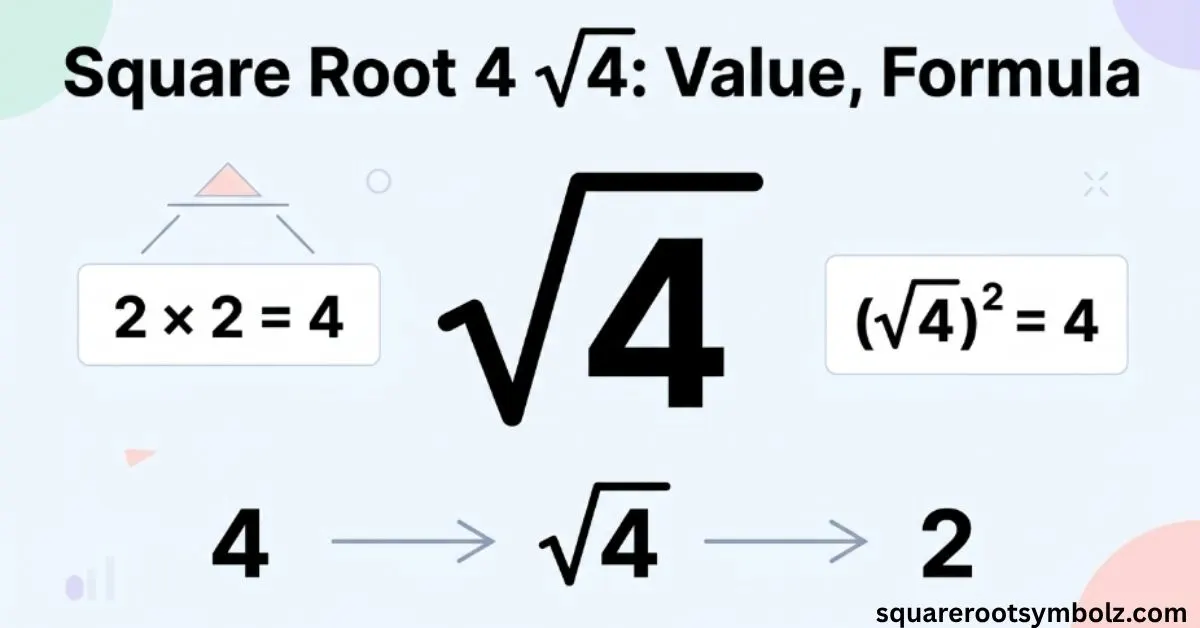
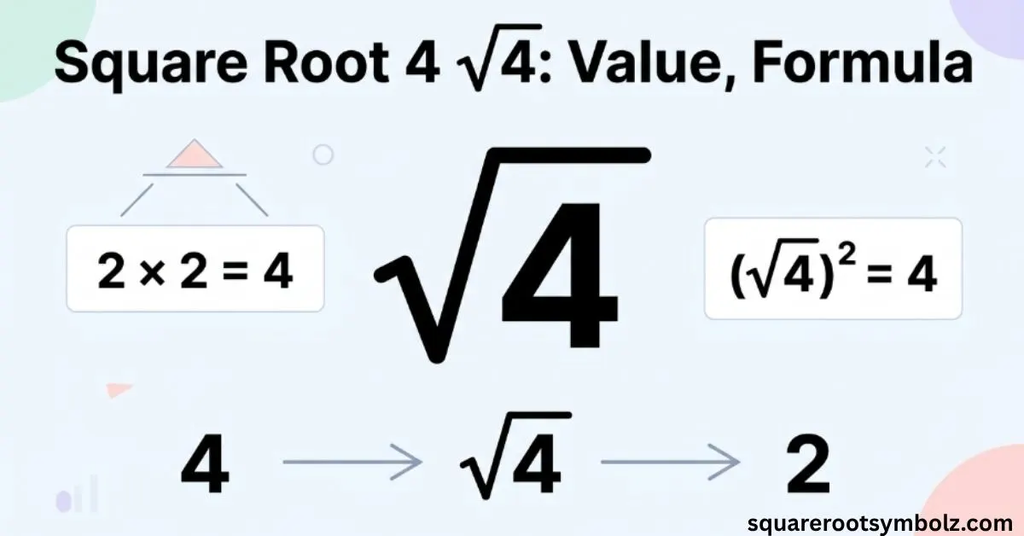
The square root of 4 is the number that, when multiplied by itself, produces 4. Since 2 × 2 = 4, the principal square root is 2. In radical notation, this is written as √4 = 2. The number 4 is therefore a perfect square.
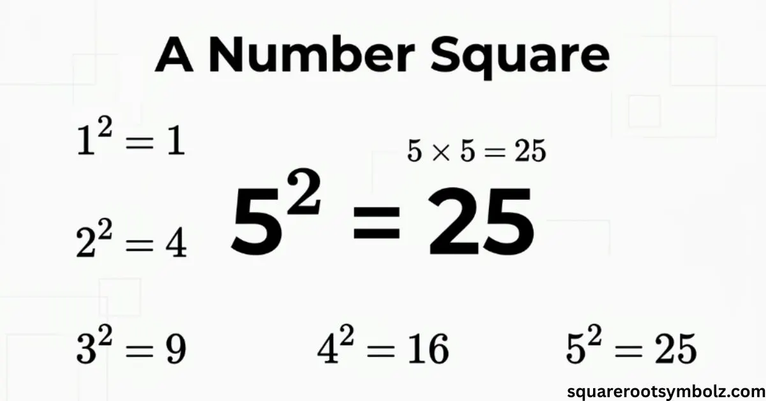
A square root reverses the operation of squaring. Because 2² = 4, taking the square root of 4 returns 2. The same idea works for other perfect squares: 3² = 9, 4² = 16, and 5² = 25. Recognizing these patterns makes basic square-root calculations almost instant.
Why does 2 squared equal 4?
Squaring a number means multiplying it by itself. Therefore, 2² means 2 × 2, which equals 4. The square root reverses that process, so √4 returns 2. This is why 4 belongs to the familiar sequence of perfect squares: 1, 4, 9, 16, 25, and so on.
Is 4 a perfect square?
Yes. A perfect square is a number that can be written as the square of an integer. Because 4 = 2², it is a perfect square. This also explains why √4 has a clean whole-number answer instead of an irrational decimal.
Key Formula for Square Root of 4
The basic formula is √4 = 2. In exponent form, the same expression can be written as 4^(1/2) = 2. The radical notation and fractional-exponent notation describe the same mathematical operation.
Another useful relationship is 2² = 4. These two statements work in opposite directions: squaring 2 produces 4, while taking the principal square root of 4 produces 2. This inverse relationship is the foundation of square-root calculations in algebra.
Radical form
The radical form of the answer is √4. The symbol √ is called the radical sign, while the number underneath it is called the radicand. Since √4 simplifies completely, the exact result is simply 2.
Exponent form
The square root can also be expressed with a fractional exponent:
4^(1/2) = 2
The denominator 2 indicates a square root. This notation becomes especially useful when working with exponent laws, rational exponents, and more advanced algebraic expressions.
Step-by-Step Illustration: How to Calculate Square Root of 4
Finding the square root of 4 is straightforward because 4 is a perfect square. Start by asking, “What number multiplied by itself equals 4?” Testing 2 gives 2 × 2 = 4, so the principal square root is 2.
You can also verify the result by squaring the answer. Take 2 and multiply it by itself: 2 × 2 = 4. Because the original number is recovered exactly, the calculation is confirmed. This simple checking method works for any square root that you calculate.
Step 1: Start with 4
Write the expression:
√4
The number under the radical is 4, so the goal is to find a number whose square equals 4.
Step 2: Find the matching square
Ask:
What number × itself = 4?
The answer is 2 because:
2 × 2 = 4
Step 3: Write the answer
Therefore:
√4 = 2
Because the radical symbol represents the principal, nonnegative square root, the answer to √4 is 2 rather than −2.
Step 4: Verify the result
Square the answer:
2² = 4
The result matches the original radicand, confirming that √4 = 2.
Is the Square Root of 4 Rational or Irrational?
The square root of 4 is rational because √4 = 2, and 2 can be written as the fraction 2/1. A rational number can be expressed as a ratio of integers with a nonzero denominator. Therefore, √4 belongs to the rational-number system.
It is also an integer and a whole number. This is different from values such as √2 or √3, which are irrational. Since 4 is a perfect square, its square root terminates exactly at 2 without requiring an approximation.
Why is 4 rational?
The number 4 itself is rational because it can be written as 4/1. Its square root is also rational because √4 = 2 = 2/1. Both the original number and its principal square root can therefore be represented as ratios of integers.
Is √4 an integer?
Yes. Since √4 = 2 and 2 is an integer, the square root of 4 is an integer. It is also a whole number and a natural number under the common convention that natural numbers begin with 1.
How to Find the Square Root of 4?
There are several methods for finding √4, including recognizing perfect squares, prime factorization, long division, and repeated subtraction. For such a small perfect square, recognizing that 2² = 4 is easily the fastest method.
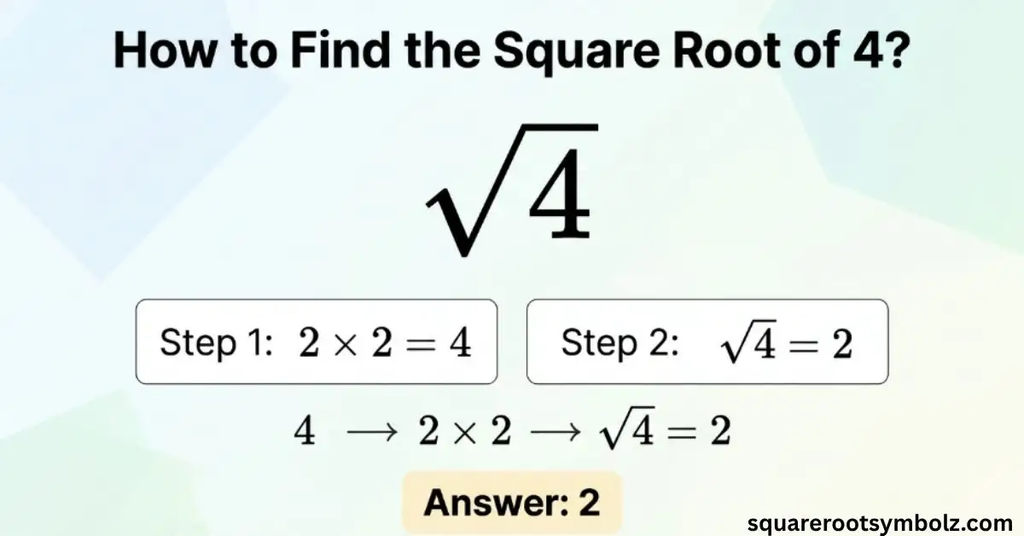
Still, learning the other methods is useful because the same techniques can be applied to larger or less familiar numbers. Prime factorization is particularly helpful when simplifying radicals, while long division can be used when a square root is not immediately recognizable.
Prime factorization
Start by factoring 4:
4 = 2 × 2 = 2²
Now take the square root:
√4 = √(2²) = 2
The paired factors make the answer obvious. This is the same basic method used to simplify larger perfect-square radicals.
Repeated subtraction
Another method is repeated subtraction of consecutive odd numbers:
4 − 1 = 3
3 − 3 = 0
It took two subtractions to reach zero, so the square root of 4 is 2. This method demonstrates an interesting property of perfect squares: the number of consecutive odd numbers needed to reduce a perfect square to zero corresponds to its square root.
Long division
The long-division method can also calculate √4. Because 4 is already a single-digit perfect square, the process finishes immediately: 2 × 2 = 4 with a remainder of zero. Therefore, the quotient is 2.
Square Root of 4 Solved Examples
The simplest example is √4 = 2, but understanding how the value behaves in equations and related expressions is more useful. These examples show the difference between evaluating a radical, solving an equation, and applying a negative sign outside a radical.
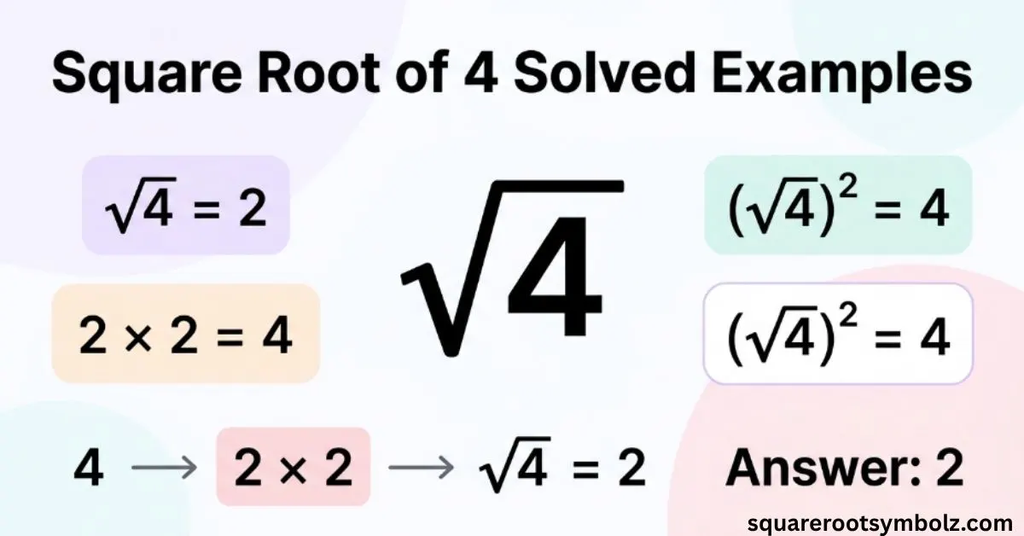
Example 1: Evaluate √4
Start with:
√4
Because:
2 × 2 = 4
the answer is:
√4 = 2
This is the direct evaluation of the principal square root.
Example 2: Solve x² = 4
This problem is different:
x² = 4
Now we are looking for all real values whose squares equal 4.
Both:
2² = 4
and:
(−2)² = 4
Therefore:
x = ±2
This is why it is important not to confuse √4 with the solutions of x² = 4. The expression √4 means the principal square root, while the equation asks for every value of x that works.
Example 3: Evaluate −√4
The negative sign is outside the radical:
−√4
First evaluate √4:
√4 = 2
Then apply the negative sign:
−√4 = −2
The expression does not mean that the square root itself is negative. It means the negative of the principal square root.
Example 4: Evaluate (√4)²
First:
√4 = 2
Then:
(√4)² = 2² = 4
So:
(√4)² = 4
This demonstrates that squaring the principal square root returns the original nonnegative number.
Example 5: Geometry application
Suppose a square has an area of 4 square units. The side length can be found with:
side = √area
Therefore:
side = √4 = 2
So each side of the square measures 2 units. This is one of the simplest real-world uses of square roots: recovering a length from an area.
Conclusion
The square root 4 is 2, because 2 multiplied by itself equals 4. Since 4 is a perfect square, √4 has an exact whole-number answer. The key distinction to remember is that √4 = 2, while the equation x² = 4 has two real solutions: x = ±2.
Once you understand this difference between the principal square root and the solutions of a squared equation, many basic algebra and radical problems become much easier. The same idea extends naturally to other perfect squares such as 9, 16, 25, and 36.
FAQs
What is the value of the square root of 4?
The value is 2 because 2 × 2 = 4. The radical symbol √ represents the principal, nonnegative square root.
Why is √4 not −2?
Because √4 represents the principal square root, which is nonnegative. Therefore, √4 = 2. However, −2 is also a solution to the equation x² = 4.
What are the two square roots of 4?
The two square roots of 4 are 2 and −2. Both produce 4 when squared:
2² = 4
(−2)² = 4
Is 4 a perfect square?
Yes. Since 4 = 2², the number 4 is a perfect square.
Is √4 rational?
Yes. √4 = 2, and 2 can be written as 2/1, so it is rational.
What is √4 in simplest form?
The simplest form is 2. Since 4 is a perfect square, the radical simplifies completely.
What is √4 as a decimal?
√4 = 2.0 as a decimal. Because the result is exact, there is no need for an approximation symbol.
What is √4 as an exponent?
The square root can be written as:
4^(1/2) = 2
This is the fractional-exponent form of the square root.
Understanding the Square Root of 4
The easiest way to remember √4 is to connect the root with its matching square: 2² = 4, so √4 = 2. The number 4 is a perfect square, which means its square root is an exact integer rather than an irrational decimal.
The most important distinction is between an expression and an equation. √4 = 2 uses the principal square root, while x² = 4 has two real solutions, x = 2 and x = −2. Keeping this difference clear prevents one of the most common square-root mistakes.
Square root 4 at a glance
| Property | Value |
| Expression | √4 |
| Principal square root | 2 |
| Two square roots of 4 | 2 and −2 |
| Perfect square? | Yes |
| Integer? | Yes |
| Rational? | Yes |
| Decimal value | 2 |
| Exponent form | 4^(1/2) |
| Equation | x² = 4 |
| Solutions of equation | x = ±2 |
Square root 4 compared with nearby values
| Number | Square root | Type |
| 1 | 1 | Perfect square |
| 2 | √2 ≈ 1.414 | Irrational |
| 3 | √3 ≈ 1.732 | Irrational |
| 4 | 2 | Perfect square |
| 5 | √5 ≈ 2.236 | Irrational |
| 6 | √6 ≈ 2.449 | Irrational |
| 9 | 3 | Perfect square |
The pattern makes 4 especially easy to recognize: it sits between the non-perfect squares 3 and 5, while its own square root is the exact integer 2.

I’m the creator of SquareRootSymbolz.com, where I publish easy-to-understand guides on symbols, Unicode characters, Alt codes, keyboard shortcuts, and copy-and-paste text symbols. My goal is to provide accurate, well-researched, and user-friendly content that helps readers quickly find the information they need.