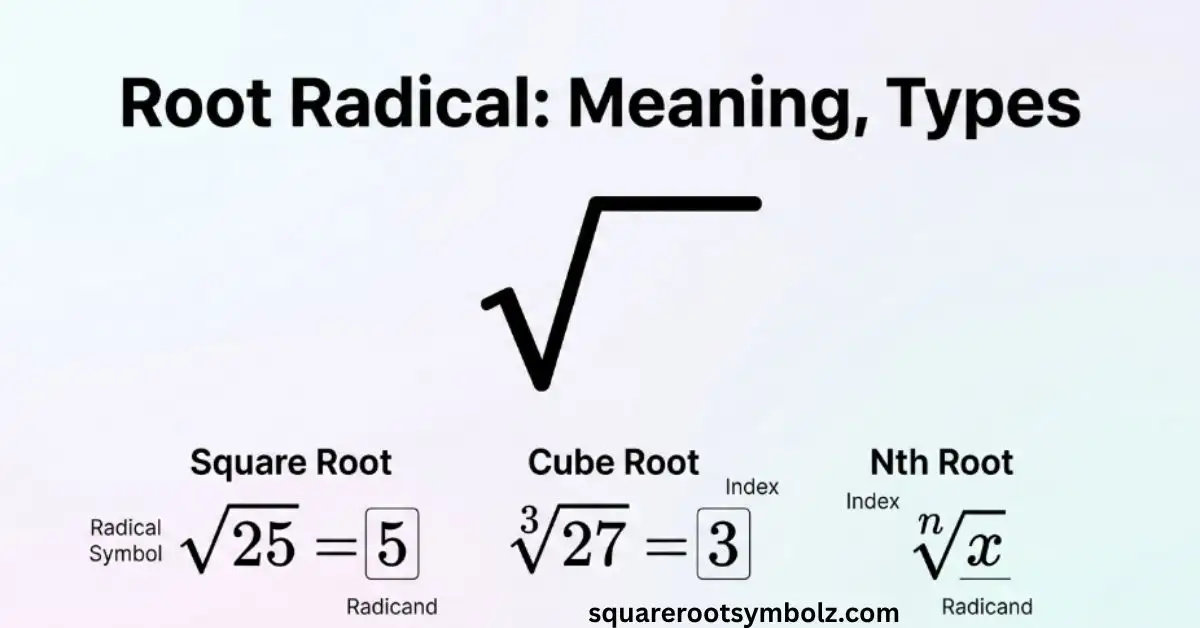
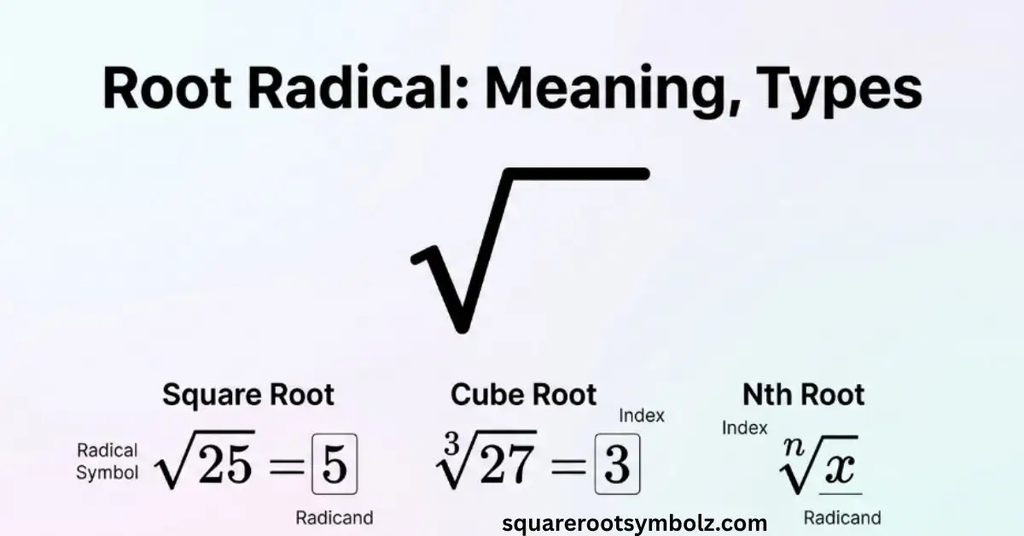
A root radical is a mathematical expression used to represent a root, such as a square root, cube root, or nth root. In simple terms, it asks which number, when raised to a particular power, produces the value inside the radical. For example, √25 = 5 because 5² = 25. The radical symbol, radicand, and index work together to identify the root being taken.
If radical notation looks confusing at first, you are not alone. The good news is that the pattern is remarkably consistent: identify the index, find the radicand, determine the matching power, and simplify when possible. Once these pieces click together, square roots, cube roots, fractional exponents, and more advanced radical expressions become much easier to understand.
Root Radical: Perfect Squares Review
Perfect squares are one of the easiest places to start with a root radical. A perfect square is a number produced by multiplying an integer by itself, such as 1, 4, 9, 16, 25, or 36. Their square roots are exact whole numbers, making the radical easy to simplify.
For example, 49 is a perfect square because 7² = 49. Therefore, √49 = 7. When the radicand contains a perfect-square factor, that factor can often be taken outside a square-root radical. Recognizing familiar squares is one of the fastest ways to simplify radical expressions.
| Number | Square | Square Root |
| 1 | 1² | 1 |
| 4 | 2² | 2 |
| 9 | 3² | 3 |
| 16 | 4² | 4 |
| 25 | 5² | 5 |
| 36 | 6² | 6 |
| 49 | 7² | 7 |
| 64 | 8² | 8 |
| 81 | 9² | 9 |
| 100 | 10² | 10 |
A quick mental check can save considerable time. If you recognize the radicand as a perfect square, you can evaluate the root immediately. If it is not a perfect square, the next step is usually to look for the largest perfect-square factor.
Root Radical: The Product Property of Radicals
The product property is one of the most useful rules for simplifying a root radical. For nonnegative values, the square root of a product can be separated into the product of the square roots:
√(ab) = √a × √b
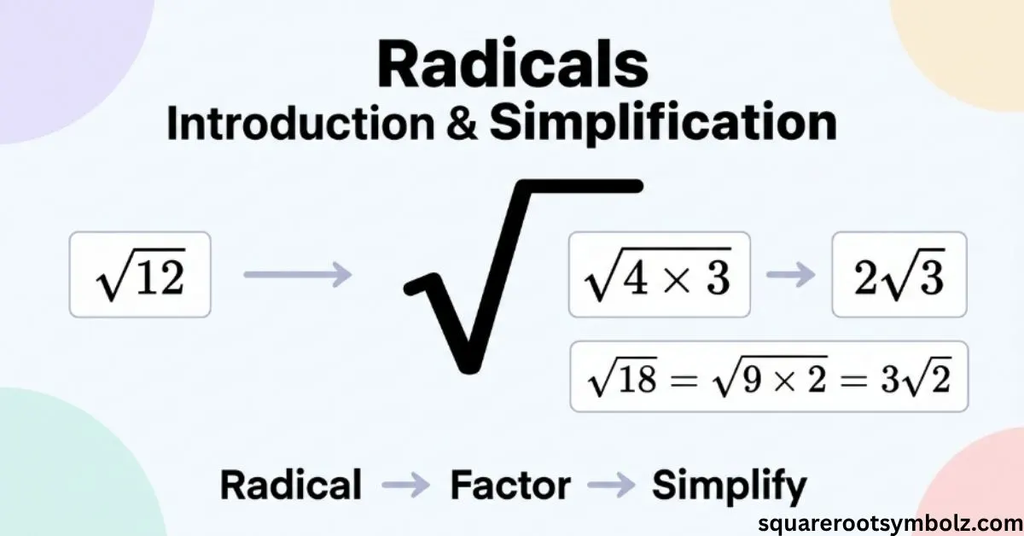
This lets you break a difficult radicand into smaller pieces. For example, √72 can be rewritten as √(36 × 2). Since √36 = 6, the expression becomes 6√2. LearnMath identifies this property as the key tool for simplifying numerical radicals.
The same relationship can work in the opposite direction:
√a × √b = √(ab)
This is especially helpful when multiplying radical expressions. However, students should avoid assuming that addition works the same way. In general, √a + √b is not equal to √(a + b).
Example
Simplify:
√48
Find a perfect-square factor:
48 = 16 × 3
Then:
√48 = √16 × √3
Therefore:
√48 = 4√3
The number 4 comes outside because 16 is a perfect square.
Root Radical: Simplifying Numerical Radicals
When a root radical does not evaluate to a whole number, simplify it by finding the largest perfect-square factor. This keeps the answer in exact form rather than forcing an unnecessary decimal approximation. For example, √50 becomes 5√2 because 50 = 25 × 2.
The goal is not simply to make the number under the radical smaller. The goal is to remove every possible perfect-square factor. For √72, stopping at 2√18 is incomplete because 18 still contains a factor of 9. The fully simplified form is 6√2.
Example: √200
Factor 200:
200 = 100 × 2
Then:
√200 = √100 × √2
Since √100 = 10:
√200 = 10√2
The exact answer is 10√2.
Example: √180
Factor 180:
180 = 36 × 5
Therefore:
√180 = √36 × √5
√180 = 6√5
This method works because 36 is the largest perfect-square factor of 180.
Root Radical: Simplifying Radicals with Variables
A root radical can contain variables as well as numbers. The same basic idea applies: look for powers that match the root. For a square root, pairs of identical factors can generally be taken outside the radical, subject to the appropriate domain conditions.
For example:
√x⁶ = x³
because:
x⁶ = (x³)²
Another example is:
√x⁷ = x³√x
The exponent 7 can be separated into 6 + 1. The x⁶ forms a perfect square and moves outside, while the remaining x stays under the radical.
Variable example
Consider:
√(50x⁴y³)
Separate the factors:
√50 × √x⁴ × √y³
Simplify each part:
5√2 × x² × y√y
After combining the factors:
5x²y√(2y)
This illustrates how numerical factors and variable powers can be simplified independently before being combined.
Root Radical Simplifying with Coefficients Already Outside
Sometimes a coefficient is already positioned outside a root radical. In that case, simplify the radical first and then multiply the resulting coefficient. This prevents arithmetic from becoming unnecessarily complicated.
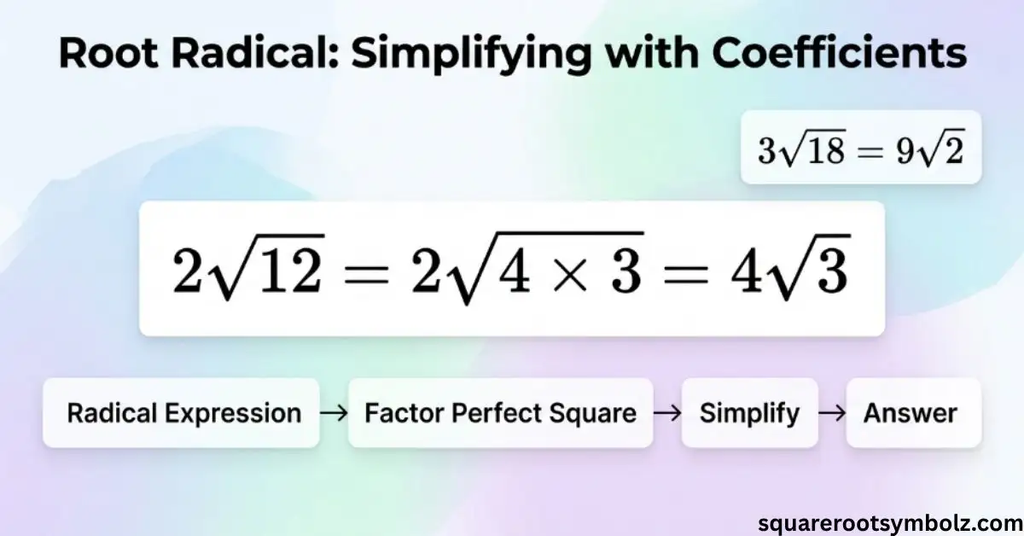
For example:
3√75
First simplify √75:
75 = 25 × 3
So:
√75 = 5√3
Now multiply by the coefficient:
3 × 5√3 = 15√3
Therefore:
3√75 = 15√3
The important habit is to keep the coefficient outside the radical while simplifying the radicand inside.
Another example
Consider:
4√20
Because:
20 = 4 × 5
we have:
√20 = 2√5
Therefore:
4√20 = 4(2√5) = 8√5
This produces a cleaner exact form.
Root Radical: Cube Roots A Brief Introduction
A root radical is not limited to square roots. A cube-root radical asks which number, when raised to the third power, produces the radicand. Cube roots use an index of 3, written as ∛a or √[3]{a}.
For example:
∛8 = 2
because:
2³ = 8
Similarly:
∛27 = 3
because:
3³ = 27
Unlike even roots, real cube roots can also be taken for negative numbers:
∛(−64) = −4
because:
(−4)³ = −64
Square root vs. cube root
| Feature | Square Root | Cube Root |
| Index | 2, usually omitted | 3 |
| Example | √25 = 5 | ∛27 = 3 |
| Power reversed | Squaring | Cubing |
| Negative radicand in real numbers | Not defined | Defined |
| Common notation | √x | ∛x |
The index tells you which power is being reversed. This same idea extends beyond square and cube roots to fourth, fifth, and higher roots.
Root Radical: Common Mistakes to Avoid
One common mistake is stopping a simplification too early. For example, √72 = 2√18 is mathematically equivalent to the original expression, but it is not fully simplified. Because 18 still contains the perfect-square factor 9, the process should continue until the result becomes 6√2.
Another frequent error is treating radical expressions like ordinary arithmetic. For example, √a + √b generally cannot be combined into √(a + b). Students also sometimes confuse the radical symbol with the entire radical expression. In √25, the symbol is the radical, 25 is the radicand, and √25 is the radical expression.
| Mistake | Incorrect Idea | Correct Idea |
| Stopping too soon | √72 = 2√18 | √72 = 6√2 |
| Combining addition | √a + √b = √(a+b) | Usually cannot combine |
| Ignoring the index | Every root is a square root | Index identifies the root |
| Confusing terms | Radical = radicand | Radicand is inside the radical |
| Using decimals unnecessarily | √50 ≈ 7.071 | Exact form: 5√2 |
A useful final check is to reverse the operation. If you simplify a square root to a value or expression, square the result when appropriate and verify that it returns the original quantity. This simple habit catches many algebra mistakes.
Root Radical: Radicals Introduction & Simplification
Roots and radicals are closely connected to exponents because they perform inverse operations. Squaring a number and then taking its square root can return the original nonnegative value, while a radical can be rewritten using a fractional exponent.
For example:
√x = x¹ᐟ²
and:
√[3]{x} = x¹ᐟ³
More generally:
√[n]{x} = x¹⁄ⁿ
The denominator of the fractional exponent tells you the root, while the numerator tells you the power. OpenStax gives the general relationship between radical notation and rational exponents as:
aᵐ⁄ⁿ = (√[n]{a})ᵐ = √[n]{aᵐ}.
The parts of a root radical
Consider:
√[3]{x⁵}
There are three important components:
- 3 = index
- x⁵ = radicand
- √[3]{ } = radical symbol
The entire expression is a radical expression.
For square roots, the index 2 is normally omitted:
√x = √[2]{x}
That convention makes ordinary square-root notation shorter and easier to read.
Principal root
For an even root of a nonnegative real number, the radical symbol represents the principal, nonnegative root. For example:
√25 = 5
rather than ±5.
The equation:
x² = 25
is different because it has two real solutions:
x = ±5
This distinction is essential when working with equations and radical expressions. OpenStax specifically distinguishes the principal square root from the two solutions of a squared equation.
Higher root radicals
The same structure works for any positive integer index:
√[n]{a}
The index n tells you which root is being taken. Thus, a second root is a square root, a third root is a cube root, and a fourth root is a fourth root. MathWorld describes the nth root as the operation that reverses an nth power.
Conclusion
A root radical represents a root operation using radical notation. The most important parts to recognize are the radical symbol, index, radicand, and resulting root. Square roots, cube roots, and higher roots all follow the same central idea: undo a corresponding power.
For practical algebra, remember three habits: identify the index, look for perfect-power factors, and simplify completely. Once you can recognize perfect squares and apply radical properties, expressions such as √72, √50x⁴y³, and ∛54 become much easier to handle. Root radicals are not a collection of unrelated rules; they are a consistent way of reversing powers.
FAQ Section
What is a root radical?
A root radical is an expression that represents a root using a radical symbol. Examples include √25, ∛27, and √[4]{16}.
Is a radical the same as a root?
They are closely related but not exactly the same term. A root is the value obtained from a root operation, while a radical refers to the notation used to represent that operation.
What is the radicand?
The radicand is the quantity located under the radical symbol. In √25, the number 25 is the radicand. MathWorld defines a radicand as the quantity under a radical sign.
What is the index of a radical?
The index tells you which root is being taken. In √[3]{8}, the index is 3, so the expression represents a cube root. For square roots, the index 2 is normally omitted.
What is the difference between a square root and an nth root?
A square root is a second root, while an nth root can use any positive integer index n. Thus, square roots are one specific type of nth root.
Can a radical be written as an exponent?
Yes. A root radical can be converted into a fractional exponent:
√[n]{x} = x¹⁄ⁿ
For example, √x = x¹⁄² and ∛x = x¹⁄³.
What is the easiest way to simplify a square-root radical?
Look for the largest perfect-square factor of the radicand. For example, 72 = 36 × 2, so √72 = 6√2.
Why can cube roots have negative radicands?
Because a negative number raised to an odd power remains negative. For example, (−4)³ = −64, so ∛−64 = −4.

I’m the creator of SquareRootSymbolz.com, where I publish easy-to-understand guides on symbols, Unicode characters, Alt codes, keyboard shortcuts, and copy-and-paste text symbols. My goal is to provide accurate, well-researched, and user-friendly content that helps readers quickly find the information they need.