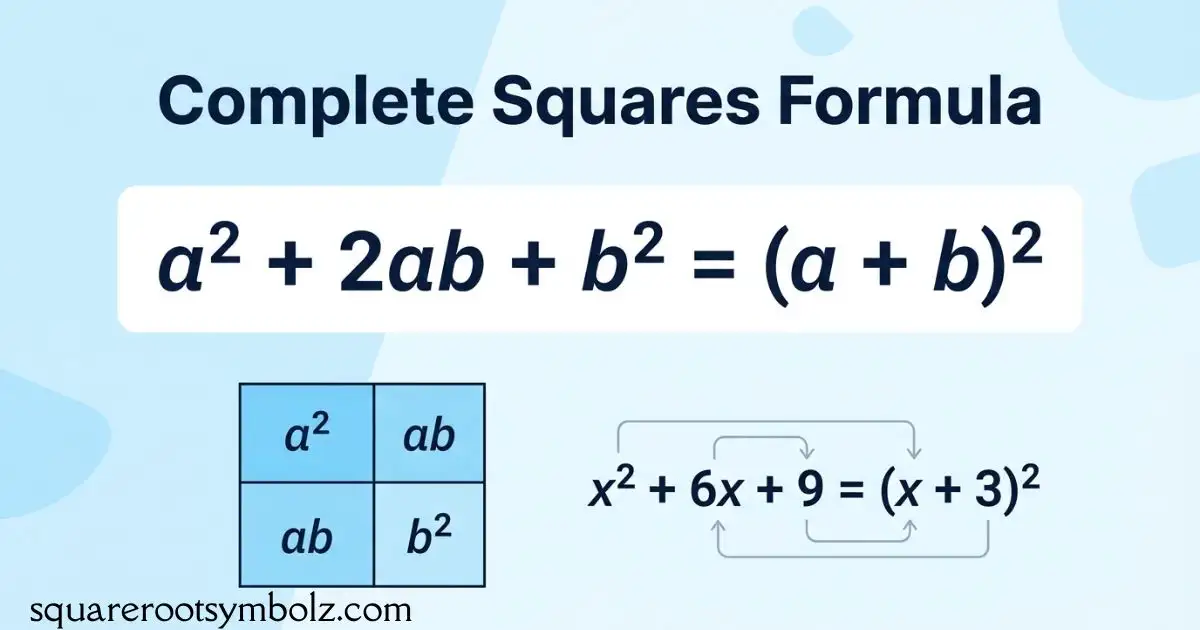
Complete squares an algebra method that rewrites a quadratic expression into a perfect-square form. For example, x² + 6x + 9 becomes (x + 3)². The method is useful because a squared binomial can be easier to solve, compare, or interpret than an expanded quadratic expression.
The central rule is to take half the coefficient of x and square it. For x² + 6x, half of 6 is 3, and 3² is 9. Adding 9 produces x² + 6x + 9, which factors into (x + 3)². The method works with positive and negative middle coefficients.

Complete-square formula
x² + bx + (b/2)² = (x + b/2)²
For a quadratic expression whose x² coefficient is 1
What is meant by a complete or exact square ?
A complete or exact square is an expression that can be written as one squared term, such as (x + 4)² or (x − 2)². Expanding these gives x² + 8x + 16 and x² − 4x + 4, respectively. The middle and constant terms fit a specific pattern.
This is different from simply having a quadratic expression with three terms. For example, x² + 5x + 6 is not a perfect-square trinomial because it does not equal the square of a binomial. Completing the square adds or rearranges terms to create that exact structure while preserving equivalence.
| Perfect-square form | Expanded form |
| (x + 1)² | x² + 2x + 1 |
| (x + 3)² | x² + 6x + 9 |
| (x − 2)² | x² − 4x + 4 |
| (x − 5)² | x² − 10x + 25 |
Keeping the Balance
When completing the square in an equation, you must preserve equality. If you add a number to the left side, add the same number to the right side. This balance is what makes the transformed equation equivalent to the original one.
Consider x² + 6x = 7. Half of 6 is 3, and squaring it gives 9. Add 9 to both sides: x² + 6x + 9 = 16. The left side becomes (x + 3)², giving (x + 3)² = 16. From here, the equation can be solved using square roots.
A Shortcut Approach
A shortcut is to compare the expression with the desired form (x + d)² + e. Expanding that form gives x² + 2dx + d² + e. Matching coefficients lets you identify d and e without separately adding and subtracting a term.
For example, compare x² + 6x + 7 with x² + 2dx + d² + e. Since 2d = 6, d = 3. Then d² + e = 7, so 9 + e = 7 and e = −2. Therefore, x² + 6x + 7 = (x + 3)² − 2.
Completing the square using algebra tiles
Algebra tiles offer a visual way to understand why a number must be added. Think of x² as a large square with side length x. The term 4x can be represented by four rectangles, each with area x. Arranging two rectangles along each side leaves a small open corner.
That missing corner has side lengths 2 and 2, so its area is 4. Adding a small 2-by-2 square fills the gap and forms a larger square with side length x + 2. This visual model explains why x² + 4x + 4 equals (x + 2)².
Visual idea
Start with x² + 4x. Split 4x into two equal rectangles of area 2x, place them along two sides of the x-by-x square, and fill the remaining 2-by-2 corner with area 4.
x² + 4x + 4 = (x + 2)²
Solving General Quadratic Equations by Completing the Square
A general quadratic equation has the form ax² + bx + c = 0, where a is not zero. If a is not 1, divide every term by a before completing the square. This creates a leading coefficient of 1, making the half-the-middle-coefficient rule easier to apply.
For example, solve 2x² + 8x + 6 = 0. Divide by 2 to get x² + 4x + 3 = 0. Move the constant: x² + 4x = −3. Add 4 to both sides: (x + 2)² = 1. Taking square roots gives x + 2 = ±1, so x = −1 or x = −3.
Steps
The completing-the-square method follows a consistent sequence. First, rearrange the equation so the constant is on the opposite side. Next, make the coefficient of x² equal to 1, then take half the coefficient of x and square it. Add that value to both sides and rewrite the trinomial as a squared binomial.
After forming the square, isolate the squared expression if necessary. Take the square root of both sides, remembering the positive and negative possibilities. Finally, solve for the variable and check the solutions in the original equation. Keeping each transformation on a separate line makes sign errors easier to catch.
Quick step checklist
- Move the constant term to the other side.
- Make the coefficient of x² equal to 1.
- Take half the coefficient of x and square it.
- Add that value to both sides.
- Rewrite the trinomial as a squared binomial.
- Use square roots to solve for x.
Examples
Worked examples make the formula easier to use because the sign and coefficient changes become visible. Start with an expression whose leading coefficient is 1, then move to a full equation. In each case, identify the middle coefficient before calculating the term needed to form a perfect square.
Example 1: Complete the square for x² + 8x.
Half of 8 is 4. Squaring gives 16.
x² + 8x + 16 = (x + 4)²
Example 2: Complete the square for x² − 10x + 3.
Half of −10 is −5. Squaring gives 25.
x² − 10x + 25 − 25 + 3 = (x − 5)² − 22
Example 3: Solve x² + 6x + 5 = 0.
Move the constant: x² + 6x = −5. Add 9 to both sides:
x² + 6x + 9 = 4
(x + 3)² = 4
x + 3 = ±2
x = −1 or x = −5
Completing the square with a couple more examples
The number added to x² + bx is always (b/2)². For x² + 6x, this number is 9. For x² − 8x, it is 16. Squaring the half makes the added value nonnegative, even when the original middle coefficient is negative.
Example 1: Find n so x² + 12x + n is a perfect-square trinomial.
n = (12/2)² = 6² = 36
Therefore, x² + 12x + 36 = (x + 6)².
Example 2: Find n so x² − 14x + n is a perfect-square trinomial.
n = (−14/2)² = (−7)² = 49
Therefore, x² − 14x + 49 = (x − 7)².
The minimum value of a quadratic function
Completing the square can reveal the minimum or maximum of a quadratic function. In vertex form, y = a(x − h)² + k, the vertex is (h, k). If a is positive, the parabola opens upward and k is its minimum value. If a is negative, it opens downward and k is its maximum value.
For example, y = x² + 6x + 5 becomes y = (x + 3)² − 4. Since a square cannot be less than zero, the smallest value of (x + 3)² is zero. The function therefore has a minimum value of −4 when x = −3.
Why “Complete the Square”?
Completing the square is useful because it changes a quadratic into a form that exposes information hidden in the expanded expression. It can solve equations, identify a parabola’s vertex, and help derive the quadratic formula. It is another tool alongside factoring and the quadratic formula, not a replacement for every method.

For some equations, factoring is faster. For others, completing the square is more revealing, especially when the quadratic does not factor neatly or when a problem asks for vertex form. Learning the method gives you flexibility: you can choose an approach based on the structure and goal of the problem.
Conclusion
Complete squares is a phrase often used when discussing the algebraic method of completing the square. The central idea is to turn a quadratic expression into a perfect-square form by taking half the coefficient of x, squaring it, and using that value to complete the expression.
For example, x² + 6x + 5 becomes (x + 3)² − 4. Once you understand this pattern, you can solve quadratic equations, identify the vertex of a parabola, and work with quadratic functions more confidently. Practice with positive and negative coefficients to make the process feel natural.
FAQ Section
What does complete squares mean in math?
“Complete squares” usually refers to completing the square, an algebra method that rewrites a quadratic expression as a squared binomial plus or minus a constant.
What is the formula for completing the square?
For an expression with a leading coefficient of 1, use:
x² + bx + (b/2)² = (x + b/2)²
The value added is half the coefficient of x, squared.
How do you complete the square step by step?
Move the constant term to the other side, make the coefficient of x² equal to 1, take half the coefficient of x and square it, then add that value to both sides. Rewrite the trinomial as a squared binomial and solve if needed.
Why do you add half the coefficient of x squared?
A perfect-square trinomial follows the pattern x² + 2px + p² = (x + p)². Since the middle coefficient is 2p, p is half that coefficient. Squaring p gives the constant term needed to form the binomial square.
Can you complete the square when the coefficient of x² is not 1?
Yes. Divide the entire equation by the coefficient of x² first, provided it is nonzero. Then use the standard completing-the-square process.
What is the difference between a perfect-square trinomial and completing the square?
A perfect-square trinomial is an expression such as x² + 6x + 9 that already equals (x + 3)². Completing the square is the process of adding or rearranging terms to create that form.
When should you use completing the square?
Use it to solve quadratic equations, rewrite quadratic functions in vertex form, find a maximum or minimum value, or derive the quadratic formula. Factoring may be quicker for some equations, so the best method depends on the problem.
Is completing the square the same as factoring?
No. Factoring expresses a polynomial as a product of factors. Completing the square rewrites a quadratic using a squared binomial and a constant. Both methods can help solve quadratic equations, but they work differently.

I’m the creator of SquareRootSymbolz.com, where I publish easy-to-understand guides on symbols, Unicode characters, Alt codes, keyboard shortcuts, and copy-and-paste text symbols. My goal is to provide accurate, well-researched, and user-friendly content that helps readers quickly find the information they need.