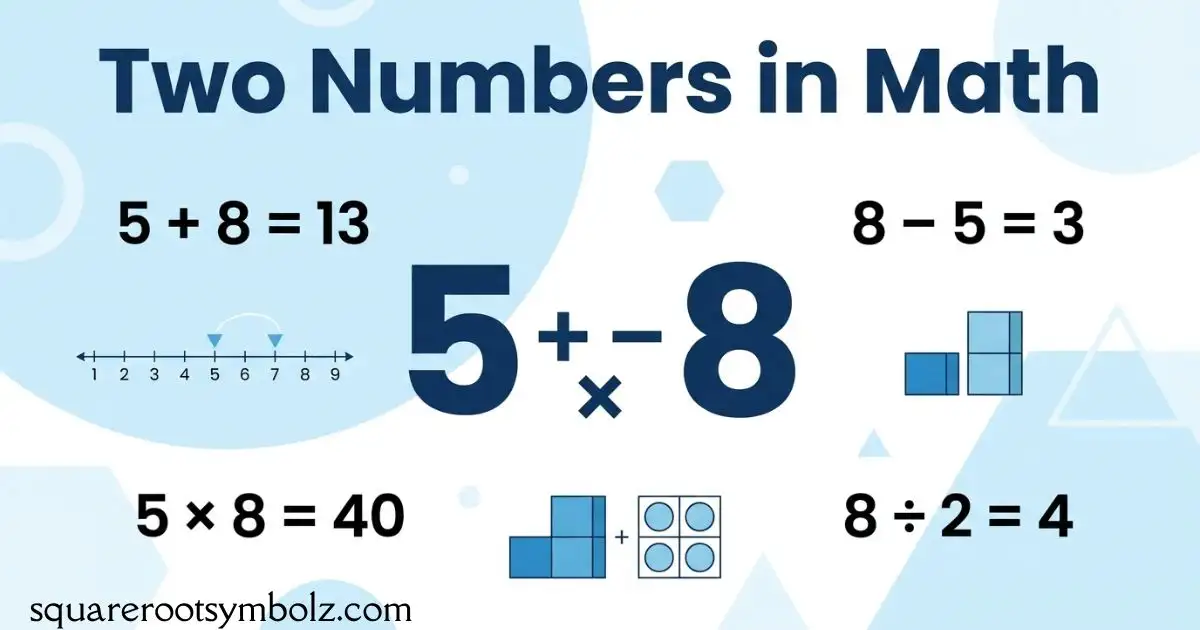
Learn how to find two numbers using their sum, difference, or product, with simple formulas, clear examples, and easy algebra steps.
Two-number problems are mathematical questions in which clues describe a relationship between two unknown values. You might know their sum, difference, product, or how much larger one number is than the other. Algebra turns those clues into equations, making it easier to find values that satisfy every condition.
For example, suppose two numbers add up to 20, and one is 4 greater than the other. Let the smaller number be x. The larger number is x + 4, so x + (x + 4) = 20. Solving gives x = 8, meaning the numbers are 8 and 12.
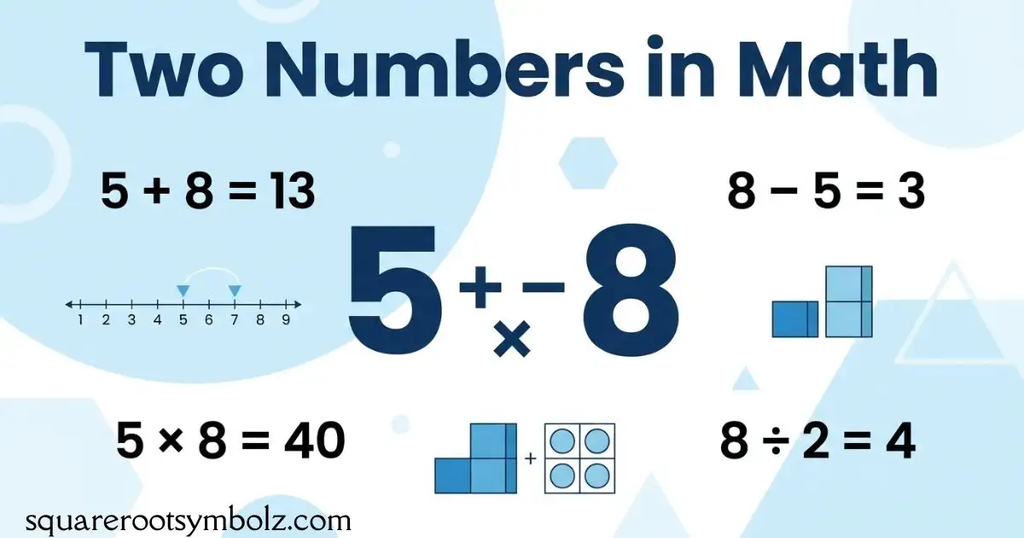
A reliable approach is to identify the unknowns, translate the clues, solve the equation or system, and check the answer against the original question. OpenStax uses a similar problem-solving process for number word problems.
What is the sum and difference problem?
A sum-and-difference problem asks you to find two numbers when you know their total and how far apart they are. The sum is the result of addition, while the difference is the result of subtracting the smaller number from the larger one. Together, these conditions can determine both values.
Suppose the sum is 30 and the positive difference is 10. The larger number is (30 + 10) ÷ 2 = 20. The smaller number is (30 − 10) ÷ 2 = 10. Checking confirms that 20 + 10 = 30 and 20 − 10 = 10.
How to use this calculator
A sum-and-difference calculator can save time when you already know the total and the gap between two numbers. Enter the sum and the nonnegative difference, then calculate the larger and smaller values. This is especially useful for checking homework or confirming a result from an algebra problem.
For example, enter a sum of 42 and a difference of 8. The larger number is (42 + 8) ÷ 2 = 25, and the smaller number is (42 − 8) ÷ 2 = 17. The calculator’s results should satisfy both original conditions when checked.
The formula explained
Let the larger number be a and the smaller number be b. If their sum is S and their positive difference is D, the relationships are a + b = S and a − b = D. Adding the equations eliminates b, while subtracting them eliminates a.
The resulting formulas are:
- Larger number = (S + D) ÷ 2
- Smaller number = (S − D) ÷ 2
For example, if S = 50 and D = 14, the larger number is 32 and the smaller is 18. These formulas work for real numbers when the inputs are consistent; they do not guarantee that the answers will be whole numbers.
Worked example
Imagine a math question says that two numbers have a sum of 58, and the larger number is 4 more than the smaller one. The phrase “4 more” gives the relationship between the values. Instead of guessing pairs, represent the smaller number with a variable and express the larger number using it.
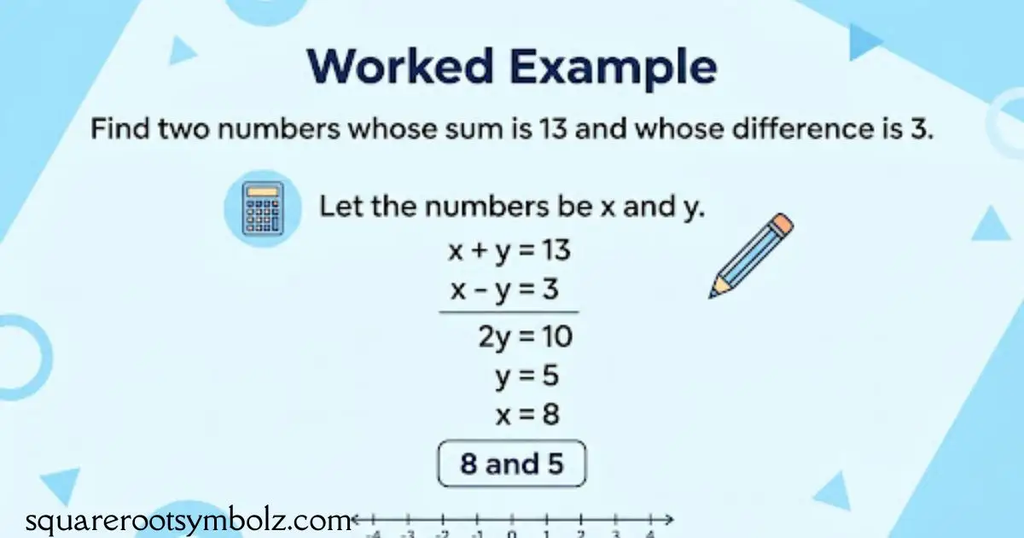
Let the smaller number be x. The larger number is x + 4.
x + (x + 4) = 58 2x + 4 = 58 2x = 54 x = 27
The larger number is 27 + 4 = 31. Therefore, the two numbers are 27 and 31. Check: 27 + 31 = 58, and 31 − 27 = 4. Both conditions are true. This variable-based method is also used in algebra word-problem lessons.
Conclusion
Two numbers can be found by understanding the relationship between them. When a problem gives a sum and a difference, formulas or algebraic equations can identify the values. When the relationship involves a product, a ratio, or consecutive integers, a different equation may be needed.
The most important habit is to translate the problem carefully and check the final values against every condition. With practice, two-number word problems become easier to recognize, organize, and solve.
FAQs
How do you find two numbers when their sum is known?
A sum alone usually does not identify a unique pair. For example, a sum of 10 could come from 2 and 8, 3 and 7, or 4 and 6. You need another condition, such as their difference or product, to determine a specific pair.
How do you find two numbers when their sum and difference are known?
Use these formulas:
- Larger number = (sum + difference) ÷ 2
- Smaller number = (sum − difference) ÷ 2
For a sum of 24 and a difference of 6, the numbers are 15 and 9.
What are two consecutive numbers?
Two consecutive integers are integers that follow one another, such as 6 and 7 or 20 and 21. If the first number is n, the next consecutive integer is n + 1.
How do you find two numbers when their product is known?
A product alone generally allows multiple pairs. For example, a product of 24 can come from 3 and 8 or 4 and 6. Additional information, such as the sum or difference, is needed to select a particular pair.
What is the formula for the sum of two numbers?
If the numbers are a and b, their sum is:
Sum = a + b
For example, if a = 12 and b = 7, their sum is 19.
Can two numbers have the same sum and difference?
Yes. If the difference is zero, both numbers are equal. For example, two numbers with a sum of 18 and a difference of 0 are 9 and 9.
How do you solve two-number problems using algebra?
Assign a variable to one number, express the other number using the relationship described in the problem, and write an equation. Solve the equation, find both values, and check that they satisfy the original conditions.

I’m the creator of SquareRootSymbolz.com, where I publish easy-to-understand guides on symbols, Unicode characters, Alt codes, keyboard shortcuts, and copy-and-paste text symbols. My goal is to provide accurate, well-researched, and user-friendly content that helps readers quickly find the information they need.