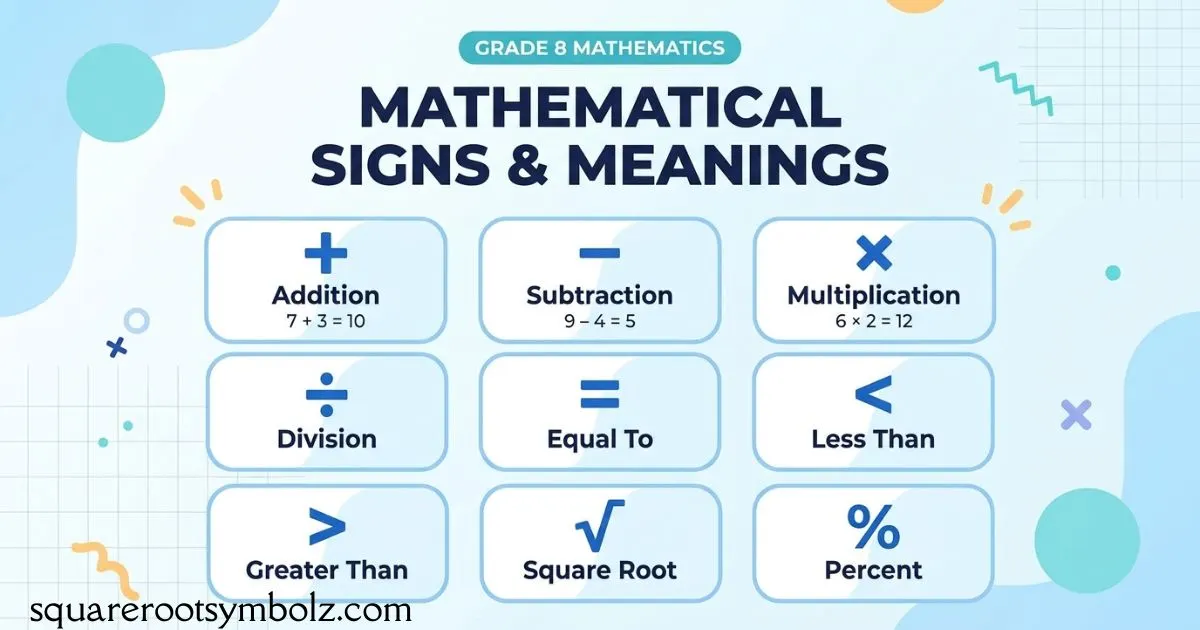
Mathematical signs and meanings explain how numbers, quantities, and expressions relate to one another. Symbols such as plus (+), minus (−), equals (=), and less than (less-than sign) represent arithmetic operations, comparisons, and mathematical relationships. Learning these signs makes equations, fractions, algebra, and geometry easier to understand.
If you’ve ever looked at a math problem and wondered what a symbol means, you’re not alone. A clear mathematical symbols chart can turn confusing notation into understandable steps. This guide explains common math signs, their names, meanings, and examples, from basic arithmetic to square roots, powers, and other notation used in school and everyday calculations.
Meanings of All Math Symbols
Mathematical signs are shorthand for operations, values, and relationships. The plus sign combines quantities, the minus sign indicates subtraction or a negative value, and the equals sign states that two expressions have the same value. Other notation communicates comparisons, approximation, grouping, and special mathematical ideas.
A symbol’s meaning also depends on the expression around it. For example, the minus sign in 8 − 3 tells you to subtract, while the minus sign in −3 identifies a negative number. Reading symbols in context is more useful than memorizing isolated names.
All Math Symbols and Their Meanings
The following chart brings together common math symbols, their names, meanings, and examples. It is designed as a quick reference for students, parents, and anyone reviewing mathematical notation. Some symbols have different meanings across subjects, so always consider the surrounding equation or the convention used in your class.
| Symbol | Name | Meaning | Example |
| + | Plus sign | Addition or positive value | 4 + 3 = 7 |
| − | Minus sign | Subtraction or negative value | 9 − 5 = 4 |
| × | Multiplication sign | Multiply | 6 × 2 = 12 |
| ÷ | Division sign | Divide | 12 ÷ 3 = 4 |
| / | Slash | Division or fraction | 10/2 = 5 |
| = | Equals sign | Same value | 3 + 2 = 5 |
| ≠ | Not equal sign | Different values | 4 ≠ 7 |
| < | Less-than sign | Smaller than | 2 < 6 |
| > | Greater-than sign | Larger than | 9 > 3 |
| ≤ | Less than or equal to | Smaller or equal | x ≤ 8 |
| ≥ | Greater than or equal to | Larger or equal | y ≥ 4 |
| ≈ | Approximately equal | Close in value | π ≈ 3.14 |
| ± | Plus-minus sign | Positive or negative alternatives | x = ±3 |
| % | Percent sign | Per hundred | 25% |
| √ | Square root | Principal square root | √25 = 5 |
| ∛ | Cube root | Number whose cube gives the value | ∛8 = 2 |
| ² | Squared | Multiply a number by itself | 5² = 25 |
| ³ | Cubed | Multiply a number three times | 2³ = 8 |
| π | Pi | Circle constant | C = 2πr |
| ∞ | Infinity | Unboundedness | x → ∞ |
| ! | Factorial | Product of positive integers down to 1 | 4! = 24 |
| ∴ | Therefore | Indicates a conclusion | x = 5, ∴ x + 1 = 6 |
| ∵ | Because | Indicates a reason | ∵ 2 + 2 = 4 |
| ( ) | Parentheses | Grouping | 2 × (3 + 4) |
| [ ] | Brackets | Grouping or organization | [2 + 3] × 4 |
| Braces | Grouping or set notation | 123 | |
| ∑ | Summation | Add a sequence of terms | ∑ from 1 to 3 of n = 6 |
| ∫ | Integral | Integration | ∫ x dx |
| Δ | Delta | Change or difference | Δx = 5 − 2 |
| ∈ | Element of | Belongs to a set | 3 ∈ 3 |
| ∉ | Not an element of | Does not belong to a set | 4 ∉ 3 |
| ∪ | Union | Elements in either set | A ∪ B |
| ∩ | Intersection | Elements shared by sets | A ∩ B |
| ∅ | Empty set | Set with no elements | A = ∅ |
| ∀ | For all | Universal quantifier | ∀x |
| ∃ | There exists | Existential quantifier | ∃x |
| ⇒ | Implies | Logical implication | P ⇒ Q |
| ⇔ | If and only if | Logical equivalence | P ⇔ Q |
| ⊥ | Perpendicular | Lines meet at a right angle | AB ⊥ CD |
| ∥ | Parallel | Lines do not intersect in a plane | AB ∥ CD |
| ∠ | Angle | An angle in geometry | ∠ABC |
| ° | Degree | Angle measurement unit | 90° |
| ≅ | Congruent | Same shape and size | △ABC ≅ △DEF |
| ∼ | Similar to | Same shape, proportional dimensions | △ABC ∼ △DEF |
| ∝ | Proportional to | Changes in proportion | y ∝ x |
| x | Absolute value | |−4| = 4 |
This chart covers common school and introductory college notation rather than every symbol used in advanced mathematics. For example, calculus, linear algebra, and mathematical logic each have additional specialized notation.
What Are Mathematical Symbols and Their Meanings?
A mathematical symbol is a character or notation that represents a number, operation, relationship, or concept. Instead of writing a full sentence, mathematics uses compact signs to express an idea clearly. For example, 7 × 4 = 28 communicates a multiplication statement in a short, recognizable form.
Symbols connect different areas of mathematics. Variables such as x and y represent values, operators such as + and × describe actions, and relation signs such as = and ≤ express conditions. Together, they form mathematical expressions, equations, inequalities, and formulas used in arithmetic, algebra, and geometry.
Mathematical Signs and Meanings: The Four Operations
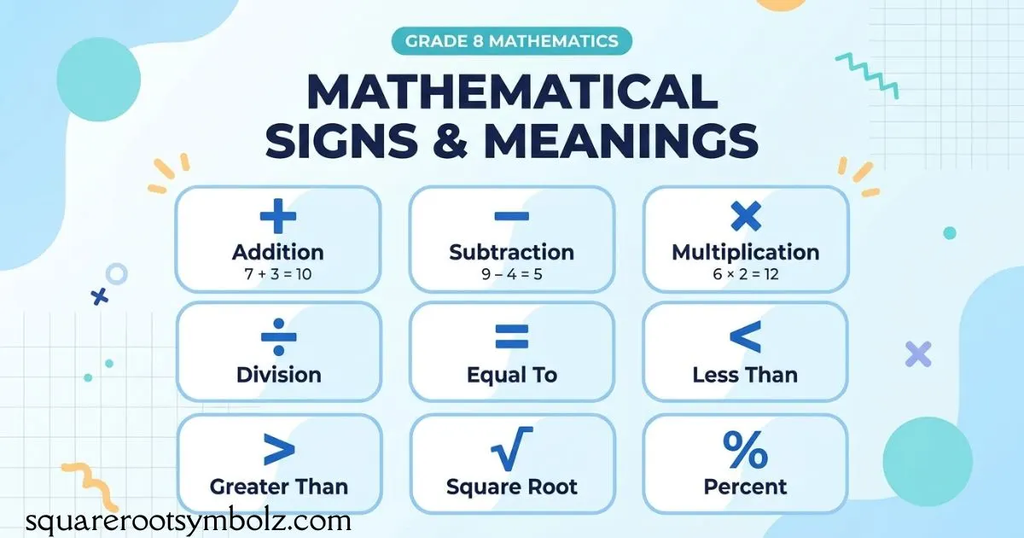
The four basic arithmetic operations are addition, subtraction, multiplication, and division. Their symbols appear in elementary arithmetic, fractions, algebra, and practical calculations. Understanding the difference between an operation and a number’s sign is important: a plus or minus can describe a value as well as an operation.
| Operation | Symbol | Example | Result |
| Addition | + | 8 + 5 | 13 |
| Subtraction | − | 8 − 5 | 3 |
| Multiplication | × | 8 × 5 | 40 |
| Division | ÷ | 40 ÷ 5 | 8 |
Consider a simple shopping example. If a notebook costs $4 and a pen costs $2, addition gives the total: $4 + $2 = $6. If you pay with a $10 bill, subtraction gives your change: $10 − $6 = $4. These signs turn everyday quantities into clear calculations.
Mathematical Signs and Meanings: Greater Than and Lesser Than
The greater-than sign (>) and less-than sign ( 4 means nine is greater than four, while 3 < 7 means three is less than seven. These comparison symbols are common in arithmetic, algebra, and number-line problems.
The signs ≤ and ≥ include equality as an option. For example, x ≤ 10 means x can be 10 or any smaller value, while y ≥ 5 means y can be 5 or greater. This distinction matters when solving inequalities, reading ranges, or interpreting conditions in word problems.
| Symbol | Read as | Example | Meaning |
| < | Less than | 4 < 8 | 4 is smaller |
| > | Greater than | 8 > 4 | 8 is larger |
| ≤ | Less than or equal to | x ≤ 6 | x is 6 or less |
| ≥ | Greater than or equal to | x ≥ 6 | x is 6 or more |
A helpful memory trick is to imagine the comparison sign as an open mouth facing the larger value. It can help beginners remember the direction, but the mathematical meaning is the relationship between the values not the shape of the symbol.
Mathematical Signs and Meanings: Squares and Square Roots
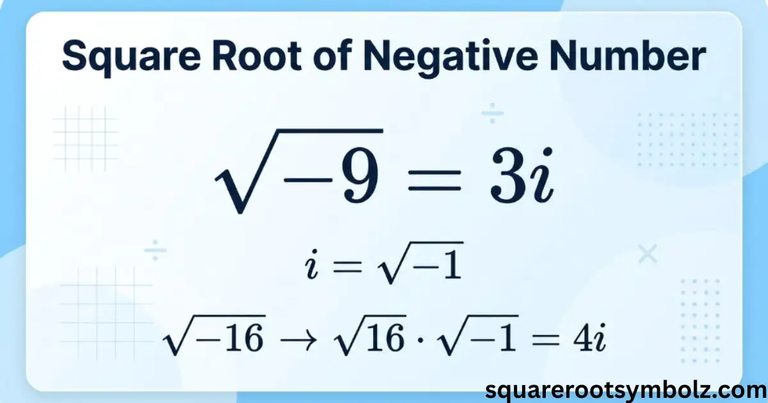
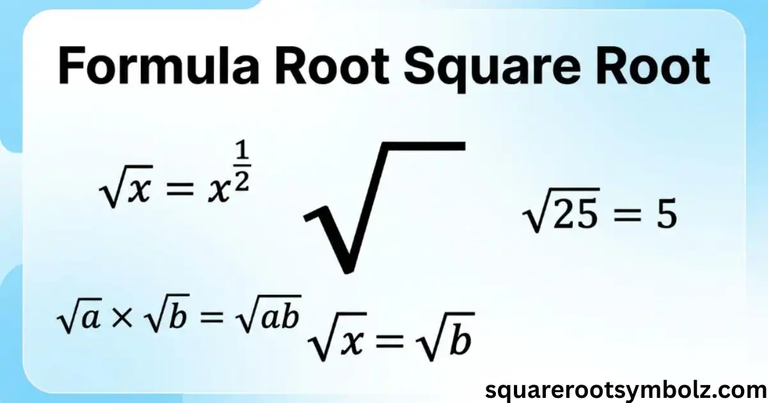
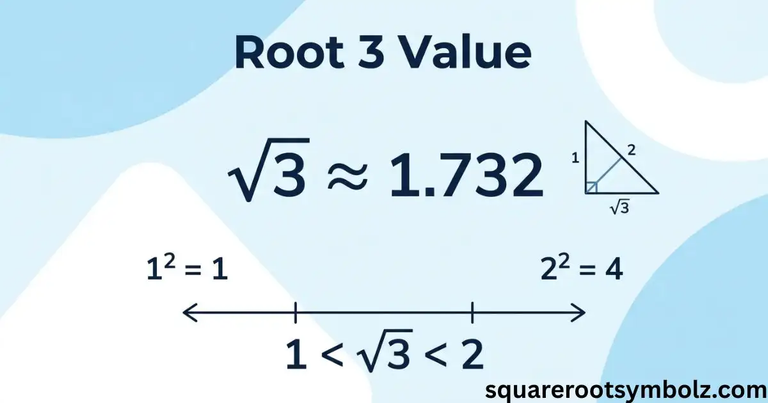
A squared number is multiplied by itself. The small raised 2 in 6² means 6 × 6, which equals 36. The square root symbol (√) represents the principal nonnegative root for nonnegative real numbers: √36 = 6. These symbols are connected, but they describe inverse operations.
Square roots appear in geometry, algebra, and measurement. If a square has an area of 49 square units, its side length is √49 = 7 units. Remember that solving an equation such as x² = 49 gives two real solutions, x = 7 and x = −7, even though √49 itself equals 7.
| Notation | Name | Meaning | Example |
| 4² | Four squared | 4 multiplied by 4 | 16 |
| 3³ | Three cubed | 3 multiplied by itself three times | 27 |
| √16 | Square root of 16 | Principal root | 4 |
| ∛27 | Cube root of 27 | Number cubed to make 27 | 3 |
| x² | x squared | x multiplied by x | x × x |
One common mistake is treating √x and the solutions to x² = a as exactly the same thing. The radical symbol denotes the principal square root in standard real-number notation. An equation involving a squared variable may have both a positive and a negative solution.
Common Math Symbols and Meaning
Beyond arithmetic and roots, many symbols help describe geometry, sets, logic, and advanced operations. The pi symbol (π) represents a constant used in circle calculations. Infinity (∞) describes unbounded behavior, while summation (∑) provides a compact way to indicate that multiple terms should be added.
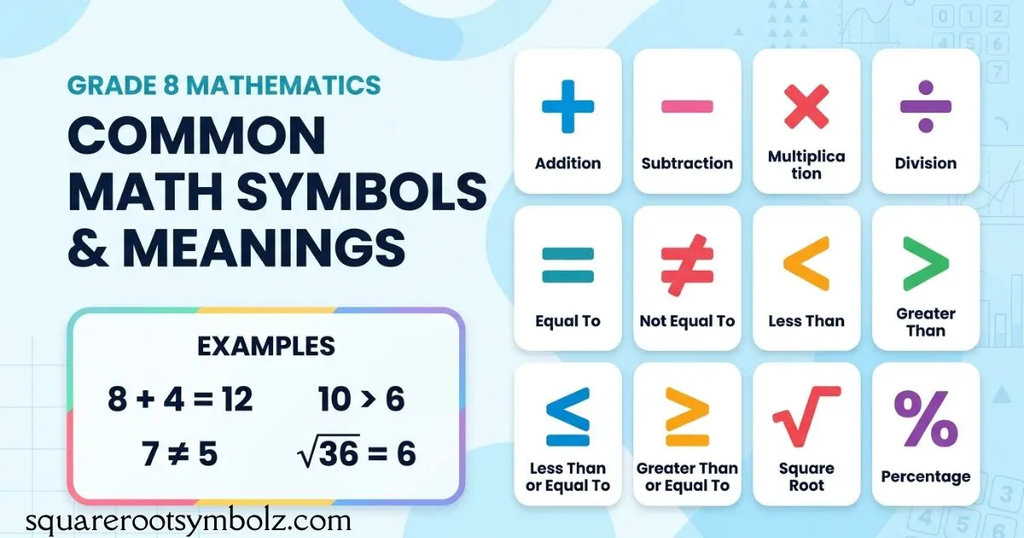
In geometry, ∠ marks an angle, ⊥ indicates perpendicular lines, and ∥ represents parallel lines. In set notation, ∈ means that an element belongs to a set. In logic, ∀ means “for all,” while ∃ means “there exists.” The same character may have specialized meanings in different contexts.
| Symbol | Name | Common meaning | Example |
| π | Pi | Circle constant | A = πr² |
| ∞ | Infinity | Unbounded quantity or behavior | x → ∞ |
| Δ | Delta | Change or difference | Δy |
| ∑ | Summation | Sum of terms | ∑xᵢ |
| ∫ | Integral sign | Integration | ∫ f(x) dx |
| ∈ | Element of | Membership in a set | 2 ∈ A |
| ∪ | Union | Combine set elements | A ∪ B |
| ∩ | Intersection | Shared set elements | A ∩ B |
| ∀ | For all | Every element or case | ∀x |
| ∃ | There exists | At least one object or case | ∃x |
| ∠ | Angle | Geometric angle | ∠ABC |
| ⊥ | Perpendicular | Right-angle relationship | l ⊥ m |
| ∥ | Parallel | Parallel relationship | l ∥ m |
For example, the formula A = πr² gives the area of a circle when r is its radius. The symbols each have a specific role: A represents area, π is the circle constant, r is the radius, and the raised 2 means the radius is squared.
Conclusion
Understanding mathematical signs and meanings makes it easier to read equations, compare numbers, and solve problems with confidence. From basic arithmetic signs such as +, −, ×, and ÷ to symbols such as √, π, ∑, and ∈, each notation communicates a specific mathematical idea.
The key is to learn symbols through examples and context instead of memorizing a long list without understanding it. Keep this mathematical symbols chart nearby when studying arithmetic, algebra, geometry, or more advanced topics. With regular practice, unfamiliar notation becomes easier to recognize and use.
FAQs
What are the most common mathematical signs?
The most common mathematical signs include + for addition, − for subtraction, × for multiplication, ÷ for division, = for equality, and
What are the 10 basic mathematical symbols?
Ten common mathematical symbols are + (addition), − (subtraction), × (multiplication), ÷ (division), = (equals), ≠ (not equal), < (less than), > (greater than), √ (square root), and % (percent).
What does the plus-minus symbol (±) mean?
The plus-minus symbol (±) indicates two possible values: one involving addition and another involving subtraction. For example, x = ±5 means x can equal 5 or −5.
What does the approximately equal symbol (≈) mean?
The symbol ≈ means two values are approximately equal rather than exactly equal. For example, π ≈ 3.14 is a rounded representation of pi.
What does the symbol ∝ mean in math?
The symbol ∝ means “proportional to.” For example, y ∝ x indicates that y changes in proportion to x, assuming a constant of proportionality.
What does the factorial symbol (!) mean?
The exclamation mark (!) represents factorial when used after a nonnegative integer. It means multiplying all positive integers from that number down to 1. For example, 5! = 5 × 4 × 3 × 2 × 1 = 120.

I’m the creator of SquareRootSymbolz.com, where I publish easy-to-understand guides on symbols, Unicode characters, Alt codes, keyboard shortcuts, and copy-and-paste text symbols. My goal is to provide accurate, well-researched, and user-friendly content that helps readers quickly find the information they need.