Formula root usually refers to a formula used to find a square root or the roots of an equation. For a square root, the basic relationship is y = √a, while for a quadratic equation ax² + bx + c = 0, the root formula is x = (-b ± √(b² – 4ac)) / 2a. These formulas connect roots, equations, variables, radicals, square roots, and the discriminant.
The confusing part is that “root” has more than one meaning in algebra. A square root asks which number produces a given value when squared, while a quadratic root is a value of x that makes an equation equal zero. This guide separates those ideas clearly and shows when to use each formula, with simple examples and practical checks.
Square Root Formula
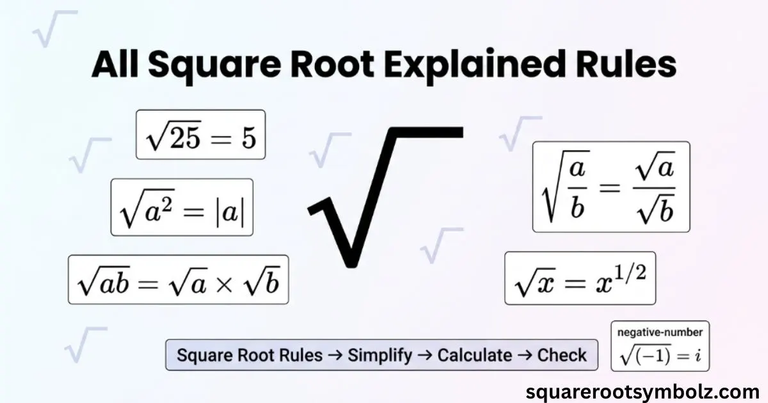
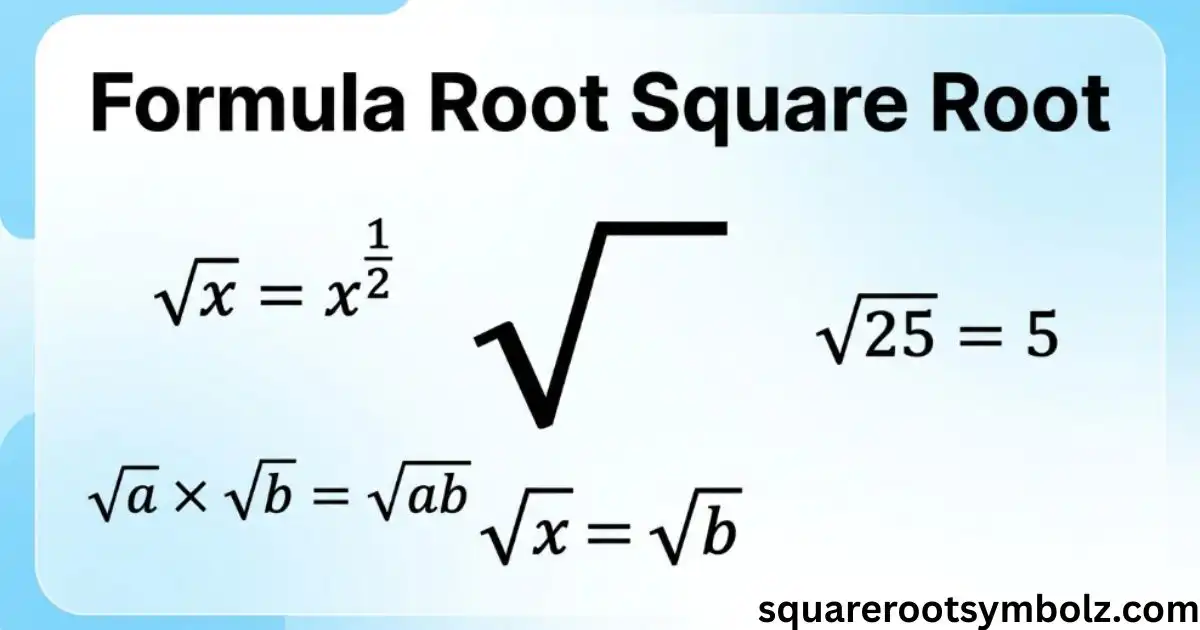
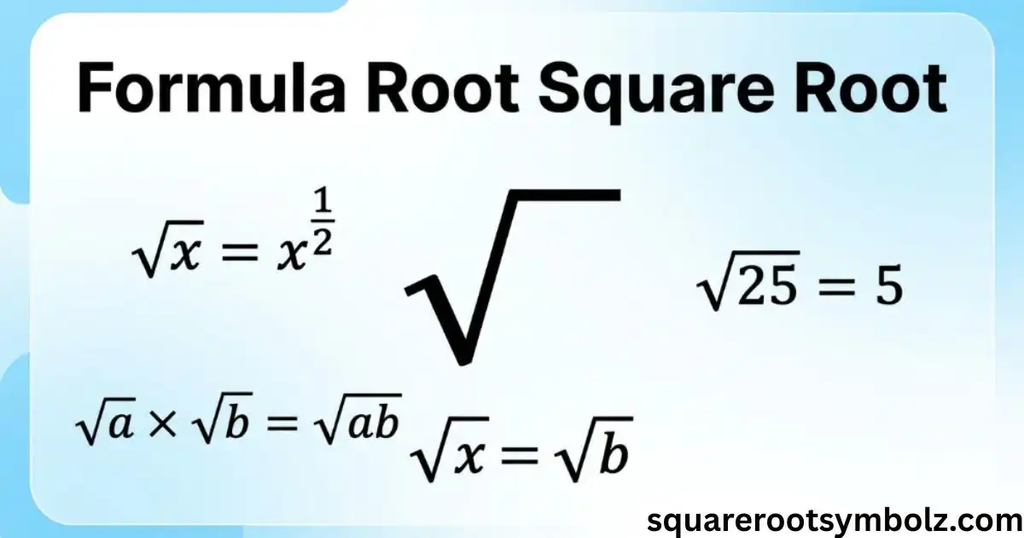
The square root formula expresses the relationship between a number and its square root as y = √a. In this relationship, a is the number under the radical, while y is its principal square root. BYJU’S gives this same basic relationship and explains that y × y = a.
For example, √25 = 5 because 5 × 5 = 25. Similarly, √49 = 7 because 7 × 7 = 49. The square root formula is therefore closely connected to squaring, perfect squares, radicals, radicands, and inverse operations.
Square root By Prime Factorization
Prime factorization works especially well when the number is a perfect square. For example, 144 can be written as 2 × 2 × 2 × 2 × 3 × 3. Pairing equal factors gives 2 × 2 × 3 = 12, so √144 = 12. This method exposes the structure behind the root.
The important idea is to group identical prime factors into pairs. Each pair contributes one factor outside the radical. This makes prime factorization useful for simplifying radicals as well as calculating exact square roots. BYJU’S includes this as one of its main square-root methods.
Finding Square Roots by Repeated Subtraction Method
The repeated-subtraction method uses consecutive odd numbers. Starting with a perfect square such as 25, subtract 1, then 3, then 5, then 7, and finally 9. The result reaches zero after five subtractions, so √25 = 5. The method works because the sum of the first n odd numbers is n².
This approach is less convenient for large numbers, but it gives students a useful visual connection between odd numbers, squares, sequences, and square roots. It also explains why perfect squares have such a recognizable numerical pattern. BYJU’S demonstrates this method using 25.
Finding Square Roots by Long Division Method
The long-division method can find square roots of numbers that are not perfect squares and can produce decimal approximations. BYJU’S demonstrates the method with √436 and reports an approximation of 20.880 to three decimal places.
This method becomes useful when estimation is not accurate enough. It is more systematic than guessing because each step produces additional decimal digits. Although calculators are faster today, learning the method can strengthen understanding of place value, approximation, division, and radicals.
Square root by Estimation Method
Estimation is useful when you need a quick approximation. To estimate √5, notice that 5 lies between 4 and 9, so √5 must lie between 2 and 3. Testing nearby decimal values then narrows the answer. √5 is approximately 2.236, which is closer to 2 than 3.
The same reasoning works for many non-perfect squares. First locate neighboring perfect squares, then test values between their roots. This gives a practical mental method for irrational numbers, decimal approximations, number lines, and square-root calculations.
How do Find Square Root of Numbers?
The first question is whether the number is a perfect square. If it is, the root may be found exactly by recognizing the square or using prime factorization. If it is not, estimation, long division, or a calculator can provide an approximation.
For example, √81 = 9 because 9² = 81. But √10 is not a whole number. Since 9 < 10 < 16, we know 3 < √10 < 4. A more accurate calculation gives √10 ≈ 3.1623.
A simple decision guide is:
| Number type | Useful method | Example |
| Perfect square | Recognition | √64 = 8 |
| Perfect square with factors | Prime factorization | √144 = 12 |
| Non-perfect square | Estimation | √5 ≈ 2.236 |
| Larger non-perfect square | Long division | √436 ≈ 20.880 |
| Quick calculation | Calculator | √73 ≈ 8.544 |
This distinction prevents a common mistake: assuming every square root must be a whole number. Many square roots are irrational decimals that continue without repeating.
Square Root of Perfect squares
A perfect square is a number that can be written as an integer multiplied by itself. Examples include 1, 4, 9, 16, 25, 36, 49, 64, 81, and 100. Their principal square roots are 1 through 10 respectively.
| Perfect square | Square root |
| 1 | 1 |
| 4 | 2 |
| 9 | 3 |
| 16 | 4 |
| 25 | 5 |
| 36 | 6 |
| 49 | 7 |
| 64 | 8 |
| 81 | 9 |
| 100 | 10 |
Remember that the symbol √ normally represents the principal nonnegative square root. Thus √25 = 5. However, the equation x² = 25 has two solutions: x = 5 and x = -5. That distinction becomes important when solving equations.
Square Root of Decimal
The same square-root concept applies to decimals. For example, because 0.3 × 0.3 = 0.09, the principal square root of 0.09 is 0.3. When solving an equation such as x² = 0.09, however, the solutions are x = ±0.3.
Decimals can sometimes be converted into fractions to make the calculation easier. For example, 0.25 = 25/100 = 1/4, so √0.25 = 1/2 = 0.5. Understanding fractions, decimal place value, and perfect squares makes decimal roots much easier.
Square Root of Negative Number
A negative number has no real square root because the square of every real number is nonnegative. For example, neither 2² nor (-2)² equals -4. In the complex-number system, however, the imaginary unit i is defined by i² = -1, allowing expressions such as √(-9) = 3i.
This creates an important connection between square roots, imaginary numbers, complex numbers, and quadratic equations. A negative value inside a square root does not simply mean the calculation has failed; it means the answer lies outside the real-number system.
Square root of Complex Numbers
Square roots can also be taken for complex numbers such as a + bi. This is more advanced than finding √25 or √49 because both a real component and an imaginary component must be considered.
For example, finding √(4 + 3i) involves assuming the result has the form x + yi, squaring it, and matching its real and imaginary parts. This creates equations for x and y. The process connects square roots with complex algebra, quadratic equations, real parts, imaginary parts, and algebraic systems.
Roots of Quadratic Equation
A root of a quadratic equation is a value of x that makes the equation equal zero. For a quadratic in standard form, ax² + bx + c = 0, the roots are the values of x that satisfy that equation. Cuemath notes that these roots are also called solutions or zeros.
For example:
x² – 7x + 10 = 0
The equation factors as:
(x – 2)(x – 5) = 0
Therefore:
x = 2 or x = 5
Both values are roots because substituting either one into the original equation produces zero.
The quadratic root formula is:
x = (-b ± √(b² – 4ac)) / 2a
This is the formula most people mean when they search for a root formula in the context of quadratic equations. GeeksforGeeks explicitly labels this relationship as the Root Formula and pairs it with the discriminant.
How to Find the Roots of Quadratic Equation?
There are several methods for finding quadratic roots, including factoring, the quadratic formula, completing the square, and graphing. Cuemath explains that factoring works when the expression can be conveniently factorized, while the quadratic formula provides a general method.
The standard quadratic equation must first be written as:
ax² + bx + c = 0
Then identify:
- a = coefficient of x²
- b = coefficient of x
- c = constant
Once these values are identified, substitute them into the quadratic root formula and simplify carefully.
Finding Roots of Quadratic Equation by Factoring
Factoring is often the fastest method when a quadratic has simple integer factors. Consider x² – 7x + 10 = 0. The expression factors as (x – 2)(x – 5) = 0. Setting each factor equal to zero produces x = 2 and x = 5.
The advantage is speed and simplicity. The limitation is that not every quadratic factors neatly using integers. When factoring becomes difficult, the quadratic formula provides a reliable alternative.
Finding Roots of Quadratic Equation by Quadratic Formula
The quadratic formula works for any quadratic equation in standard form where a is not zero. First identify a, b, and c, substitute them into x = (-b ± √(b² – 4ac)) / 2a, and simplify. Cuemath demonstrates this method using x² – 7x + 10 = 0.
For that equation, a = 1, b = -7, and c = 10:
x = [7 ± √9] / 2
x = [7 ± 3] / 2
So the roots are:
x = 5 and x = 2
The ± symbol is essential because it produces the two possible roots.
Finding Roots of Quadratic Equation by Completing Square
Completing the square rewrites a quadratic into a form where a squared expression can be isolated. Once the equation has the form (x – h)² = k, take the square root of both sides and remember the ± sign.
For example, if (x – 7/2)² = 9/4, then x – 7/2 = ±3/2. Solving the two resulting equations gives x = 5 and x = 2. This method also explains how the quadratic formula itself can be derived.
Finding Roots of Quadratic Equation by Graphing
Graphing provides a visual way to identify real roots. When a quadratic function is graphed, its roots correspond to the x-intercepts. For x² – 7x + 10, the graph crosses the x-axis at x = 2 and x = 5.
Graphing is excellent for visual understanding, but it has a limitation: complex roots cannot be seen as ordinary x-intercepts on a real coordinate graph. For exact algebraic answers, factoring or the quadratic formula is usually more useful.
Nature of Roots of Quadratic Equation
The discriminant determines the nature of the roots of a quadratic equation:
D = b² – 4ac
Its value tells you whether the roots are real, repeated, or complex. This is one of the most useful features of the quadratic root formula because the discriminant appears directly underneath the square-root symbol.
| Discriminant | Nature of roots |
| D > 0 | Two distinct real roots |
| D = 0 | One repeated real root |
| D < 0 | Two complex roots |
This lets you predict the type of answer before completing the entire calculation.
Nature of Roots When D > 0
When D > 0, the square root of the discriminant is a positive real number. The ± in the quadratic formula therefore produces two different real values of x. The equation has two distinct real roots.
For example, if D = 25, then √D = 5. The formula contains -b + 5 and -b – 5, producing two different results as long as the denominator is nonzero.
Nature of Roots When D < 0
When D < 0, the discriminant is negative, so its square root is not a real number. Instead, the roots are complex. Cuemath explains that complex roots occur in pairs for quadratic equations with real coefficients.
For example, if D = -16, then √D = 4i. The quadratic formula therefore produces two complex conjugate roots. This is where the topics of negative square roots, imaginary numbers, complex numbers, and quadratic equations meet.
Nature of Roots When D = 0
When D = 0, the square-root portion of the quadratic formula becomes zero. The two expressions created by the ± symbol therefore become identical. The equation has one real repeated root, equal to -b / 2a.
Geometrically, this means the corresponding parabola touches the x-axis at exactly one point. Algebraically, the same root appears twice. This is often called a repeated root or equal roots.
Important Formulas
The most useful formulas connected with roots include the square-root relationship and the quadratic root formula. For a square root, y = √a means y² = a. For a quadratic equation ax² + bx + c = 0, the roots are x = (-b ± √(b² – 4ac)) / 2a.
The quadratic discriminant is:
D = b² – 4ac
For roots r₁ and r₂, two additional relationships are:
r₁ + r₂ = -b/a
r₁ × r₂ = c/a
These formulas are especially useful for checking answers without calculating every root individually. Cuemath derives the sum and product relationships directly from the quadratic formula.
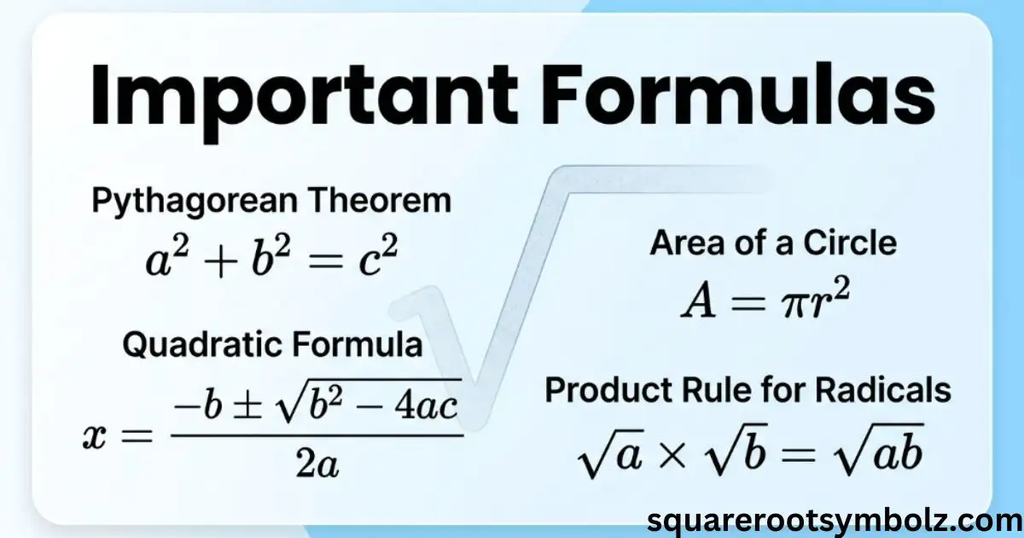
A quick reference:
| Concept | Formula |
| Square root | y = √a |
| Quadratic standard form | ax² + bx + c = 0 |
| Quadratic root formula | x = (-b ± √(b² – 4ac)) / 2a |
| Discriminant | D = b² – 4ac |
| Sum of roots | r₁ + r₂ = -b/a |
| Product of roots | r₁r₂ = c/a |
The main lesson is that “formula root” is not one universal formula. The correct formula depends on whether you are finding the square root of a number or solving for the roots of an equation.
Conclusion
The phrase formula root most often points toward a formula for finding a square root or a formula for finding the roots of a quadratic equation. The square-root relationship is y = √a, while the quadratic root formula is x = (-b ± √(b² – 4ac)) / 2a.
The key is to identify the problem first. If you are finding the root of a number such as 25, use square-root methods. If you are solving an equation such as ax² + bx + c = 0, use the quadratic formula, factoring, completing the square, or graphing. The discriminant then tells you whether the quadratic has two real roots, one repeated real root, or two complex roots.
FAQ Section
What is the formula root?
The phrase can refer to a formula used to calculate a root. For square roots, a basic formula is y = √a. For quadratic equations, the root formula is x = (-b ± √(b² – 4ac)) / 2a.
What is the formula for a square root?
The basic square-root relationship is y = √a, which means y² = a. For example, √36 = 6 because 6² = 36.
What is the root formula for a quadratic equation?
For ax² + bx + c = 0, the quadratic root formula is:
x = (-b ± √(b² – 4ac)) / 2a
It can be used to find the roots of a quadratic equation when a ≠ 0.
What is the discriminant formula?
The discriminant is:
D = b² – 4ac
It determines the nature of the quadratic roots. D > 0 gives two distinct real roots, D = 0 gives a repeated real root, and D < 0 gives two complex roots.
What is the formula for the roots of ax² + bx + c = 0?
The roots are:
x = (-b ± √(b² – 4ac)) / 2a
First identify a, b, and c from the standard equation, then substitute them into the formula.
How do you find a square root without a calculator?
You can use several methods, including prime factorization, repeated subtraction, long division, and estimation. The best method depends on whether the number is a perfect square.
What happens when the discriminant is zero?
When D = 0, the quadratic equation has one real repeated root. Its value is -b / 2a.
What happens when the discriminant is negative?
A negative discriminant produces complex roots rather than real roots. The square root of the negative discriminant introduces the imaginary unit i.
What is the difference between a square root and a quadratic root?
A square root reverses squaring, such as √25 = 5. A quadratic root is a value of x that makes a quadratic equation equal zero, such as x = 2 or x = 5 for x² – 7x + 10 = 0.
Can a quadratic equation have two roots?
Yes. A quadratic equation can have two distinct real roots, two complex roots, or one repeated real root, depending on its discriminant.

I’m the creator of SquareRootSymbolz.com, where I publish easy-to-understand guides on symbols, Unicode characters, Alt codes, keyboard shortcuts, and copy-and-paste text symbols. My goal is to provide accurate, well-researched, and user-friendly content that helps readers quickly find the information they need.