
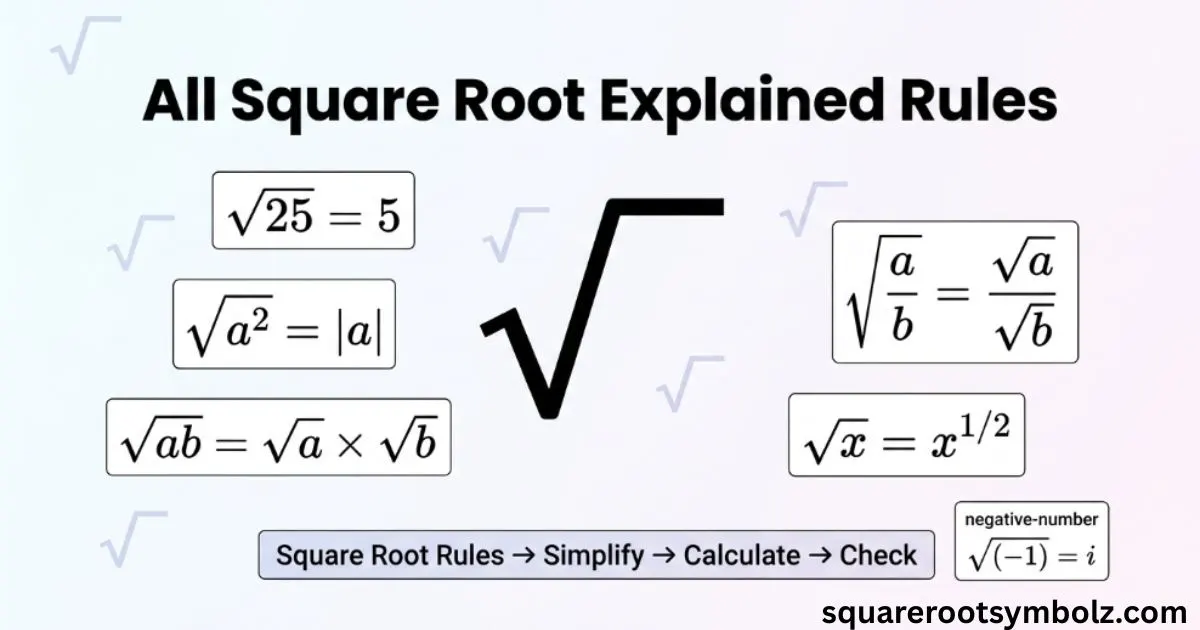
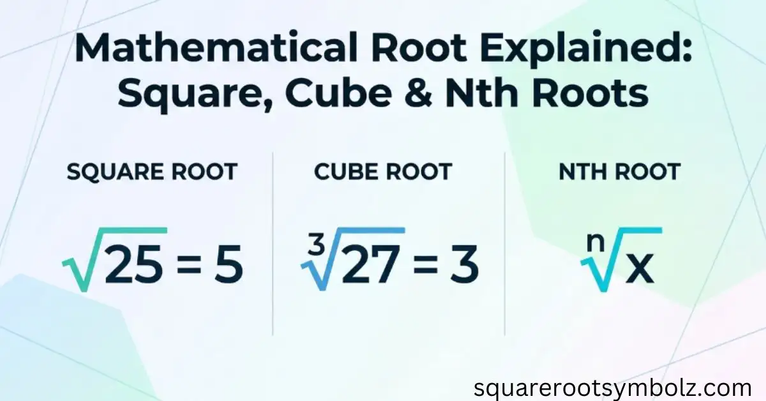
If you’re looking for all square root basics in one place, the key idea is simple: a square root is the number that produces a given value when multiplied by itself. For example, √25 = 5 because 5 × 5 = 25. Once you understand perfect squares, radical notation, and the difference between a principal root and equation solutions, the topic becomes much easier.
After years of explaining elementary and algebra-level mathematics, one mistake appears again and again: students memorize answers without understanding where they come from. This guide connects square roots, integer values, irrational numbers, estimation, and real-world geometry so you can recognize the pattern instead of relying on guesswork.
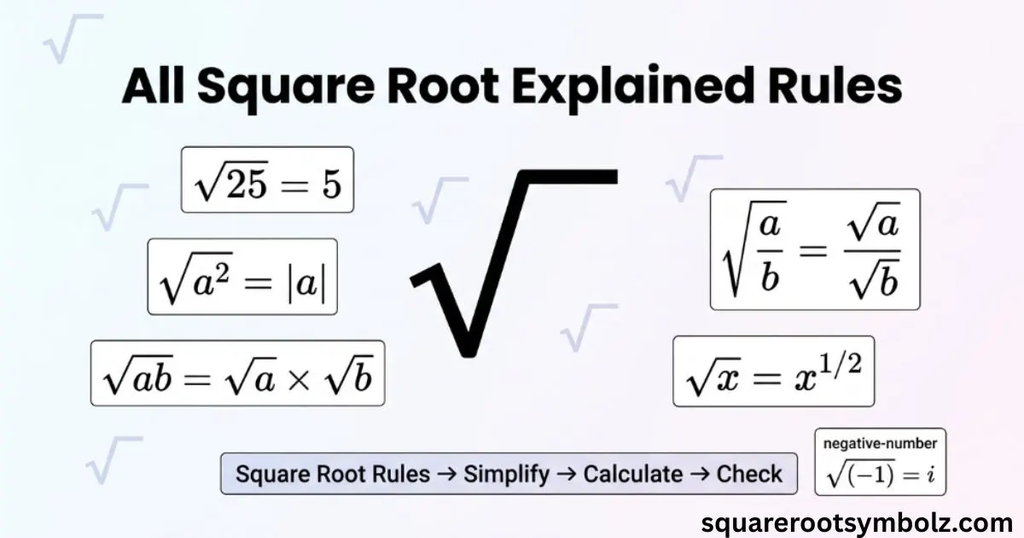
Square Roots
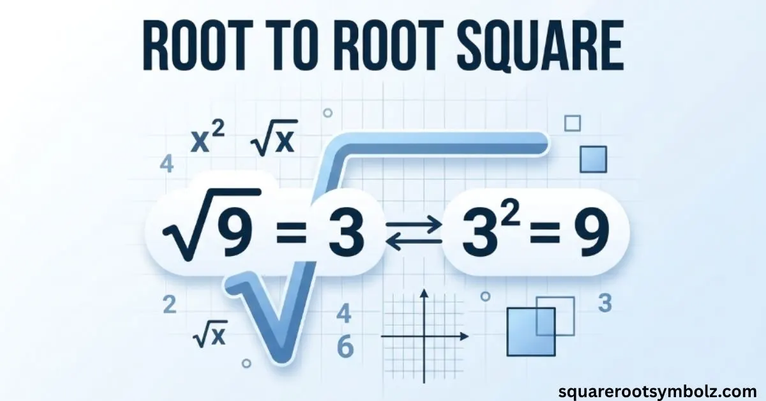
A square root reverses the operation of squaring. If 6² = 36, then 6 is a square root of 36. In symbols, √36 = 6. The radical sign √ tells you to find the principal square root, which is the nonnegative value.
The idea becomes easier when you ask one question: “What number multiplied by itself gives the number underneath the radical?” For √49, the answer is 7 because 7 × 7 = 49. This simple connection between squaring, multiplication, and radicals forms the foundation for later algebra.
What Is a Square Root?
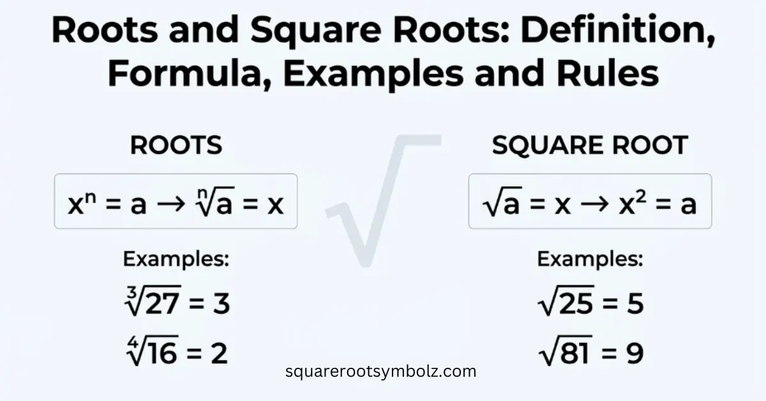
A square root is a number that, when multiplied by itself, produces the original number. In general, if a² = b, then a is a square root of b. For instance, 10² = 100, so 10 is a square root of 100.
There is an important distinction between the expression √100 and the equation x² = 100. The radical √100 means the principal root, 10. But solving x² = 100 gives two solutions: x = 10 and x = −10, because both numbers produce 100 when squared.
The Square Root Symbol
The symbol √ is called the radical sign. The number beneath or inside it is the radicand. For √64, 64 is the radicand and the expression asks for its principal square root. The radical notation provides a compact way to represent a root in arithmetic and algebra.
Perfect Squares
A perfect square is a number obtained by multiplying an integer by itself. Examples include 1, 4, 9, 16, 25, 36, 49, and 64. Their roots are whole numbers: √1 = 1, √4 = 2, √9 = 3, and √64 = 8.
Memorizing common perfect squares makes square-root problems much faster. For example, knowing that 12² = 144 immediately tells you √144 = 12. The pattern also helps you estimate a root that is not exact by locating the nearest perfect squares on either side.
| Number | Square | Square Root |
| 1 | 1 | 1 |
| 2 | 4 | 2 |
| 3 | 9 | 3 |
| 4 | 16 | 4 |
| 5 | 25 | 5 |
| 6 | 36 | 6 |
| 7 | 49 | 7 |
| 8 | 64 | 8 |
| 9 | 81 | 9 |
| 10 | 100 | 10 |
| 11 | 121 | 11 |
| 12 | 144 | 12 |
| 13 | 169 | 13 |
| 14 | 196 | 14 |
| 15 | 225 | 15 |
The sequence of perfect squares is useful beyond memorization. The difference between consecutive squares grows by odd numbers: 4 − 1 = 3, 9 − 4 = 5, 16 − 9 = 7, and 25 − 16 = 9.
Calculating Square Roots
For a perfect square, calculating the root is usually a matter of recognizing which number was multiplied by itself. For example, √81 = 9 because 9 × 9 = 81. Similarly, √121 = 11 because 11² = 121.
For a number such as √10, the answer is not a whole number. Because 3² = 9 and 4² = 16, √10 must lie between 3 and 4. Its decimal value is approximately 3.1623, so an exact radical form can be more appropriate when a decimal approximation is unnecessary.
A useful mental check is to square your answer. If you calculate √144 and get 12, check 12 × 12. Because the result is 144, the answer is confirmed. This habit catches many simple calculation mistakes before they reach the final step.
Square Roots and Negative Numbers
Negative numbers create one of the most common square-root misunderstandings. In the real number system, no real number squared produces a negative result. For example, 5² = 25 and (−5)² = 25, so neither produces −25.
However, positive numbers can have two square roots. The equation x² = 49 has solutions x = 7 and x = −7. By contrast, √49 specifically represents the principal square root, so √49 = 7 rather than −7.
| Expression | Result |
| √25 | 5 |
| Square roots of 25 | 5 and −5 |
| x² = 25 | x = ±5 |
| √49 | 7 |
| x² = 49 | x = ±7 |
| √(−25) | No real-number result |
For advanced mathematics, negative radicands can be handled using imaginary and complex numbers. But for elementary real-number square-root problems, a negative number inside an even-index radical has no real solution.
Estimating Square Roots
When a number is not a perfect square, estimation starts by finding the nearest perfect squares. For √50, notice that 7² = 49 and 8² = 64. Therefore, √50 lies between 7 and 8 and is much closer to 7. Its value is approximately 7.07.
The same strategy works with larger values. Suppose you need √80. Since 8² = 64 and 9² = 81, the answer lies between 8 and 9. Because 80 is very close to 81, its square root is close to 9; the actual value is approximately 8.94.
A practical estimation process is:
- Find the perfect square below the number.
- Find the perfect square above it.
- Identify the two corresponding roots.
- Decide which root the number is closer to.
- Refine the decimal if greater precision is required.
This approach gives you a reasonable answer even before using a calculator.
Simplifying Square Roots
Some radicals can be simplified even when their radicand is not a perfect square. The main strategy is to find a perfect-square factor. For example, 12 can be written as 4 × 3, so √12 becomes √4 × √3, which simplifies to 2√3.
Consider √18. Because 18 = 9 × 2 and √9 = 3, the expression becomes 3√2. The radical does not disappear completely because 2 is not a perfect square. This form is often more useful than its decimal approximation.
The basic pattern is:
√(ab) = √a × √b
when the quantities are suitable real-number factors. Look for the largest perfect-square factor you can remove. That usually produces the simplest radical form with the least work.
Operations with Square Roots
Square roots can be added or subtracted when their simplified radical parts match. For example, 3√5 + 2√5 = 5√5. The radical √5 behaves like a common variable, while the coefficients 3 and 2 are combined.
Unlike radicals cannot normally be combined. For example, √3 + √5 cannot be simplified into √8. The radicands are different, so the expressions remain separate. Multiplication follows a different rule: √2 × √8 = √16 = 4.
| Operation | Example | Result |
| Add like radicals | 3√5 + 2√5 | 5√5 |
| Unlike radicals | √3 + √5 | Cannot combine |
| Multiply | √2 × √8 | 4 |
| Square a root | (√7)² | 7 |
| Product property | √(4 × 9) | 6 |
One useful warning: √(a + b) is generally not equal to √a + √b. For example, √25 = 5, while √9 + √16 = 3 + 4 = 7. Recognizing this difference prevents a very common algebra error.
Connection to a square
Square roots have a direct geometric meaning. Imagine a square with an area of 25 square units. To determine the length of one side, ask which number multiplied by itself equals 25. The answer is 5, so each side measures 5 units.
This connection makes the concept less abstract. If a square garden covers 144 square feet, its side length is √144 = 12 feet. Once you know the side, you can calculate the perimeter as 4 × 12 = 48 feet. Square roots therefore reverse an area calculation to recover a length.
The same idea appears in geometry when finding unknown sides. The Pythagorean theorem, for example, can lead to an equation such as c² = a² + b². Taking the square root of the result gives the missing side length.
Real-World Applications
Square roots appear whenever mathematics needs to reverse a squared measurement. In geometry, they help find side lengths, diagonals, and distances. In physics and engineering, square-root relationships can occur in formulas involving speed, time, distance, and measurement.
Consider a square floor with an area of 400 square feet. Its side length is √400 = 20 feet. In coordinate geometry, the distance between two points can also require a square root. These examples show why learning roots matters beyond classroom exercises.
Statistics provides another important connection. Standard deviation involves a square root, while finance, science, engineering, computer graphics, and data analysis also use square-root relationships. The operation may look simple, but its applications reach far beyond basic arithmetic.
Common Square Root Mistakes
A frequent error is writing √25 = ±5. The equation x² = 25 has two solutions, but the radical expression √25 refers specifically to the principal, nonnegative root. Therefore, √25 = 5.
Another mistake is assuming every square root is a whole number. √2, √10, and √50 are not perfect-square roots. Their decimal representations require approximation, while their radical forms can remain exact. Understanding this distinction helps you choose between an exact answer and a rounded decimal.
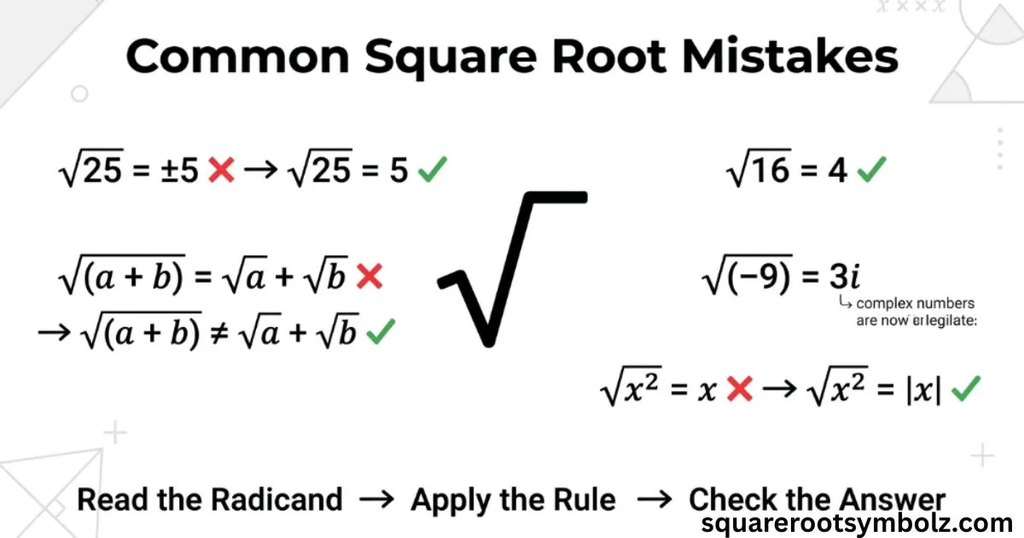
A third mistake is skipping estimation. If your calculator says √80 = 18, you should immediately question the result because 9² = 81. Estimating first gives you a powerful reasonableness check.
Conclusion
Understanding all square root concepts becomes much easier when you connect each result to squaring. A perfect square has a whole-number root, while a non-perfect square may have an irrational root that requires estimation. Remember that √a represents the principal square root, whereas an equation such as x² = a can have both positive and negative solutions.
From perfect squares and radical simplification to geometry, equations, and real-world measurements, square roots are a fundamental mathematical tool. The fastest way to improve is to recognize common squares, estimate before calculating, simplify when possible, and always check an answer by squaring it.
FAQ Section
What is a square root?
A square root is a number that produces the original number when multiplied by itself. For example, √36 = 6 because 6 × 6 = 36.
What are the square roots of 25?
The two square roots of 25 are 5 and −5, because both 5² and (−5)² equal 25. However, √25 specifically equals 5.
What is the difference between a square root and a perfect square?
A square root is the number that produces another number when squared. A perfect square is the resulting number, such as 25 in 5² = 25.
Are all square roots whole numbers?
No. Only perfect squares have whole-number square roots. Values such as √2 and √10 are irrational and have non-terminating, non-repeating decimal expansions.
Can a square root be negative?
The principal square-root symbol √ gives a nonnegative result for a nonnegative real number. However, a positive number has both a positive and negative square root when solving an equation such as x² = 25.
What is √100?
√100 = 10, because 10 × 10 = 100.
What is √50 approximately?
√50 ≈ 7.071. It lies between √49 = 7 and √64 = 8.
What is the easiest way to find a square root?
For perfect squares, recognize the corresponding multiplication fact. For non-perfect squares, locate the number between two known perfect squares and refine the estimate or use a calculator.

I’m the creator of SquareRootSymbolz.com, where I publish easy-to-understand guides on symbols, Unicode characters, Alt codes, keyboard shortcuts, and copy-and-paste text symbols. My goal is to provide accurate, well-researched, and user-friendly content that helps readers quickly find the information they need.


One Comment