Root to root in mathematics usually refers to understanding how roots connect to powers, square roots, and the original number. A square root, radical, perfect square, principal root, and exponent all describe different parts of this relationship. After working through countless root problems, the biggest confusion usually comes from one question: why can one number seem to have two roots while the √ symbol gives only one answer?
The answer becomes simple once you see roots as reverse operations. A number is squared by multiplying it by itself, while a square root works backward to find the value that produced that square. This guide explains the root to root relationship, the radical symbol, positive and negative roots, perfect squares, and practical methods for finding roots without unnecessary complexity.
Square Root
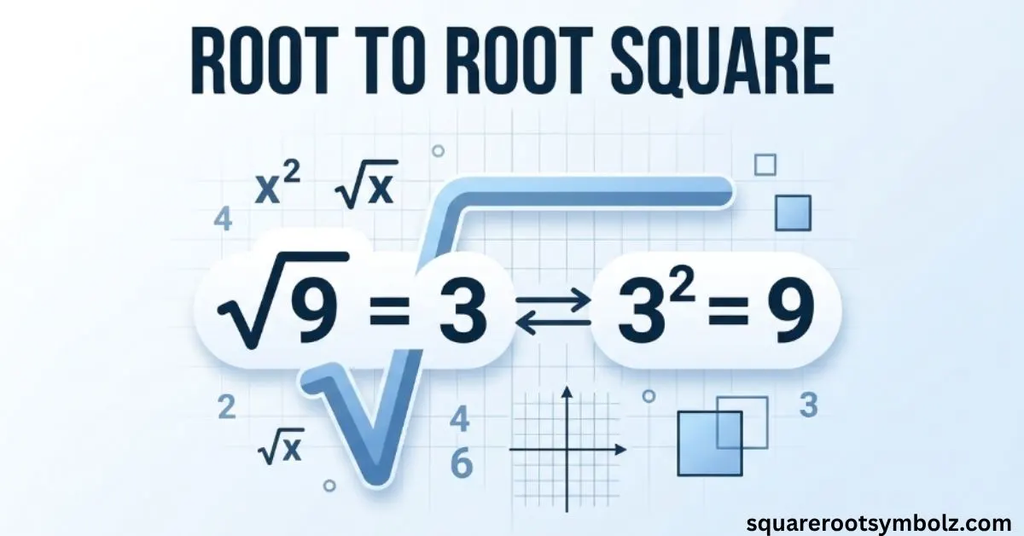
A square root is a value that, when multiplied by itself, gives the original number. For example, because 5 × 5 = 25, the square root relationship connects 5 with 25. In simple terms, a square root reverses the process of squaring.
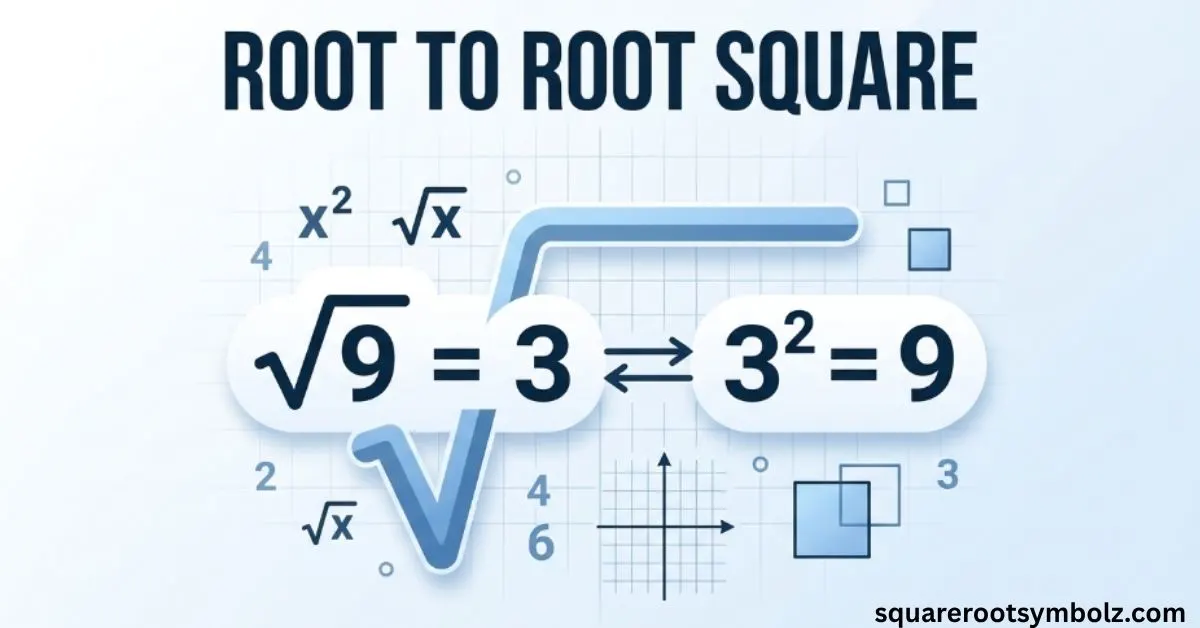
The root to root idea becomes easier when you compare both directions. Squaring starts with 5 and produces 25. Taking a square root starts with 25 and asks which value, multiplied by itself, creates that number. The two operations are closely connected.
For example:
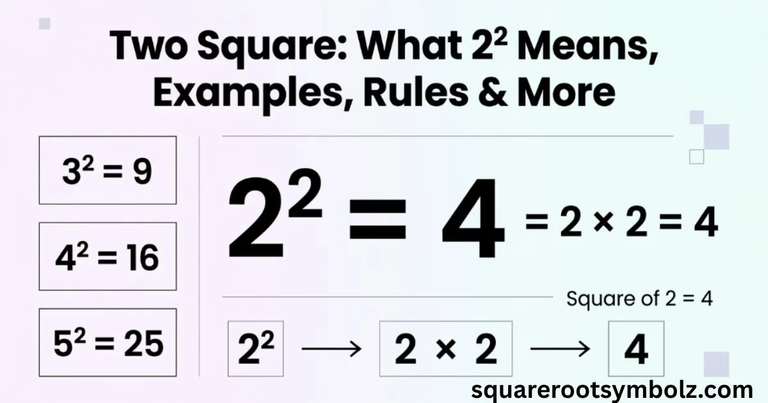
6² = 36
Therefore:
√36 = 6
A square root does not randomly produce a new number. It identifies the value connected to the original number through repeated multiplication.
Definition
The mathematical definition of a square root is precise. A number r is a square root of x when:
r² = x
This means that squaring the root returns the original value. If 4² = 16, then 4 is a square root of 16. The relationship works as an inverse connection between powers and roots.
However, one detail creates confusion. Since both 4 × 4 and −4 × −4 equal 16, both 4 and −4 are roots of the equation x² = 16. This is why roots of equations and radical notation must be understood separately.
MathsIsFun explains that a square root of a number is a value whose square equals the original number.
The Square Root Symbol
The symbol √ is called the square root symbol or radical symbol. When written before a number, it asks for the principal square root of that value. For example:
√49 = 7
The symbol provides a compact way to represent a root without writing a full sentence or equation.
The number inside the radical is called the radicand. In √64, the radicand is 64. The answer is 8 because 8 × 8 = 64. Understanding the radical, radicand, and result makes root expressions easier to read.
One important distinction is that √25 = 5, not ±5. The radical symbol specifically represents the principal, non-negative square root in standard real-number notation.
Two Square Roots
A positive number can have two numbers whose squares equal that positive value. For example:
5² = 25
and
(−5)² = 25
Therefore, the equation x² = 25 has two solutions:
x = 5 or x = −5
This is often where students get confused about the root to root relationship. The equation asks for all values that work, so both roots matter. But the radical expression √25 follows a different convention and gives the principal square root only.
We can write the two solutions together as:
x = ±5
The ± symbol means “plus or minus.” It reminds us not to lose a valid negative solution when solving an equation involving a squared variable.
Principal Square Root
The principal square root is the non-negative value represented by the radical symbol √. Although 25 has two square roots in the broader mathematical sense, √25 is defined as 5, the positive result.
This convention prevents ambiguity. If every radical automatically produced two values, equations and expressions would become harder to interpret. The principal root gives one standard output, while equation-solving can separately include positive and negative solutions.
Examples:
√9 = 3
√36 = 6
√100 = 10
But the equations:
x² = 9
x² = 36
x² = 100
have two real solutions each:
x = ±3, x = ±6, and x = ±10.
Perfect Squares
A perfect square is a number created by multiplying an integer by itself. These numbers have square roots that are whole numbers. Learning perfect squares makes root problems much faster because you can recognize common answers without a calculator.
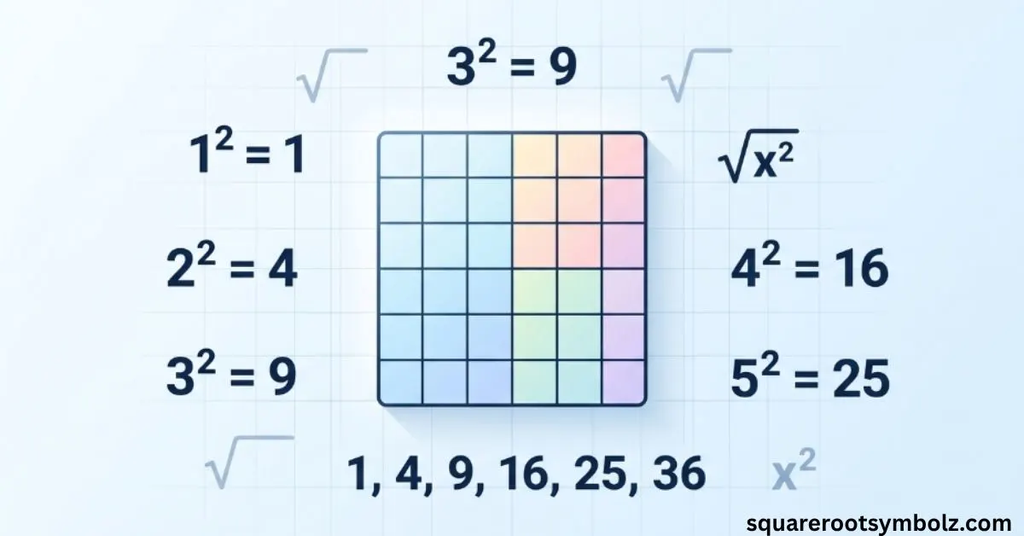
Some common perfect squares are:
| Number | Square | Square Root |
| 1 | 1² = 1 | √1 = 1 |
| 2 | 2² = 4 | √4 = 2 |
| 3 | 3² = 9 | √9 = 3 |
| 4 | 4² = 16 | √16 = 4 |
| 5 | 5² = 25 | √25 = 5 |
| 6 | 6² = 36 | √36 = 6 |
| 7 | 7² = 49 | √49 = 7 |
| 8 | 8² = 64 | √64 = 8 |
| 9 | 9² = 81 | √81 = 9 |
| 10 | 10² = 100 | √100 = 10 |
Perfect squares are useful because they provide a mental map between numbers and roots. Once you recognize 49, for example, you can immediately connect it with 7 × 7 and identify its square root.
Calculating Square Roots
The easiest square roots involve perfect squares. You simply ask which number multiplied by itself produces the given value. For √81, the answer is 9 because 9 × 9 = 81.
When the number is not a perfect square, the result may be a decimal or an irrational number. For example, √10 lies between 3 and 4 because:
3² = 9
and
4² = 16
Since 10 is closer to 9 than 16, its square root is slightly greater than 3. A calculator gives approximately:
√10 ≈ 3.162
Another useful method is prime factorization. For example:
√144 = √(2 × 2 × 2 × 2 × 3 × 3)
Pairing equal factors gives:
√144 = 2 × 2 × 3 = 12
This method becomes especially helpful when simplifying larger perfect squares.
An Exponent of a Half
A square root can also be written using a fractional exponent:
√x = x½
For example:
√25 = 25½ = 5
This notation shows the deep relationship between roots and powers. Squaring uses an exponent of 2, while taking a square root uses an exponent of ½ under the standard real-number conditions.
Similarly:
∛x = x⅓
The cube root reverses cubing, just as the square root reverses squaring. Exponent notation becomes especially useful in algebra because it allows roots and powers to be manipulated within the same mathematical system.
The root to root connection is therefore part of a larger pattern: powers move in one direction, while fractional exponents and radicals move backward to identify the original factor.
The nth Root
The nth root generalizes the idea of square roots and cube roots. The square root is the second root, while the cube root is the third root. An nth root asks which value, multiplied by itself n times, produces the original number.
For example:
√16 = 4
because:
4² = 16
And:
∛27 = 3
because:
3³ = 27
In general, if:
rⁿ = a
then r is an nth root of a.
The nth-root concept connects all roots under one mathematical rule. Square roots, cube roots, fourth roots, and higher roots are simply different versions of the same inverse relationship between multiplication and exponentiation.
Conclusion
The root to root relationship becomes much easier once you understand that roots reverse powers. A square root finds a value that produces the original number when multiplied by itself, while roots of an equation may include both positive and negative solutions.
The most important distinction is between √x, which represents the principal square root, and an equation such as x² = a, which may have two roots. Learn the common perfect squares, understand the radical symbol, and remember how roots connect with fractional exponents. Once those relationships become clear, square roots stop feeling like separate rules and start making mathematical sense.
FAQs
What does root to root mean in math?
Root to root generally refers to the relationship between roots, powers, and the values that produce an original number through repeated multiplication.
What is the square root of a number?
A square root is a value that, when multiplied by itself, gives the original number. For example, the square root of 25 is 5 because 5 × 5 = 25.
Why does a number have two square roots?
A positive number can be produced by squaring either a positive or negative number. For example, both 5² and (−5)² equal 25.
Why is √25 equal to 5 and not ±5?
The radical symbol √ represents the principal, non-negative square root. The equation x² = 25, however, has two solutions: x = 5 and x = −5.
What is the difference between a square root and a root?
A square root is specifically a second root. The broader term root can include square roots, cube roots, fourth roots, or solutions of equations.
What is the radical symbol?
The radical symbol is √. It is used to represent a square root and can also represent higher roots when an index is added, such as ∛ for a cube root.
How do you find a square root?
You can use known perfect squares, prime factorization, estimation, long-division methods, or a calculator depending on the number.
Is every square root a whole number?
No. Perfect squares have whole-number roots, but many numbers have decimal or irrational square roots. For example, √2 is approximately 1.414 and continues without repeating.

I’m the creator of SquareRootSymbolz.com, where I publish easy-to-understand guides on symbols, Unicode characters, Alt codes, keyboard shortcuts, and copy-and-paste text symbols. My goal is to provide accurate, well-researched, and user-friendly content that helps readers quickly find the information they need.