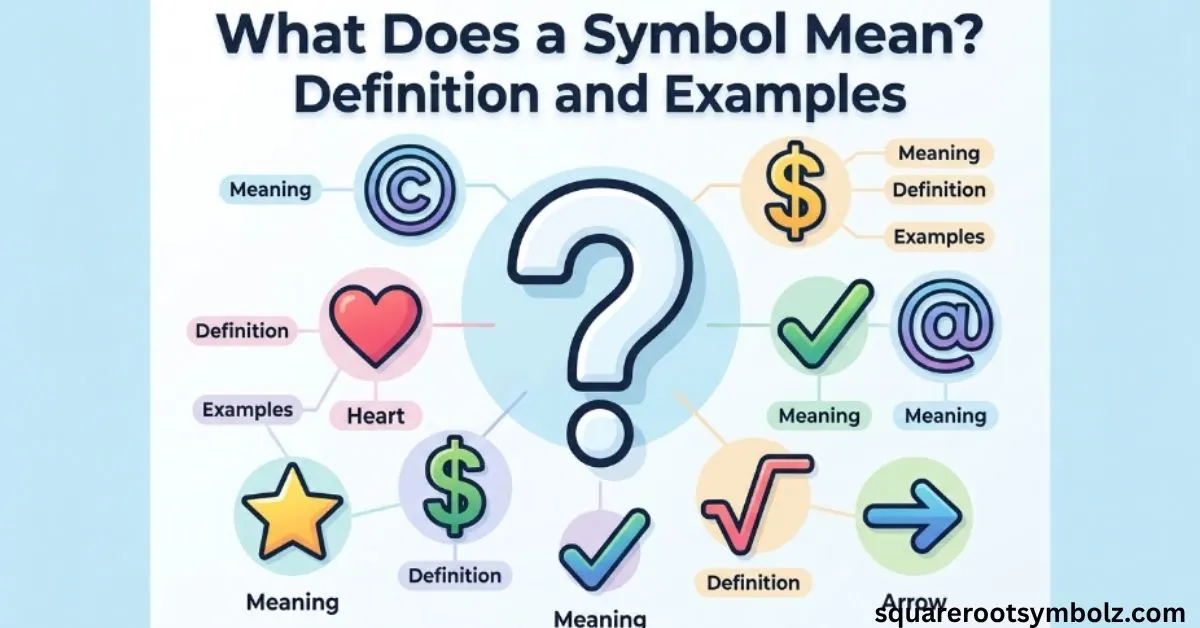
What does a symbol mean? Discover symbol meanings, symbolism, examples, types, and how context changes the message behind common signs.
A symbol mean is the idea, message, object, emotion, or concept represented by a sign, image, mark, or object. After studying symbol meanings across language, mathematics, culture, and everyday communication, one lesson stands out: a symbol rarely explains itself. Its meaning, context, representation, association, and cultural use all help people understand it.
That is why a simple heart, dove, cross, peace sign, or mathematical mark can feel confusing when you see it without context. A symbolic meaning may represent an emotion, belief, identity, warning, or deeper idea. This guide explains what symbols mean, how symbolism works, why interpretation changes, and how to understand common signs with greater confidence.
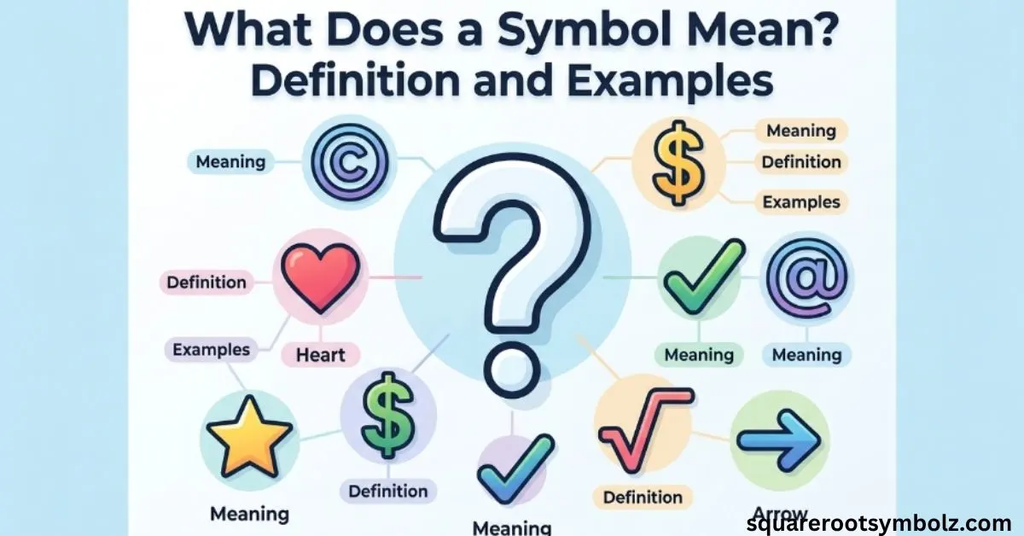
What Is Symbolism?
Symbolism is the use of something visible to represent an idea that may be abstract, emotional, cultural, or invisible. A symbol, sign, object, color, gesture, or image can therefore carry meaning beyond its literal appearance. This process allows people to communicate complex ideas quickly and powerfully.
For example, a dove is physically a bird, but it can symbolize peace, hope, or purity. The meaning comes from shared cultural associations rather than the bird’s literal identity. In the same way, a heart shape can represent love, even though a symbol does not need to resemble what it represents.
A symbol mean can also change according to the situation. The color red may suggest danger on a warning sign, love on a greeting card, or importance in another setting. Context gives the symbol its practical meaning and prevents us from assuming that every interpretation is universal.
Examples of Symbolism
One of the easiest ways to understand a symbol is to compare its literal form with its symbolic meaning. A dove is an animal, but it may represent peace. A heart is a visual shape, but it commonly represents love, affection, or emotional connection.
A skull and crossbones offers another useful example. The image may literally show a skull, yet its symbolic purpose is usually to communicate danger, poison, death, or a serious warning. The same symbol can therefore move beyond its physical appearance to deliver an immediate message.
| Symbol | Common Meaning | Context |
| ♥ | Love or affection | Relationships and communication |
| ☮ | Peace | Culture and social movements |
| 🕊 | Peace or hope | Art, religion, and culture |
| ⚠ | Warning or caution | Safety signs |
| ☠ | Danger or poison | Hazard warnings |
| ™ | Trademark claim | Business and branding |
| © | Copyright | Intellectual property |
The important lesson is that a symbol does not always have only one fixed meaning. People understand symbols through history, culture, convention, and the situation in which the sign appears.
Types of Symbolism
Symbols can be grouped according to how they communicate meaning. Some are widely understood because people repeatedly encounter them in daily life, while others belong to a particular religion, culture, profession, scientific field, or work of art.
A universal-looking symbol may communicate across many communities, while a cultural symbol depends more heavily on shared history and tradition. Personal symbols can also carry private meaning connected to memory, family, identity, or an important life experience.
Common categories include:
| Type | Main Purpose | Example |
| Cultural symbol | Represents shared traditions | National flag |
| Religious symbol | Represents faith or belief | Cross |
| Emotional symbol | Represents feelings | Heart |
| Warning symbol | Communicates risk | ⚠ |
| Mathematical symbol | Represents an operation or relationship | + or = |
| Scientific symbol | Represents a substance or concept | O for oxygen |
| Literary symbol | Suggests a deeper theme | Dove representing peace |
Symbols in mathematics, music, and science often have more standardized meanings, while artistic and cultural symbols may allow broader interpretation.
More Examples
Think about the peace sign. Its shape can function as a visual message representing peace, protest, unity, or a social movement. The exact interpretation depends on the historical and cultural setting in which people encounter it.
The Statue of Liberty provides another example of symbolic meaning. It is a physical monument, yet it has become associated with ideas such as freedom, democracy, hope, and arrival in the United States. A symbol can therefore be a real object as well as a written character or visual sign.
Even everyday technology uses symbolic communication. A magnifying glass often represents search, a trash can represents deletion, and a gear represents settings. These icons work because users learn the relationship between a visual object and a digital action.
National Geographic notes that warning signs, colors, objects, and pictograms can provide concrete representations of broader ideas and messages.
How to Use Symbolism
To understand a symbol correctly, begin by looking at where it appears. A symbolic meaning inside a poem may be different from the meaning of the same object in a road sign, logo, tattoo, religious setting, or mathematical equation.
Next, consider the surrounding words, images, and situation. If a snake appears in a story, it may represent danger, temptation, transformation, or something else entirely. The surrounding narrative helps determine which symbolic relationship is most reasonable.
When using symbolism in writing or design, choose a symbol with a meaningful connection to the idea you want to communicate. Strong symbols can make a message memorable because they allow people to connect a visible image with a deeper concept or emotional response.
However, avoid assuming that every audience interprets a symbol in the same way. Cultural background, religion, personal experience, and historical knowledge can all influence how a person understands a sign.
Related Words and Phrases
The word symbol is closely connected to several other terms, but they are not always interchangeable. Understanding these related words helps explain why a symbol mean can change between ordinary communication, literature, science, and visual design.
A sign generally communicates information, while a symbol represents something through association or convention. An icon is often a recognizable visual representation, and an emblem commonly represents an organization, group, or identity.
Other related terms include:
- Symbolism: the use of symbols to express deeper meaning
- Symbolic: relating to or functioning as a symbol
- Representation: something that stands for something else
- Emblem: a design representing a group or idea
- Icon: a widely recognized visual representation
- Sign: a mark or object that communicates information
- Metaphor: a comparison that helps explain an idea
- Motif: a repeated element carrying thematic importance
Dictionary definitions commonly describe a symbol as something that represents something else, while also recognizing symbols as letters, numbers, or marks used in specialized fields.
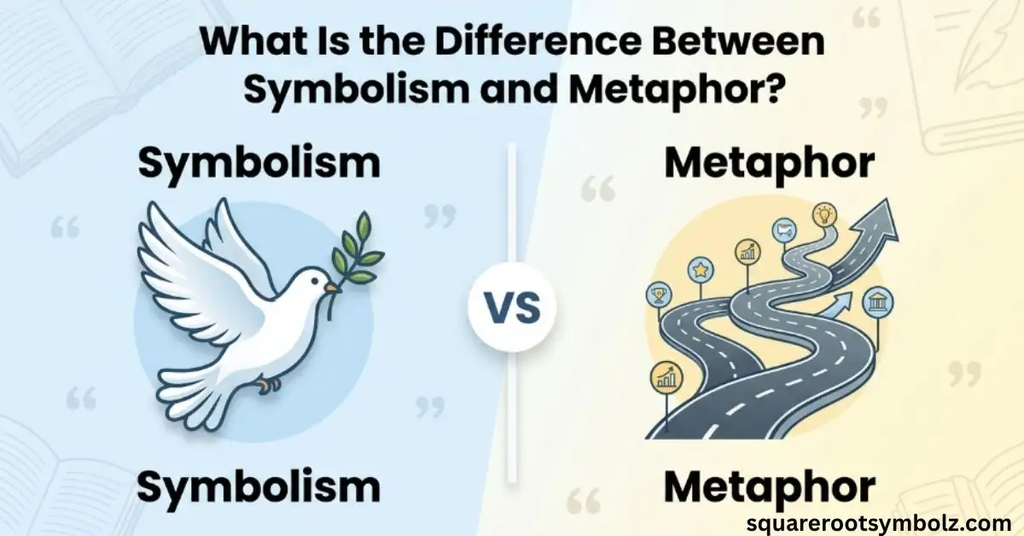
What Is the Difference Between Symbolism and Metaphor?
Symbolism uses a thing, image, action, or object to represent a broader idea. A metaphor directly compares one thing with another to create meaning. Both can communicate ideas beyond literal language, but they work in different ways.
For example, saying “Time is a thief” is a metaphor because time is directly compared with a thief. A recurring clock in a story may become a symbol of time, aging, pressure, or mortality without making a direct comparison.
Symbols often gain meaning through repetition, culture, and association. Metaphors usually gain meaning from the immediate relationship created between two ideas. A story can use both devices at the same time to create stronger emotional and thematic depth.
Frequently Asked Questions About Symbolism
People often ask what a particular symbol means because symbols can look simple while carrying several possible interpretations. The safest approach is to identify the symbol, examine its setting, and then consider its cultural, technical, historical, or personal context.
A heart symbol may communicate love in a message, identify a card suit in a game, or serve as a design element. The visible shape stays the same, but the meaning changes according to the relationship between the symbol and its environment.
The same principle applies to mathematical signs, emojis, logos, warning marks, and cultural symbols. Understanding the intended audience and context is usually the fastest way to find the correct meaning.
Conclusion
A symbol mean is ultimately the message or idea that a sign, image, object, mark, or character represents. Some symbols have widely recognized meanings, while others depend heavily on context, culture, history, and personal association. That is why the same symbol can communicate different ideas in different situations.
When you want to understand what a symbol means, do not look at the shape alone. Consider where it appears, who is using it, and what surrounding words or images tell you. Once you understand that relationship, symbols become much easier to read, interpret, and use correctly.
FAQ
What does a symbol mean?
A symbol means something that represents another idea, object, emotion, concept, or message. Its exact meaning can depend on culture, history, and context.
What is an example of a symbol?
A heart is a common symbol of love and affection. A dove may symbolize peace, while a warning sign can symbolize danger or caution.
Can a symbol have more than one meaning?
Yes. Many symbols have multiple meanings. The correct interpretation often depends on where the symbol appears and how people use it.
What is the difference between a symbol and a sign?
A sign usually communicates direct information, while a symbol often represents a broader idea through association, culture, or convention.
What is symbolism?
Symbolism is the practice of using an object, image, word, action, or sign to represent a deeper or more abstract idea.
Why do symbols mean different things in different cultures?
Symbol meanings develop through history, religion, traditions, language, and shared cultural experiences. A symbol that has one meaning in one culture may have a different interpretation elsewhere.
Are mathematical symbols also symbols?
Yes. Mathematical symbols represent operations, relationships, quantities, and concepts. For example, + represents addition and = represents equality.

I’m the creator of SquareRootSymbolz.com, where I publish easy-to-understand guides on symbols, Unicode characters, Alt codes, keyboard shortcuts, and copy-and-paste text symbols. My goal is to provide accurate, well-researched, and user-friendly content that helps readers quickly find the information they need.