A simple root is a root of a polynomial that has multiplicity 1, meaning its corresponding factor occurs only once. In algebra, you can identify one from the factored form, root multiplicity, linear factor, or derivative test. For example, in (x − 3)(x + 2), both roots are simple because each factor appears once. This small distinction becomes important when solving polynomial equations, reading graphs, using calculus, or applying numerical methods. If repeated roots have ever made a polynomial feel confusing, the key is simple: look at how many times the root’s factor occurs.
In practical algebra, a simple root satisfies p(r) = 0 while also satisfying p'(r) ≠ 0. That gives you two reliable ways to recognize the same idea: multiplicity one and a nonzero derivative at the root. A simple root normally crosses the x-axis, while an even repeated root touches the axis and turns around. These relationships connect factoring, polynomial graphs, derivatives, root-finding, and numerical analysis.
How It Works
To find a simple root, first factor the polynomial completely. Then inspect the exponent attached to each linear factor. If (x − r) appears to the first power, r has multiplicity 1 and is a simple root. If (x − r)² or a higher power appears, r is a repeated root instead.
There is an equally useful derivative test. If r is a root and p(r) = 0, calculate p'(r). When p'(r) is not zero, r is a simple root. When p'(r) equals zero, the root is not simple under the usual polynomial setting and has multiplicity greater than 1. This gives students a quick check after factoring.
The two tests are really describing the same structure from different viewpoints. Factoring tells you the multiplicity directly, while differentiation detects whether the polynomial has a nonzero slope at the root. For a simple root, the curve has a nonzero first-order term, so the graph crosses the x-axis rather than merely touching it.
A useful formula is:
Simple root condition:
p(r) = 0 and p'(r) ≠ 0
Another equivalent factor-based condition is:
p(x) = (x − r)q(x), where q(r) ≠ 0
The second expression shows why the root occurs only once. The factor (x − r) is present, but there is no additional copy hidden inside q(x). In more advanced mathematics, this same idea is generalized to differentiable functions and other algebraic settings.
| Root type | Multiplicity | Factor pattern | Derivative at root | Typical graph behavior |
| Simple root | 1 | (x − r) | p'(r) ≠ 0 | Crosses x-axis |
| Double root | 2 | (x − r)² | p'(r) = 0 | Touches and turns |
| Triple root | 3 | (x − r)³ | p'(r) = 0 | Crosses with flattening |
| Higher multiple root | 4 or more | (x − r)^m | Usually p'(r) = 0 | Depends on multiplicity |
This table also explains a common source of confusion: crossing the x-axis does not automatically prove that a root is simple. A root with multiplicity 3 can cross the axis too. What makes a root simple is specifically multiplicity 1, or equivalently p'(r) ≠ 0 in the standard differentiable setting.
Worked Example
Consider the polynomial:
p(x) = (x − 1)(x + 3)²
Set each factor equal to zero. The roots are x = 1 and x = −3. Now look at the exponents. The factor (x − 1) has exponent 1, so x = 1 is a simple root. The factor (x + 3) has exponent 2, so x = −3 is a double root, not a simple root.
The derivative provides a second check. Expanding or differentiating the factored expression gives:
p'(x) = (x + 3)² + 2(x − 1)(x + 3)
At x = 1, the derivative is 16, which is not zero. Therefore x = 1 is confirmed as a simple root. At x = −3, the derivative is zero, confirming that this root is repeated rather than simple.
Now imagine the graph. At x = 1, the curve passes through the x-axis. At x = −3, the squared factor causes the graph to touch the x-axis and turn back. This visual difference is useful, but the algebraic definition remains the final test: multiplicity 1 means simple; multiplicity greater than 1 means multiple.
Here is another quick example:
p(x) = (x − 4)(x + 1)(x − 2)²
The roots are 4, −1, and 2.
- x = 4 has multiplicity 1 → simple root
- x = −1 has multiplicity 1 → simple root
- x = 2 has multiplicity 2 → double root
So this polynomial has two simple roots and one multiple root.
A useful classroom habit is to write the factorization before deciding anything about multiplicity. If you only list the numerical solutions, you can miss repetition. The exponent in the factored polynomial contains the information you need.
Why It Matters
Simple roots matter beyond basic factoring. In numerical analysis, Newton’s method has its familiar quadratic convergence near a simple root under the usual smoothness and local assumptions. At a multiple root, the standard Newton method generally loses that quadratic behavior and becomes only linearly convergent.
This distinction also matters in partial fraction decomposition, where the structure of repeated factors changes the form of the decomposition. A factor that occurs once contributes differently from a factor raised to a higher power. Understanding multiplicity therefore prevents errors when moving from polynomial algebra into calculus.
There is also a useful graph connection. A simple root has multiplicity 1, which is odd, so the graph crosses the x-axis. But odd multiplicity alone is not enough to identify a simple root: a triple root also crosses. The exponent, not merely the crossing behavior, determines whether the root is simple.
In numerical computation, the distinction becomes even more important. Newton’s method uses the derivative in its update, so the behavior of p'(r) affects convergence. Research on multiple-root methods specifically modifies Newton-type algorithms because repeated roots behave differently from simple roots.
One terminology warning is worth remembering. In ordinary algebra, simple root means a root of multiplicity one. In Lie theory, however, a simple root has a different meaning: it is a positive root that cannot be expressed as the sum of two positive roots. These are different mathematical concepts even though they use the same words.
Common Mistakes
One common mistake is assuming that a root is simple because it appears only once in a list of answers. For example, writing “1, 2, 2” and seeing 1 once does not by itself establish multiplicity. Multiplicity belongs to the polynomial’s factorization, so the safest approach is to factor completely and inspect the exponent of each corresponding linear factor.
Another mistake is thinking that every graph crossing represents a simple root. A triple root also crosses the x-axis, although the curve is flatter near the intercept. Therefore, use the factor exponent or derivative test when you need certainty. Graphs are excellent for intuition, but multiplicity gives the precise algebraic classification.
Students also sometimes reverse the derivative test. Remember the pattern:
p(r) = 0 means r is a root.
p(r) = 0 and p'(r) ≠ 0 means r is a simple root.
p(r) = 0 and p'(r) = 0 means r is not simple in the ordinary polynomial setting.
For example, consider:
p(x) = (x − 5)²
At x = 5, p(5) = 0 and p'(5) = 0. Therefore, 5 is a double root, not a simple root.
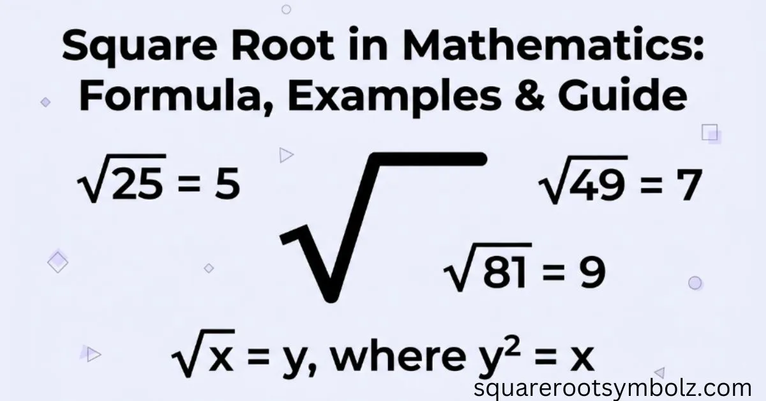
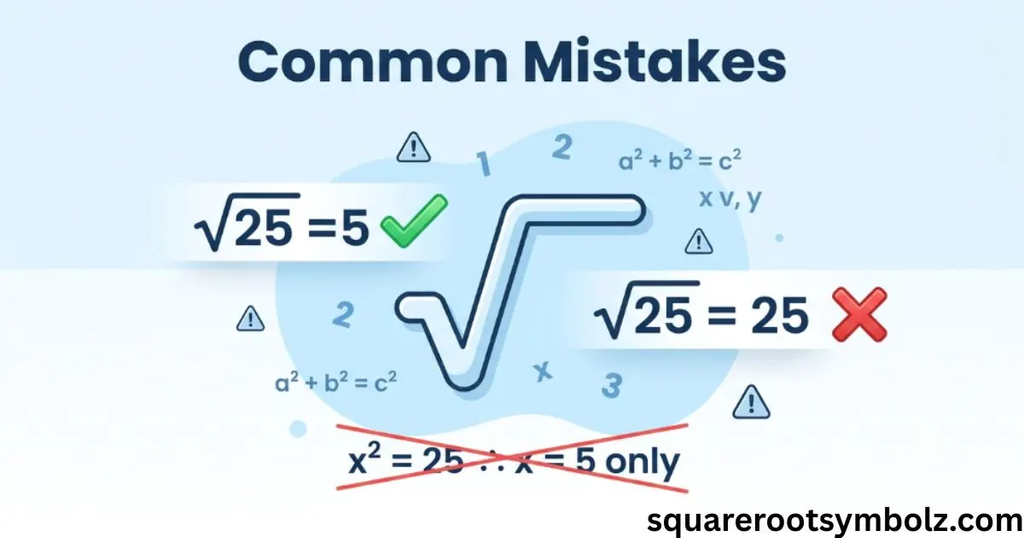
A final mistake is confusing simple root with simple square root. They are not the same expression. A simple root in polynomial algebra concerns multiplicity. A square root concerns the operation represented by the radical symbol. Keeping those concepts separate makes later topics such as polynomial roots, square roots, complex numbers, and numerical root-finding much easier to follow.
Quick reference
If you need to identify a simple root quickly, use this three-step check:
- Find the root: verify that p(r) = 0.
- Check multiplicity: see whether (x − r) occurs exactly once.
- Use the derivative if needed: verify p'(r) ≠ 0.
If all three observations agree, you have a simple root.
Conclusion
A simple root is a polynomial root with multiplicity 1. In factored form, its corresponding factor appears once. In calculus, the equivalent derivative test is p(r) = 0 with p'(r) ≠ 0. This distinction helps explain why some graphs cross the x-axis cleanly, why repeated roots behave differently, and why numerical methods such as Newton’s method treat simple and multiple roots differently. Once you learn to look at the exponent of each factor, identifying a simple root becomes a quick and reliable algebra skill.
FAQ Section
What is a simple root?
A simple root is a root of a polynomial with multiplicity 1. If r is a simple root of p(x), then p(r) = 0 and, in the standard differentiable setting, p'(r) ≠ 0.
How do you know if a root is simple?
Factor the polynomial and check the exponent of the corresponding factor. If (x − r) appears to the first power, r is a simple root. You can also verify that p'(r) ≠ 0.
Is a simple root the same as a root of multiplicity 1?
Yes. In polynomial algebra, a simple root is precisely a root whose multiplicity is 1. A root with multiplicity 2 or greater is called a multiple or repeated root.
Can a simple root be negative?
Yes. The sign of the root does not determine its multiplicity. For example, in p(x) = (x + 3)(x − 2), x = −3 and x = 2 are both simple roots because each corresponding factor occurs once.
Does a simple root always cross the x-axis?
For a real polynomial graph, a simple root crosses the x-axis. However, some multiple roots with odd multiplicity, such as triple roots, also cross the axis. Therefore, crossing alone does not prove that a root is simple.
What is the derivative test for a simple root?
For a differentiable function, a root r is simple when f(r) = 0 and f'(r) ≠ 0. For polynomial functions, this is equivalent to saying that r has multiplicity 1.
What is the difference between a simple root and a double root?
A simple root has multiplicity 1, while a double root has multiplicity 2. A factor such as (x − r) represents a simple root, whereas (x − r)² represents a double root.
Why are simple roots important in Newton’s method?
Newton’s method has its standard quadratic convergence near a simple root under appropriate smoothness and starting-point conditions. Multiple roots generally reduce the standard method’s convergence to linear, which is why modified methods are used for repeated roots.
Is “simple root” used outside polynomial algebra?
Yes. The term also appears in numerical analysis, complex analysis, algebra, and Lie theory. In Lie theory, however, a simple root has a different definition involving positive roots, so context matters.

I’m the creator of SquareRootSymbolz.com, where I publish easy-to-understand guides on symbols, Unicode characters, Alt codes, keyboard shortcuts, and copy-and-paste text symbols. My goal is to provide accurate, well-researched, and user-friendly content that helps readers quickly find the information they need.