Root mean square (RMS) is the square root of the arithmetic mean of squared values, making it a useful way to measure the overall magnitude of numbers, signals, or changing quantities. For a data set, you square every value, average those squares, and then take the square root.
If you have ever averaged positive and negative values and ended up with a number that seems misleadingly small, RMS solves that problem by removing the effect of opposite signs. The same idea appears in statistics, electrical engineering, physics, signal processing, and error analysis. In the sections below, we will build the calculation from the ground up and show why the formula works.
What is root mean square? Root mean square formula
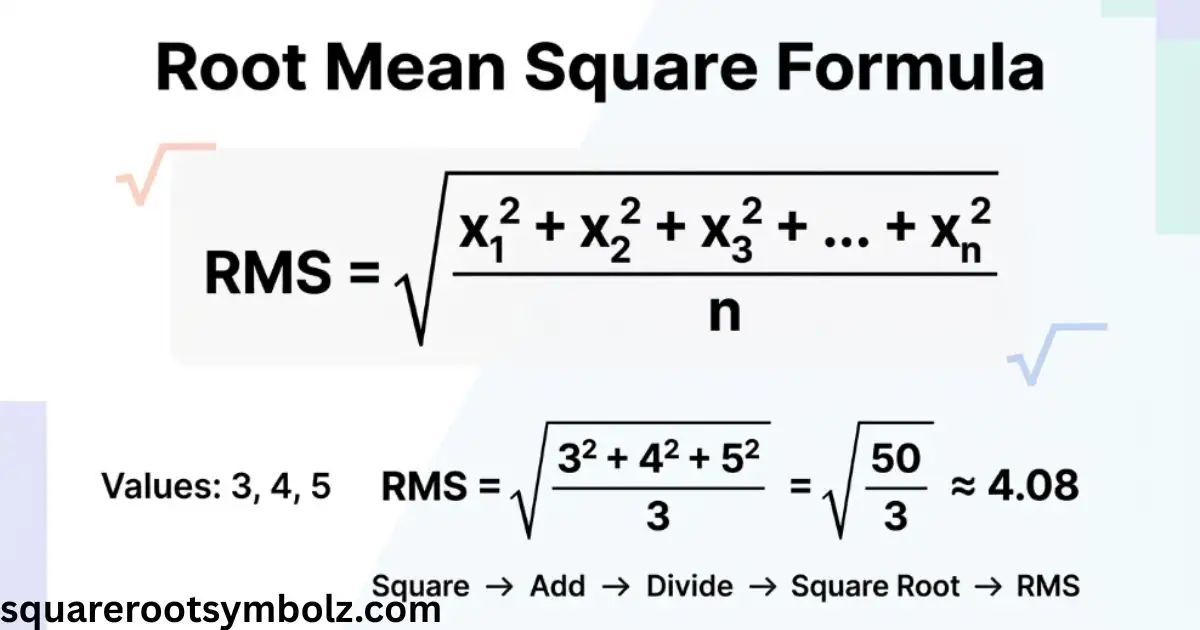
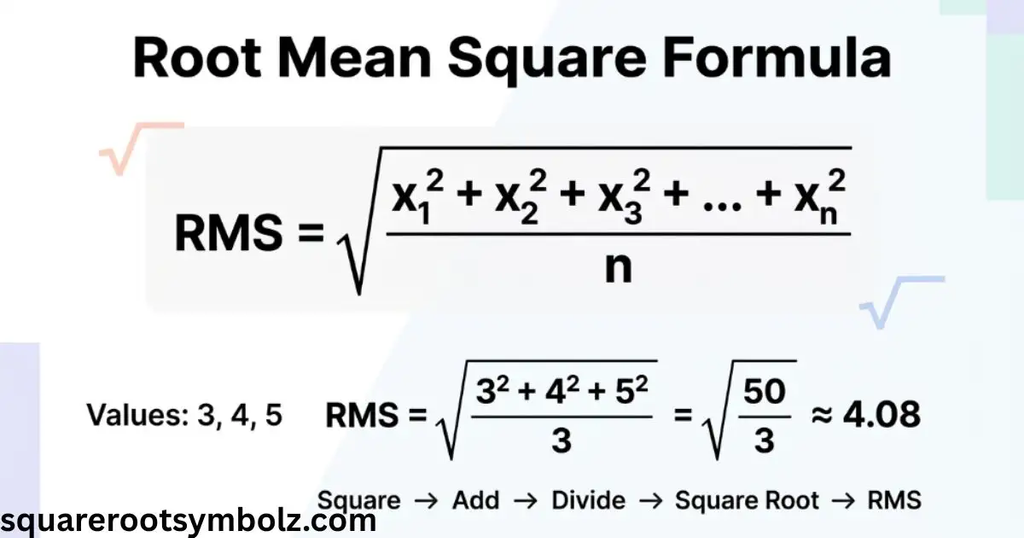
Root mean square, abbreviated RMS, is also called the quadratic mean. For n values x₁, x₂, …, xₙ, the formula is:
RMS = √[(x₁² + x₂² + … + xₙ²) / n]
In simple language, the name tells you the entire process: square, find the mean, then take the root. This standard definition is given by mathematical references including Wolfram MathWorld and the University of Cambridge’s Underground Mathematics.
Suppose the values are 3, 4, and 5. Their squares are 9, 16, and 25. The mean of those squares is 50/3, or about 16.67. Taking the square root gives approximately 4.08. Notice that RMS is not simply the ordinary average, which would be 4.
| Step | Calculation | Result |
| Original values | 3, 4, 5 | — |
| Square values | 9, 16, 25 | — |
| Add squares | 9 + 16 + 25 | 50 |
| Mean square | 50 ÷ 3 | 16.67 |
| Square root | √16.67 | 4.08 |
The reason RMS is valuable is that squaring prevents positive and negative values from canceling. Cambridge describes it as useful for measuring the average “size” of numbers when their signs are not important.
For example, consider -6, 0, and 6. Their ordinary arithmetic mean is zero, even though the numbers clearly have substantial magnitude. RMS gives:
RMS = √[(36 + 0 + 36) / 3] = √24 ≈ 4.90
That result better represents the overall size of the values.
For a continuous function, the same idea uses integration instead of a finite sum:
fᵣₘₛ = √[(1/(b − a)) ∫ₐᵇ f(x)² dx]
For a periodic waveform, RMS can be calculated over one complete period. MathWorld and Cambridge both give this continuous-function formulation.
How to calculate the root mean square by hand
Calculating RMS by hand is straightforward when you follow the same four-step pattern every time: square each value, add the squares, divide by the number of values, and take the square root. The order matters because taking the ordinary mean first would produce a completely different statistic.
Consider this data set:
2, 6, 3, -4, 2, 4, -1, 3, 2, -1
First, square every number:
4, 36, 9, 16, 4, 16, 1, 9, 4, 1
The negative numbers are now positive because a negative number multiplied by itself produces a positive square. Add the squared values:
4 + 36 + 9 + 16 + 4 + 16 + 1 + 9 + 4 + 1 = 100
There are 10 observations, so divide by 10:
100 ÷ 10 = 10
Finally, take the square root:
RMS = √10 ≈ 3.16
This is the same worked process used by Omni Calculator.
| Step | Operation | Answer |
| 1 | Square each value | 4, 36, 9, 16, 4, 16, 1, 9, 4, 1 |
| 2 | Add squared values | 100 |
| 3 | Divide by 10 | 10 |
| 4 | Take square root | 3.16 |
A useful mental check is that RMS cannot be smaller than the average of the absolute values. Squaring gives greater influence to larger magnitudes, so one unusually large observation can pull RMS upward more strongly than it would pull an ordinary arithmetic mean.
Another quick example makes the idea clearer. Find the RMS of 4, 8, and 10:
RMS = √[(4² + 8² + 10²) / 3]
= √[(16 + 64 + 100) / 3]
= √60
≈ 7.75
The important habit is to avoid rounding too early. Keep the exact squared sum and division as long as possible, then round the final square-root result.
How to use this RMS calculator
An RMS calculator follows the same mathematical process you would use by hand, but it handles the arithmetic automatically. Omni’s calculator allows users to enter values and returns the RMS result; additional fields appear as more numbers are entered.
To use an RMS calculator correctly, enter the original observations rather than their squares. For example, if your data are 5, 7, 9, and 11, enter those four values. The calculator squares them internally, finds their mean square, and then takes the square root.
The calculation is:
RMS = √[(25 + 49 + 81 + 121) / 4]
= √(276 / 4)
= √69
≈ 8.31
A calculator is especially useful when a data set contains many observations or decimal values. It reduces arithmetic mistakes, but understanding the formula remains important because it lets you recognize whether a result makes sense.
Before trusting an answer, check three things: the number of observations, whether negative values were entered correctly, and whether you selected RMS rather than another statistic such as arithmetic mean or RMSE. A correct tool cannot compensate for incorrect input.
For larger calculations, software can also compute RMS from arrays, signals, or sampled data. In engineering and scientific work, the values may come from sensors, voltage measurements, sound recordings, motion data, or other time-dependent signals.
The key difference is that the calculator changes how quickly you perform the calculation, not what the calculation means. RMS remains the square root of the average of squared values.
Weighted root mean square
A weighted RMS is useful when some observations should contribute more strongly than others. Instead of giving every value the same weight, each value receives a weight that reflects its importance, frequency, reliability, or contribution to the calculation. Omni gives the weighted RMS formula as:
Weighted RMS = √[(w₁x₁² + w₂x₂² + … + wₙxₙ²) / (w₁ + w₂ + … + wₙ)]
Here, x represents each value and w represents its associated weight.
For example, suppose two measurements are 2 and 8, but the second measurement has twice the weight of the first. The weighted RMS is:
√[(1×2² + 2×8²) / (1 + 2)]
= √[(4 + 128) / 3]
= √44
≈ 6.63
The ordinary RMS of 2 and 8 would be:
√[(4 + 64) / 2] = √34 ≈ 5.83
The weighted version is higher because the larger value, 8, has more influence.
This distinction matters in real data analysis. If every observation deserves equal treatment, use ordinary RMS. If the observations have unequal importance, a weighted calculation may be more appropriate.
Weighted RMS should not be confused with simply multiplying the final RMS by a weight. The weights belong inside the squared-value calculation and are normalized by their total.
Generalized (power) means
RMS belongs to a broader mathematical family called generalized means, or power means. For a set of values, changing the exponent changes the type of mean being calculated. Omni identifies RMS as the case where the exponent is 2.
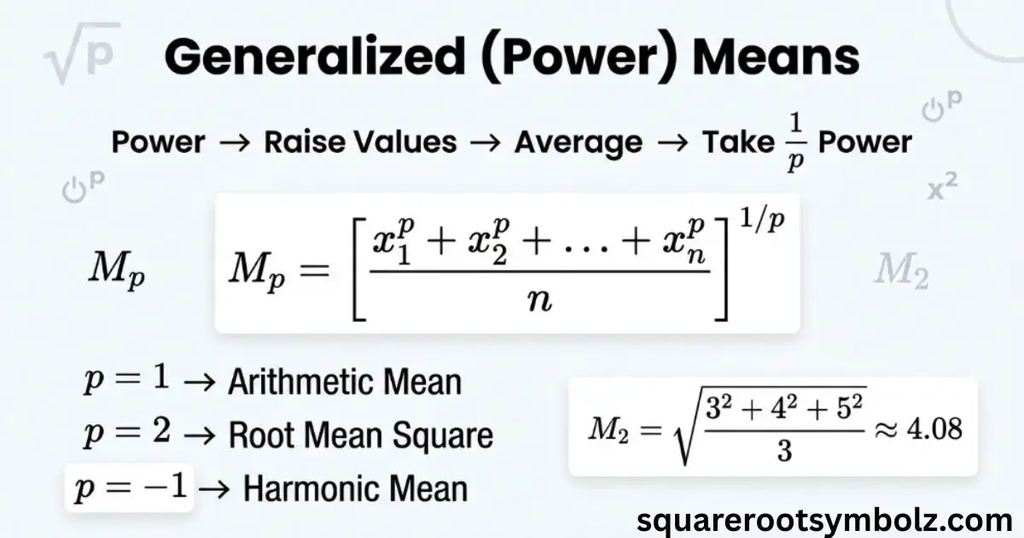
The generalized mean can be written as:
Mₚ = [(1/n) Σxᵢᵖ]¹⁄ᵖ
When p = 1, the result is the arithmetic mean.
When p = 2, the result is the quadratic mean, or RMS.
Other values of p produce other members of the power-mean family. This places RMS in a broader mathematical framework rather than treating it as an isolated formula.
The relationship also helps explain why RMS behaves differently from the arithmetic mean. Squaring emphasizes larger magnitudes. A value of 10 contributes 100 to the squared total, while a value of 2 contributes only 4.
That difference becomes important when a data set contains a few unusually large observations. RMS is sensitive to those values because the squaring operation gives them disproportionately greater influence before the final square root brings the result back to the original units.
RMS also has a useful relationship with the arithmetic mean and population standard deviation:
RMS² = mean² + variance
or, equivalently,
RMS = √(mean² + variance)
This relationship follows from the definition of variance and is particularly useful when analyzing statistical data. Omni discusses the connection between RMS, population standard deviation, and variance.
If the mean is zero, this simplifies to:
RMS = standard deviation
That special case appears frequently with centered data and signals.
Applications
Root mean square appears across mathematics, statistics, physics, engineering, and signal processing because it measures magnitude in a way that does not allow positive and negative values to cancel each other. Omni specifically identifies applications in statistics, prediction-error measurement, electrical engineering, signal processing, and molecular physics.
One major application is alternating current. AC voltage and current change direction over time, so their ordinary averages can be zero even though the electrical signal can transfer energy and produce heat. RMS gives an effective value related to the power produced by a corresponding steady quantity. Engineering references use RMS for this reason.
For a sinusoidal voltage with peak value Vₚ, the RMS voltage is:
Vᵣₘₛ = Vₚ / √2
So a sine wave with a peak voltage of 170 V has an RMS value of approximately:
170 / √2 ≈ 120.2 V
This relationship is why RMS values are so important when working with AC electrical systems.
RMS is also useful in signal processing. A changing audio, vibration, sensor, or electronic signal can move above and below zero. RMS provides a measure of its overall magnitude without allowing positive and negative portions to cancel.
In statistics, RMS is closely related to standard deviation. If RMS is applied to deviations from the mean rather than to the original observations, it becomes the standard deviation under the population definition. Cambridge explicitly describes standard deviation as the RMS of deviations from the mean.
Another important application is root mean square error (RMSE). Instead of squaring the original measurements, RMSE squares the differences between observed and predicted values:
RMSE = √[(Σ(observed − predicted)²) / n]
The result measures the typical magnitude of prediction errors while giving larger errors greater influence.
For example, if prediction errors are 1, -2, and 3, then:
RMSE = √[(1² + (-2)² + 3²) / 3]
= √(14/3)
≈ 2.16
A lower RMSE generally indicates smaller prediction errors when comparing models on the same data and scale.
RMS also appears in kinetic theory of gases. The RMS speed of gas molecules is connected to their average kinetic energy. Omni explains that the RMS speed is the single speed that would produce the same total kinetic energy as the collection of particles when their masses are identical.
For a gas, the RMS speed is commonly written as:
vᵣₘₛ = √(3RT/M)
where R is the gas constant, T is absolute temperature, and M is molar mass.
This explains why temperature and molecular mass affect RMS speed: increasing absolute temperature increases molecular motion, while lighter molecules have greater RMS speeds under the same temperature conditions.
| Field | RMS application |
| Statistics | Magnitude and standard deviation |
| Machine learning | RMSE and prediction errors |
| Electrical engineering | AC voltage and current |
| Signal processing | Signal magnitude |
| Physics | Molecular RMS speed |
| Mechanics | Motion and varying quantities |
| Audio | Signal and waveform analysis |
| Engineering | Sensor and measurement analysis |
The same mathematical operation therefore connects several subjects that may initially seem unrelated. Whether you are analyzing exam data, an electrical waveform, a sensor signal, or molecular motion, the underlying principle remains the same: square, average, then take the squar
Conclusion
Root mean square is a powerful way to describe the magnitude of a set of values or a changing signal. Its formula is simple:
RMS = √[(x₁² + x₂² + … + xₙ²) / n]
The three essential operations are square → mean → root. Unlike an ordinary average, RMS prevents positive and negative values from canceling and gives greater influence to larger magnitudes.
Its usefulness extends far beyond basic mathematics. RMS appears in statistics, RMSE, standard deviation, AC voltage, AC current, signal processing, and molecular physics. Understanding the underlying calculation makes it much easier to recognize when RMS is the right measurement and when another type of average is more appropriate.
FAQ Section
What is root mean square in simple words?
Root mean square is the square root of the average of squared values. You square each number, find the mean of those squares, and then take the square root.
What is the root mean square formula?
For n values, the formula is RMS = √[(x₁² + x₂² + … + xₙ²) / n]. It is also called the quadratic mean.
How do you calculate RMS?
Square every value, add the squared values, divide the sum by the number of observations, and take the square root of the result.
Why do we square values in RMS?
Squaring removes negative signs and gives larger magnitudes greater influence. This prevents positive and negative values from canceling each other.
Is RMS the same as average?
No. The arithmetic mean averages the original values, while RMS averages their squares before taking a square root.
Is RMS always greater than the mean?
For real-valued data, RMS is greater than or equal to the arithmetic mean, with equality when all values are equal. More precisely, RMS is also at least the mean of the absolute values.
What is the difference between RMS and standard deviation?
RMS measures the magnitude of the original values. Standard deviation measures the RMS of deviations from the mean. When the mean is zero, RMS and population standard deviation are equal.
What is RMSE?
RMSE stands for root mean square error. It applies the RMS operation to prediction errors and is commonly used to measure the difference between predicted and observed values.
What is the RMS of a sine wave?
For a sinusoidal waveform with peak amplitude A, the RMS value is A/√2. This relationship is widely used for AC voltage and current.
Why is RMS used for AC voltage?
AC voltage changes direction, so its ordinary average can be misleading. RMS gives an effective value related to the power or heating effect of the alternating signal.
What is weighted RMS?
Weighted RMS gives different observations different levels of influence. Its denominator is the sum of the weights rather than simply the number of observations.
What is another name for RMS?
RMS is also called the quadratic mean. Mathematically, it is the power mean with exponent 2.

I’m the creator of SquareRootSymbolz.com, where I publish easy-to-understand guides on symbols, Unicode characters, Alt codes, keyboard shortcuts, and copy-and-paste text symbols. My goal is to provide accurate, well-researched, and user-friendly content that helps readers quickly find the information they need.