Finding the square root means identifying the number that, when multiplied by itself, gives the original value. In mathematics, this connects square roots, perfect squares, multiplication, exponents, radicals, and the radicand. After working through many beginner-level examples, I have found that the hardest part is usually knowing which method to use.
The good news is that finding the square root becomes much easier once you recognize the relationship between a squared number, inverse operation, perfect square, factor tree, and prime factorization. Whether you need an exact answer, a simplified radical, or an estimate without a calculator, this guide walks through each method step by step.
Terminology for Finding the Square Root
Before finding the square root, it helps to understand a few basic math terms. The radical is the √ symbol, while the number inside it is called the radicand. In √49, the radical sign tells you to find a root, and 49 is the radicand.
The square root is also connected to the index, although the index of 2 is usually hidden in an ordinary square root. So √49 can also be understood as the second root of 49. Learning this terminology makes radical expressions and later algebra much less confusing.
| Term | Meaning | Example |
| Radical | The root symbol | √ |
| Radicand | Number under the radical | √49 |
| Square root | A value multiplied by itself to make the radicand | √49 = 7 |
| Perfect square | A number with a whole-number square root | 49 = 7² |
| Index | Shows which root is required | ²√49 |
Square Roots and Finding the Square Root
Finding the square root is the inverse operation of squaring a number. When you square 8, you multiply 8 × 8 and get 64. Therefore, finding √64 means reversing that operation and asking which number multiplied by itself produces 64.
The simplest question to ask is: “What number times itself equals this value?” That one habit connects multiplication, perfect squares, factors, and square roots. For example, because 9 × 9 = 81, the principal square root is √81 = 9.
One important distinction matters here. The symbol √81 represents the principal square root, which is 9. But if you solve the equation x² = 81, both 9 and −9 satisfy the equation because 9² = 81 and (−9)² = 81.
Finding the Square Root
For perfect squares, finding the square root is often a matter of recognizing multiplication patterns. Ask what whole number can be multiplied by itself to create the radicand. This method works quickly for familiar values such as 4, 9, 16, 25, 36, and 49.
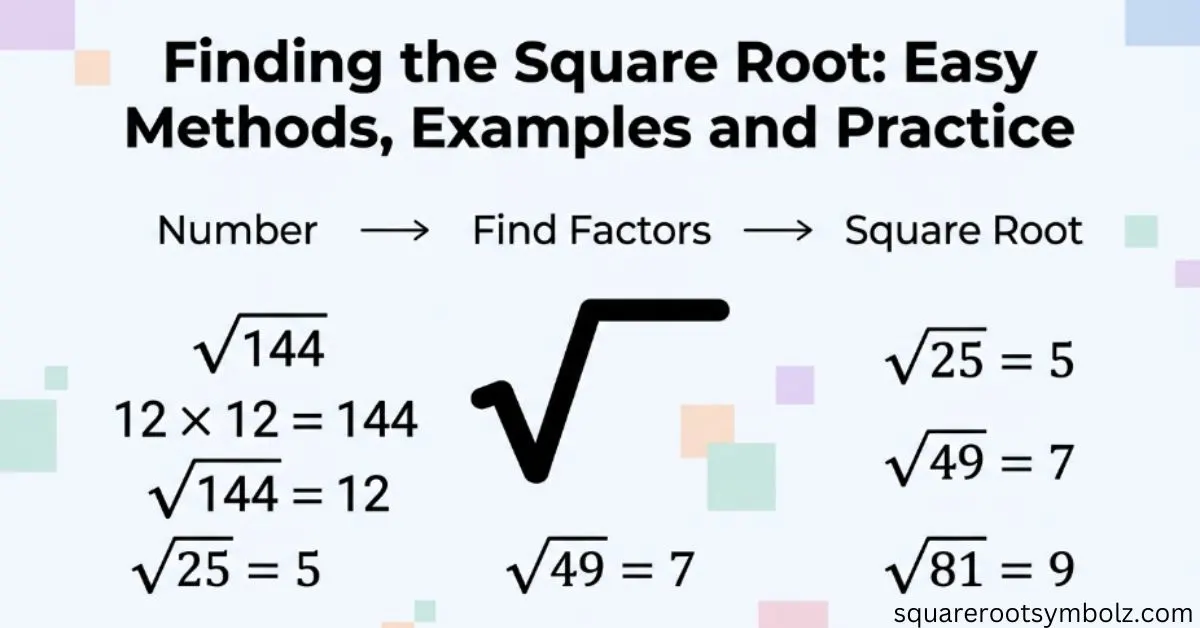
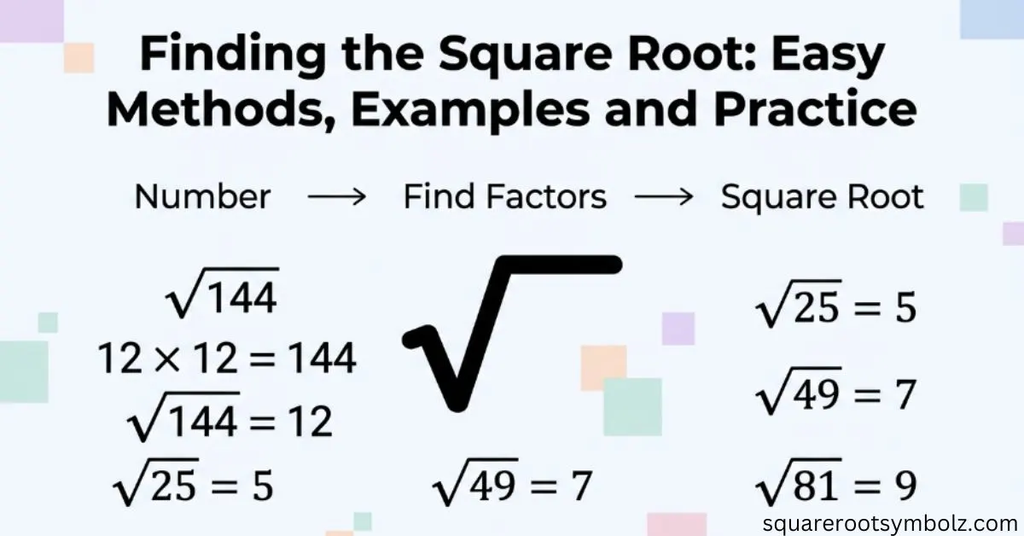
For example, consider √144. Think through the multiplication fact 12 × 12 = 144. Since 12 squared gives 144, the principal square root is 12. This relationship between a number, its square, and its radical expression is the foundation of the topic.
Finding the Square Root of Perfect Squares
A perfect square is created when a whole number is multiplied by itself. Examples include 1, 4, 9, 16, 25, 36, 49, 64, 81, and 100. Memorizing common perfect squares makes finding the square root faster and reduces calculator dependence.
Here are useful examples: √25 = 5 because 5 × 5 = 25, √36 = 6 because 6 × 6 = 36, and √100 = 10 because 10 × 10 = 100. The fastest way to check an answer is to square your result.
| Perfect Square | Square Root | Check |
| 1 | 1 | 1 × 1 = 1 |
| 4 | 2 | 2 × 2 = 4 |
| 9 | 3 | 3 × 3 = 9 |
| 16 | 4 | 4 × 4 = 16 |
| 25 | 5 | 5 × 5 = 25 |
| 36 | 6 | 6 × 6 = 36 |
| 49 | 7 | 7 × 7 = 49 |
| 64 | 8 | 8 × 8 = 64 |
| 81 | 9 | 9 × 9 = 81 |
| 100 | 10 | 10 × 10 = 100 |
Finding Square Roots of Numbers That Aren’t Perfect Squares Without a Calculator
When the radicand is not a perfect square, the answer may not be a whole number. For example, √10 lies between √9 and √16, so its value must fall between 3 and 4. Estimation gives you a useful starting point.
A practical method is to estimate, divide, and average repeatedly. Start with a nearby value, divide the radicand by that estimate, then average the two numbers. Repeating the process improves accuracy and can produce a strong decimal approximation without a calculator.
Example: Finding √10
First, identify nearby perfect squares:
3² = 9
4² = 16
Therefore:
√10 is between 3 and 4.
Start with 3:
10 ÷ 3 = 3.333
Now average:
(3 + 3.333) ÷ 2 = 3.1665
Repeat:
10 ÷ 3.1665 ≈ 3.158
Average again:
(3.1665 + 3.158) ÷ 2 ≈ 3.162
So:
√10 ≈ 3.162
Checking the estimate by squaring it brings the result very close to 10. This estimate-divide-average approach is one method for approximating roots when an exact whole number does not exist.
Simplifying Square Roots While Finding the Square Root
Sometimes finding the square root does not produce a whole number, but the radical can still be simplified. The goal is to find a perfect-square factor inside the radicand. That perfect square can then move outside the radical in simplified form.
Take √40 as an example. Since 40 = 4 × 10 and 4 is a perfect square, √40 becomes √4 × √10. Because √4 = 2, the simplified result is 2√10. The remaining 10 stays under the radical.
Another example is √96. You can identify 16 as a perfect-square factor because 96 = 16 × 6. Therefore:
√96 = √16 × √6
√96 = 4√6
This method connects factorization, perfect squares, radicals, and simplification. It is especially useful in algebra because the exact simplified form is often preferred over a rounded decimal.
Practice Finding the Square Root
Practice works best when you begin with familiar multiplication facts. Try asking the same question for every problem: What number multiplied by itself gives the radicand? This turns square-root practice into a pattern-recognition skill rather than a memorization challenge.
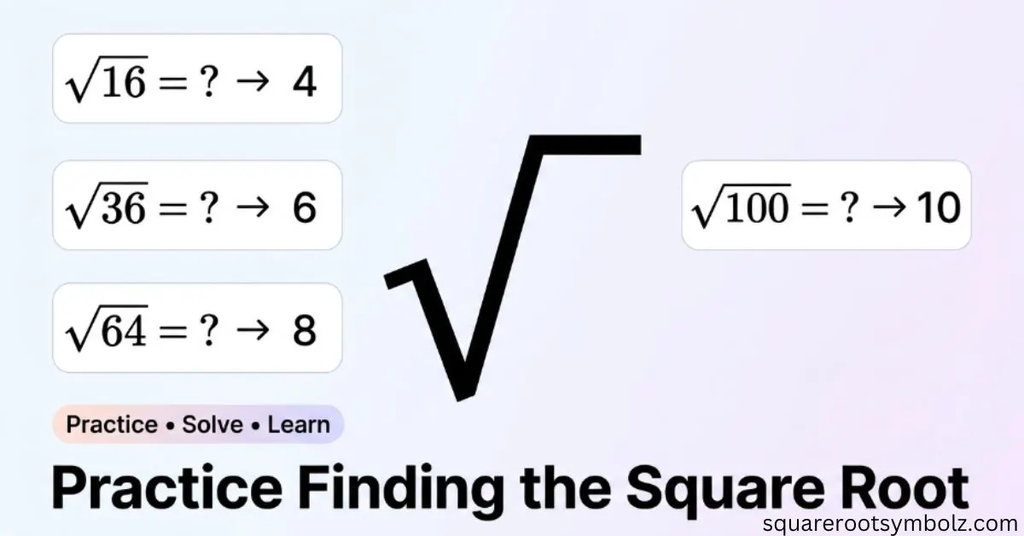
Start with whole number square roots, then move toward factor trees and simplified radicals. Khan Academy uses practice alongside square-root review because repeated problems help learners connect perfect squares, prime factors, and the inverse relationship between squaring and taking roots.
Try these:
- √49 = ?
- √121 = ?
- √169 = ?
- √225 = ?
- √50 in simplified form = ?
- Estimate √30 between two whole numbers.
Answers:
- 7
- 11
- 13
- 15
- 5√2
- Between 5 and 6
Perfect Squares and Square Root Practice Questions
Perfect-square practice is useful because these values create exact integer answers. A number is a perfect square when it can be written as an integer multiplied by itself. For example, 64 is a perfect square because 8 × 8 = 64.
Try identifying which numbers are perfect squares: 36, 41, 81, 99, 100, and 121. The correct values are 36, 81, 100, and 121. Each one can be produced by multiplying the same whole number twice.
Quick Practice Table
| Question | Answer | Reason |
| √36 | 6 | 6 × 6 = 36 |
| √81 | 9 | 9 × 9 = 81 |
| √121 | 11 | 11 × 11 = 121 |
| √144 | 12 | 12 × 12 = 144 |
| √50 | 5√2 | 50 = 25 × 2 |
| √72 | 6√2 | 72 = 36 × 2 |
A helpful habit is to separate exact roots from simplified roots. Perfect squares usually produce a whole number. Non-perfect squares may require simplification or approximation. Knowing that difference saves time and helps prevent one of the most common square-root mistakes.
Finding the Square Root: A Quick Method Comparison
| Situation | Best Method | Example |
| Familiar perfect square | Use multiplication facts | √64 = 8 |
| Large perfect square | Recognize a squared number | √144 = 12 |
| Number with repeated prime factors | Factor tree | √36 = 6 |
| Simplifiable non-perfect square | Extract perfect-square factor | √40 = 2√10 |
| Decimal approximation needed | Estimate and refine | √10 ≈ 3.162 |
| Quick verification | Square the answer | 7² = 49 |
The best method depends on the number and the answer format your problem requires. For mental math, perfect-square recognition is fastest. For algebra, factorization and simplification are often more useful. For decimals, estimation helps you find a practical approximation.
Conclusion
Finding the square root becomes much easier when you remember one central idea: you are looking for the number that produces the original value when multiplied by itself. Start with perfect squares, use factorization for harder numbers, simplify radicals when possible, and estimate when you need a decimal.
The most reliable check is also the simplest: square your answer. If the result returns to the original radicand, your solution is correct. With a strong list of perfect squares and regular practice, finding the square root quickly becomes a natural math skill.
FAQs
How do I find a square root?
Ask what number multiplied by itself gives the original number. For example, because 7 × 7 = 49, √49 = 7. If the number is not a perfect square, you may need to simplify the radical or estimate its decimal value.
What are the whole number square roots from 1 to 20?
The whole-number roots in this range correspond to perfect squares: √1 = 1, √4 = 2, √9 = 3, and √16 = 4. A whole-number square root exists when the radicand is a perfect square.
What are numbers with integer square roots?
Numbers with integer square roots are called perfect squares. Examples include 1, 4, 9, 16, 25, 36, and 64 because each is produced by multiplying the same integer by itself.
What are the first 20 perfect squares?
The first 20 perfect squares begin with 1, 4, 9, 16, 25, 36, 49, and continue through 400. Each value comes from squaring a whole number from 1 through 20.
How do you determine perfect squares?
A number is a perfect square if it equals an integer multiplied by itself. For example, 25 is perfect because 5 × 5 = 25. You can also recognize perfect squares by memorizing common multiplication patterns.
Can every number have a whole-number square root?
No. Only perfect squares have whole-number square roots. For example, √49 = 7, but √50 is not a whole number. It can be simplified to 5√2 or written as an approximate decimal.

I’m the creator of SquareRootSymbolz.com, where I publish easy-to-understand guides on symbols, Unicode characters, Alt codes, keyboard shortcuts, and copy-and-paste text symbols. My goal is to provide accurate, well-researched, and user-friendly content that helps readers quickly find the information they need.