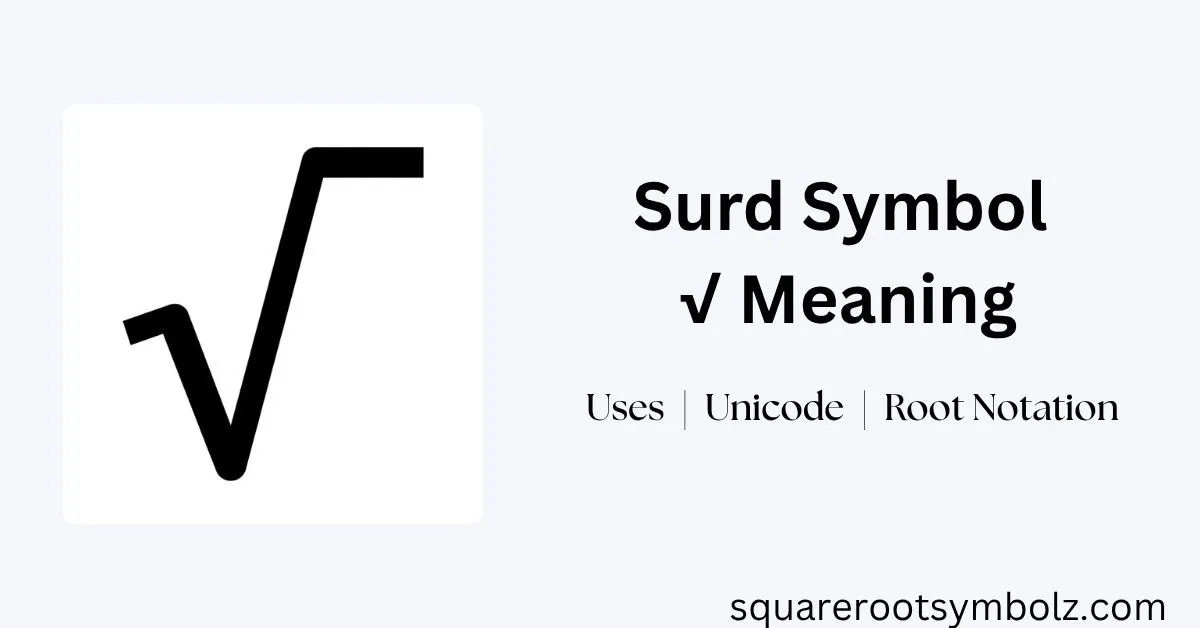
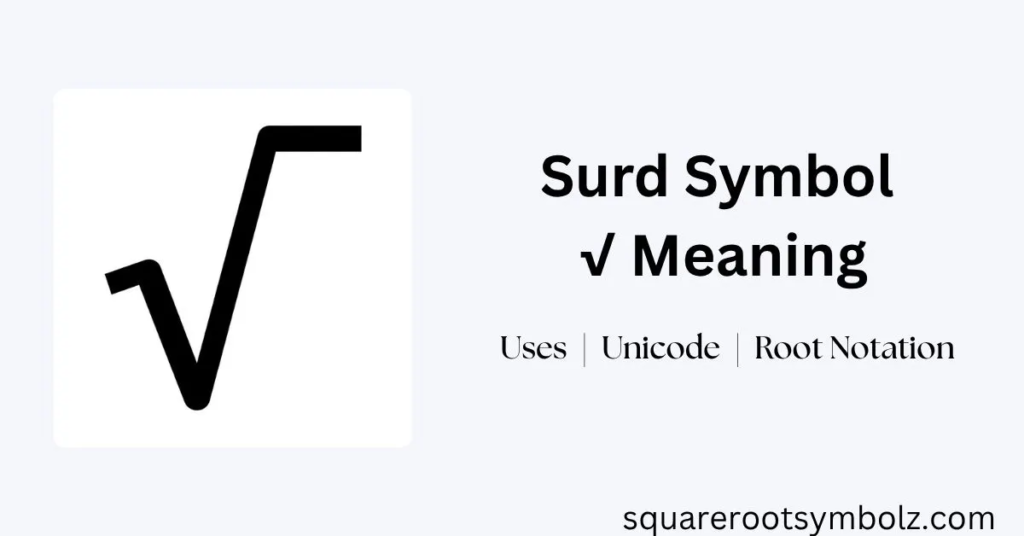
The surd symbol √ is the familiar radical sign used to represent a square root or, with an index, a higher-order root. If you have ever searched for the correct root symbol, wondered what the line over a radical means, or confused a surd with an irrational number, this guide clears it up. The notation connects square roots, radical expressions, radicands, indices, irrational numbers, and mathematical notation in one simple system.
After working through mathematical notation and symbol references, I find that the biggest confusion is usually not the √ itself, it is understanding what each part means. Below, you will see how the radical sign, principal root, nth root, Unicode character, LaTeX notation, and surd expression fit together, with practical examples you can use in school, documents, websites, and technical writing.
Principal Square Root
The surd symbol is closely associated with the principal square root. For a positive real number, a square has two roots, but the radical notation √x conventionally represents the nonnegative one. Thus, √25 means 5, while both 5 and −5 are square roots of 25.
This distinction matters when reading an equation. If you see √36, the answer represented by the radical is 6, not ±6. The ± notation is used when an equation asks for both square roots. This small detail prevents a common mistake when working with radicals, equations, real numbers, and square-root functions.
Why the Principal Root Matters
Consider √49. The number 7 satisfies 7² = 49, while −7 also satisfies (−7)² = 49. However, the radical expression √49 specifically denotes the principal, nonnegative square root: 7. This convention keeps mathematical notation consistent when radicals appear inside formulas and calculations.
Origin
The history of the surd symbol is more interesting than its simple appearance suggests. The modern radical sign developed gradually rather than appearing fully formed. Wikipedia notes that its origin is uncertain, with historical explanations connecting it to Arabic mathematical writing and, alternatively, to the Latin word radix, meaning root.
The familiar horizontal bar also became important later. Historical accounts describe Christoff Rudolff using a radical sign in print in 1525, while René Descartes is associated with combining the radical sign with the vinculum in the form that became familiar in European mathematical notation.
From Root Notation to Modern Mathematics
Today, the same basic idea appears in algebra, geometry, calculus, physics, engineering, and computer-based mathematics. The notation may look simple, but the radical sign, root, index, radicand, and vinculum allow complicated expressions to be grouped and interpreted precisely.
Encoding
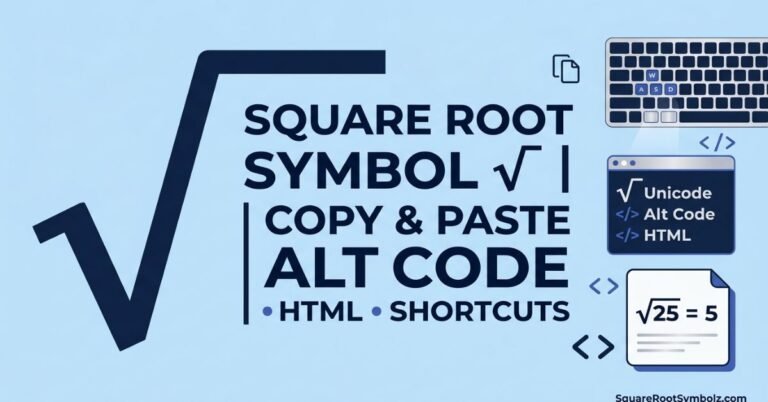
For digital text, the standard character √ has the Unicode code point U+221A and the official Unicode name SQUARE ROOT. It belongs to the Mathematical Operators block and has the general category “Math Symbol.”
This is particularly useful when you need to place the surd symbol into a website, document, spreadsheet, social post, or plain-text field. Unicode identifies √ as a single mathematical character, while full mathematical typesetting can use specialized notation to create a radical whose horizontal bar automatically stretches over its contents.
√ Symbol Quick Reference
| Property | Value |
| Symbol | √ |
| Unicode name | SQUARE ROOT |
| Unicode | U+221A |
| Decimal | 8730 |
| Hexadecimal | 221A |
| Category | Math Symbol |
| Block | Mathematical Operators |
| HTML decimal | √ |
| HTML hexadecimal | √ |
The Unicode record confirms U+221A as the character’s code point, while Unicode’s mathematics documentation explains that √ can represent the start of square-root notation in plain-text mathematical expressions.
Legacy Encodings
Before Unicode became the standard way to represent characters across modern digital systems, the square-root character appeared in several older character encodings. Wikipedia lists examples including Code Page 437, Mac OS Roman, Symbol font encoding, Japanese JIS, Korean Wansung, and Chinese character encodings.
These historical codes are rarely necessary for ordinary users today. If you are creating a modern webpage or document, Unicode U+221A is a much more useful reference. Legacy encoding information is mainly valuable when maintaining older software, documents, databases, fonts, or technical systems that were created before Unicode became widespread.
Why Unicode Is Better for Copy and Paste
Unicode gives the same underlying character identity across compatible systems. That means copying √ from one modern application to another generally preserves the character rather than depending on a particular legacy font. For ordinary copy-and-paste tasks, remembering U+221A is more useful than memorizing older encoding tables.
Radicand
The radicand is the quantity underneath the radical sign, the number or expression from which the root is taken. In √25, for example, 25 is the radicand. In √(x + 4), the entire expression x + 4 is the radicand. Understanding this term makes radical expressions much easier to read.
The horizontal line above the radicand is called the vinculum. Its length is meaningful because it indicates how much of an expression belongs under the root. For example, √(p − q) means the entire difference is under the radical, whereas √p − q means only p is rooted.
Radicand Examples
| Radical expression | Radicand |
| √9 | 9 |
| √25 | 25 |
| √x | x |
| √(x + 2) | x + 2 |
| √(a² + b²) | a² + b² |
| ∛27 | 27 |
This vocabulary becomes especially helpful when discussing square roots, cube roots, nth roots, radical expressions, and algebraic formulas because it tells you exactly which quantity the root operation applies to.
Radical Symbol
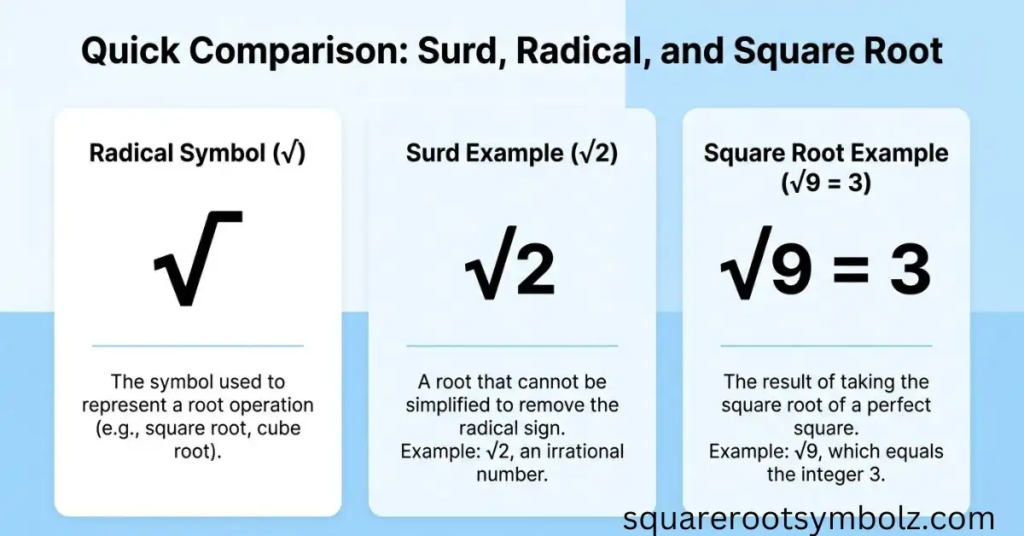
The radical symbol is √, and it is also commonly called the radical sign, root symbol, or surd. In mathematical notation, it indicates a square root when no index is shown and a higher-order root when an index appears.
For example, √16 means the square root of 16, while ∛27 means the cube root of 27. More generally, an nth root can be written with n as the index. MathWorld describes an unresolved nth root involving a radical symbol as a surd, while Wikipedia uses surd as one of the names associated with the radical symbol.
Radical Symbol vs. Surd
These terms overlap, but they are not always interchangeable. Radical symbols usually refer to the notation itself, such as √. Surd can refer to the radical notation or, in mathematical contexts, to an irrational root expression that remains in radical form. MathWorld specifically recognizes both uses.
For example:
- √2 is a radical expression and an irrational value.
- √9 is a radical expression whose value is rational.
- 3√5 is a surd expression.
- ∛7 is an unresolved root and can be described as a surd.
This distinction is worth remembering because a radical expression does not automatically produce an irrational result.
Degree
The degree or index identifies which root is being taken. A missing index means the root is a square root, so √x is equivalent to the second root of x. A small 3 before the radical indicates a cube root, while 4 indicates a fourth root.
For example, √16 = 4, while ∛8 = 2 and ∜16 = 2. The index changes the mathematical operation, even though the general radical structure looks similar. This is why index, degree, square root, cube root, fourth root, and nth root are closely connected terms.
Common Root Degrees
| Index | Name | Example | Result |
| 2 | Square root | √25 | 5 |
| 3 | Cube root | ∛27 | 3 |
| 4 | Fourth root | ∜16 | 2 |
| 5 | Fifth root | ⁵√32 | 2 |
| n | nth root | ⁿ√x | Depends on x |
When the index is omitted, readers automatically interpret the radical as a square root. This convention keeps everyday mathematical writing compact while still allowing higher-order roots whenever necessary.
Surd
A surd generally refers to an unresolved root or a radical expression involving an irrational root. MathWorld explains that the term can describe an unresolved nth root and can also refer to a sum of one or more irrational roots.
A useful example is √2. Its exact value cannot be written as a terminating decimal or a repeating decimal, so keeping √2 preserves its exact mathematical form. By contrast, √9 simplifies completely to 3, meaning there is no irrational surd left after evaluation.
Surf Examples
Some common examples include:
- √2
- √3
- √5
- 2√7
- √11 + √2
- ∛5
- √(a + b)
However, terminology can vary by mathematical context. Some educational sources use “surd” more narrowly for an irrational root of a rational number that cannot be simplified to a rational number. MathWorld takes a broader terminology-based approach.
Surd Symbol and Radical Symbol: Are They the Same?
Not always. √ is fundamentally the square-root/radical symbol, while surd can describe the notation or an expression involving an irrational root. This is why saying “surd symbol” is understandable in search and everyday usage, but “radical symbol” is often the more precise name for √ itself.
A Simple Way to Remember It
Think of the relationship this way:
√ = the symbol
radicand = what is under it
index = which root
vinculum = the horizontal bar
surd = an unresolved/irrational radical expression, depending on context
Once these five ideas click, radical notation becomes much easier to read.
Quick Comparison Surd, Radical, and Square Root
| Term | What it usually means | Example |
| Radical symbol | Root notation | √ |
| Square root | Second root of a number | √25 = 5 |
| Radical expression | Expression containing a root | √(x + 1) |
| Surd | Unresolved/irrational root expression | √2 |
| Radicand | Quantity under the radical | 25 in √25 |
| Index | Root degree | 3 in ∛8 |
| Vinculum | Horizontal radical bar | Line over the radicand |
This terminology is consistent with the mathematical structure described by MathWorld, Wikipedia, and Math Open Reference.
Conclusion
The surd symbol √ is more than a simple mathematical character; it is the standard radical symbol used to represent square roots and, with an index, higher-order roots. Once you understand the radicand, index, vinculum, principal square root, and surd expression, radical notation becomes much easier to read and use.
Whether you need √ for copy and paste, Unicode, HTML, LaTeX, schoolwork, or mathematical writing, the key reference is U+221A. Remember that √ is technically the radical or square-root symbol, while “surd” can also describe an unresolved irrational root expression. With that distinction clear, you can use the surd symbol confidently in both everyday and advanced mathematics.
FAQ Section
What is the surd symbol?
The surd symbol usually refers to the radical symbol √, which is used for square roots and, with an index, higher-order roots. The term “surd” can also describe an unresolved or irrational root expression.
What is the Unicode for the surd symbol?
The Unicode character √ is U+221A, officially named SQUARE ROOT. It belongs to the Mathematical Operators block and has the category Math Symbol.
Is √ a surd or a radical symbol?
√ is more precisely called the radical symbol or radical sign. “Surd” is also used as a name for the symbol in some mathematical contexts and can describe an unresolved irrational root expression.
What is the difference between a surd and a radical?
A radical refers broadly to root notation or an expression containing a root. A surd often refers specifically to an unresolved irrational root expression, although mathematical sources do not always use the terms identically.
What is the radicand in √25?
The radicand is 25 because it is the quantity underneath the radical symbol. In √(x + 5), the radicand is the entire expression x + 5.
What is the index of √x?
The index is 2, even though it is normally omitted. Therefore, √x represents the second or square root of x.
What does the bar over a radical mean?
The horizontal bar is called the vinculum. It shows which numbers or expressions belong under the radical and therefore tells you what quantity the root operation applies to.
Can every irrational number be called a surd?
No. In the narrower mathematical sense, a surd is generally an irrational root expression. Numbers such as π and e are irrational but are not normally described as surds.

I’m the creator of SquareRootSymbolz.com, where I publish easy-to-understand guides on symbols, Unicode characters, Alt codes, keyboard shortcuts, and copy-and-paste text symbols. My goal is to provide accurate, well-researched, and user-friendly content that helps readers quickly find the information they need.