The 3 number is the natural number that comes after 2 and before 4, but mathematically it is far more interesting than its small size suggests. It is the second-smallest prime, first odd prime, triangular number, Fibonacci number, Mersenne prime, and Fermat prime.
If you’re researching the number three for school, mathematics, a symbol project, or simple curiosity, the most useful place to start is its structure. The number has exactly two divisors 1 and 3 and connects naturally to prime numbers, number sequences, geometry, numeral systems, powers, roots, and mathematical functions.
Number 3 Properties
The 3 number is a natural number and integer. It follows 2 and precedes 4. It is also an odd number because it cannot be divided evenly by 2. Most importantly, 3 is a prime number, meaning its only positive divisors are 1 and itself.
Three has several special classifications. It is a twin prime because 5 is also prime and differs from 3 by 2. It is also classified as a Sophie Germain prime, safe prime, Mersenne prime, and Fermat prime.
| Property | Value |
| Number | 3 |
| Name | Three |
| Type | Natural number, integer |
| Odd or even | Odd |
| Prime | Yes |
| Divisors | 1, 3 |
| Sum of divisors | 4 |
| Previous integer | 2 |
| Next integer | 4 |
| Roman numeral | III |
| Square | 9 |
| Cube | 27 |
| Square root | ≈ 1.73205 |
| Factorial | 6 |
Number 3 Arithmetic & Divisor Properties
The 3 number has exactly two positive divisors: 1 and 3. Their sum is 4. Because the number has no other positive factors, it satisfies the basic definition of a prime number. Number Empire also identifies 3 as the second prime and gives its prime gap as 2.
Another useful property appears in divisibility tests. An integer is divisible by 3 when the sum of its decimal digits is divisible by 3. For example, 123 is divisible by 3 because 1 + 2 + 3 = 6, and 6 is divisible by 3.
Quick examples
- 3 ÷ 1 = 3
- 3 ÷ 3 = 1
- 6 ÷ 3 = 2
- 9 ÷ 3 = 3
- 12 ÷ 3 = 4
This simple divisibility rule becomes especially useful when checking larger numbers.
Number 3 Number Properties
The 3 number has an unusually rich collection of sequence and classification properties. It is the second triangular number, the fourth Fibonacci number under the conventional sequence beginning 0, 1, 1, 2, 3, and a Lucas number.
Three is also a deficient number because the sum of its proper divisors is less than the number itself. Its only proper positive divisor is 1, and 1 < 3. Number Empire also classifies 3 as a regular number, palindrome and polygonal number.
Why 3 is a triangular number
Triangular numbers represent the number of objects that can form a triangle:
1, 3, 6, 10, 15,…
The number 3 is the second triangular number because:
1+2=3
This gives the number a direct connection to both arithmetic sequences and geometry.
Number 3 in Different Bases
The 3 number can be represented in many numeral systems. In ordinary decimal notation it is simply 3, while in binary it is 11₂ and in ternary it is 10₃. It remains the same mathematical quantity even though its written representation changes.
Here are several representations:
| Number System | Representation of 3 |
| Binary | 11 |
| Ternary | 10 |
| Quaternary | 3 |
| Octal | 3 |
| Decimal | 3 |
| Hexadecimal | 3 |
| Roman numerals | III |
| Arabic-Indic | ٣ |
This illustrates an important mathematical idea: a numeral is a representation of a number. The quantity stays the same while the notation can change according to the number system.
Roman numeral for 3
The Roman numeral representation of 3 is III. It simply repeats the Roman numeral I three times. Unicode also includes dedicated Roman numeral characters such as Ⅲ. Kiddle lists both the Roman representation and Unicode forms.
Number 3 Mathematical Functions
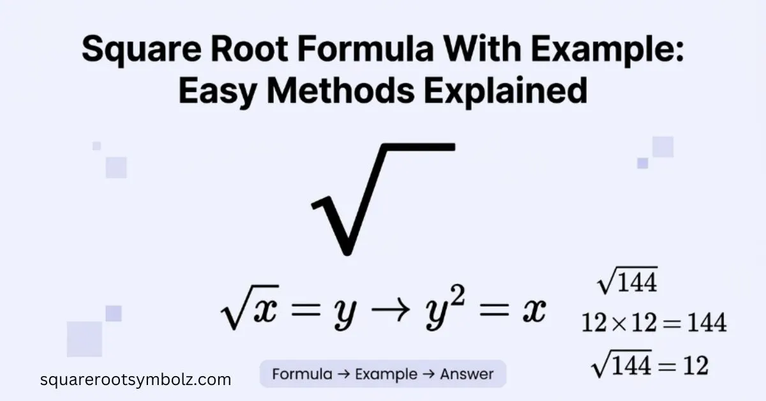
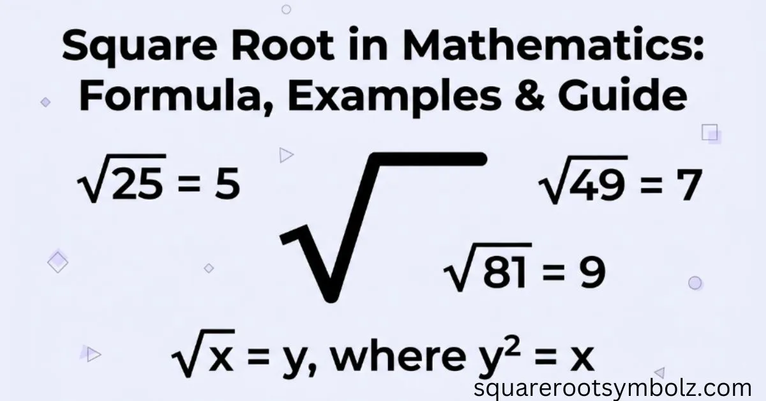
The 3 number produces several familiar values when mathematical functions are applied to it. Its square is 9, its cube is 27, and its fourth power is 81. Its factorial is 6 because 3 × 2 × 1 = 6.
Its square root is irrational:
3≈1.7320508075689
Its cube root is approximately:
33≈1.4422495703074
These values demonstrate that even a simple integer can generate more complicated mathematical results.
| Function | Result |
| 3² | 9 |
| 3³ | 27 |
| 3⁴ | 81 |
| √3 | ≈ 1.73205 |
| ∛3 | ≈ 1.44225 |
| 3! | 6 |
| ln(3) | ≈ 1.09861 |
| log₁₀(3) | ≈ 0.47712 |
Number Empire also lists the sine, cosine and tangent of 3 radians, showing how the number connects to trigonometry.
Number 3 in Mathematics
The 3 number has several elegant mathematical relationships. It is the only prime number that is one less than a perfect square: 3=22−1. More generally, n2−1=(n−1)(n+1), which is composite for integers n>2.
Three also has an important geometric role. Three non-collinear points determine a plane and a circle, giving the number a natural connection to geometry. It is also the minimum number of sides required to form a polygon, creating the triangle.
Three and fractions
Fractions with 3 in the denominator have repeating decimal expansions. For example:
31=0.3333…
and
32=0.6666…
The repeating digit pattern is a direct consequence of the relationship between 3 and the decimal number system. New World Encyclopedia specifically notes the repeating behavior of fractions involving 3.
Number 3 in Culture
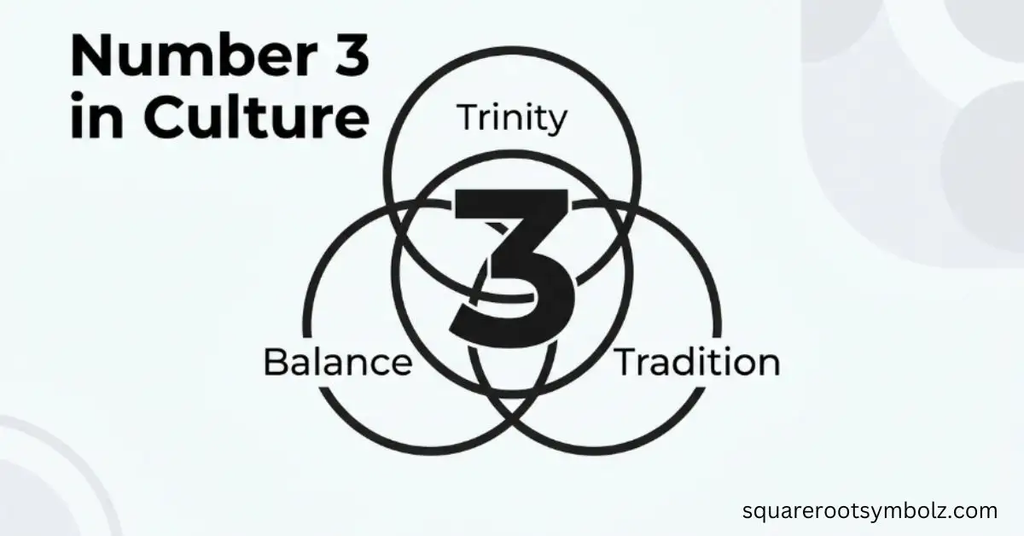
Beyond mathematics, the 3 number appears frequently in stories, traditions, symbols and everyday patterns. Kiddle notes examples ranging from the Three Stooges and Goldilocks to religious and cultural traditions involving groups of three.
For an SEO page targeting the mathematical query, however, cultural information should remain secondary. The strongest topical relevance comes from explaining prime properties, factors, sequences, representations, mathematical functions and geometry first, then briefly acknowledging the broader cultural presence of three.
Conclusion
The 3 number may be small, but its mathematical identity is surprisingly rich. It is a prime, odd number, triangular number, Fibonacci number, Mersenne prime, Fermat prime, twin prime, and palindrome, while also appearing naturally in geometry, number systems, algebra and trigonometry.
For a strong understanding, remember the simplest facts first: 3 has two factors, 1 and 3; its square is 9; its cube is 27; its Roman numeral is III; and its square root is approximately 1.73205. From those basics, the deeper properties of the number become much easier to appreciate.
FAQ Section
Is 3 a prime number?
Yes. 3 is a prime number because its only positive divisors are 1 and 3. It is the second-smallest prime after 2.
Why is 3 an odd number?
3 is odd because it cannot be divided evenly by 2. When 3 is divided by 2, the remainder is 1.
What are the factors of 3?
The positive factors of 3 are 1 and 3.
What is 3 in Roman numerals?
The Roman numeral for 3 is III. Unicode also provides the Roman numeral character Ⅲ.
Is 3 a triangular number?
Yes. 3 is the second triangular number because 1 + 2 = 3.
Is 3 a Fibonacci number?
Yes. In the common Fibonacci sequence 0, 1, 1, 2, 3, 5…, 3 occurs as a Fibonacci number.
What is the square of 3?
The square of 3 is 9, because 3×3=9.
What is the cube of 3?
The cube of 3 is 27, because 3×3×3=27.
What is the square root of 3?
The square root of 3 is approximately 1.7320508075689 and is an irrational number.
What is 3 in binary?
The decimal number 3 is represented as 11 in binary.

I’m the creator of SquareRootSymbolz.com, where I publish easy-to-understand guides on symbols, Unicode characters, Alt codes, keyboard shortcuts, and copy-and-paste text symbols. My goal is to provide accurate, well-researched, and user-friendly content that helps readers quickly find the information they need.