The root 3 value is √3 ≈ 1.73205080757, the positive number whose square equals 3. If you have ever paused at a geometry or trigonometry problem wondering where 1.732 came from, you are not alone. Understanding the square root, radical form, decimal approximation, irrational number, and perfect square idea makes the answer much easier to remember.
When I explain √3 to students, I start with the simplest fact: 3 is not a perfect square, so its square root does not become a whole number. From there, long division, estimation, radical notation, 30-60-90 triangles, and trigonometric ratios all connect naturally. This guide follows that path so the number feels logical rather than something to memorize.
What Is the Value of Root 3 (√3)?
The root 3 value means the positive number that produces 3 when multiplied by itself. In radical notation, it is √3. Its exact form stays √3, while its decimal approximation is 1.73205080757. Because 1.73205² is very close to 3, this decimal is useful for calculations.
A useful distinction is exact value versus approximate value. √3 does not equal 1.732 exactly; the decimal continues indefinitely without repeating. The radical form therefore preserves perfect accuracy, while a rounded decimal such as 1.732 works when a problem asks for three decimal places.
Decimal Value of Root 3
The decimal value of root 3 begins 1.7320508075688772 and continues without ending or repeating. For everyday school calculations, 1.732 is commonly sufficient. To four decimal places, it becomes 1.7321, while five decimal places gives 1.73205.
| Form | Value |
| Exact radical form | √3 |
| Decimal, 3 places | 1.732 |
| Decimal, 4 places | 1.7321 |
| Decimal, 5 places | 1.73205 |
| Decimal, 7 places | 1.7320508 |
The key is to match precision to the question. If a worksheet asks for the nearest hundredth, use 1.73. If it asks for an exact answer, keep √3. Replacing an exact radical with a rounded decimal too early can introduce unnecessary calculation error.
How to Calculate Square Root of 3?
Because 3 is not a perfect square, its square root cannot be obtained as an integer. One traditional method is square-root long division. Start with 3.000000, choose 1 because 1² is less than 3, subtract 1, and bring down pairs of zeros to continue finding decimal digits.
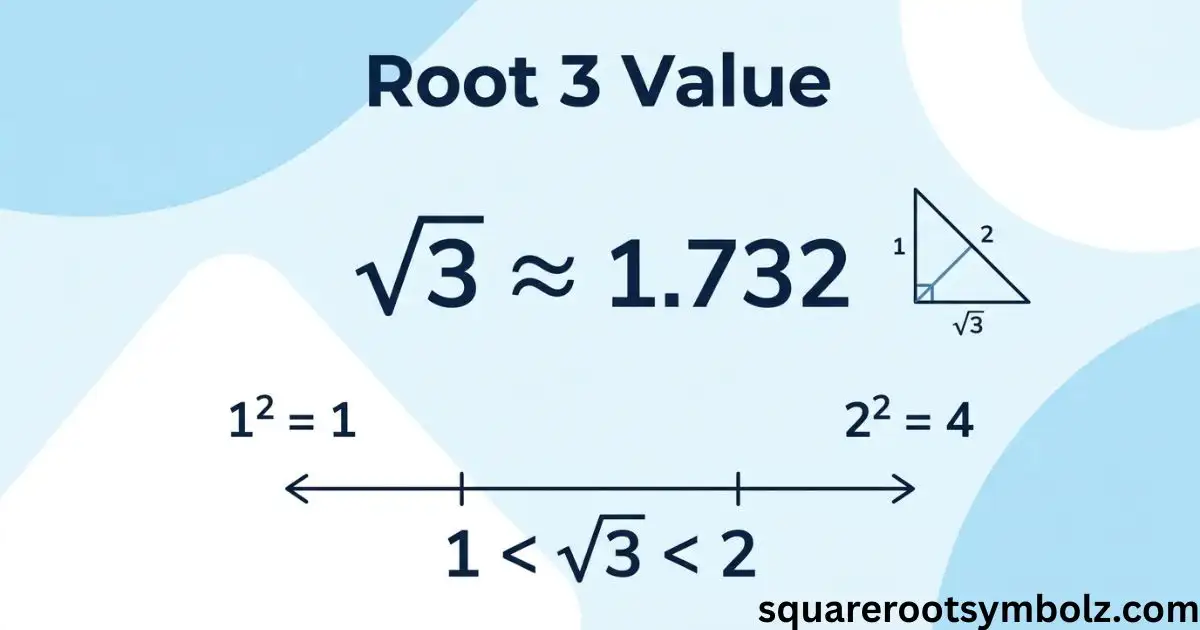
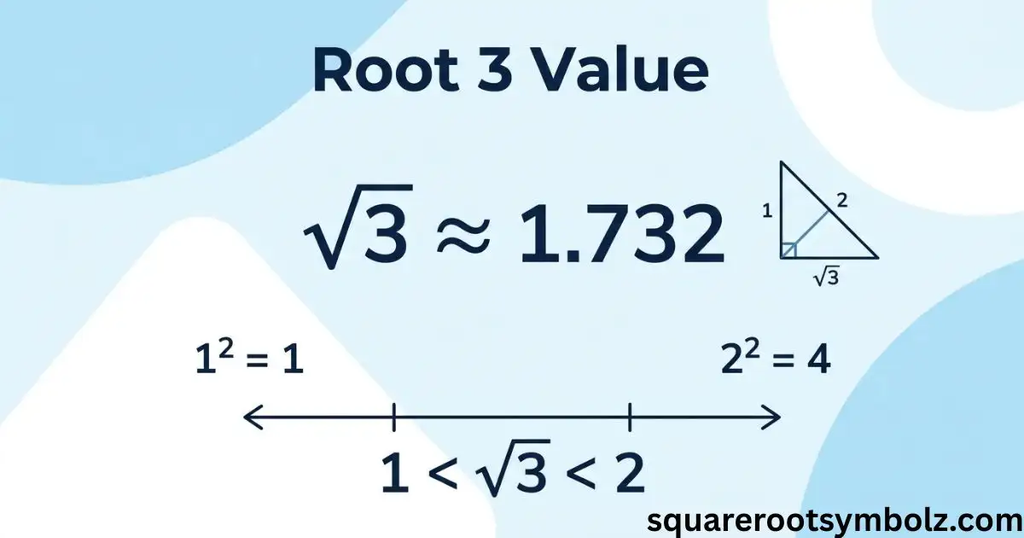
The process produces 1.7, then 1.73, then 1.732, and continues toward 1.73205080757. Another practical approach is estimation: because 1² = 1 and 2² = 4, √3 must lie between 1 and 2. Testing nearby decimals quickly narrows the value.
Why Is Root 3 (√3) Irrational?
The root 3 value is irrational because it cannot be written exactly as a ratio of two integers. Its decimal representation is non-terminating and non-repeating. The fact that 3 is prime also means it has no square factor that can be extracted from the radical.
A simple way to see the idea is to compare √3 with √4 = 2. The number 3 lies between perfect squares 1 and 4, but it is not itself a perfect square. Therefore, √3 cannot simplify to an integer or terminate a rational decimal.
Where Is the Value of Root 3 Used?
The root 3 appears naturally in geometry and trigonometry. In a 30-60-90 triangle, the side ratios are 1 : √3 : 2. It also appears in the area and height formulas for equilateral triangles, making it especially useful when solving problems involving triangles and lengths.
For example, an equilateral triangle with side length 6 has height equal to 3√3, which is approximately 5.196. In trigonometry, √3 also appears in familiar special-angle relationships, including tan 60° = √3 and sin 60° = √3/2.
Root 3 Value in Maths
In mathematics, root 3 is commonly written in three connected forms: √3 in radical notation, 3^(1/2) in exponent notation, and approximately 1.73205080757 in decimal notation. These expressions describe the same positive real number, although the decimal form is only an approximation.
The number is an irrational real number and is not a perfect-square result. That makes √3 an important example when students learn the difference between integers, rational numbers, irrational numbers, radicals, and decimal approximations.
| Representation | Meaning |
| √3 | Radical form |
| 3^(1/2) | Exponent form |
| 1.73205080757… | Decimal approximation |
| 3 | Square of √3 |
| √3 × √3 | 3 |
How to find the value root of 3?
To find the value of root 3 without a calculator, long division provides a systematic method. Begin with 3.00 00 00 and identify the largest integer whose square does not exceed 3. That integer is 1. Continue bringing down pairs of zeros and selecting each decimal digit.
For a quick estimate, remember that √3 lies between √1 and √4, so it lies between 1 and 2. Since 1.7² = 2.89 and 1.8² = 3.24, √3 must lie between 1.7 and 1.8. Refining the estimate gives approximately 1.73205.
What is the Square Root of 3?
The square root of 3 is √3, meaning the positive real number that produces 3 when squared. In exact form, the answer is √3. In decimal form, it is approximately 1.7320508075688772. The radical cannot be simplified further because 3 has no perfect-square factor.
There is an important notation detail here. √3 refers to the principal, or positive, square root. The equation x² = 3 has two real solutions, +√3 and −√3, because both numbers produce 3 when squared. The symbol √3 itself conventionally denotes the positive value.
Is the Square Root of 3 Rational or Irrational?
The square root of 3 is irrational. That means no fraction made from two integers can represent √3 exactly. Its decimal expansion continues indefinitely without repeating a fixed pattern. This makes it different from values such as √4 = 2, which is an integer.
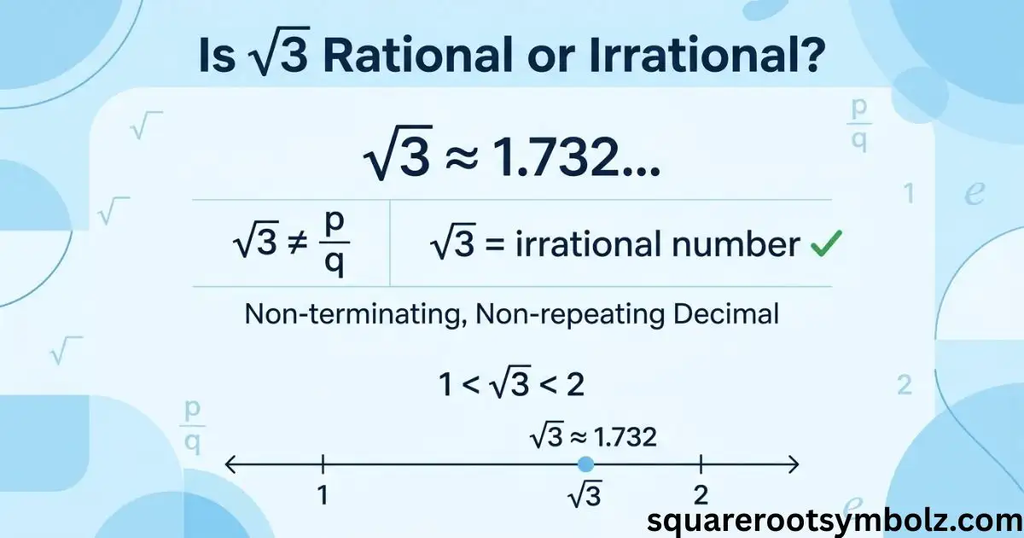
You can also understand this through prime factors. The number 3 appears to be the first power in its prime factorization, so it does not contain a pair of identical factors that could leave the radical. Therefore, √3 remains in its simplest radical form rather than becoming a whole number.
Conclusion
The root 3 value is exactly √3 and approximately 1.73205080757. It is an irrational number, not a perfect-square root, and it cannot be simplified beyond √3. Once you connect the radical form with its decimal approximation, long-division calculation, and geometric meaning, √3 becomes much easier to recognize.
The most useful memory point is simple: √3 ≈ 1.732, but √3 is the exact answer. Keep the radical when precision matters, and use the decimal approximation when a calculation requires it. That small distinction prevents one of the most common mistakes students make with irrational roots.
FAQs
What is the Value of the Square Root of 3?
The square root of 3 is approximately 1.73205080757. Its exact form is √3, and it is an irrational number because its decimal expansion does not terminate or repeat.
Why is the Square Root of 3 an Irrational Number?
√3 is irrational because 3 is not a perfect square and √3 cannot be represented exactly as a fraction of two integers. Its decimal expansion continues indefinitely without repeating.
Is the number 3 a Perfect Square?
No. A perfect square is an integer produced by multiplying another integer by itself. Since no integer multiplied by itself equals 3, the number 3 is not a perfect square.
What is the Square Root of 3 in Simplest Radical Form?
The simplest radical form is √3. Because 3 is prime and has no perfect-square factor, nothing can be taken outside the radical.
What is the approximate value of √3?
Common approximations are 1.73 to two decimal places, 1.732 to three decimal places, and 1.73205 to five decimal places.
Is √3 a real number?
Yes. √3 is a positive real number. It is irrational, meaning it belongs to the real-number system but cannot be written exactly as a ratio of two integers.
What is the square of √3?
The square of √3 is 3. In other words, multiplying √3 by itself gives 3.
Where is √3 used?
√3 appears frequently in geometry and trigonometry, particularly in 30-60-90 triangles, equilateral-triangle formulas, and special-angle trigonometric values.

I’m the creator of SquareRootSymbolz.com, where I publish easy-to-understand guides on symbols, Unicode characters, Alt codes, keyboard shortcuts, and copy-and-paste text symbols. My goal is to provide accurate, well-researched, and user-friendly content that helps readers quickly find the information they need.