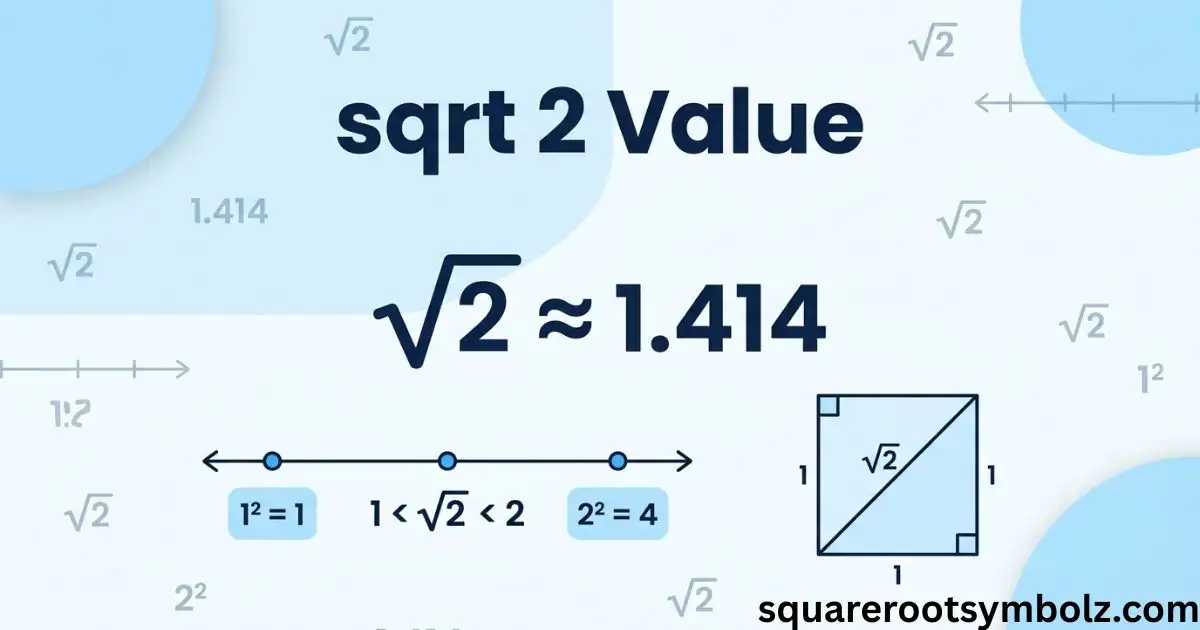
The sqrt 2 value is approximately 1.4142135623730951, while its exact form is √2. It is the positive number that produces 2 when multiplied by itself. If √2 has ever appeared in a geometry problem and seemed like a mysterious decimal, the idea becomes much easier once you connect square roots, irrational numbers, radicals, diagonals, and the Pythagorean theorem.
When teaching square roots, I find that students usually need two things first: a quick answer and a reason behind it. This guide gives both. You will see the exact form, decimal approximation, irrational-number explanation, calculation methods, geometric meaning, common comparisons, and practical examples without turning the topic into something harder than it needs to be.
What Is Square Root of 2?
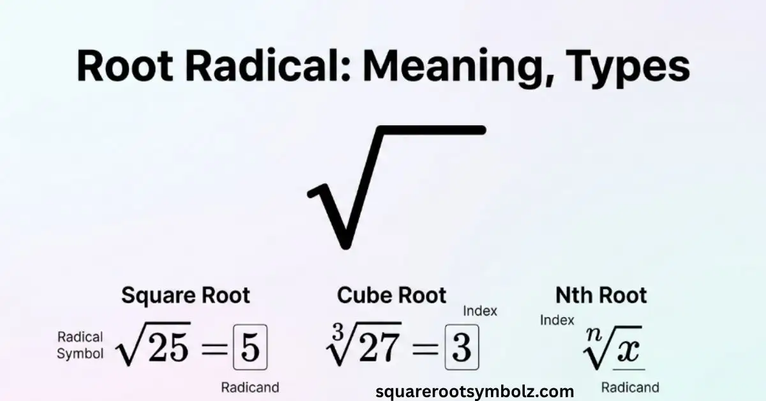
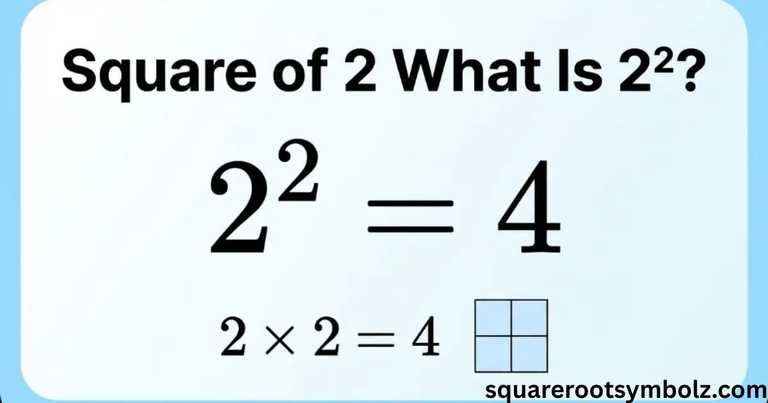
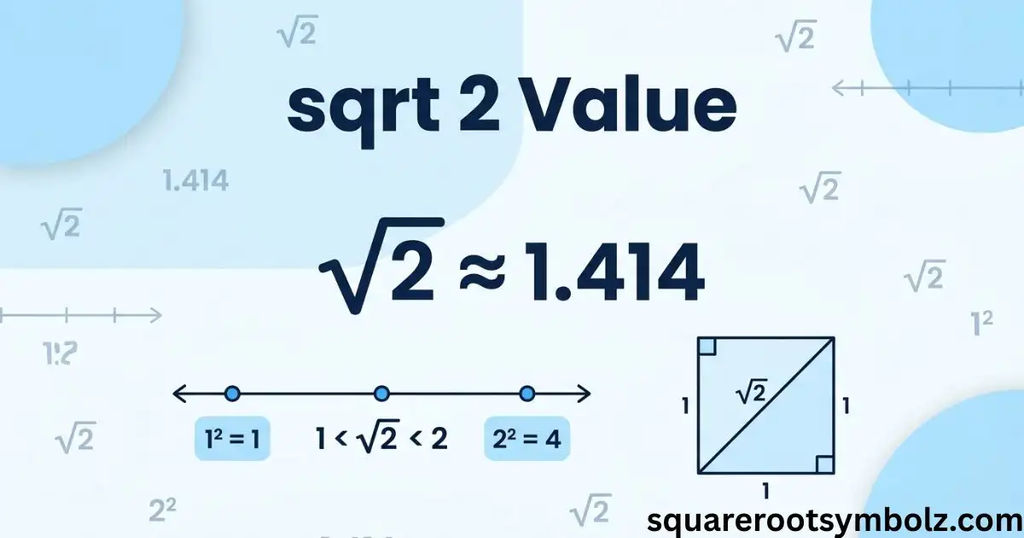
The square root of 2 is the positive real number that, when multiplied by itself, gives 2. It is written as √2 in radical form and can also be represented as 2^(1/2). Since 1² equals 1 and 2² equals 4, √2 lies between 1 and 2.
The distinction between the symbol and its decimal form matters. √2 is exact, while 1.41421356 is an approximation. The decimal continues without ending or repeating, so keeping the radical form is often the best choice when a math problem asks for an exact answer.
Key Formula for Square Root of 2
The key relationship is simple: √2 × √2 = 2. Equivalently, if x = √2, then x² = 2. This connects the square root operation directly with squaring and explains why √2 is the positive solution of x² = 2.
There is another useful form: √2 = 2^(1/2). The radical notation is usually easier for elementary calculations, while exponent notation becomes particularly useful when studying powers, fractional exponents, algebraic expressions, and more advanced mathematical operations.
Decimal Value and Fraction Approximation
The decimal expansion of √2 begins 1.4142135623730951 and continues indefinitely without repeating. For ordinary calculations, you might use 1.414, 1.41, or another rounded value depending on the requested precision. The correct approximation depends on how many decimal places the problem requires.
√2 cannot be represented exactly by a fraction of two integers because it is irrational. Fractions such as 99/70 can provide useful approximations, but they are not equal to √2. This difference between an exact irrational value and a rational approximation is important in accurate mathematical work.
| Form | Value |
| Exact radical | √2 |
| Exponent form | 2^(1/2) |
| Three decimal places | 1.414 |
| Four decimal places | 1.4142 |
| Eight decimal places | 1.41421356 |
| Approximate fraction | 99/70 |
Is the Square Root of 2 Rational or Irrational?
√2 is an irrational number. It cannot be written exactly as a fraction of two integers, and its decimal expansion is non-terminating and non-repeating. This makes it different from square roots such as √4, which equals 2 and is therefore rational.
A classic proof uses contradiction. Suppose √2 could equal a fraction a/b in lowest terms. Squaring gives a² = 2b², so a must be even. Substituting an even value for a then shows b must also be even, contradicting the assumption that a and b share no common factor.
The geometric story makes the same idea memorable. A square with sides of one unit has a diagonal of √2 units. The Pythagorean theorem gives 1² + 1² = 2, so the diagonal squared is 2. This creates a real length that cannot be expressed exactly as an ordinary fraction.
How to Find the Square Root of 2?
There are several ways to find √2, including estimation, long division, iteration, and a calculator. For a quick estimate, notice that √2 lies between 1 and 2. Since 1.4² = 1.96 and 1.5² = 2.25, the answer must fall between 1.4 and 1.5.
For a more precise manual answer, the long division method generates decimal digits one at a time. Another approach repeatedly improves an estimate by averaging the estimate with 2 divided by that estimate. These methods explain where 1.41421356… comes from rather than treating it as a number to memorize.
Square Root of 2 by Long Division Method
To begin, write 2 as 2.00 00 00 and take 1 because 1² is the largest perfect square not exceeding 2. Subtract 1 from 2, bring down a pair of zeros, and continue the square-root division process to generate additional decimal digits.
The first decimal digit is 4, giving 1.4. Continuing the same process produces 1.41, then 1.414, and progressively more accurate values. The method is useful when a calculator is unavailable or when a classroom problem specifically asks you to demonstrate the calculation.
Square Root of 2 by Estimation and Approximation Method
A fast estimation method starts with nearby perfect squares. Because 1² = 1 and 2² = 4, √2 must lie between 1 and 2. Trying 1.4 gives 1.96, which is slightly low, while 1.5 gives 2.25, which is high.
You can refine the estimate by choosing a value between 1.4 and 1.5. For example, 1.414 is extremely close because its square is close to 2. Repeated averaging can improve the estimate further, eventually approaching 1.41421356237 without requiring you to memorize every digit.
Where is Square Root of 2 Used?
√2 appears naturally in geometry because the diagonal of a square equals its side length multiplied by √2. It also occurs in trigonometry, where sin 45° and cos 45° both equal √2/2. These relationships make √2 much more than a decimal approximation.
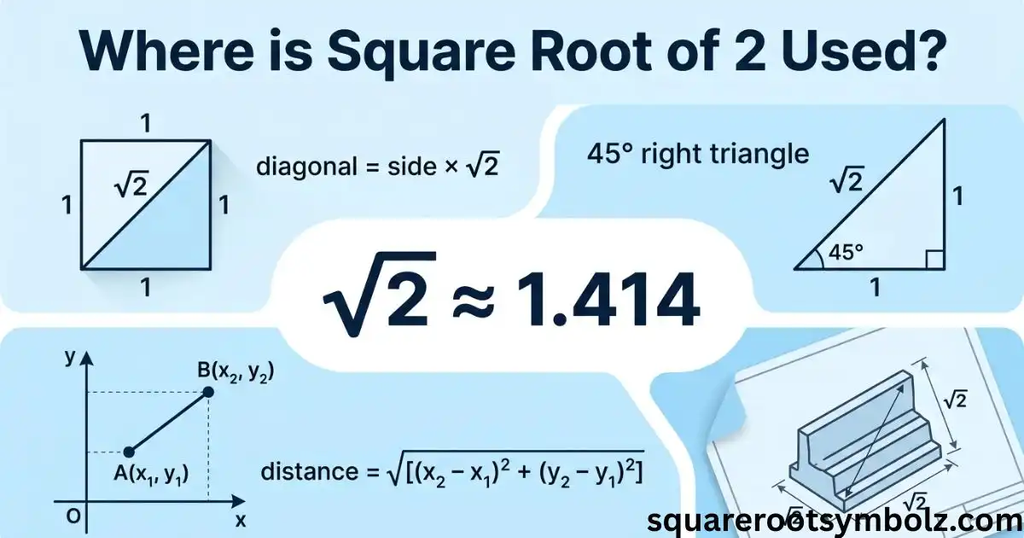
You can also encounter √2 in paper-size standards, engineering calculations, construction layouts, coordinate geometry, and root mean square calculations. The common thread is distance, right triangles, or square-based measurements. Once you recognize the geometry behind √2, many formulas become easier to understand.
Visual Representation on the Number Line
You can construct √2 geometrically with a right triangle. Draw two perpendicular sides, each one unit long. The hypotenuse has length √2 because the Pythagorean theorem gives 1² + 1² = 2. That length can then be transferred onto a number line.
This construction is useful because it shows that an irrational number can still represent an exact geometric length. √2 is not merely an endless decimal on a calculator screen. It is a precise distance that can be constructed using simple geometric tools.
Comparison: Square Root of 2 vs Other Roots
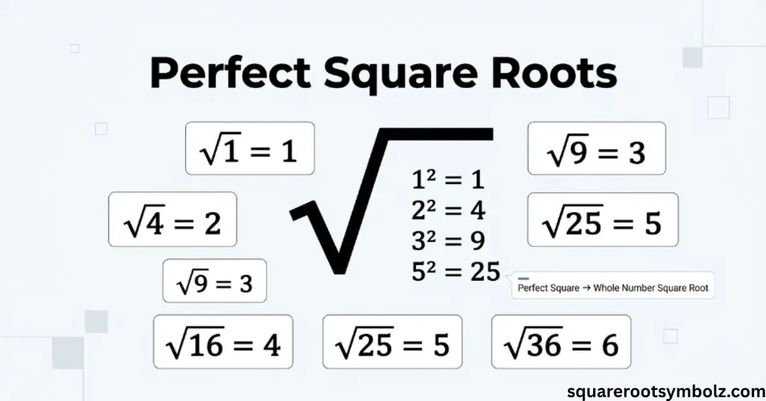
Comparing neighboring square roots helps put √2 into perspective. √1 equals 1, √2 is approximately 1.4142, √3 is approximately 1.7321, and √4 equals 2. The middle two values are irrational, while √1 and √4 are rational.
| Square root | Decimal value | Number type |
| √1 | 1 | Rational |
| √2 | 1.41421356… | Irrational |
| √3 | 1.73205080… | Irrational |
| √4 | 2 | Rational |
This comparison also explains why √2 cannot be simplified to a whole number. Two is not a perfect square. There is no integer that can be multiplied by itself to produce exactly 2, so the radical remains √2 in simplest form.
Conclusion
The sqrt 2 value is exactly √2 and approximately 1.4142135623730951. It is an irrational number, so its decimal expansion never terminates or repeats. The most useful way to understand it is to connect the radical with its square, the diagonal of a unit square, and the Pythagorean theorem.
For quick work, remember √2 ≈ 1.414. For exact mathematics, keep √2. Whether you are calculating a diagonal, studying irrational numbers, working with trigonometry, or solving an algebra problem, that distinction will help you choose the right form of the answer.
FAQs
What is the value of square root of 2?
The exact value is √2, while its decimal approximation is 1.4142135623730951. If a problem asks for three decimal places, use 1.414. The appropriate number of decimal places depends on the precision requested.
Is √2 a rational or irrational number?
√2 is irrational. It cannot be expressed exactly as a ratio of two integers, and its decimal expansion continues indefinitely without repeating. This can also be demonstrated through the classic proof by contradiction.
How do you calculate the square root of 2?
You can calculate √2 by estimation, long division, iteration, or a calculator. Estimation quickly places the answer between 1 and 2, while long division or repeated averaging produces progressively more accurate decimal digits.
Why is the square root of 2 important in Maths?
√2 connects arithmetic with geometry, algebra, and trigonometry. It represents the diagonal of a unit square, appears in 45-degree trigonometric values, and provides one of the classic examples of an irrational number.
What is the square of √2?
The square of √2 is 2. This follows directly from the definition of a square root: √2 is the positive number whose square equals 2.
What is √2 in fraction form?
There is no exact fraction equal to √2 because √2 is irrational. Fractions such as 99/70 can approximate it, but they should not be treated as the exact value.
Is the number 2 a perfect square?
No. A perfect square is an integer that can be written as another integer multiplied by itself. Since no integer squared equals 2, 2 is not a perfect square.
What is the square root of -2?
In the real-number system, √−2 has no real value. In the complex-number system, it can be written as i√2, where i represents the imaginary unit and i² = −1.
What is the value of 17√2?
Using √2 ≈ 1.41421356, multiply 17 by that approximation to obtain approximately 24.04163056. If an exact answer is preferred, leave the expression as 17√2.

I’m the creator of SquareRootSymbolz.com, where I publish easy-to-understand guides on symbols, Unicode characters, Alt codes, keyboard shortcuts, and copy-and-paste text symbols. My goal is to provide accurate, well-researched, and user-friendly content that helps readers quickly find the information they need.