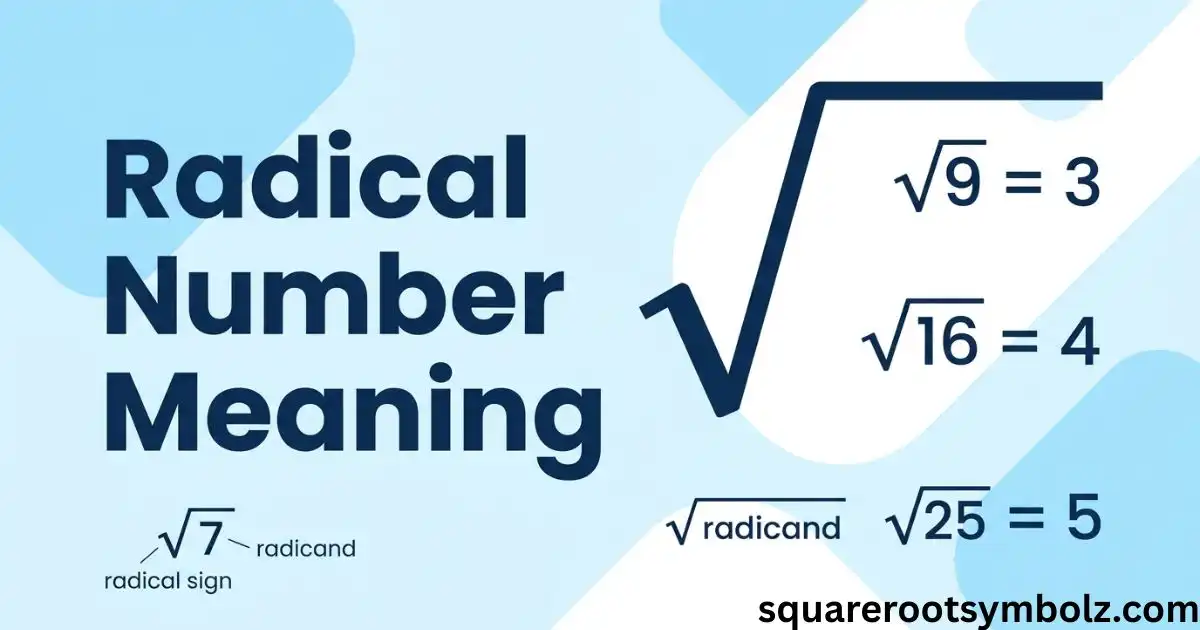
A radical number is a number or mathematical expression involving a root, such as a square root, cube root, or nth root. In a radical expression like √18, the √ symbol is the radical, 18 is the radicand, and the root tells you what value produces the number inside. If radicals have ever looked like complicated checkmarks and mystery numbers, the good news is that their structure is quite logical. Once you understand the radical symbol, index, radicand, perfect squares, and basic radical rules, simplifying and solving these expressions becomes much easier.
In school algebra, people often use “radical number” to describe numbers written with roots, especially expressions such as √2, √18, and ³√5. Some are rational, while others are irrational. A useful distinction is that a radical is notation for a root, while a radical expression contains that notation as part of a mathematical expression. This guide breaks down the terminology, shows practical examples, explains simplification, and addresses the mistakes that commonly cause confusion.
Definition of a Radical
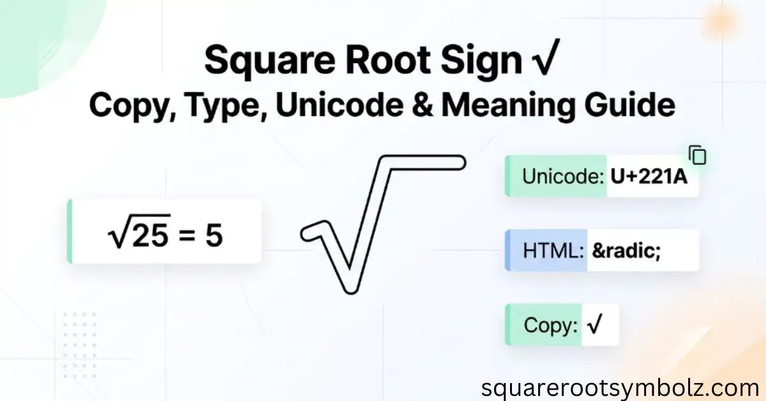
A radical is the notation used to represent a root. The familiar symbol is √, while a small number called the index can appear at the upper-left of the symbol to specify the root. For example, √25 represents a square root, while ³√27 represents a cube root.
The number or expression underneath the radical symbol is called the radicand. The index tells you which root to find. When no index is written, the index is understood to be 2. Therefore, √a means the square root of a, while ³√a means the cube root of a.
Radical, radicand, and index
Think of a radical expression as having separate parts. In ³√64, the √-style symbol is the radical, 3 is the index, and 64 is the radicand. Because 3 is the index, you are looking for the number that produces 64 when multiplied by itself three times. That number is 4.
Examples of Radicals
Simple examples make the terminology easier to recognize. √16 = 4 because 4 × 4 = 16. Similarly, ³√8 = 2 because 2 × 2 × 2 = 8. A fourth root can also be written, such as ⁴√81 = 3 because 3 × 3 × 3 × 3 = 81.
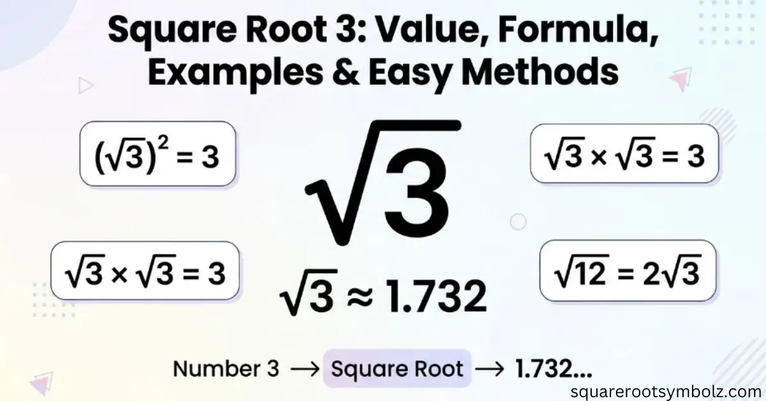
Radicals can contain variables as well as numbers. For example, √x is a square-root expression, while 2√3 + √12 contains two radical terms. A radical number does not have to be an integer. √2, for instance, is an irrational number, while √9 = 3 is rational.
| Radical | Root type | Value |
| √16 | Square root | 4 |
| √25 | Square root | 5 |
| ³√8 | Cube root | 2 |
| ⁴√81 | Fourth root | 3 |
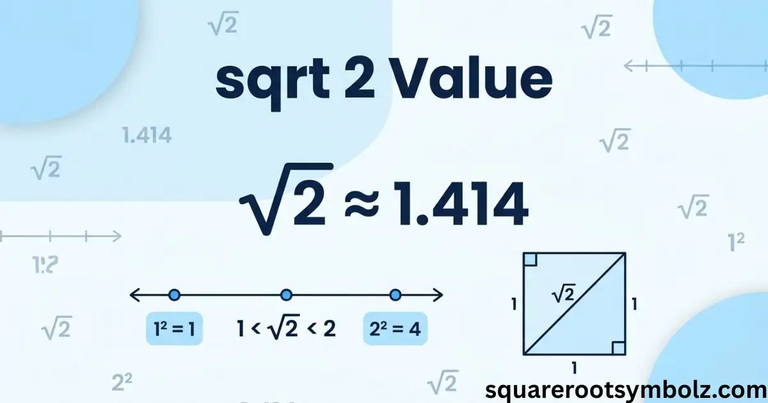
| √2 | Square root | Approximately 1.414 |
Perfect Squares and Simplifying Radicals
A perfect square is an integer that results from multiplying an integer by itself. Examples include 1, 4, 9, 16, 25, 36, and 49. When a radicand is a perfect square, its square root can be simplified to an integer. For example, √36 = 6 because 6 × 6 = 36.
When the radicand is not a perfect square, look for the largest perfect-square factor. Consider √18. Since 18 = 9 × 2, rewrite it as √9 × √2. The √9 becomes 3, leaving 3√2. This is the simplified radical form because √2 cannot be reduced to an integer.
How to simplify a radical
Start by factoring the radicand and searching for a perfect square, perfect cube, or other perfect power that matches the index. For √72, use 72 = 36 × 2. Therefore, √72 = √36 × √2 = 6√2. The goal is to remove every factor that can be taken completely outside the radical.
Multiplying and Dividing Radicals
Radicals can often be multiplied by combining their radicands when the root degree is compatible. For example, √2 × √3 = √6. Likewise, √5 × √5 = √25 = 5. When coefficients appear outside the radical, multiply those coefficients separately and then simplify the radical portion.
Division follows a related pattern. For compatible square roots, √a ÷ √b can be written as √(a ÷ b), provided the expressions meet the required conditions. For example, √16 ÷ √25 = 4 ÷ 5 = 4/5. Always simplify the final expression rather than stopping at an unsimplified radical.
Multiplication Rule:
For nonnegative real numbers, the product property allows √a × √b to be written as √(ab). For example, √3 × √12 = √36 = 6. This rule is especially useful when simplifying expressions because it lets you combine or separate factors strategically.
Division Rule:
For suitable nonnegative values with a nonzero denominator, √a ÷ √b can be expressed as √(a/b). For example, √36 ÷ √4 = √9 = 3. When a radical remains in the denominator of a fraction, another algebraic step may be needed to rationalize the denominator.
Adding and Subtracting Radicals
You cannot simply add two radicals because they both contain square-root symbols. Radicals must first be simplified, and only like radicals can be combined. Like radicals have the same index and the same simplified radicand. For example, 2√3 + 5√3 = 7√3.
Consider √12 + √3. These do not initially look alike, but √12 can be simplified to 2√3. The expression becomes 2√3 + √3, which equals 3√3. By contrast, √2 + √3 cannot be combined into √5. That shortcut is a common algebra mistake.
Radicals and Exponents
Radicals and fractional exponents describe the same mathematical relationship in different forms. A square root corresponds to an exponent of 1/2, while a cube root corresponds to an exponent of 1/3. More generally, an nth root corresponds to an exponent of 1/n.
For example, √x can be written as x^(1/2), and ³√x can be written as x^(1/3). If a power appears inside the radical, the exponent becomes the numerator of the fractional exponent. This connection becomes particularly useful when simplifying expressions and working with more advanced algebra and calculus.
| Radical form | Exponent form |
| √x | x^(1/2) |
| ³√x | x^(1/3) |
| ⁴√x | x^(1/4) |
| ⁵√x² | x^(2/5) |
Solving Equations with Radicals
A radical equation contains a variable inside a radical expression. A common strategy is to isolate the radical first and then raise both sides to the power represented by the index. For √x = 5, square both sides to obtain x = 25. The method is straightforward, but checking the answer is essential.
Checking matters because raising both sides to an even power can introduce an extraneous solution. After solving, substitute the candidate answer into the original equation. This simple habit catches answers that work in the transformed equation but fail in the original one. It is one of the most important habits when solving radical equations.
Example: Solving √(x + 3) = 5
First isolate the radical, which is already alone. Square both sides: x + 3 = 25. Subtract 3 from both sides to obtain x = 22. Finally, substitute 22 into the original equation: √25 = 5. Because the original equation is true, x = 22 is the solution.
Common Mistakes to Avoid
One common mistake is combining unlike radicals. √2 + √3 does not equal √5. Another is forgetting to simplify a radical before combining terms. For example, √12 + √3 should first become 2√3 + √3, which simplifies to 3√3.
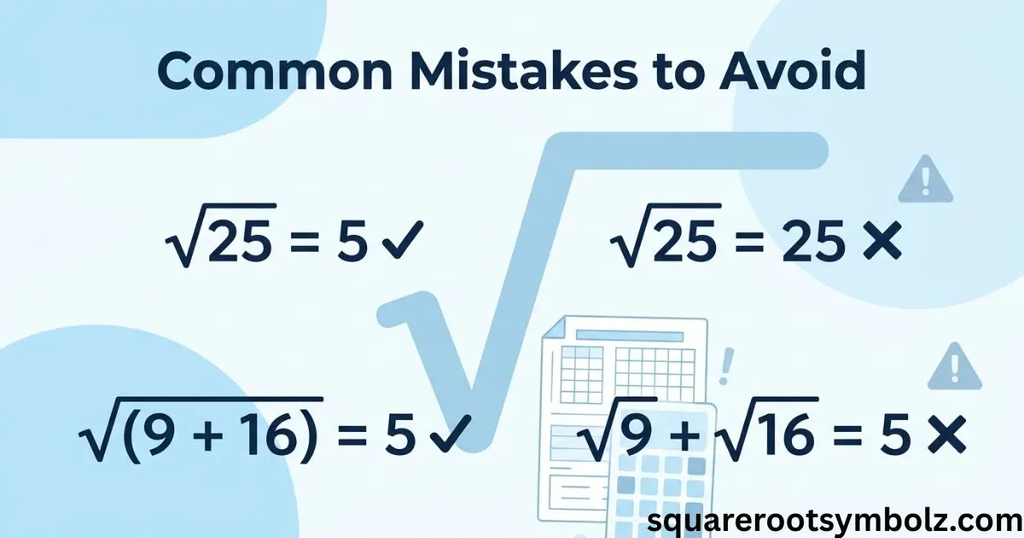
Another frequent error occurs when squaring expressions containing addition. For example, (√x + 2)² is not simply x + 4. The middle term matters. Students also sometimes forget to check radical equations after squaring or leave an expression such as √50 unsimplified even though it can become 5√2.
| Mistake | Correct idea |
| √2 + √3 = √5 | Unlike radicals cannot be combined |
| √12 = 12 | √12 = 2√3 |
| (a + b)² = a² + b² | Include the middle term 2ab |
| Stop after squaring an equation | Check the result in the original equation |
| Leave √50 unchanged | Simplify it to 5√2 |
Conclusion
A radical number is commonly used in school mathematics to describe a number or expression involving a root, such as √2, √18, or ³√5. Understanding the radical symbol, radicand, index, root degree, and radical expression gives you the foundation needed to simplify and manipulate these numbers confidently.
The most useful habit is to look at the structure before calculating. Identify the index, identify the radicand, check for perfect powers, simplify when possible, and use the correct rule for addition, subtraction, multiplication, or division. With that approach, radicals stop looking mysterious and become another organized part of algebra.
FAQs
What is a radical number?
A radical number is commonly used to describe a number or expression written with a root, such as √2, √18, or ³√5. The term is often used in school algebra, although “radical” more precisely refers to the root notation or radical expression.
What is the difference between a radical and a radicand?
The radical is the root notation or radical symbol, while the radicand is the number or expression inside the radical. In √50, √ is the radical symbol and 50 is the radicand.
What is the index of a radical?
The index tells you which root to take. In ³√27, the index is 3, so you are finding the cube root. In √27, the index is understood to be 2.
How do you simplify a radical?
Factor the radicand and look for a perfect power that matches the index. For √18, use 18 = 9 × 2. Then √18 = √9 × √2 = 3√2.
Can you add or subtract radicals?
Yes, but only like radicals can be combined after simplification. For example, 2√5 + 3√5 = 5√5. However, √2 + √3 cannot be combined into a single radical term.
How do you multiply radicals?
For compatible radicals, multiply the radicands and then simplify. For example, √3 × √12 = √36 = 6. If coefficients are present, multiply the coefficients separately.
How do you divide radicals?
For suitable radicals, divide the radicands or simplify the fraction under one radical. For example, √25 ÷ √4 = √(25/4) = 5/2.
Are radical numbers irrational?
Not always. Some radicals produce rational numbers. For example, √25 = 5. Others are irrational, such as √2. Therefore, the presence of a radical does not automatically mean the result is irrational.
Can a radical have a negative number inside it?
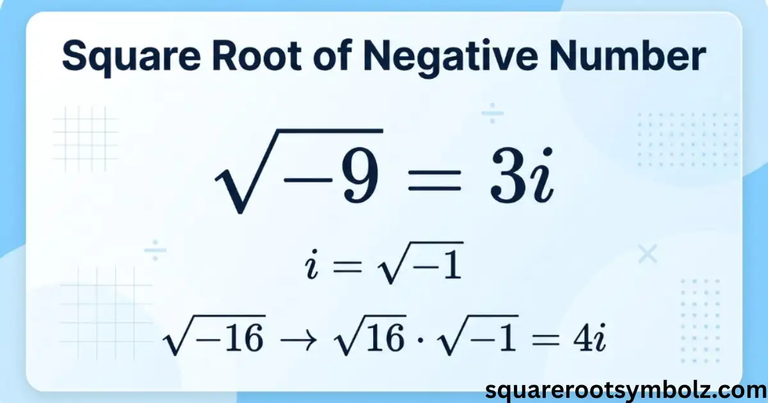
For real numbers, an even root such as a square root cannot have a negative radicand and produce a real result. Odd roots, such as cube roots, can have negative radicands. In complex numbers, square roots of negative numbers can also be represented using the imaginary unit i.
How are radicals related to exponents?
A radical can be represented with a fractional exponent. A square root corresponds to an exponent of 1/2, while a cube root corresponds to 1/3. More generally, an nth root corresponds to an exponent of 1/n.

I’m the creator of SquareRootSymbolz.com, where I publish easy-to-understand guides on symbols, Unicode characters, Alt codes, keyboard shortcuts, and copy-and-paste text symbols. My goal is to provide accurate, well-researched, and user-friendly content that helps readers quickly find the information they need.