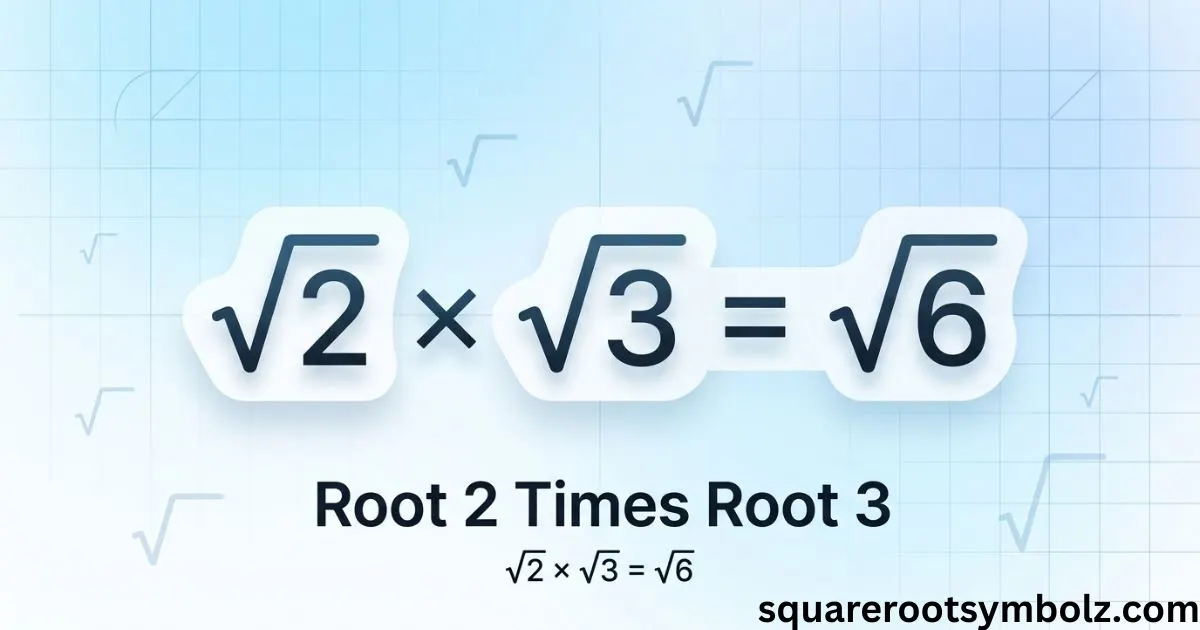
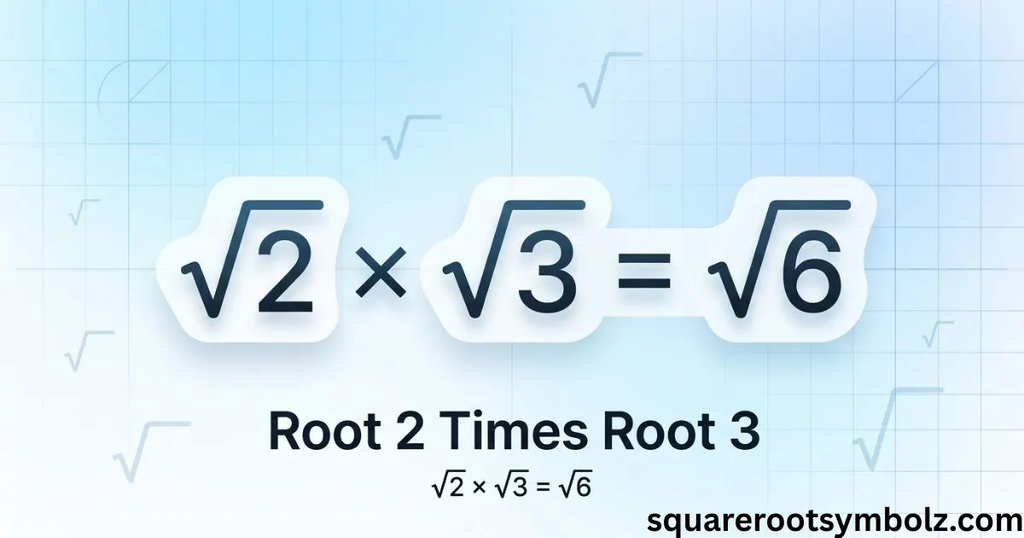
Root 2 times root 3 equals √6. In symbols, √2 × √3 = √6. The reason is the product rule for square roots: when nonnegative numbers are multiplied under square roots, their radicands can be multiplied together. So 2 × 3 becomes 6, leaving the answer as √6.
If you have ever wondered whether you should multiply the roots, add the numbers, or somehow turn the answer into 6, this is a very common algebra question. The cleanest approach is to recognize the radical expression, combine the radicands, and then check whether the resulting square root can be simplified further. Here, √6 is already in simplest exact form.
Solution
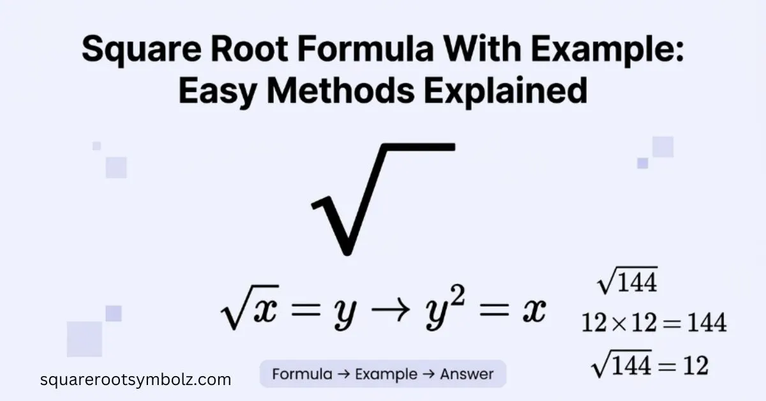
The expression √2 × √3 contains two square roots being multiplied. The numbers underneath the radical signs are called radicands. Because the radicands are nonnegative, the multiplication property allows the expression to be combined into one square root: √2 × √3 = √(2 × 3).
Now multiply the numbers inside the radical. Since 2 × 3 = 6, the expression becomes √6. This is the exact answer. You should not write 6 because the square root operation has not disappeared. The result is √6, which is an irrational number.
Multiplying surds
Root 2 times root 3 When multiplying surds, multiply the coefficients outside the radical and multiply the radicands inside the radical. In the simple expression √2 × √3, there are no outside coefficients, so only 2 and 3 need to be multiplied. This gives √(2 × 3), or √6.
The general pattern is a√b × c√d = ac√(bd) when the expressions are in the usual real-number setting. For example, 2√3 × 4√5 becomes 8√15. The important habit is to handle the ordinary coefficients and the radical parts separately before simplifying the final result.
Example 1 – multiplying surds
For Root 2 times root 3, combine the two radicals first: √2 × √3 = √(2 × 3). Then multiply 2 by 3 to obtain 6, giving √6. Because 6 has no perfect-square factor greater than 1, √6 cannot be simplified into a smaller radical.
A quick decimal check confirms the result. √2 is approximately 1.41421 and √3 is approximately 1.73205. Their product is approximately 2.44949, which matches √6. Symbolab reports a decimal value of about 2.44948 on its solution page, while Mathway gives the same exact result as √6.
Why √6 cannot be simplified further
To simplify a square root, look for a perfect-square factor inside the radicand. Numbers such as 4, 9, 16, and 25 can produce factors that come outside a radical. Since 6 equals 2 × 3, it contains no perfect-square factor other than 1, so √6 remains unchanged.
Why the answer is not 6
A common mistake is to multiply the numbers under the roots and then forget the radical sign. Although 2 × 3 equals 6, the original expression is √2 × √3, not 2 × 3. The multiplication rule produces √6, so the square-root operation remains part of the answer.
Why you cannot write √5
Another common error is adding the radicands instead of multiplying them, producing √5. That would be appropriate for neither multiplication nor the square-root product rule. When multiplying √2 by √3, multiply the radicands: 2 × 3 = 6. Therefore, the result is √6, not √5.
Exact Form:
The exact form of root 2 times root 3 is √6. Exact notation is valuable because √6 represents the value without rounding. Its decimal expansion continues indefinitely without repeating, so writing 2.44949 is only an approximation rather than the exact mathematical value.
This distinction matters in algebra and higher mathematics. If a problem asks for an exact answer, √6 is preferred over a rounded decimal. Keeping the radical also makes later algebraic manipulation easier because the expression retains its precise mathematical relationship.
| Expression | Exact result | Approximate value |
| √2 | √2 | 1.41421… |
| √3 | √3 | 1.73205… |
| √2 × √3 | √6 | 2.44949… |
The exact form also makes the multiplication rule visible. You can immediately see that the product of the two square roots has been combined into one square root. That is much more informative than replacing the entire expression with a rounded decimal.
Decimal Form:
Root 2 times root 3 The decimal form of √6 is approximately 2.44948974278. For most school calculations, it may be rounded to 2.44949 or 2.45 depending on the required precision. The decimal is useful when comparing numerical sizes or entering an answer into a calculator.
The exact radical should normally be kept until the final stage of a calculation. Rounding √6 too early can introduce small errors, especially when the result is later multiplied, divided, or used in another formula. Keeping √6 preserves the original value throughout the calculation.
For a quick verification, calculate √2 and √3 separately and multiply their decimal approximations. You get approximately 1.41421 × 1.73205 = 2.44949. That agrees with √6, giving a simple numerical check without replacing the exact answer.
FAQs
What is sqrt(2)× sqrt(3) ?
√2 × √3 = √6. Apply the product rule for square roots, multiply the radicands 2 and 3, and keep the radical: √(2 × 3) = √6. The result cannot be simplified further because 6 has no perfect-square factor greater than 1.
What is root 2 times root 3 in decimal form?
√2 × √3 = √6 ≈ 2.44949. The radical form √6 is exact, while 2.44949 is a rounded decimal approximation.
Can you multiply square roots together?
Yes. For nonnegative real numbers, the product rule allows √a × √b to be written as √(ab). Therefore, √2 × √3 becomes √6.
Can √6 be simplified?
No. The number 6 has no perfect-square factor greater than 1. Therefore, √6 is already in simplest radical form.
Is √2 × √3 equal to √5?
No. The radicands are multiplied, not added. Therefore, √2 × √3 = √6, whereas √2 + √3 cannot be simplified by turning it into √5.
Are √2 and √3 surds?
Yes. Both √2 and √3 are irrational radical expressions commonly treated as surds. Their decimal expansions do not terminate or repeat. RMIT uses √2 and √3 among its examples of surds.
What happens if there are coefficients?
Multiply the coefficients separately and multiply the radicands together. For example, 2√3 × 4√5 = 8√15. RMIT gives this same general multiplication pattern for surds.
Does the multiplication rule work for every square root?
For real-number square roots, the standard product rule applies when the radicands are nonnegative. The condition matters because ordinary real square roots are defined for nonnegative inputs.

I’m the creator of SquareRootSymbolz.com, where I publish easy-to-understand guides on symbols, Unicode characters, Alt codes, keyboard shortcuts, and copy-and-paste text symbols. My goal is to provide accurate, well-researched, and user-friendly content that helps readers quickly find the information they need.