The cube symbol ³ is the raised number three used to show that a number or measurement is cubed, such as 2³, x³, cm³, or m³. It is officially named SUPERSCRIPT THREE in Unicode and has the code point U+00B3. If you have ever searched for the right symbol, struggled with an Alt code, or wondered whether ³ is the same as superscript formatting, this guide gives you the answer quickly and clearly.
For students, teachers, writers, programmers, and anyone working with mathematical notation, the small raised 3 can save a surprising amount of frustration. You can copy ³ directly, type it with a Windows Alt code, insert it in Word or Google Docs, or use Unicode and HTML codes. The important thing is knowing when you need the actual character and when ordinary superscript formatting is better.
Copy and paste the cubed symbol
³
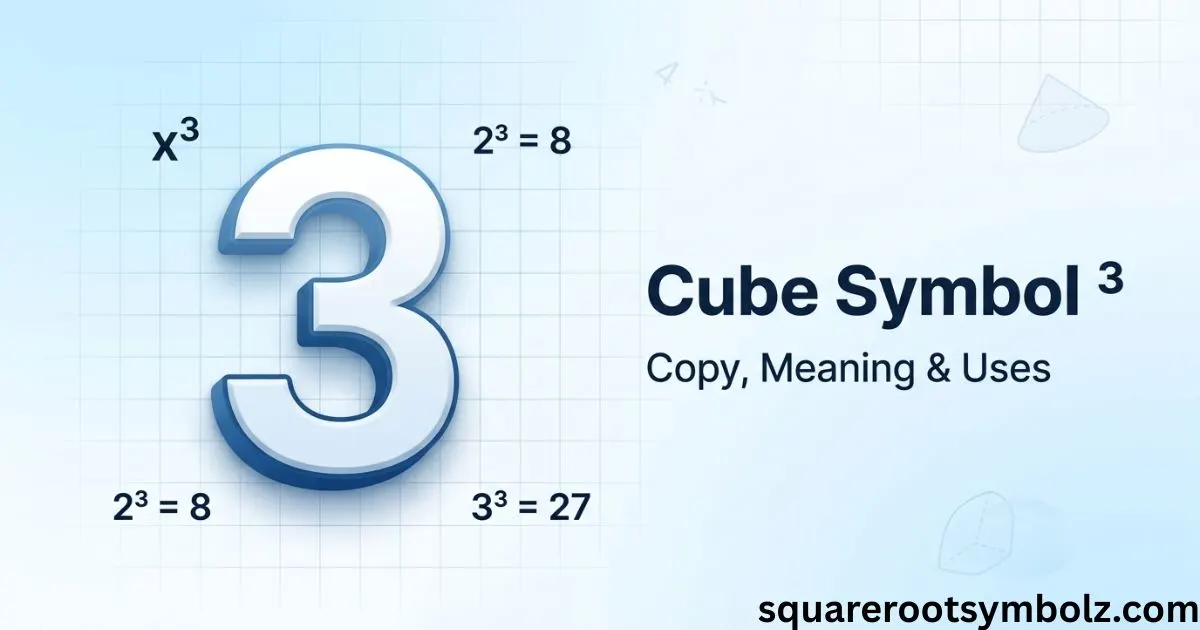
Copy this character directly and paste it wherever you need it. The symbol is called superscript three, and it represents a value raised to the third power. For example, 2³ means 2 × 2 × 2, which equals 8. In measurement, m³ means cubic meters and cm³ means cubic centimeters.
| Character | Name | Unicode | Windows Alt Code | HTML |
| ³ | Superscript Three / Cubed | U+00B3 | Alt + 0179 | ³ |
| ² | Superscript Two / Squared | U+00B2 | Alt + 0178 | ² |
| ¹ | Superscript One | U+00B9 | Alt + 0185 | ¹ |
The cube symbol is especially useful when plain text does not provide mathematical formatting. Instead of writing cm3, you can write cm³. Instead of 5 cubed, you can write 5³. That small raised character makes mathematical meaning immediately visible and is widely used in schoolwork, science, engineering, measurement, and everyday technical writing.
How to type the cubed symbol on any device
The easiest method depends on your device. Windows users can use the numeric-keypad Alt code, while Mac users can open Character Viewer. Microsoft Word and Google Docs also provide superscript tools, and mobile users can usually copy the character when their default keyboard does not provide it.
There is an important distinction between ³ as a Unicode character and a normal 3 with superscript formatting. They may look almost identical, but they are technically different. The character is useful for plain text and units, while formatting is often preferable when creating mathematical expressions with several different exponents.
Type ³ on Windows
On a Windows keyboard with a numeric keypad, place the cursor where you want the cube symbol, turn on Num Lock, hold Alt, type 0179 on the numeric keypad, and release Alt. The character should appear as ³. The number row above the letters generally is not the same as the numeric keypad for this traditional Alt-code method.
If you are using a laptop without a separate numeric keypad, the Alt-code method may not be convenient. In that situation, copying ³, using Microsoft Word’s Unicode conversion, or opening a character map can be easier. For frequent work with mathematical notation, saving the character somewhere convenient can also eliminate repeated searching.
Type ³ on Mac
Mac users can insert the cube symbol through the built-in Character Viewer. Open Character Viewer with Control + Command + Space, search for “superscript three,” and select ³. This inserts the actual character rather than merely making an ordinary number look raised.
Another option is to type a normal 3 and apply superscript formatting when working inside a document. That approach is useful for expressions such as x³, especially when you need different exponents throughout the same equation. For plain text, however, the Unicode character remains a convenient choice.
Type ³ on iPhone and Android
Phones do not always provide ³ directly on their default keyboards, so copying and pasting is often the quickest solution. Copy ³ from a trusted symbol reference, place your cursor in the desired text field, and paste it. This works well for messages, notes, captions, documents, and online forms.
Some third-party keyboards or specialized mathematical keyboards may provide superscript characters directly. If yours does not, there is no need to recreate the symbol manually. Keep a copy of ³ in a note or use a text replacement shortcut if you frequently write cubic units such as m³, cm³, or ft³.
Type ³ in Microsoft Word
Microsoft Word provides two useful approaches. To insert the actual Unicode character, type 00B3 and press Alt + X. Word converts the hexadecimal code into ³. This is particularly useful when you need the real character rather than merely changing the appearance of a normal 3.
You can also type a normal 3, select it, and use Word’s superscript formatting command. This works for any exponent, not only three. For example, a writer can create x³, x⁴, or x⁵ using the same formatting concept. The best method depends on whether the content needs a literal Unicode character or editable mathematical formatting.
Type ³ in Excel and Google Sheets
In Excel, you can insert the character directly or use superscript formatting when creating labels and text. A Unicode-aware formula can also generate the character using its numeric value. Remember that inserting ³ as text does not automatically perform a mathematical cube operation.
When you actually want to calculate a cube in a spreadsheet, use the spreadsheet’s mathematical syntax instead. For example, a formula such as =2^3 calculates 8. The character ³ is primarily notation; the caret and spreadsheet functions perform the calculation.
Type ³ in HTML and CSS
For HTML, the named entity ³ produces ³, while the numeric character reference ³ also represents the same character. For scalable mathematical markup, <sup>3</sup> can be preferable because the browser treats the 3 as normal text displayed in superscript position.
CSS can also represent the Unicode character through an escaped code point when it is needed in generated content. For websites, choose the method according to the purpose: use the literal character or entity for a fixed superscript-three character, and semantic markup when the superscript is part of structured content.
Meaning and Usage of the Cubed or Superscript Three Symbol ³
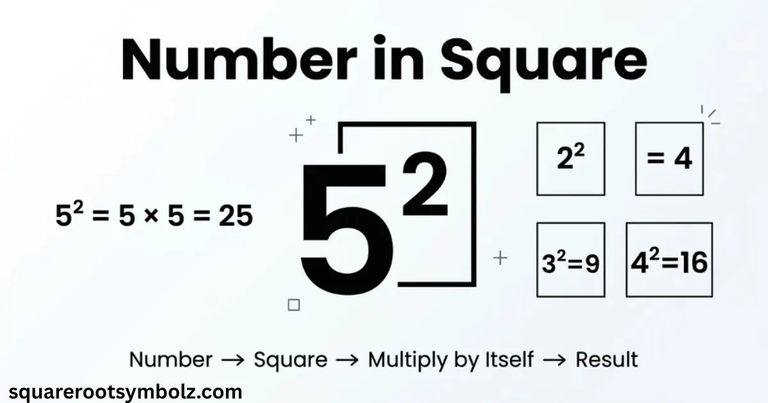
The cube symbol ³ means that the preceding number or variable is raised to the third power. Thus, 4³ means 4 × 4 × 4, giving 64. The word “cubed” comes from the geometric connection: multiplying a length by itself three times produces the volume of a cube with that length as its side.
This connection makes the notation easier to remember. A square uses two dimensions, so x² relates naturally to area. A cube uses three dimensions, so x³ relates naturally to volume. That is why you encounter the raised three in measurements such as m³, cm³, ft³, and in³ as well as in algebraic expressions such as x³.
A useful example is 3³ = 27. Imagine a cube made from small unit cubes with three units along its length, three along its width, and three along its height. The total is 3 × 3 × 3 = 27 unit cubes. The notation 3³ compresses that repeated multiplication into a small, readable symbol.
The cube symbol can also appear beside variables. In x³, x is the base and 3 is the exponent. In a³ + b³, both a and b are raised to the third power. This notation is common in algebra, geometry, calculus, physics, engineering, and scientific formulas.
The ³ character vs a formatted superscript
The visible result may look the same, but ³ and a formatted superscript 3 are not identical. The Unicode character ³ is a single encoded character. Superscript formatting instead takes an ordinary digit 3 and changes its visual position and size. This difference becomes important when text is copied, searched, converted, or processed.
For simple plain-text writing, the character ³ is convenient because it travels with the text. For equations containing many different exponents, formatting is usually more flexible. A mathematical document may need x², x³, x⁴, fractions, variables, and other structures that are easier to control through proper mathematical or text formatting.
| Feature | ³ character | Formatted 3 |
| Unicode character | Yes | No |
| Plain-text friendly | Yes | Not reliably |
| Looks raised | Yes | Yes |
| Works as a volume-unit character | Yes | Yes |
| Flexible for any exponent | Limited | Yes |
| Useful for complex equations | Less flexible | More flexible |
Unicode specifically identifies U+00B3 as SUPERSCRIPT THREE and notes that superscript two and three have long been used in general text for area and volume units. For structured mathematical content, Unicode recommends appropriate styling or markup where applicable rather than treating every superscript as a separate mathematical operator.
Cubic units: m³, cm³, and the volume they measure
A cubic unit measures volume, or the amount of three-dimensional space occupied by an object. The notation m³ means cubic meter, while cm³ means cubic centimeter. Similar forms include ft³ for cubic feet and in³ for cubic inches. The raised three tells you that the unit has been multiplied through three dimensions.
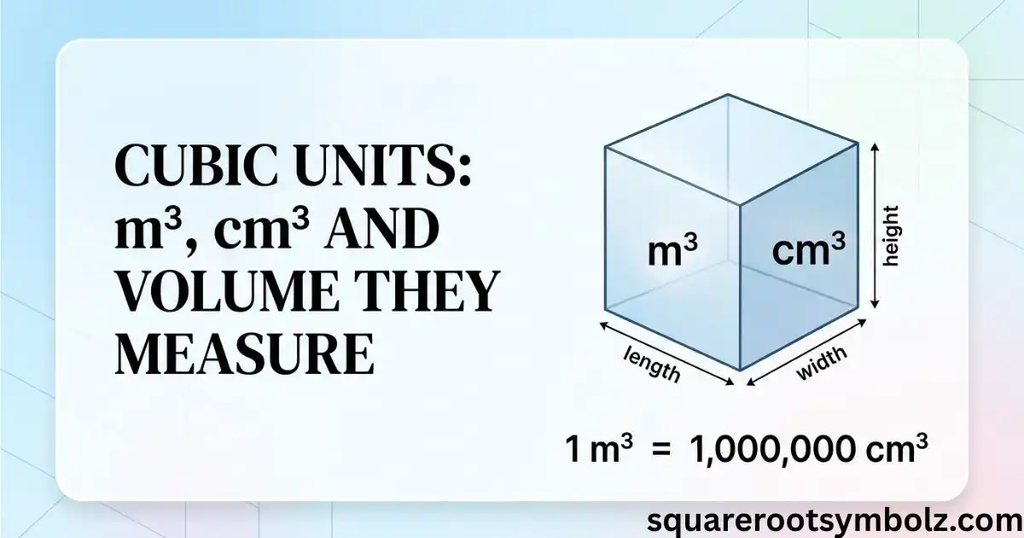
For example, a box measuring 2 meters by 2 meters by 2 meters has a volume of 8 cubic meters. The calculation is 2 × 2 × 2 = 8, so its volume can be written as 8 m³. The exponent is not decorative; it tells you that length has been applied across three dimensions.
| Symbol | Meaning | Typical context |
| m³ | Cubic meter | Large volumes |
| cm³ | Cubic centimeter | Small scientific measurements |
| ft³ | Cubic foot | U.S. customary measurements |
| in³ | Cubic inch | Small U.S. customary volumes |
| mm³ | Cubic millimeter | Very small volumes |
This is also why unit conversion becomes more dramatic for volume than for length. If one meter equals 100 centimeters, then one cubic meter contains 100 × 100 × 100 cubic centimeters, or 1,000,000 cm³. Each of the three dimensions contributes a factor of 100.
cm³, cc, and mL: one volume, three names
A particularly useful relationship is 1 cm³ = 1 cc = 1 mL. These expressions describe the same volume, although they belong to different conventions and contexts. You may see cm³ in science, cc in engine specifications, and mL in everyday measurement, cooking, or pharmacy.
For example, a container holding 5 mL has the same volume as 5 cm³. The notation changes because different fields have different habits, not because the physical amount changes. Understanding this relationship can make scientific labels, medical information, and everyday measurements much easier to interpret.
| Notation | Full name | Common context |
| cm³ | Cubic centimeter | Science and engineering |
| cc | Cubic centimeter | Engines and some older usage |
| mL | Milliliter | Everyday and medical measurement |
The raised three therefore connects mathematical notation with practical measurement. When you see cm³ on a science worksheet or m³ in an engineering document, you are looking at a volume unit built from three dimensions.
Bonus: HTML / Unicode Codes for ³ (For Websites)
The cube symbol has several useful representations for digital work. Its Unicode code point is U+00B3. In HTML, you can use the named entity ³ or the numeric reference ³. These forms allow a website author to produce the raised three without depending on a particular keyboard layout.
| Format | Code | Result |
| Character | ³ | ³ |
| Unicode | U+00B3 | ³ |
| HTML named entity | ³ | ³ |
| HTML decimal | ³ | ³ |
| HTML superscript markup | <sup>3</sup> | ³ |
For a simple symbol such as cm³, the character or HTML entity is straightforward. For more complex mathematical expressions, semantic markup or a dedicated mathematical representation may provide better control. The choice should follow the purpose of the content rather than simply using whichever code looks shortest.
One important point is that ³ is not an ASCII character. It belongs to Unicode, which is why Unicode-aware software can display it consistently across modern websites, documents, and applications. If an older system cannot display it correctly, an encoding or font problem may be responsible.
Troubleshooting
If the cube symbol appears as an empty box, question mark, or strange characters, the problem is usually not the mathematics. It may be caused by a missing font glyph, incorrect character encoding, or an application that does not handle the character correctly.
If Alt + 0179 does not work in Windows, check that Num Lock is enabled and that you are using the numeric keypad. If your keyboard does not have one, use copy and paste or a Unicode-compatible application instead. Word’s 00B3 + Alt + X method can also be useful.
If ³ turns into an ordinary 3 after pasting, check whether you copied a formatted superscript rather than the actual Unicode character. Formatting can disappear when text moves between applications, while the literal ³ character remains part of the text.
FAQs
How do I type the cube symbol?
For the actual ³ character on Windows, hold Alt and type 0179 using the numeric keypad. In Word, type 00B3 and press Alt + X. On Mac, open Character Viewer and search for “superscript three.” On mobile, copying and pasting ³ is often simplest.
Is ³ the same as superscript 3?
Not exactly. ³ is a Unicode character named SUPERSCRIPT THREE. Superscript formatting takes an ordinary digit 3 and visually raises it. They can look nearly identical, but they behave differently when text is copied, searched, or stripped of formatting.
What does ³ mean in math?
The cube symbol means that the preceding number or variable is raised to the third power. For example, 5³ means 5 × 5 × 5, which equals 125. It is also called cubed notation or the third power.
What does m³ mean?
m³ means cubic meter, a unit of volume. It describes the amount of three-dimensional space equivalent to a cube measuring one meter along each of its three dimensions.
Is cm³ the same as mL?
Yes. 1 cm³ = 1 mL. The abbreviation cc also represents a cubic centimeter, so 1 cm³ = 1 cc = 1 mL. The different forms are used in different fields and contexts.
What is the Unicode for the cube symbol?
The Unicode code point for ³ is U+00B3. Unicode’s official name is SUPERSCRIPT THREE, with “cubed” listed as its alias.
What is the HTML code for ³?
You can write the character using ³ or ³. You can also use <sup>3</sup> when you want a normal digit displayed as a scalable superscript.
Does the cube symbol calculate a number?
No. The character ³ is notation. It shows that something is cubed, but software does not necessarily perform a calculation simply because the character appears. In programming or spreadsheets, use the appropriate exponent or power operation to calculate a cube.
Is the cube symbol the same as the cube root symbol?
No. ³ means “cubed” or raised to the third power. ∛ means “cube root.” They are related mathematical concepts but represent opposite operations.

I’m the creator of SquareRootSymbolz.com, where I publish easy-to-understand guides on symbols, Unicode characters, Alt codes, keyboard shortcuts, and copy-and-paste text symbols. My goal is to provide accurate, well-researched, and user-friendly content that helps readers quickly find the information they need.