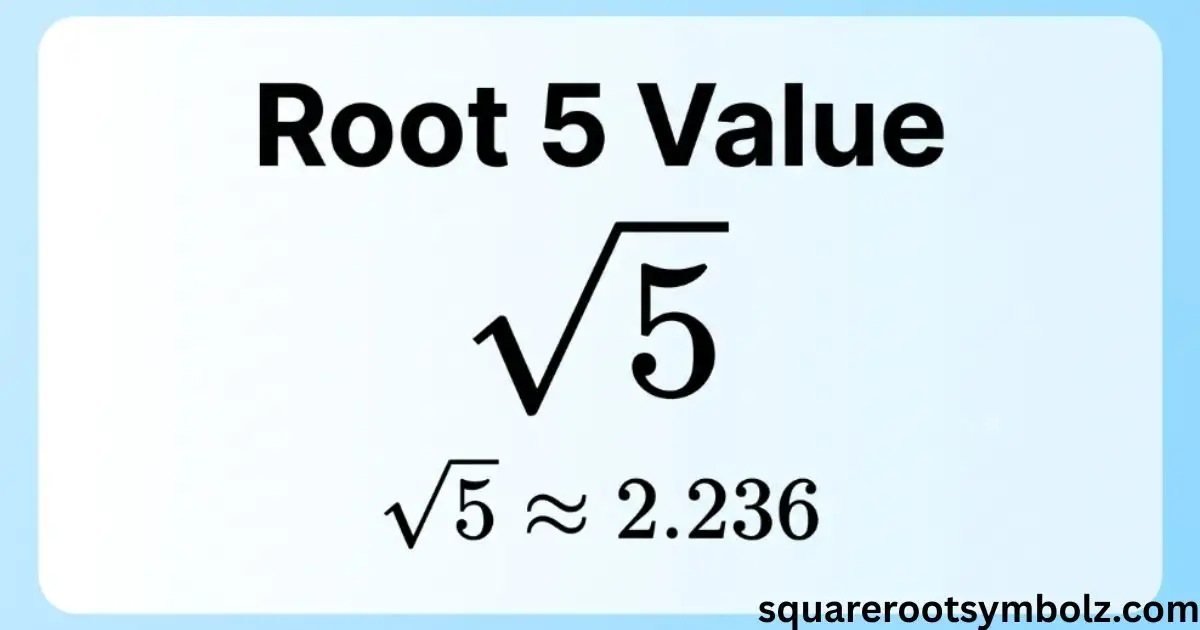
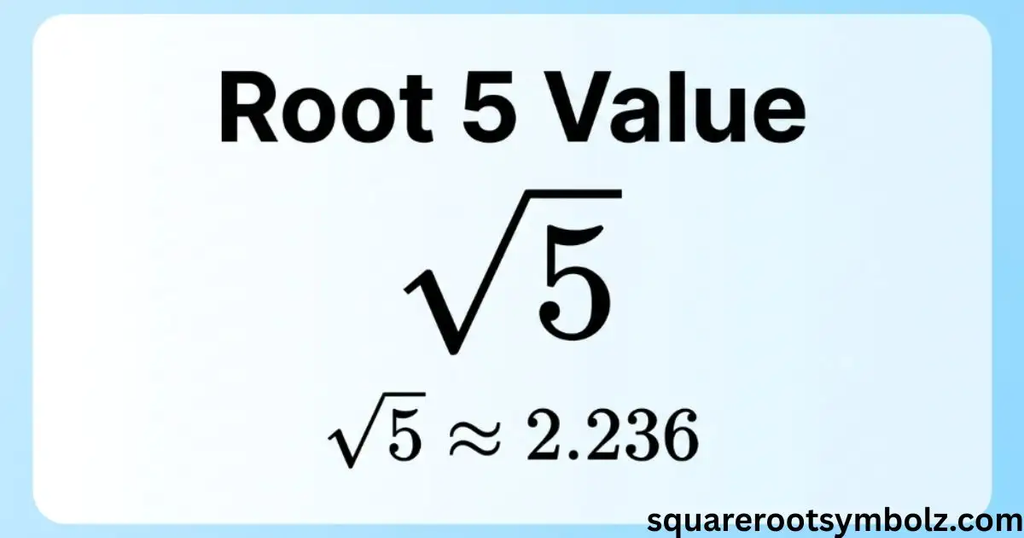
The value of root 5 is √5 ≈ 2.23606797749979, and it is an irrational real number. If you are stuck wondering why the answer never becomes a neat whole number, the reason is that 5 is prime and not a perfect square. This makes √5 a useful example of irrational numbers, square roots, radicals, and decimal approximations.
In this guide, I will explain root 5 the way I would explain it at a math board: first the exact value, then its decimal form, followed by practical calculation methods and the proof of irrationality. You will also see where √5 appears in geometry, algebra, the golden ratio, and everyday mathematical modeling.
What Is Value of Root 5?
Root 5 means the positive number that becomes 5 when multiplied by itself. It is written as √5, and its decimal value is approximately 2.23606797749979. Because 2² = 4 and 3² = 9, √5 must lie between 2 and 3. This makes estimation straightforward.
The radical form √5 is exact, while 2.236 is only an approximation. Since 5 is not a perfect square, there is no whole number whose square equals 5. The expression therefore stays under the radical sign when written in simplest form.
| Form | Root 5 |
| Radical form | √5 |
| Decimal value | 2.23606797749979… |
| Rounded to 3 places | 2.236 |
| Rounded to 4 places | 2.2361 |
| Type | Irrational |
| Number type | Real |
| Between | 2 and 3 |
| Simplest radical form | √5 |
A useful check is to square the approximation. Using enough digits gives a result extremely close to 5. But remember that a rounded decimal is never the same thing as the exact irrational value. For exact algebra, keep √5 rather than replacing it with 2.236.
Is Root 5 Rational or Irrational?
Root 5 is irrational. That means √5 cannot be expressed exactly as a fraction p/q where p and q are integers and q is not zero. Its decimal representation continues indefinitely without settling into a repeating pattern. This is one of the clearest examples of an irrational real number.
The reason is connected to perfect squares. Numbers such as 1, 4, 9, 16, and 25 have integer square roots. Five does not. Since 5 is prime and no pair of equal factors can be extracted from it, √5 cannot simplify to a rational whole number or terminating decimal.
A quick comparison makes the idea easier:
| Number | Square root | Type |
| 1 | 1 | Rational |
| 4 | 2 | Rational |
| 5 | √5 ≈ 2.236 | Irrational |
| 9 | 3 | Rational |
| 16 | 4 | Rational |
The important lesson is that not every square root produces a whole number. When the number inside the radical is not a perfect square, the result may be irrational. Root 5 is a classic example because its decimal continues without terminating or repeating.
How to Find Value of Root 5: Step-by-Step Methods
There are several ways to find root 5, including estimation, long division, and iterative methods. The quickest starting point is to locate 5 between nearby perfect squares: 4 and 9. Therefore, √5 is greater than 2 and less than 3. More precise methods then narrow the value toward 2.236067977….
For everyday schoolwork, a calculator gives the value almost instantly. However, understanding the calculation is more useful when you need to show your work. Long division provides decimal digits manually, while the average or Babylonian method gives a fast numerical approximation from an initial guess.
Long Division Method
To calculate √5 manually, begin with 5.000000 and group decimal digits in pairs. The largest square below 5 is 4, so the first digit is 2. Subtract 4, bring down two zeros, double the current result, and continue selecting digits whose products remain within the current remainder.
Following this process produces digits beginning 2.236067…. You can continue until you reach the precision required by your problem. Because root 5 is irrational, the calculation does not terminate with a final decimal digit. The method simply provides increasingly accurate approximations.
Average (Babylonian) Method—Quick Trick
A convenient approximation method starts with a reasonable guess, such as 2.2. Divide 5 by that guess and average the two numbers: (2.2 + 5/2.2) ÷ 2, giving about 2.236. Repeating the process quickly converges toward the actual value of √5.
This method is useful when you want a strong approximation without carrying out traditional long division. It also demonstrates an important numerical idea: repeated improvement can bring an estimate remarkably close to an irrational value even though the exact decimal never ends.
Why Does the Proof Need 5 To Be Prime?
The contradiction proof depends on an important property of 5: it is prime. Suppose √5 could be written as p/q in lowest terms. Squaring gives p² = 5q². Therefore, p² is divisible by 5. Because 5 is prime, 5 must divide p itself.
Now write p = 5m and substitute it back into the equation. The result shows that q² is also divisible by 5, meaning q is divisible by 5 too. But that is impossible because p/q was assumed to be in lowest terms. Both numerator and denominator cannot share a factor of 5.
This is the contradiction that proves root 5 is irrational. The prime property is not a small technical detail. It is the logical bridge that allows us to move from “5 divides p²” to “5 divides p.” Without that step, the proof would not be complete.
Claiming 5 divides p without using that 5 is prime.
The statement “5 divides p², so 5 divides p” works because 5 is prime. This follows from Euclid’s lemma. For a composite number, the same reasoning is not always valid; for example, 4 divides 6², but 4 does not divide 6. Naming the prime property makes the proof mathematically complete.
Is There Another Way to Prove That Root 5 Is Irrational?
Yes. A second approach uses prime factorization and the Fundamental Theorem of Arithmetic. Starting from p² = 5q², count how many factors of 5 appear on each side. A square contains an even number of each prime factor, while the extra 5 on the right creates an odd count.
That creates another contradiction. The same number cannot contain an even number of factors of 5 on one side and an odd number on the other. This method is useful because it shows that the reasoning is not limited to root 5. The same principle applies to square roots of positive integers that are not perfect squares.
| Proof method | Main idea | Why it works |
| Contradiction | Assume √5 = p/q | Both p and q become divisible by 5 |
| Prime factorization | Compare factors of 5 | Even and odd factor counts conflict |
| Long division | Calculate decimal digits | Shows the continuing decimal pattern |
The contradiction method is usually the clearest proof for a school assignment, while prime-factor reasoning provides a deeper explanation of why non-perfect-square roots are irrational.
What Does the Decimal of Root 5 Actually Show?
The decimal expansion of root 5 begins 2.23606797749979…. Those digits are useful for calculation and estimation, but simply writing down a long sequence of digits does not by itself prove irrationality. A calculator can display only a finite number of digits, and every finite decimal can be represented as a fraction.
The algebraic contradiction proof is stronger because it rules out every possible fraction at once. The decimal helps you understand the size of √5, while the proof establishes its mathematical type. Keeping these two ideas separate prevents a common mistake in irrational-number problems.
For practical calculations:
- To 1 decimal place: 2.2
- To 2 decimal places: 2.24
- To 3 decimal places: 2.236
- To 4 decimal places: 2.2361
- To 5 decimal places: 2.23607
The exact answer remains √5. The decimal versions are rounded approximations used when a numerical answer is required.
Where Is the Irrationality of Root 5 Used in the Real World?
Root 5 appears naturally in geometry. A rectangle with side lengths 1 and 2 has a diagonal of √5 because the Pythagorean theorem gives 1² + 2² = 5. This provides a physical way to understand an irrational length rather than treating √5 as merely an abstract algebraic expression.
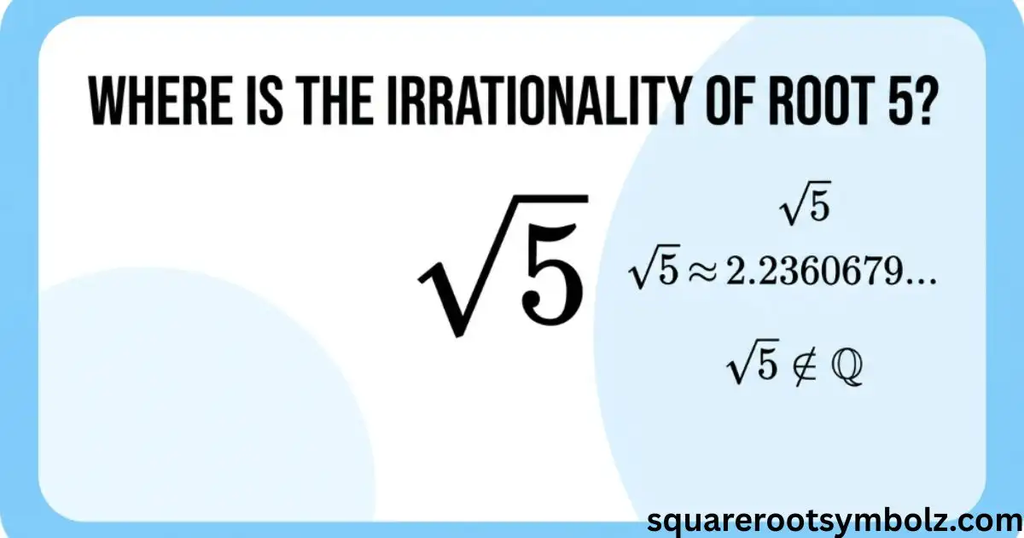
The number also appears in important mathematical relationships. The golden ratio can be written as (1 + √5) / 2, and √5 appears in Binet’s formula for Fibonacci numbers. These connections link root 5 with geometry, algebra, number patterns, and mathematical modeling.
A simple geometric example is especially memorable:
Diagonal² = 1² + 2²
Diagonal² = 1 + 4
Diagonal² = 5
Therefore:
Diagonal = √5 ≈ 2.236
This is one reason root 5 is more than a number students memorize. It represents a real geometric length that cannot be expressed exactly as an ordinary fraction.
Forgetting to assume the fraction is in lowest terms.
In a contradiction proof, start by assuming √5 = p/q, where p and q have no common factor. If you skip the lowest-terms condition, discovering that both numbers are divisible by 5 does not create a contradiction. The entire proof depends on breaking that original assumption.
Claiming 5 divides p without using that 5 is prime.
Another common error occurs after reaching p² = 5q². Do not simply jump to the conclusion that 5 divides p without explaining why. Since 5 is prime, Euclid’s lemma gives the required step. Including that reason makes the argument clear and logically sound.
Treating a long non-repeating decimal as the proof.
Writing √5 = 2.2360679… and saying “the digits do not repeat” is not a complete proof. Any finite decimal you calculate is rational. The reliable proof uses algebra to show that no fraction in lowest terms can equal √5, regardless of how many decimal digits are calculated.
Conclusion
Root 5 is √5, approximately 2.23606797749979, and it is an irrational real number. It cannot be simplified into a whole number because 5 is prime and not a perfect square. Its exact radical form should be retained whenever precision matters.
The most useful way to remember root 5 is to connect the facts: 4 < 5 < 9, so 2 < √5 < 3; its decimal begins 2.236; and its irrationality follows from a contradiction involving the prime factor 5. That same number then appears naturally in geometry, the golden ratio, and other areas of mathematics.
FAQ Section
What is the value of root 5?
√5 ≈ 2.23606797749979. The exact form is √5, while the decimal is an approximation.
Is root 5 rational or irrational?
Root 5 is irrational because √5 cannot be expressed as a fraction of two integers in exact form.
Why is root 5 irrational?
Because 5 is prime. Assuming √5 = p/q in lowest terms eventually forces both p and q to be divisible by 5, creating a contradiction.
Is root 5 a perfect square?
No. Five is not a perfect square. The closest perfect squares around it are 4 and 9.
What is root 5 to 3 decimal places?
√5 ≈ 2.236 to three decimal places.
What is root 5 to 2 decimal places?
√5 ≈ 2.24 to two decimal places.
Is √5 a real number?
Yes. √5 is an irrational real number because 5 is positive.
Can root 5 be simplified?
No. √5 is already in simplest radical form because 5 has no perfect-square factor other than 1.
What is the square of root 5?
(√5)² = 5.
What is 2√5?
2√5 ≈ 4.472135955. Cuemath also specifically addresses the irrationality of 2√5 and 3√5 in its FAQ coverage.
Where does √5 appear in geometry?
A rectangle measuring 1 unit by 2 units has a diagonal of √5 units, according to the Pythagorean theorem.
Does √5 appear in the golden ratio?
Yes. The golden ratio can be expressed as (1 + √5) / 2, connecting √5 with pentagonal geometry and Fibonacci mathematics.

I’m the creator of SquareRootSymbolz.com, where I publish easy-to-understand guides on symbols, Unicode characters, Alt codes, keyboard shortcuts, and copy-and-paste text symbols. My goal is to provide accurate, well-researched, and user-friendly content that helps readers quickly find the information they need.