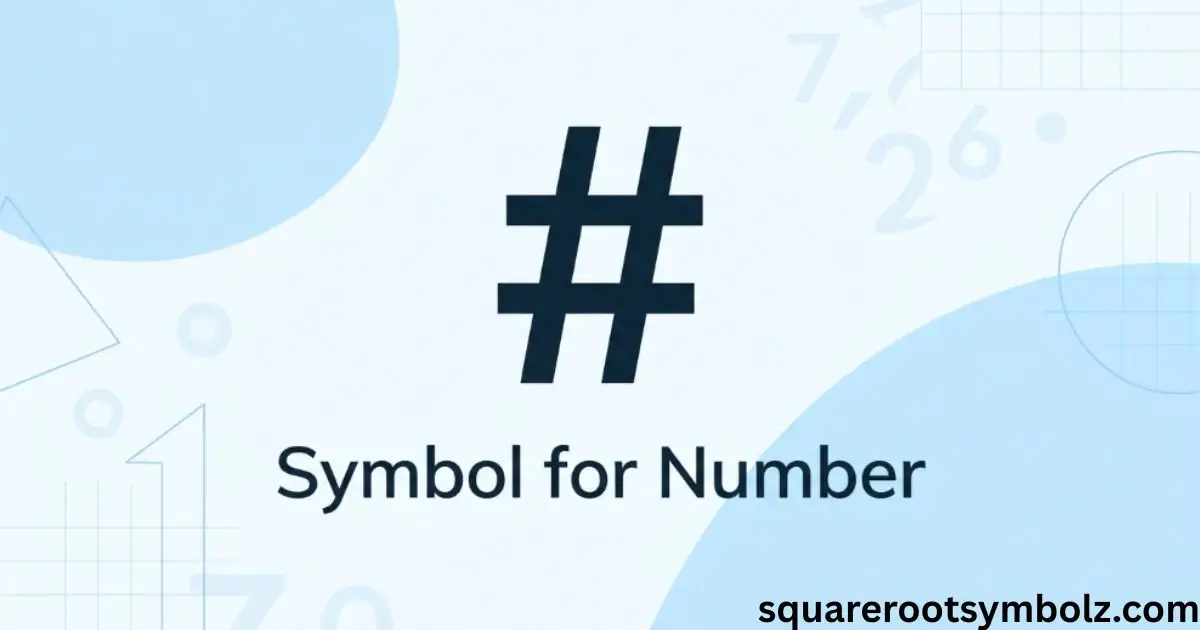
The most common symbol for number in American English is #, called the number sign, while № is the separate numero sign used as a typographic abbreviation for “number.” The right choice depends on whether you are numbering an item, typing on a keyboard, writing formally, or using a technical system.
If you searched for the symbol for number because you need something to copy, type, or understand, you are not alone. The characters #, №, No., and numerals can look or function similarly, but they are not interchangeable. This guide explains their meanings, names, Unicode identities, keyboard methods, digital uses, and the situations where each character makes sense.
Copy Number Text Symbol
If you need a symbol for number that you can copy immediately, the two characters most likely to be relevant are:
#
№
The # character is the number sign. In American English, it can appear before a numeral to mean “number,” as in #1, #5, or Room #204. It is also widely used as a hash in computing, a pound key on telephones, and a hashtag on social platforms.
The № character is called the numero sign. It is a typographic abbreviation of the word “number” and is particularly associated with ordinal numbering. For example, № 10 means “number 10.” It is a different Unicode character from #.
If your goal is simply to copy the most familiar U.S. number sign, use:
#
For a typographic numero character, use:
№
The choice matters because these characters have different Unicode code points and different conventional uses.
Number/ Numero Symbol Information Table
| Symbol | Name | Unicode | Common use |
| # | Number Sign | U+0023 | Numbered items, hash, pound key |
| № | Numero Sign | U+2116 | Abbreviation for number |
| No. | Number abbreviation | Letters | Formal English abbreviation |
| £ | Pound Sign | U+00A3 | British currency |
| ♯ | Sharp Sign | U+266F | Music notation |
The most important distinction is between # and №. The Unicode Consortium identifies # as NUMBER SIGN, U+0023. Unicode identifies № separately as the NUMERO SIGN, U+2116. These are not two fonts for the same character; they are separate characters.
There is another common source of confusion: £ is the pound currency sign, while # may be called the pound sign in the United States, particularly when referring to a telephone keypad. The musical sharp sign ♯ is also different from #.
How to Get the Number / Numero
The easiest way to get a symbol for number is to copy the character you need. For everyday American writing, # is usually the most recognizable choice. For typography that specifically calls for a numero sign, № is appropriate.
On many devices, # is already available directly from the keyboard. On a standard U.S. keyboard, pressing Shift + 3 produces #. This makes the number sign much easier to access than №.
For №, you may need a character picker, symbol menu, Unicode input method, or application-specific insertion feature. Microsoft Word, Google Docs, and operating systems provide ways to insert characters that are not printed directly on the keyboard.
The important first step is to identify which character you actually need. If a form asks for a numbered item, # may be sufficient. If a document specifically requires the numero character, use № rather than substituting another symbol.
The symbol for Number Alt Code (Keyboard Shortcut)
For the standard U.S. keyboard, the quickest shortcut for # is Shift + 3. This produces the Unicode NUMBER SIGN character, U+0023.
The numero sign № is different. Symbol Hippo lists Alt + 8470 as a Microsoft Word Windows method and also identifies U+2116 as its Unicode code point.
Keyboard methods can vary according to the operating system, application, keyboard layout, and input method. An Alt code that works in one Windows application may not behave identically everywhere.
For most U.S. users, the practical rule is simple:
# = Shift + 3
If you need №, use your application’s symbol insertion tool or a Unicode-compatible character picker.
This distinction prevents one of the most common mistakes when searching for a symbol for number: assuming that # and № are interchangeable.
Number Symbol In Google Docs
Google Docs provides a convenient way to insert characters that are not printed on your physical keyboard. To insert the numero sign, open a document and choose Insert → Special characters.
You can search for Numero in the Special Characters window. Symbol Hippo specifically describes this method for finding and inserting № in Google Docs.
For #, there is usually no need to use the symbol picker because the character is directly available on a standard U.S. keyboard. Press Shift + 3, and the number sign appears.
Google Docs is particularly useful when you need less common characters such as №, because searching by the character name is often easier than trying to remember its code.
Number Symbol on The Character Map (Windows)
Windows includes a utility called Character Map that lets users browse characters installed in available fonts and copy them into other applications.
To find a number-related character, open Character Map from the Windows Start menu. You can browse fonts, search through available characters, select the character you need, and copy it to the clipboard.
This is useful when you need № or another special character that does not have a dedicated keyboard key. Symbol Hippo also recommends Character Map as a method for finding and copying the numero symbol.
For #, Character Map is usually unnecessary because the character is part of the Basic Latin character set and is directly available on standard U.S. keyboards.
Adding Numero / Number in HTML/CSS
When publishing a symbol for number on a website, the visible character and its underlying character encoding are both important.
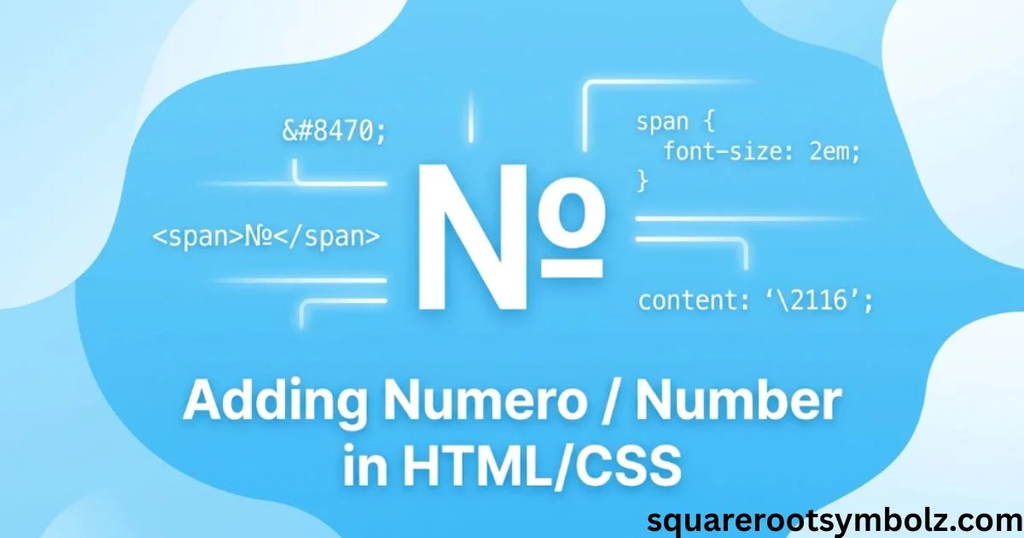
For #, the Unicode code point is U+0023. In HTML, the character can also be represented with the numeric reference #. Unicode identifies # as NUMBER SIGN.
For №, the Unicode code point is U+2116. It has HTML and CSS representations that can be useful when a document or website needs the character programmatically. Symbol Hippo lists the HTML numeric reference and CSS code for №.
One special consideration applies to # in URLs. The character has a reserved role in web addresses, so a literal # used as data may need URL encoding as %23.
Names
The same symbol can have different names depending on where and how it is used. This is one reason searches for a symbol for number often produce apparently conflicting answers.
For #, common names include number sign, hash, pound sign, pound key, and hashtag. Wikipedia documents these names and explains that their use varies by region and context.
The Unicode Consortium officially uses NUMBER SIGN for U+0023. Importantly, Unicode also explains that a character’s classification and practical function can depend on context.
Number sign
Number sign is the Unicode name for #, U+0023. When the character appears before a numeral, it can mean “number,” as in #10 or #25.
This is especially familiar in North American English. The number sign can also function differently in programming, mathematics, telephony, and social media.
Pound sign
In the United States and Canada, # is commonly called the pound sign or pound key, especially on telephone systems.
For example, an automated phone message might say, “Press pound,” meaning press #. This should not be confused with £, which is the currency symbol for the British pound.
Hash
Hash is another common name for #, particularly in computing and in British English.
Programmers may use the hash character for comments, directives, commands, identifiers, or other language-specific purposes. The exact function depends on the programming language or system.
Hashtag
A hashtag is formed when # is placed directly before a word or phrase used as a social-media tag, such as #Mathematics or #SEO.
The character itself is still #. What changes is its context and function. Unicode and reference sources distinguish the underlying character from the social-media concept of a hashtag.
Usage
The symbol for number has a surprisingly wide range of uses. The simplest is numbering: #1 means number one, while #25 can identify item 25.
The same character becomes a hash in technology, a pound key on telephone systems, and a hashtag when used before a social-media topic. Wikipedia documents these different contexts as part of the number sign’s modern usage.
Context is therefore essential. Seeing # alone does not always tell you what the character means. Its surrounding text, application, and position usually provide the missing information.
Mathematics
In mathematics, # can have specialized meanings that are different from ordinary numbering.
For example, in set theory, #S can denote the cardinality or size of a set S. In number theory, n# can denote the primorial of n. Other mathematical fields may assign additional meanings to the character.
This is an important semantic point: the number sign is not a universal mathematical operator. Its interpretation depends on the mathematical context.
Computing
In computing, # is commonly called hash and can perform different functions depending on the programming language.
In many scripting languages, it can introduce a comment. In the C preprocessor, it is associated with preprocessor directives. The combination #! is commonly known as a shebang in Unix-like systems.
Therefore, a programmer seeing # may not interpret it as “number” at all. The surrounding code determines its function.
Other uses
The number sign also appears in telephone systems, social media, typography, copy editing, chess notation, and other specialized contexts.
For example, the # key became part of touch-tone telephone systems, while social-media usage transformed the character into a familiar tagging mechanism. These different uses explain why a single symbol can have several names and meanings.
Unicode
Unicode gives computers a consistent way to identify characters across different platforms and languages.
The number sign # is U+0023 NUMBER SIGN. Its ASCII decimal value is 35. It belongs to the Basic Latin range and is therefore extremely widely supported.
The numero sign № is a separate character, U+2116 NUMERO SIGN. It represents a typographic abbreviation of “number” rather than being another Unicode name for #.
| Character | Unicode | Decimal | Unicode name |
| # | U+0023 | 35 | NUMBER SIGN |
| № | U+2116 | 8470 | NUMERO SIGN |
| £ | U+00A3 | 163 | POUND SIGN |
| ♯ | U+266F | 9831 | MUSIC SHARP SIGN |
Unicode’s own documentation notes that # is categorized as punctuation in its general Unicode category, although characters can function as symbols depending on context.
On keyboards
On a standard U.S. keyboard, type # by pressing Shift + 3. This is the quickest answer for most American users looking for a symbol for number.
The placement can differ on international keyboard layouts. Wikipedia notes that on some U.K. and European layouts, the same key combination may produce the pound currency symbol instead, while # may be assigned elsewhere.
The numero sign № normally does not have its own dedicated key on a standard U.S. keyboard. You can instead use a symbol picker, Unicode input, Word’s symbol tools, Google Docs Special Characters, or copy and paste it.
If your goal is simply to label an item as “number,” # is normally the easiest choice in American digital writing.
Symbol for Number: Quick Comparison
| If you mean… | Use | Example |
| Numbered item | # | #12 |
| Typographic number abbreviation | № | № 12 |
| Formal English abbreviation | No. | No. 12 |
| British currency | £ | £12 |
| Music sharp | ♯ | F♯ |
| Social-media tag | # | #Math |
| U.S. telephone pound key | # | Press # |
The most important lesson is that these characters may look related, but they are not interchangeable.
For a U.S. reader asking for the symbol for number, the safest everyday answer is #. If the request specifically concerns the typographic numero character, use №.
Symbol for Number Examples
Here are several everyday examples:
#1 = number one
#10 = number ten
Room #204 = Room number 204
Question #5 = Question number five
№ 12 = Number 12 using the numero sign
#Math = a social-media hashtag
Press # = press the pound key on a U.S. telephone system
Notice how the character stays visually similar while its meaning changes according to context. That is why simply memorizing a symbol is not enough. You also need to understand where it is being used.
Symbol for Number and Numerals
There is another meaning behind searches for “symbol for number” that is important in mathematics education.
A numeral is a written representation of a number. For example, 7 is a numeral representing the number seven. The word “seven,” the digit 7, and a quantity containing seven objects are related but are not identical concepts.
A numeral system uses symbols to represent numbers according to defined rules. For example, decimal notation uses the digits 0 through 9. The same written sequence can represent different values in different numeral systems.
So if a student asks, “What is the symbol for the number seven?” the answer may simply be 7, depending on the intended educational context.
That is different from asking, “What is the symbol used to mean number?” In that case, # or № may be the intended answer.
Understanding this distinction makes the phrase “symbol for number” much clearer.
Symbol for Number in Mathematics
Mathematics does not have one universal symbol meaning “number.”
Instead, mathematicians use different symbols according to the type of number or the role being represented. For example:
- n can represent a general number or integer.
- x can represent an unknown number.
- ℕ can represent the natural numbers in many mathematical conventions.
- ℤ can represent the integers.
- ℚ can represent the rational numbers.
- ℝ can represent the real numbers.
- ℂ can represent the complex numbers.
A mathematics reference from Rutgers notes an important point: there is not a single universal mathematical symbol for the vague concept “number”; instead, notation depends on what kind of number or variable is being discussed.
This is why the search phrase can have two different meanings. In typography and everyday writing, the answer may be # or №. In algebra, the answer may instead involve a variable such as n or x.
Symbol for Number: Which One Should You Use?
For most everyday U.S. writing, choose # when you want a compact way to indicate a numbered item.
Use № when you specifically need the typographic numero sign.
Use No. when following a conventional formal abbreviation style that calls for it.
Do not use £ when you mean number. It represents the pound currency in British contexts.
Do not use ♯ for number. It is the musical sharp sign.
The surrounding context should always guide your choice. This is particularly important in professional documents, mathematics, programming, websites, and international communication.
Conclusion
The most common symbol for number in American English is #, officially called the NUMBER SIGN and identified by Unicode as U+0023. Another character, №, is the NUMERO SIGN, a separate typographic abbreviation for “number.” Both can represent numbering, but they serve different purposes.
If you simply need a symbol for number to copy, type # on a standard U.S. keyboard with Shift + 3. If you need the formal numero character, use № through a symbol picker, Unicode method, or copy and paste.
The biggest takeaway is simple: # and № are not the same character. Once you understand their names, Unicode values, keyboard methods, and contextual uses, choosing the correct number symbol becomes much easier.
FAQ Section
What is the symbol for number?
The most common symbol for number in the United States is #, called the number sign. It can be placed before a numeral, such as #1, to mean “number one.”
Is # the symbol for number?
Yes. # is officially named NUMBER SIGN in Unicode and has the code point U+0023. In American English, it is commonly used before numbers and on telephone keypads.
What is the symbol for number besides #?
Another character is №, called the numero sign. It is a typographic abbreviation for “number” and has the Unicode code point U+2116.
What is the Unicode for the number sign?
The Unicode code point for # is U+0023. Its decimal character value is 35. Unicode officially calls it NUMBER SIGN.
What is the Unicode for №?
The numero sign № is U+2116. It is a separate Unicode character from #.
How do you type # on a keyboard?
On a standard U.S. keyboard, press Shift + 3. The result is #.
How do you type №?
The numero sign usually does not have a dedicated key on a standard U.S. keyboard. You can use a character picker, Unicode input method, Google Docs Special Characters, Microsoft Word’s symbol tools, or copy № directly.
Is # the same as a hashtag?
The character is the same, but its function can differ. # before a word or phrase in social media creates a hashtag, while # before a numeral can mean “number.”
Is # the same as the pound sign?
In the United States, # is commonly called the pound sign or pound key. However, £ is the separate British pound currency symbol.
What is the difference between # and №?
# is the number sign, U+0023. № is the numero sign, U+2116. The first is especially common in American digital writing, while the second is a typographic abbreviation for “number.”
What symbol represents a number in mathematics?
There is no single universal mathematical symbol for the general concept of “number.” Depending on context, mathematicians may use variables such as n or x, or special symbols for number sets such as ℕ, ℤ, ℚ, ℝ, and ℂ.

I’m the creator of SquareRootSymbolz.com, where I publish easy-to-understand guides on symbols, Unicode characters, Alt codes, keyboard shortcuts, and copy-and-paste text symbols. My goal is to provide accurate, well-researched, and user-friendly content that helps readers quickly find the information they need.