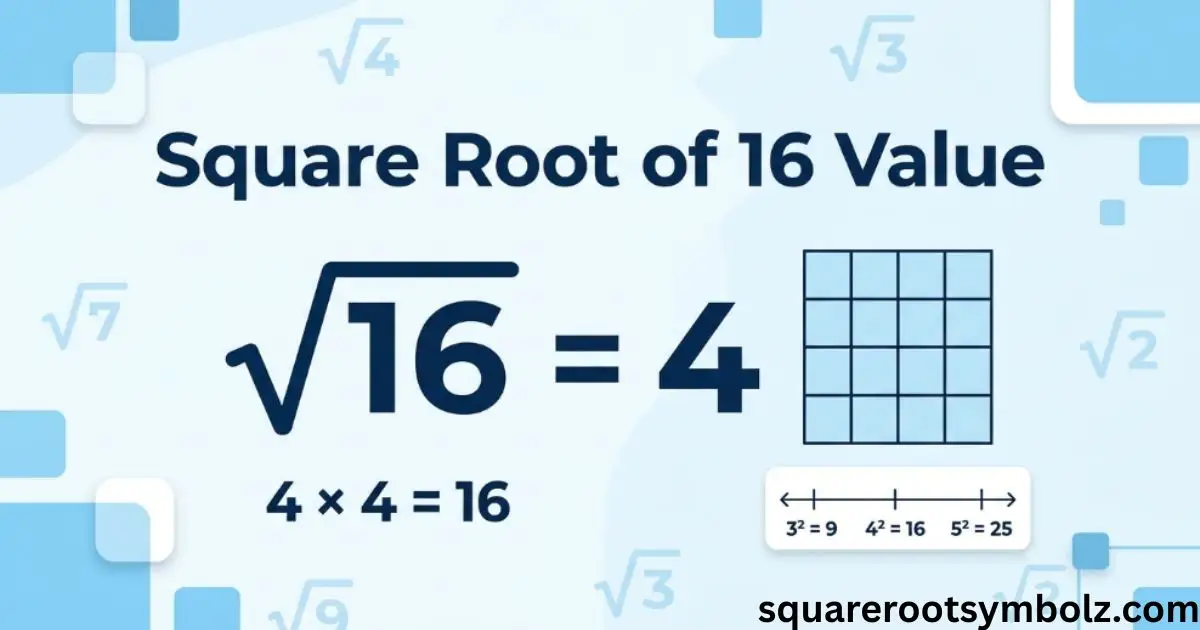
The square root of 16 is 4 because 4 × 4 = 16. It is an exact, rational, whole-number answer because 16 is a perfect square. If you are checking a homework problem, simplifying a radical, or wondering why an equation can have both 4 and −4, the key distinction is simple: √16 means the principal root, while x² = 16 has two solutions.
In this guide, we will connect the square root, perfect square, radical form, prime factorization, long division, integer, rational number, and principal square root in one clear explanation. These are the points that usually cause confusion, especially when a student sees √16 = 4 in one problem but x = ±4 in another.
What Is the Square Root of 16?
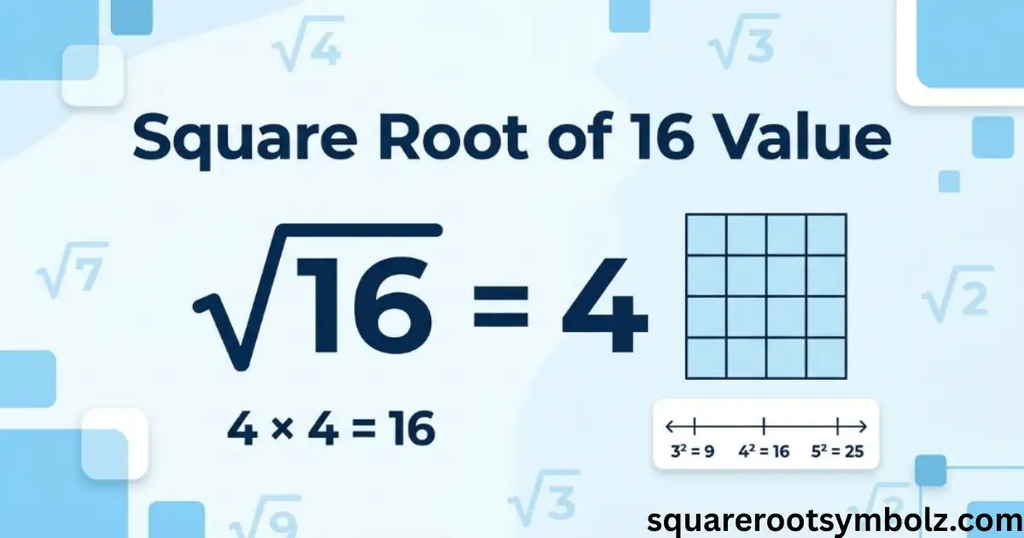
The square root of 16 is the number that produces 16 when multiplied by itself. Since 4 × 4 = 16, the principal square root is 4. In radical notation, the answer is written as √16 = 4. The number underneath the radical symbol is called the radicand.
There is an important detail here. Both 4 and −4 produce 16 when squared because 4² = 16 and (−4)² = 16. However, the symbol √16 represents the principal, nonnegative square root, so √16 equals 4. When solving x² = 16, both signs must be considered.
What is the Value of Square Root of 16?
The value of the square root of 16 is 4. Unlike numbers such as √2 or √7, no decimal approximation is needed because 16 is a perfect square. The exact value, decimal value, integer value, and rational value all point to the same number: 4.
You can verify the answer in seconds by squaring it. Start with 4 and multiply it by itself: 4 × 4 = 16. Because the result returns to the original radicand, the calculation checks perfectly. This simple square-back test is a reliable habit whenever you evaluate a square root.
Is the Square Root of 16 Rational or Irrational?
The square root of 16 is rational because √16 = 4, and 4 can be written as the fraction 4/1. It is also an integer, whole number, and natural number. Since the answer terminates exactly, there is no repeating or nonterminating decimal involved.
This classification follows directly from the perfect-square property of 16. A perfect square has an integer square root. For example, √9 = 3, √16 = 4, and √25 = 5. By contrast, √15 and √17 are irrational because their values cannot be represented exactly as ratios of integers.
How to Find the Square Root of 16?
To find the square root of 16, ask which number multiplied by itself equals 16. The answer is 4 because 4 × 4 = 16. You can also use prime factorization or long division, both of which lead to the same exact result.
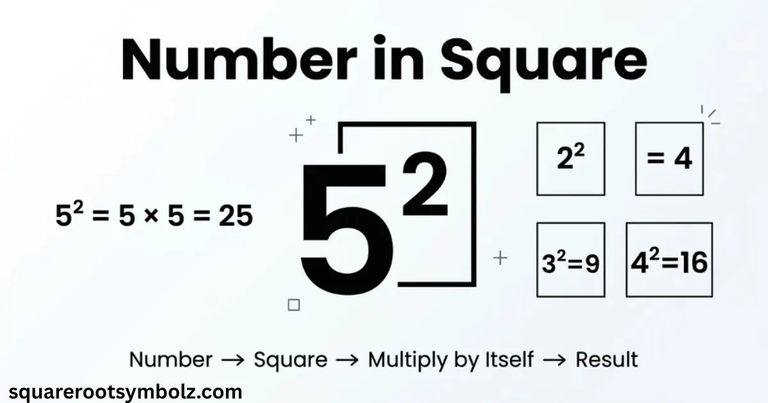
For a quick mental method, remember the nearby perfect squares: 9 = 3², 16 = 4², and 25 = 5². Since 16 appears directly in the square-number pattern, its square root is immediately 4. This recognition is faster than using a calculator and becomes useful as your perfect-square knowledge grows.
Square Root of 16 by Prime Factorization
Prime factorization writes 16 as 2 × 2 × 2 × 2. Pairing equal prime factors gives (2 × 2) and (2 × 2). One factor from each pair comes outside the radical, producing 2 × 2 = 4. Therefore, the square root of 16 is exactly 4.
The method works because square roots undo pairs of identical factors. In this case, every prime factor can be paired, which is another way to recognize that 16 is a perfect square. If one factor had been left unpaired, some radical would have remained in the simplified answer.
Square Root of 16 By Long Division
The long division method also gives 4. Begin with 16 and identify the largest whole number whose square does not exceed 16. That number is 4 because 4 × 4 = 16. Subtracting 16 from 16 leaves zero, so the process ends with an exact root and no remainder.
Long division becomes more useful with numbers that are not perfect squares, where additional decimal places may be required. For 16, however, the calculation stops immediately. The zero remainder is another confirmation that 16 is a perfect square and that its square root is a whole number.
Square Root of 16 in Radical Form
The radical form of the square root of 16 is √16. Once evaluated, √16 simplifies completely to 4. The exponent form is 16^(1/2), which represents the same square-root operation. These different forms describe the same mathematical quantity and are useful in different algebraic settings.
It is helpful to distinguish an expression from its evaluated value. √16 is the radical expression, while 4 is its simplified value. If a question asks you to simplify or evaluate √16, the expected final answer is 4. Leaving √16 unchanged usually means the calculation has not been completed.
Square Root of 16 by Prime Factorization Method
Using prime factorization, start by breaking 16 into prime factors: 16 = 2 × 2 × 2 × 2. Group them into two pairs. Each pair represents a perfect square, so one 2 from each pair can leave the radical. Multiplying those outside factors gives 2 × 2 = 4.
The same idea can be written using powers: 16 = 2⁴. Because the exponent 4 is even, the square root reduces to 2², which equals 4. This is a useful pattern to recognize when simplifying larger perfect-square radicals, because even prime exponents divide cleanly by 2.
| Form | Result |
| Radical form | √16 |
| Simplified value | 4 |
| Exponent form | 16^(1/2) |
| Prime factorization | 2 × 2 × 2 × 2 |
| Perfect square | Yes |
| Integer | Yes |
| Rational | Yes |
| Decimal | 4 |
Square Root of 16 by Long Division Method
With long division, pair the digits of 16 from the right. Because there is only one pair, consider the largest digit whose square is 16 or less. The digit is 4. Multiply 4 by itself to get 16, subtract, and obtain a remainder of zero. Therefore, √16 = 4.
Although this example is short, learning the method prepares you for non-perfect squares. When a square root does not end evenly, the long division process can continue by bringing down pairs of zeros and finding additional decimal digits. With 16, there is nothing more to calculate because the exact root has already been found.
Worked Example – Using Square Root of 16 in an Expression
Consider the expression 7√16 + 15. First evaluate the radical: √16 = 4. Substitute 4 for √16, giving 7 × 4 + 15. Multiplication comes first, so 28 + 15 = 43. The important step is simplifying the radical before completing the arithmetic.
This example shows why knowing perfect squares saves time. Instead of carrying √16 through several operations, you can immediately replace it with 4. The same strategy works in many algebraic expressions. Always simplify a perfect-square radical when doing so is mathematically valid and makes the remaining calculation clearer.
Square Root of 16 Solved Examples
Here are several common examples involving √16. They demonstrate how the exact value can be substituted into expressions, equations, and geometry problems without introducing unnecessary decimal rounding. Cuemath and BYJU’S both use examples involving expressions containing √16, while Cuemath also connects √16 with square arrangements and lengths.
Example 1: Simplify 3 + √16
√16 = 4
3 + 4 = 7
Example 2: Solve m + √16 = 20
m + 4 = 20
m = 16
Example 3: Simplify 5√16 ÷ √16 + 20
5(4) ÷ 4 + 20
5 + 20 = 25
These examples show that recognizing √16 as 4 can turn a radical expression into ordinary arithmetic.
Negative Roots and Principal Square Roots
The principal square root of 16 is 4, but the equation x² = 16 has two solutions: x = 4 and x = −4. The difference comes from notation. The radical symbol √ is defined to return the nonnegative square root, whereas an equation asking which values square to 16 must include both possibilities.
This is one of the most common square-root mistakes. Writing √16 = ±4 is not the standard interpretation of the radical symbol. Instead, write √16 = 4. If you are solving x² = 16, then write x = ±4 because both values satisfy the equation. Recent math discussions continue to highlight this exact distinction.
Formula Used in Square Root of 16
The defining relationship is simple: if a² = b, then the principal square root of b is √b. For 16, 4² = 16, so √16 = 4. In exponent notation, the same relationship can be represented as 16^(1/2) = 4.
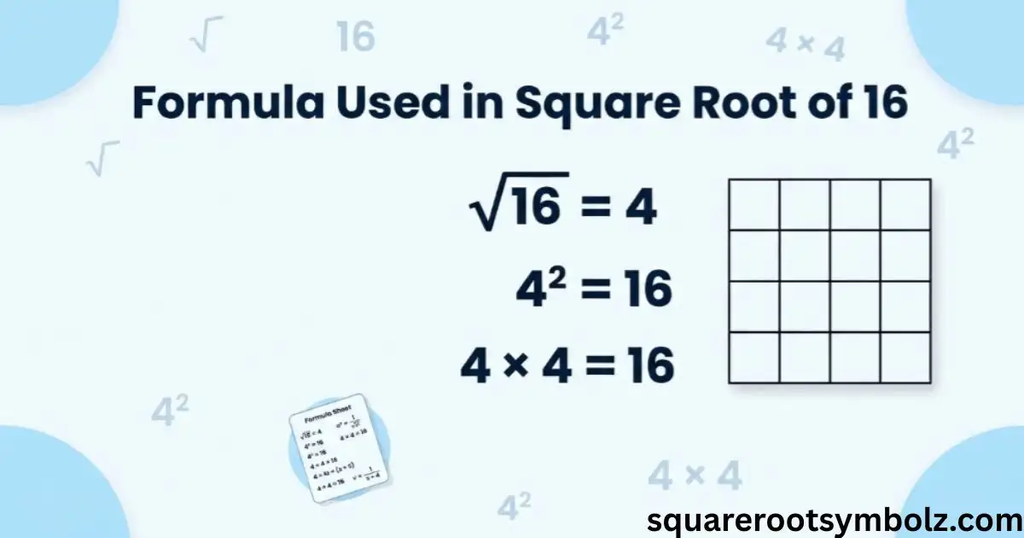
You can also use the perfect-square identity 16 = 4². Taking the principal square root reverses the squaring operation and gives 4. Remember that the equation x² = 16 is slightly different because it asks for every real number whose square equals 16, giving both 4 and −4.
Quick Facts About √16
| Question | Answer |
| What is √16? | 4 |
| Is 16 a perfect square? | Yes |
| Is √16 rational? | Yes |
| Is √16 an integer? | Yes |
| Is √16 a whole number? | Yes |
| Is √16 a natural number? | Yes |
| What is 16²? | 256 |
| What is (√16)²? | 16 |
| What are the solutions of x² = 16? | x = ±4 |
| Radical form | √16 |
| Exponent form | 16^(1/2) |
Conclusion
The square root of 16 is 4, and the reason is simply that 4 × 4 = 16. Because 16 is a perfect square, √16 simplifies completely and belongs to the rational, integer, whole-number, and natural-number sets. The most important distinction to remember is that √16 = 4, while x² = 16 has two solutions, x = ±4. Prime factorization and long division both confirm the same exact result.
FAQ Section
What is the square root of 16?
The square root of 16 is 4 because 4 × 4 = 16. The radical notation is √16 = 4.
Is 16 a perfect square?
Yes. 16 is a perfect square because it can be written as 4 × 4 or 4².
Is the square root of 16 rational or irrational?
√16 is rational because it equals 4, and 4 can be written as 4/1. It is also an integer, whole number, and natural number.
What are the two square roots of 16?
The two numbers whose squares equal 16 are 4 and −4. However, the radical expression √16 specifically represents the principal root, 4.
Why is √16 equal to 4 and not ±4?
The radical symbol √ denotes the principal, nonnegative square root. Therefore, √16 = 4. The ±4 appears when solving the equation x² = 16 because both 4 and −4 satisfy that equation.
What is the simplest radical form of √16?
The expression √16 simplifies completely to 4 because 16 is a perfect square.
What is the square of the square root of 16?
The square of √16 is 16:
(√16)² = 16.
What is 16 squared?
The square of 16 is 256 because 16 × 16 = 256. This is different from the square root of 16, which is 4.
What is the square root of 0.16?
The square root of 0.16 is 0.4 because 0.4 × 0.4 = 0.16. Cuemath specifically includes this as a related application of the √16 relationship.
How do you find √16 using prime factorization?
Factor 16 as 2 × 2 × 2 × 2, group the factors into pairs, and take one factor from each pair. This gives 2 × 2 = 4.

I’m the creator of SquareRootSymbolz.com, where I publish easy-to-understand guides on symbols, Unicode characters, Alt codes, keyboard shortcuts, and copy-and-paste text symbols. My goal is to provide accurate, well-researched, and user-friendly content that helps readers quickly find the information they need.