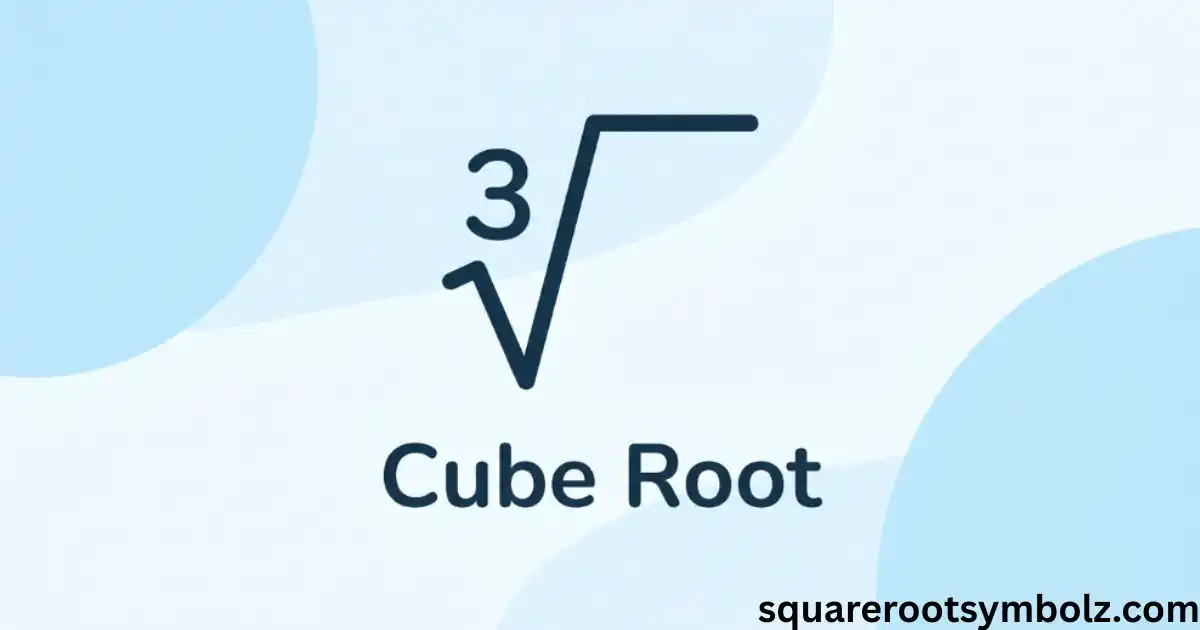
A cube root is the number that, when multiplied by itself three times, gives the original number. For example, ∛27 = 3 because 3 × 3 × 3 = 27. If cube roots have ever felt confusing, the good news is that the idea is simply the reverse of cubing. Once you understand perfect cubes, radicals, exponents, and the cube root symbol, the process becomes much easier.
In teaching and explaining roots, I have found that students usually struggle with the notation or with numbers that are not perfect cubes. This guide brings those pieces together. You will learn how cube roots work, how to find them using prime factorization, how negative numbers behave, how to estimate non-perfect values, and where cube roots appear in algebra and geometry.
Cube Root
A cube root reverses the process of cubing. If 4³ = 64, then ∛64 = 4. In other words, the cube root asks a simple question: “What number was multiplied by itself three times to produce this result?” This inverse relationship connects powers, radicals, integers, and algebra.
For example, 5 × 5 × 5 = 125, so the cube root of 125 is 5. The same idea works with negative numbers because an odd number of negative factors produces a negative result. Therefore, ∛(−8) = −2 because (−2)³ = −8.
The Cube Root Symbol
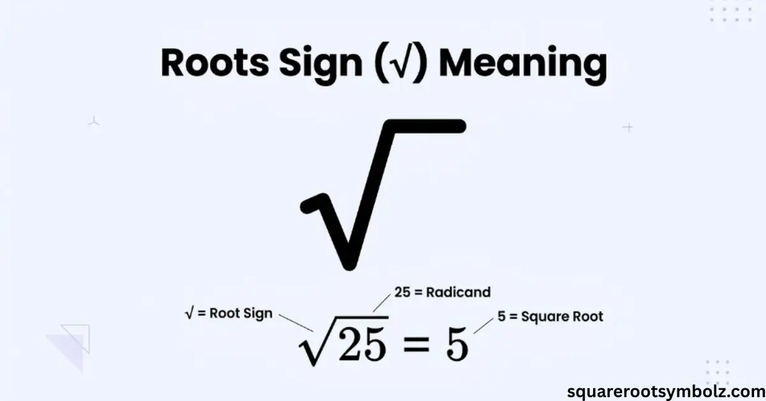
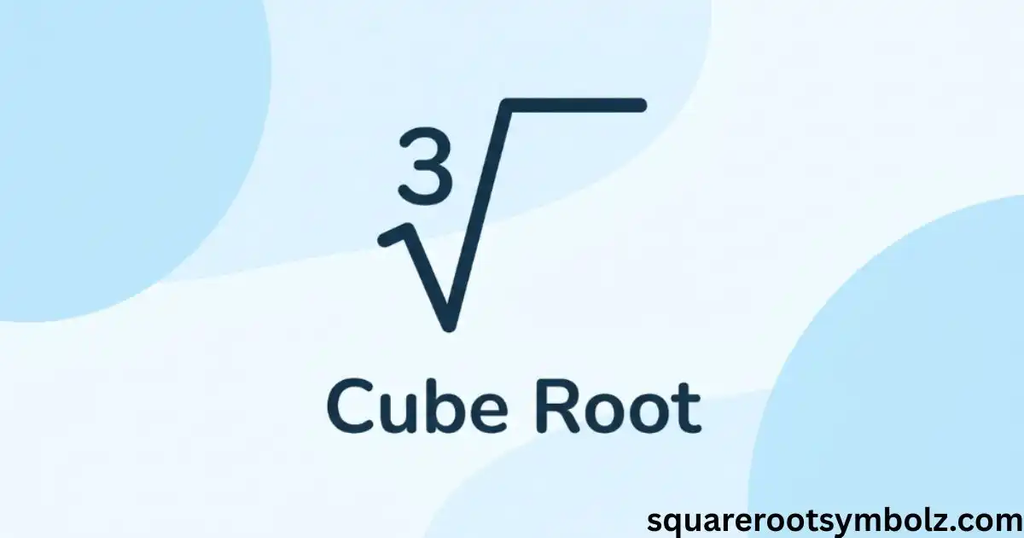
The cube root symbol is ∛. The small 3 is called the index and tells you that the radical represents a cube root rather than a square root. For example, ∛64 means the number whose third power equals 64. This notation is common in arithmetic, algebra, equations, and scientific calculations.
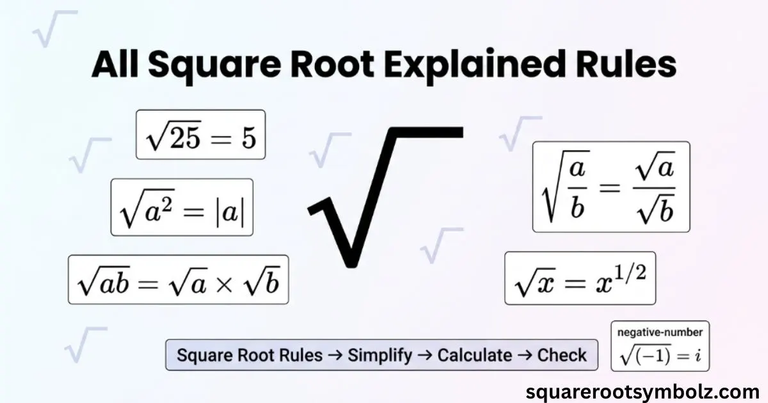
The symbol can also be written using a fractional exponent. For example, ∛27 = 27^(1/3) = 3. These two forms describe the same operation. The radical form is often easier to recognize in basic mathematics, while the fractional-exponent form connects cube roots directly with the laws of exponents.
Cube roots
Cube roots are the inverse of cubes. When you cube a number, you multiply it by itself three times. When you take its cube root, you work backward to find the original number. This makes cube roots an important part of powers, radicals, number systems, and introductory algebra.
Consider the sequence 1, 8, 27, 64, and 125. These are perfect cubes because they come from 1³, 2³, 3³, 4³, and 5³. Their cube roots symbol are therefore 1, 2, 3, 4, and 5. Learning these common values makes mental calculation much faster.
Finding cube roots
For a perfect cube, you can often find the answer by recognizing the number immediately. For example, because 7³ = 343, the cube root of 343 is 7. When the number is larger or less familiar, prime factorization gives you a reliable method for identifying groups of three equal factors.
Take 216 as an example. Its prime factorization is 2 × 2 × 2 × 3 × 3 × 3. Grouping the factors into triples gives (2 × 2 × 2) and (3 × 3 × 3). Taking one factor from each group gives 2 × 3 = 6, so ∛216 = 6.
Cube Root Definition
The formal definition is simple: if a³ = b, then a is the real cube root of b. Thus, ∛b = a. Unlike a positive number under a square root, a real number can be negative and still have a real cube root because multiplying three negative factors produces a negative result.
For example, (−5)³ = −125, so ∛(−125) = −5. Every real number has exactly one real cube root. This is an important difference from square roots, where a positive number has two square roots as solutions to an equation such as x² = 25.
How to Find Cube Root of a Number?
The easiest method depends on the number. If it is a familiar perfect cube, recall the integer that produces it. If it is larger, prime factorization can reveal groups of three identical factors. For example, 729 = 9 × 9 × 9, so ∛729 = 9.
For a non-perfect cube, the exact result may not be an integer. You can locate it between two nearby perfect cubes and then estimate or use a calculator. Since 27 < 30 < 64, ∛30 must lie between 3 and 4. Its value is approximately 3.107, showing why approximation is useful for non-perfect cubes.
Cube Root Formula
The basic cube root formula is:
∛x = x^(1/3)
It means that taking the cube root is equivalent to raising a number to the one-third power. If y³ = x, then y = ∛x. For example, 216^(1/3) = 6 because 6³ = 216.
The formula also connects radicals with fractional exponents. This becomes useful when simplifying algebraic expressions or working with powers. For example, ∛125 = 125^(1/3) = 5. The formula therefore gives you both a radical form and an exponent form for the same mathematical operation.
List of Cube Root of Numbers
Knowing common perfect cubes can make cube-root questions almost automatic. The following table is especially useful for middle-school and introductory algebra work.
| Number | Cube form | Cube root |
| 1 | 1³ | 1 |
| 8 | 2³ | 2 |
| 27 | 3³ | 3 |
| 64 | 4³ | 4 |
| 125 | 5³ | 5 |
| 216 | 6³ | 6 |
| 343 | 7³ | 7 |
| 512 | 8³ | 8 |
| 729 | 9³ | 9 |
| 1000 | 10³ | 10 |
These values are perfect cubes because each can be written as an integer raised to the third power. Memorizing the first ten is useful, but understanding the relationship is more important than memorizing a list.
Cube Root Examples
Example 1: Find ∛64
Ask which number multiplied by itself three times equals 64.
4 × 4 × 4 = 64
Therefore:
∛64 = 4
Example 2: Find ∛(−27)
Because:
(−3) × (−3) × (−3) = −27
the answer is:
∛(−27) = −3
Example 3: Find ∛216
Since:
6 × 6 × 6 = 216
we get:
∛216 = 6
These examples show an important pattern: positive perfect cubes have positive cube roots, while negative perfect cubes have negative real cube roots.
A cube root can also arise from geometry. If a cube has a volume of 512 cubic inches, its side length is the cube root of 512:
∛512 = 8
So each side is 8 inches long. This is one practical reason cube roots matter: they can reverse a volume calculation and reveal the missing dimension.
For a non-perfect cube, the answer may not be an integer. For example, ∛50 lies between 3 and 4 because 27 < 50 < 64. A calculator gives approximately 3.684. The result can be rounded according to the accuracy required by the problem.
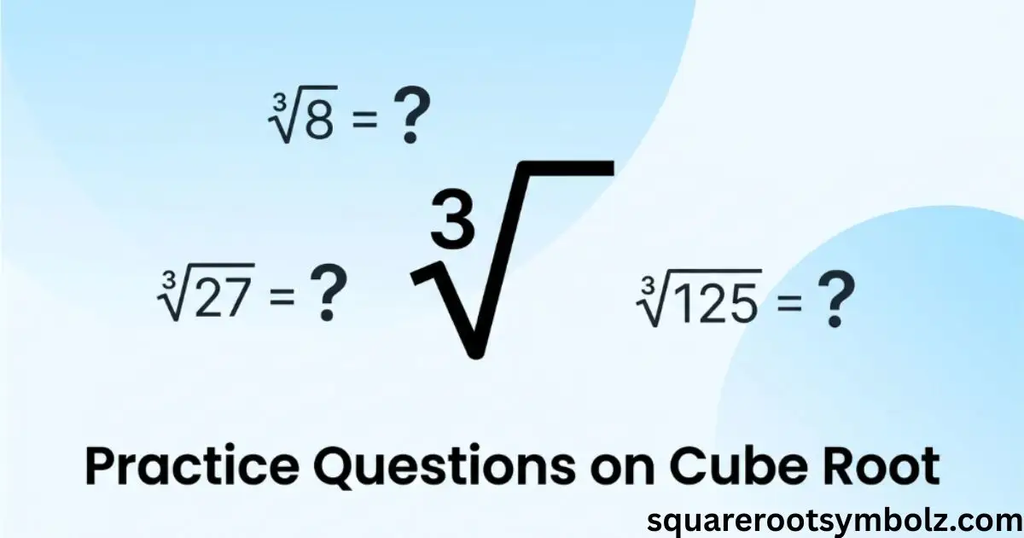
Practice Questions on Cube Root
Try these without looking at the answers first.
| Question | Answer |
| ∛8 | 2 |
| ∛27 | 3 |
| ∛125 | 5 |
| ∛343 | 7 |
| ∛729 | 9 |
| ∛(−64) | −4 |
| ∛1000 | 10 |
| ∛216 | 6 |
For a little more challenge, find the cube root of 1728, then verify your answer by cubing it. Next, determine whether 200 is a perfect cube. Because 5³ = 125 and 6³ = 216, you can immediately tell that 200 lies between two consecutive perfect cubes.
These exercises build the same skill used in formal algebra: recognize a power relationship, reverse the operation, and verify the result. Practice with perfect cubes first, then move to estimation and prime factorization.
Conclusion
A cube root is the inverse of cubing: it tells you which number produces a given value when multiplied by itself three times. Once you recognize perfect cubes, understand the ∛ symbol, use the formula x^(1/3), and know how negative numbers behave, cube roots become much easier. For larger or non-perfect cubes, prime factorization, estimation, and calculators provide practical ways to find or approximate the answer. From basic arithmetic to algebra and the dimensions of a cube, understanding the cube root gives you a useful mathematical tool that connects powers, radicals, equations, and geometry.
FAQs
What is the cube root of a number?
The cube root is the number that, when multiplied by itself three times, produces the original number. For example, ∛125 = 5 because 5 × 5 × 5 = 125.
What is the difference between a cube and a cube root?
Cubing means multiplying a number by itself three times. A cube root reverses that process. For example, 4³ = 64, while ∛64 = 4. They are inverse operations.
What is the cube root symbol?
The cube root symbol is ∛. The small 3 is the index and tells you that the operation is a cube root. For example, ∛27 = 3.
What is the cube root of a negative number?
The real cube root of a negative number is negative. For example, ∛(−125) = −5 because (−5)³ = −125. Every real number has exactly one real cube root.
What are perfect cubes?
A perfect cube is a number that can be written as an integer multiplied by itself three times. Examples include 1, 8, 27, 64, 125, and 216.
How do you find the cube root of a large number?
First check whether it is a familiar perfect cube. If not, use prime factorization and group identical factors in sets of three. For a non-perfect cube, locate it between nearby perfect cubes and estimate its value.
Is the cube root of a negative number real?
Yes. Unlike the real square root of a negative number, a negative number has a real cube root. For example, ∛(−8) = −2 because (−2)³ = −8.
Is every real number a cube root?
Every real number is the cube root of another real number because if a is real, then a³ is real and ∛(a³) = a. Equivalently, every real number has exactly one real cube root.

I’m the creator of SquareRootSymbolz.com, where I publish easy-to-understand guides on symbols, Unicode characters, Alt codes, keyboard shortcuts, and copy-and-paste text symbols. My goal is to provide accurate, well-researched, and user-friendly content that helps readers quickly find the information they need.