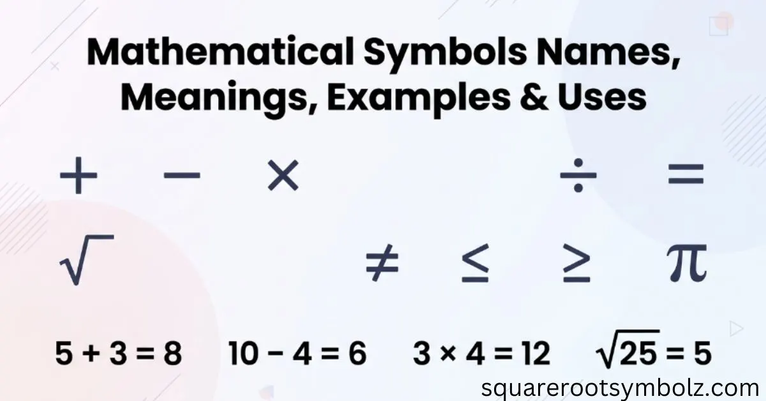
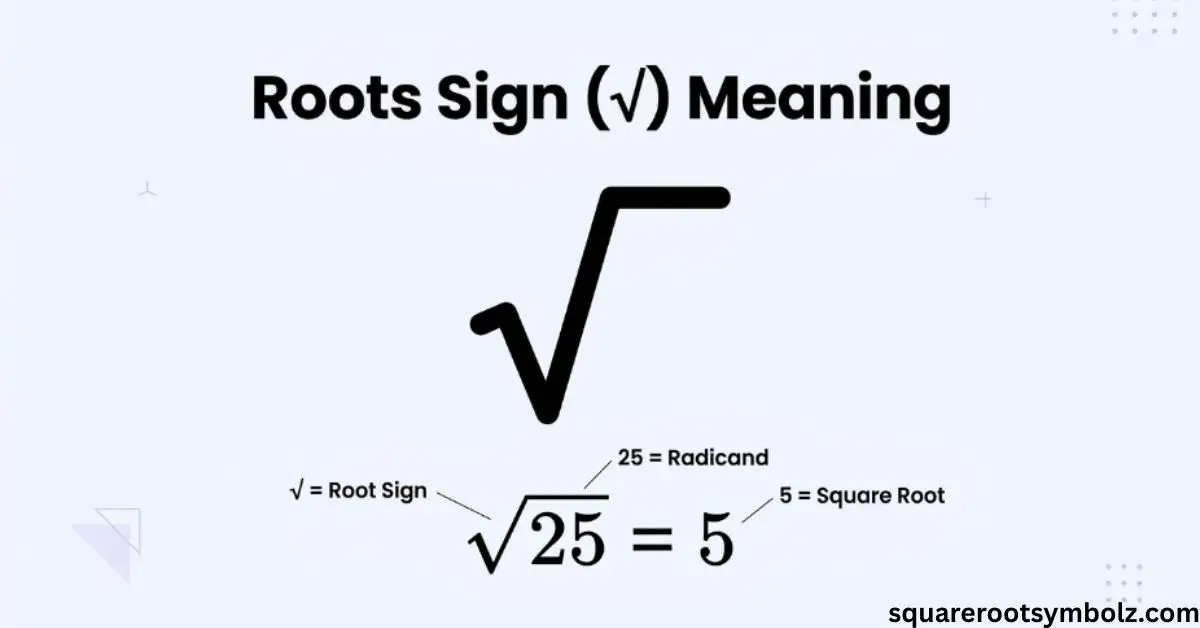
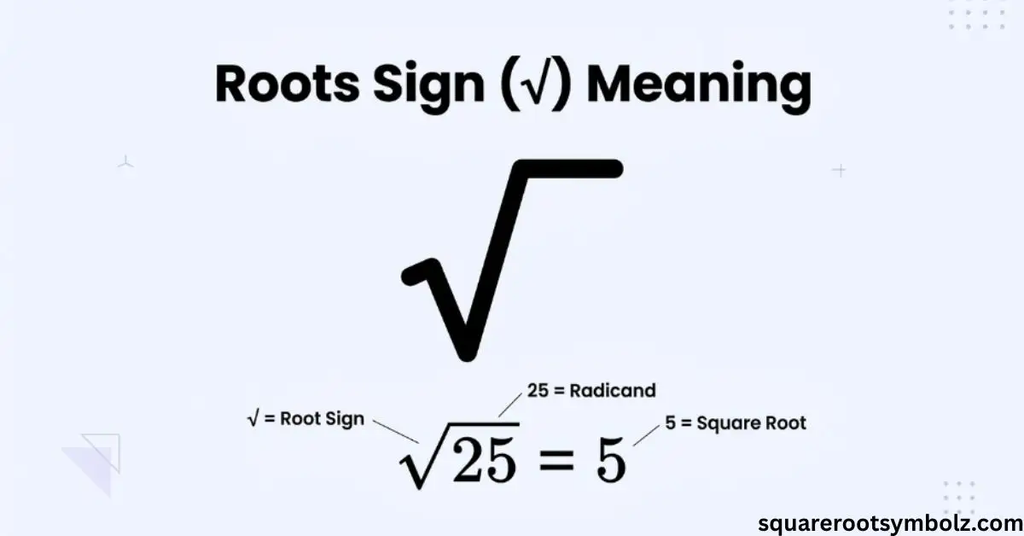
The roots sign √ is the familiar mathematical symbol used to express a square root. It is formally called the radical sign, and the number beneath it is called the radicand. For example, √25 = 5 because 5 × 5 = 25. In algebra, this symbol provides a quick way to show a root operation.
If you have ever wondered what the curved check-like mark means, the answer is simpler than it first appears. The radical sign, radicand, square root, principal square root, and negative root each have a specific role. Once these pieces are clear, reading and simplifying root expressions becomes much easier.
Square Root
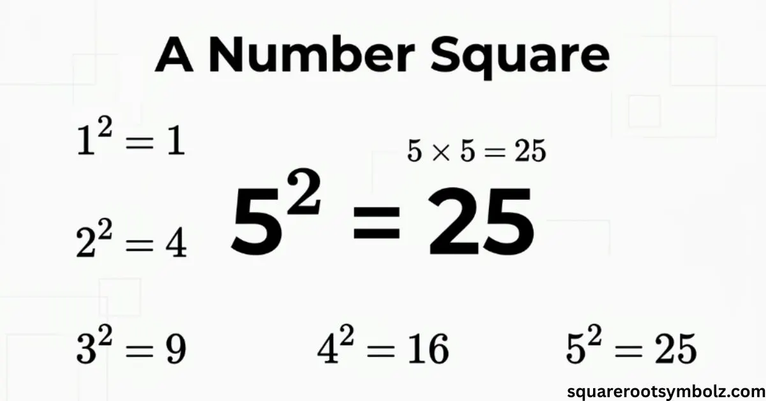
A square root reverses the process of squaring a number. If 6² = 36, then 6 is a square root of 36. In other words, a square root is a number that produces the original value when multiplied by itself. This makes square roots the inverse operation of squaring.
For example:
4² = 16
Therefore:
√16 = 4
The roots sign provides a compact way to express this operation. Instead of explaining that we need the number that multiplies by itself to make 16, we simply write √16.
Definition
A square root of a number is a value that produces that number when multiplied by itself.
For example:
5² = 25
and:
(−5)² = 25
Therefore, both 5 and −5 are square roots of 25.
This creates an important distinction between a square root and the value represented by the roots sign. The equation x² = 25 has two solutions, x = 5 and x = −5. However, √25 specifically represents the principal, nonnegative square root.
The Square Root Symbol
The square root symbol is √. It is also called the radical sign. When you see √36, the expression means the principal square root of 36.
Because 6² = 36:
√36 = 6
The symbol can be understood through these basic parts:
| Part | Meaning | Example |
| √ | Radical sign | √ |
| 25 | Radicand | √25 |
| √25 | Radical expression | √25 = 5 |
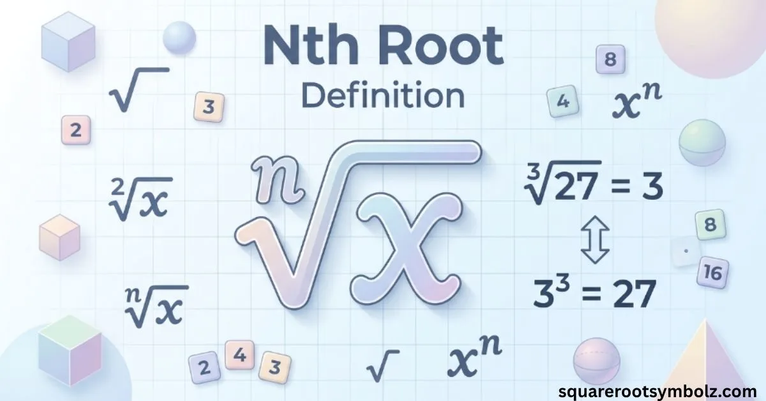
For a square root, the index is normally not written because the index 2 is understood. For higher roots, an index appears next to the radical, such as ∛8 for the cube root of 8.
Square Root Notation
Square root notation provides a short mathematical way to communicate a root. The expression √m is read as “the square root of m.”
For example:
√49 = 7
because:
7² = 49
The roots sign also works as a grouping symbol. Compare these two expressions:
√(25 + 144)
and:
√25 + √144
They do not mean the same thing. In the first expression, 25 and 144 are added before finding the square root. In the second, the two square roots are calculated separately.
This is an important detail when evaluating mathematical expressions.
Square Root of a Number
To find the square root of a perfect square, ask:
What number multiplied by itself gives the number under the radical?
For example:
√81 = 9
because:
9 × 9 = 81
Common perfect squares include:
| Number | Square Root |
| 1 | 1 |
| 4 | 2 |
| 9 | 3 |
| 16 | 4 |
| 25 | 5 |
| 36 | 6 |
| 49 | 7 |
| 64 | 8 |
| 81 | 9 |
| 100 | 10 |
Not every number has a whole-number square root. For example:
√20 ≈ 4.472
This is an irrational number, so its decimal representation continues without repeating in a fixed pattern.
Two Square Roots
Every positive real number has two square roots: one positive and one negative.
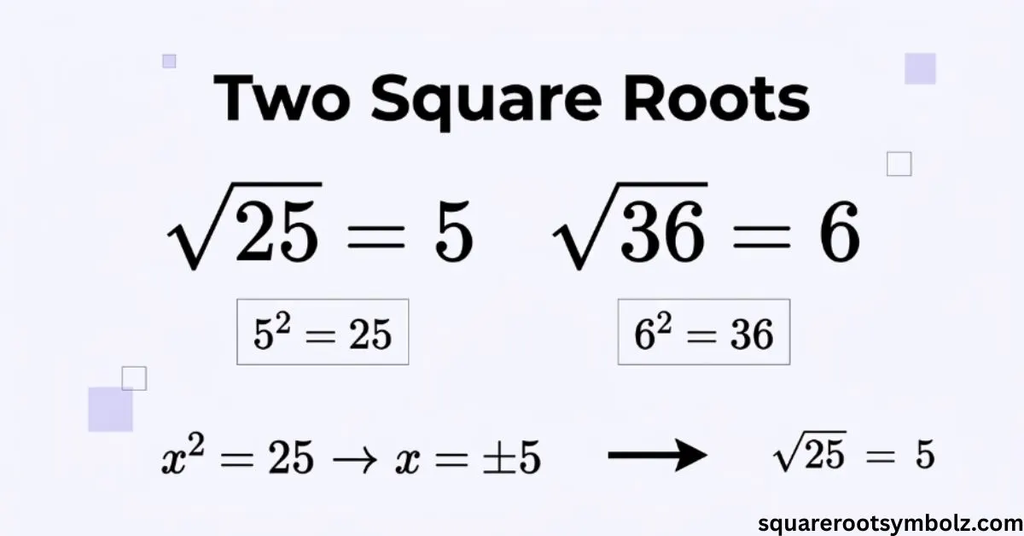
For example, 36 has two square roots:
6 and −6
because:
6² = 36
and:
(−6)² = 36
However, this does not mean:
√36 = ±6
Instead:
√36 = 6
The reason is that the radical sign represents the principal square root, which is nonnegative.
If you are solving an equation such as:
x² = 36
then both solutions must be included:
x = ±6
So:
x = 6 or x = −6
This distinction is one of the most important rules to remember when working with the roots sign.
Principal Square Root
The principal square root is the nonnegative square root represented by the radical sign.
For example:
√25 = 5
not −5.
The negative value can still be a square root of 25, but it is not the value represented by √25.
Consider:
x² = 25
Taking the square root of both sides gives:
x = ±√25
Therefore:
x = ±5
The radical sign gives the principal root, while the plus-minus sign accounts for both possible solutions of the original equation.
Plus-Minus Sign
The ± symbol means “plus or minus.” It is commonly used when an equation has two possible solutions.
For example:
x² = 49
Taking the square root gives:
x = ±√49
Therefore:
x = ±7
The two solutions are:
x = 7
and:
x = −7
A useful rule is:
√49 = 7
but:
x² = 49 → x = ±7
The roots sign and plus-minus sign therefore perform different jobs.
Square Root of xy
For nonnegative real numbers, the square root of a product can be separated:
√(xy) = √x × √y
For example:
√(100 × 4)
can be written as:
√100 × √4
Then:
10 × 2 = 20
So:
√(100 × 4) = 20
This property can also help simplify radicals.
Consider:
√72
Since:
72 = 36 × 2
we can write:
√72 = √36 × √2
Therefore:
√72 = 6√2
The remaining √2 cannot be simplified into a whole number because 2 is not a perfect square.
How About the Square Root of Negatives?
A negative number does not have a real square root.
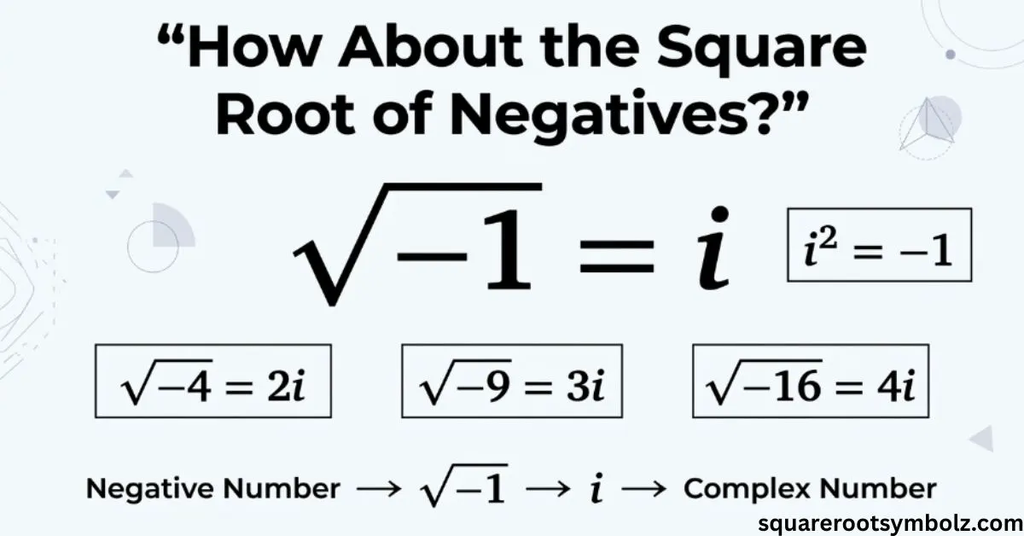
For example:
√(−25)
has no real-number answer because the square of every real number is nonnegative.
For instance:
5² = 25
and:
(−5)² = 25
Neither produces −25.
However, negative square roots can be represented using complex numbers. The imaginary unit is defined as:
i = √(−1)
Therefore:
√(−25) = 5i
This distinction is important because the roots sign can appear in both real-number and complex-number mathematics, but the resulting value depends on the number system being used.
Quick Roots Sign Reference
| Expression | Answer | Explanation |
| √9 | 3 | 3² = 9 |
| √16 | 4 | 4² = 16 |
| √25 | 5 | 5² = 25 |
| −√25 | −5 | Negative sign is outside the radical |
| x² = 25 | x = ±5 | Two solutions |
| √(−25) | 5i | Complex-number result |
| ∛(−8) | −2 | (−2)³ = −8 |
The central lesson is simple: √ is the radical sign for a principal square root, while ± is used when an equation has both positive and negative solutions.
Conclusion
The roots sign √ is the familiar mathematical symbol used to express a square root. It is formally called the radical sign, and the number beneath it is called the radicand. The symbol represents the principal, nonnegative square root.
The most important distinction to remember is:
√25 = 5
but:
x² = 25 → x = ±5
Once you understand the relationship between the roots sign, radical sign, square root, radicand, and plus-minus sign, square-root expressions become much easier to read, simplify, and solve.
FAQ Section
What is the roots sign in math?
The roots sign usually refers to the radical sign √, which is used to indicate a square root. For example, √25 = 5.
What is the symbol for a square root?
The square root symbol is √. It is also called the radical sign.
What is the difference between √ and ±?
√ represents the principal, nonnegative square root. The ± symbol means both the positive and negative possibilities should be considered when solving an equation.
What is the number under the roots sign called?
The number or expression underneath the radical is called the radicand. In √36, the radicand is 36.
What does √25 equal?
√25 = 5
The principal square root is 5, although both 5 and −5 are square roots of 25.
Why is √25 not ±5?
The radical sign represents only the principal square root. Therefore, √25 = 5. The ± symbol is used when solving an equation such as x² = 25.
Can the roots sign be used for cube roots?
Yes. A cube root uses an index of 3. For example:
∛8 = 2
because:
2³ = 8
What is a radical expression?
A radical expression contains a radical sign and a quantity under it, such as √16, √x, or ∛27.
Can you take the square root of a negative number?
Not within the real numbers. In complex numbers, negative square roots can be represented using the imaginary unit i.

I’m the creator of SquareRootSymbolz.com, where I publish easy-to-understand guides on symbols, Unicode characters, Alt codes, keyboard shortcuts, and copy-and-paste text symbols. My goal is to provide accurate, well-researched, and user-friendly content that helps readers quickly find the information they need.