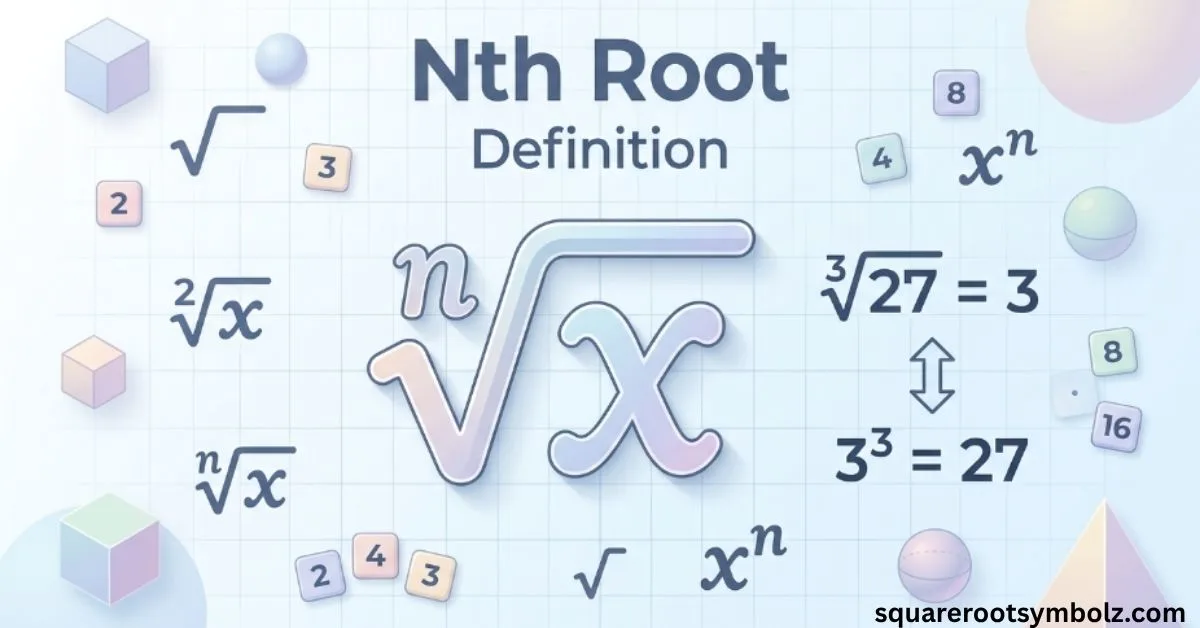
An nth root is a number that, when raised to the power of n, produces the original number. The idea connects square roots, cube roots, radical expressions, exponents, and inverse operations in one simple concept. After years of working through common math questions, I have found that most confusion starts when students see the small n beside the radical symbol and are unsure what it changes.
The good news is that the nth root follows a clear pattern. Once you understand the index, radicand, principal root, fractional exponent, and the difference between odd and even roots, even higher radicals become easier to read and solve. This guide explains the rules with simple examples rather than leaving you to memorize formulas without understanding them.
The nth Root
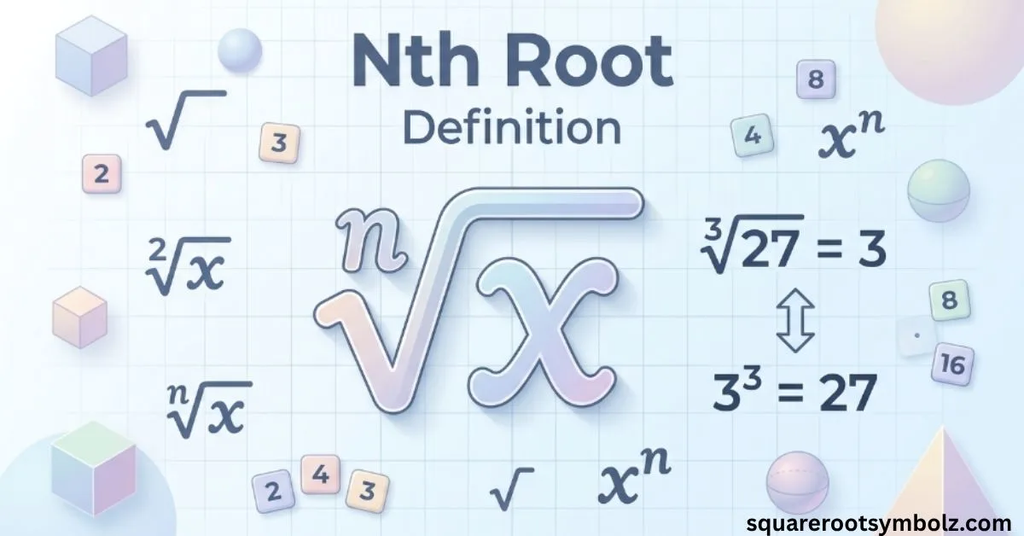
An nth root is the general form used to describe roots of different degrees. If a number r satisfies rⁿ = a, then r is an nth root of a. The value of n tells you how many times the root must be multiplied by itself.
For example, 3 is the fifth root of 243 because:
3⁵ = 3 × 3 × 3 × 3 × 3 = 243
Therefore:
⁵√243 = 3
This makes the nth root the inverse of raising a number to the nth power. A square root is simply a second root, while a cube root is a third root. Higher roots follow exactly the same mathematical idea.
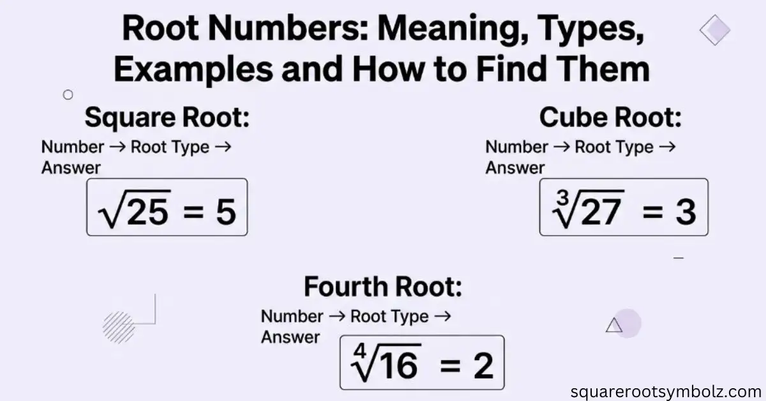
| Index | Root Name | Example |
| 2 | Square root | √25 = 5 |
| 3 | Cube root | ∛27 = 3 |
| 4 | Fourth root | ⁴√81 = 3 |
| 5 | Fifth root | ⁵√32 = 2 |
| n | nth root | ⁿ√a |
The word “nth” is useful because mathematics does not need a separate name for every possible root. Instead of saying ninth root, fifteenth root, or hundredth root every time, the general expression nth root describes them all.
The nth Root Symbol
The nth root symbol uses the familiar radical symbol √ with a small number called the index. The number inside the radical is called the radicand.
The general notation is:
ⁿ√a
Here:
- n is the index
- a is the radicand
- the entire expression represents the nth root
For example:
⁴√16 = 2
The index is 4, the radicand is 16, and the answer is 2 because:
2⁴ = 16
A square root is written differently because the index 2 is normally omitted. So √16 actually means ²√16. The cube root, however, usually displays its index as ∛.
Key Formula
The basic nth root formula is:
ⁿ√a = a^(1/n)
This means that an nth root can be written as a fractional exponent. The radical and exponent forms express the same mathematical relationship.
For example:
³√8 = 8^(1/3) = 2
because:
2³ = 8
Another example is:
⁴√81 = 81^(1/4) = 3
because:
3⁴ = 81
The formula is useful because some algebra problems are easier to simplify using rational exponents. Instead of treating radicals and powers as unrelated topics, this equation shows that they are two different ways to represent the same operation.
Worked Example
Find the fourth root of 81.
Write the expression:
⁴√81
Now ask a simple question:
What number multiplied by itself four times equals 81?
Try 3:
3 × 3 × 3 × 3 = 81
Therefore:
⁴√81 = 3
Here is another example:
Find ⁵√32.
Since:
2⁵ = 32
the answer is:
⁵√32 = 2
A useful strategy is to think backward from exponentiation. Ask which number, raised to the index of the radical, creates the radicand. This turns an intimidating-looking radical into a familiar multiplication problem.
Even Roots of Negative Values
An even root has an even index such as 2, 4, 6, or 8. Within the real number system, a negative radicand cannot have a real even root.
For example:
√−9
has no real-number answer because no real number multiplied by itself can produce a negative result. The same issue applies to fourth roots, sixth roots, and other even roots.
For example, neither:
2⁴
nor:
(−2)⁴
equals −16. Both produce a positive result. Therefore, ⁴√−16 is not a real number.
In complex mathematics, even roots of negative values can involve imaginary numbers. For basic real-number algebra, however, the important rule is simple: do not expect a real answer when an even root contains a negative radicand.
Odd Roots of Negative Values
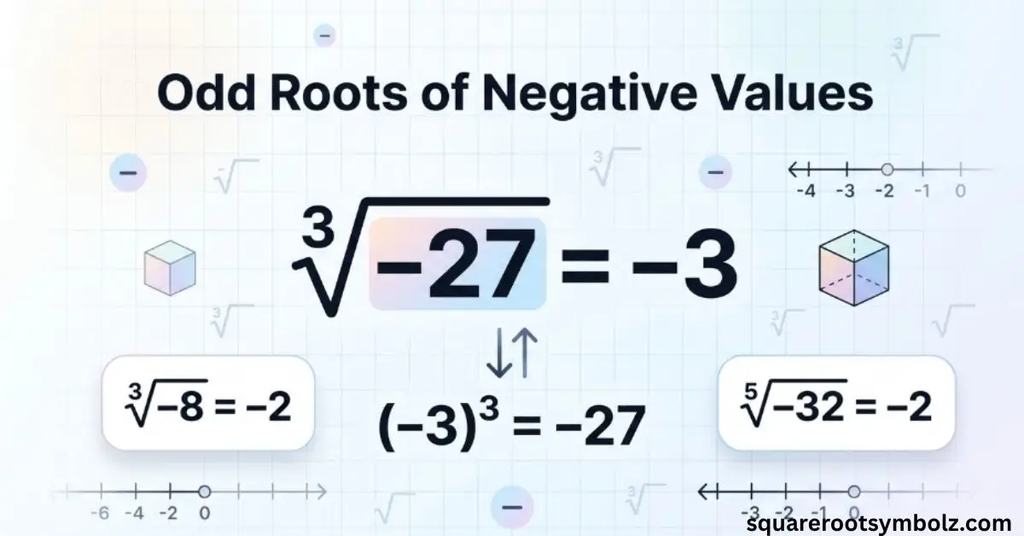
Odd roots behave differently. An odd index includes numbers such as 3, 5, 7, and 9. A negative number can have a real odd root because multiplying a negative number by itself an odd number of times keeps the final result negative.
For example:
∛−8 = −2
because:
(−2)³ = −8
Similarly:
⁵√−32 = −2
because:
(−2)⁵ = −32
This creates one of the most important distinctions in nth-root problems: odd roots can accept negative real radicands, while even roots cannot produce real answers from negative radicands. Understanding the index immediately tells you which rule applies.
Properties
Nth roots follow several useful properties, especially when simplifying radical expressions. These rules connect multiplication, division, exponents, and powers.
The most important rule to remember is that roots and powers often reverse each other. However, signs and absolute values can matter, especially when even roots are involved.
Multiplication and Division
For appropriate real-number values, an nth root of a product can be written as the product of nth roots:
ⁿ√(ab) = ⁿ√a × ⁿ√b
For example:
∛128 = ∛(64 × 2)
= ∛64 × ∛2
= 4∛2
Division follows a similar pattern:
ⁿ√(a/b) = ⁿ√a / ⁿ√b
This rule can simplify complicated radical expressions. However, even-index roots require extra care with negative values, and division by zero is never allowed.
Exponents vs Roots
Exponents and roots are inverse operations. If:
aⁿ = b
then:
a = ⁿ√b
For example:
5⁴ = 625
Therefore:
⁴√625 = 5
This relationship gives you a fast way to solve many nth-root problems. Instead of guessing randomly, think about which exponent creates the radicand.
The same relationship can also be written with fractional exponents:
ⁿ√a = a^(1/n)
This connection is especially useful in algebra because radical expressions can often be rewritten in a form that works smoothly with exponent rules.
nth Root of a-to-the-nth-Power
When the root index and exponent match, the nth root usually reverses the nth power:
ⁿ√(aⁿ)
For positive values, the result returns to a.
For example:
∛(5³) = 5
Odd indices also preserve negative values:
∛(−2)³ = −2
Even indices require more care. For example:
√(−3)² = √9 = 3
The result is not −3; it is the principal square root. In general, an even root of an even power may produce the absolute value:
ⁿ√(aⁿ) = |a|
when the index is even.
nth Root of a-to-the-mth-Power
When the exponent and root index are different, fractional exponents provide a useful shortcut:
ⁿ√(aᵐ) = a^(m/n)
For example:
∛(4⁶)
can be written as:
4^(6/3)
which becomes:
4² = 16
Another example is:
⁴√(16³) = 16^(3/4)
The fractional exponent shows how the exponent and root work together. This is one reason rational exponents are closely connected to nth roots and radical simplification.
Conclusion
The nth root is the general mathematical idea behind square roots, cube roots, fourth roots, and every higher root. If a number raised to the power of n produces another number, reversing that process means finding its nth root.
The most important things to remember are the index, radicand, and the connection between roots and exponents. Odd and even roots also behave differently with negative numbers. Once these patterns become familiar, nth-root expressions stop looking complicated and become another logical form of inverse operations in mathematics.
FAQs
What is an nth root?
An nth root is a number that, when raised to the power of n, produces the original number. If rⁿ = a, then r is an nth root of a.
What does the n mean in an nth root?
The n is called the index. It tells you how many times the root must be multiplied by itself to produce the radicand.
What is the formula for an nth root?
The general formula is:
ⁿ√a = a^(1/n)
This means an nth root can also be written as a fractional exponent.
Is a square root an nth root?
Yes. A square root is an nth root where n = 2. For example, √16 is the same as ²√16.
Is a cube root an nth root?
Yes. A cube root is an nth root with an index of 3. For example, ∛27 = 3.
Can an nth root be negative?
Yes, particularly when the index is odd. For example, ∛−8 = −2. However, an even root of a negative number is not a real number.
What is the nth root of 81?
The answer depends on the index. The square root of 81 is 9, while the fourth root of 81 is 3.
How do you find the nth root of a number?
Ask which number, raised to the power shown by the index, equals the original number. For example, since 3⁴ = 81, the fourth root of 81 is 3.

I’m the creator of SquareRootSymbolz.com, where I publish easy-to-understand guides on symbols, Unicode characters, Alt codes, keyboard shortcuts, and copy-and-paste text symbols. My goal is to provide accurate, well-researched, and user-friendly content that helps readers quickly find the information they need.