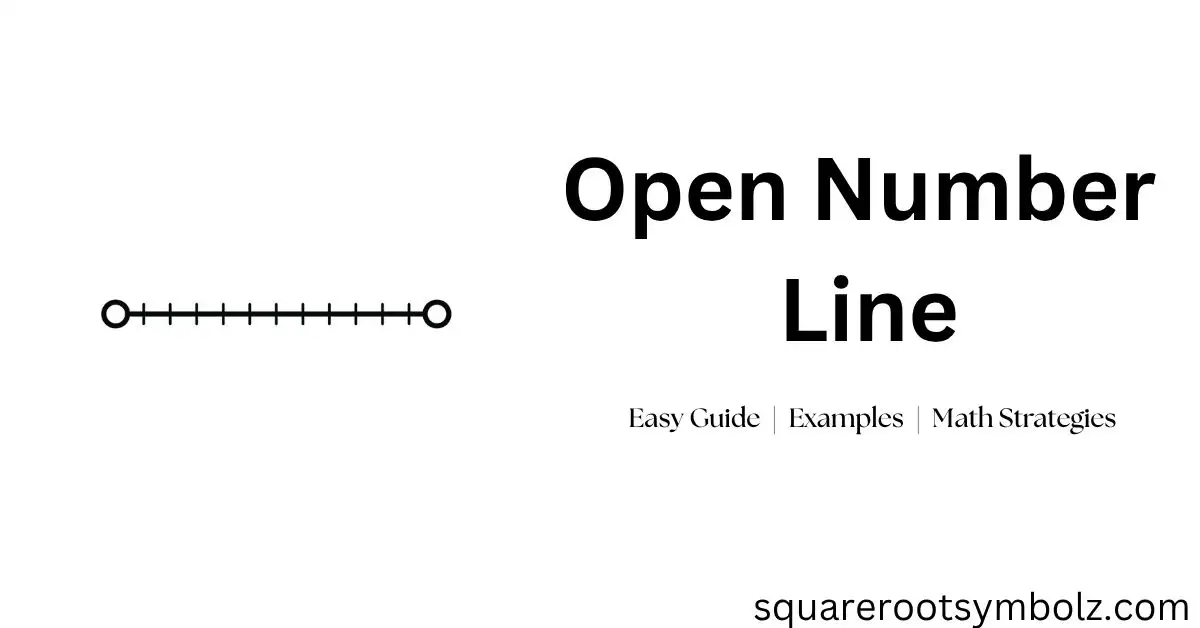
An open number line is a blank line where students choose the numbers, landmarks, and jumps they need to solve a math problem. Unlike a fixed number line, it does not force students to use every tick mark. This makes number sense, mental math, addition, subtraction, place value, and magnitude easier to see.
Teachers often introduce this model when students know how to calculate but struggle to explain how they reached an answer. Instead of hiding the thinking inside a written algorithm, the open number line puts each step on display. That simple change can make mental computation feel much more understandable and flexible.
What Is a Number Line?
A number line represents numbers in an ordered sequence, normally increasing from left to right. Equal intervals help show the relationship between values, while the position of a number communicates its relative size. Students can use this visual model for counting, comparison, addition, subtraction, fractions, decimals, and negative numbers.
The important idea is that a number line is more than a row of numbers. It gives numbers a location and magnitude. For example, seeing 80 positioned farther right than 50 immediately communicates that 80 is greater. This spatial relationship helps connect abstract arithmetic with something students can actually see.
Uses of Number Lines Across Grade Levels
Number lines change as mathematical understanding develops. Younger students may use them for counting forward and backward or comparing numbers. Later, students use them for addition and subtraction, fractions, decimals, rounding, and negative numbers. This makes the model useful across multiple elementary grade levels.
An open model becomes particularly useful when students need flexibility. Instead of treating every problem as a fixed sequence of one-unit movements, students can choose larger jumps. For 63 + 28, a student might move 20 to reach 83 and then 8 more to reach 91. The jumps reveal place-value thinking.
Open Number Lines
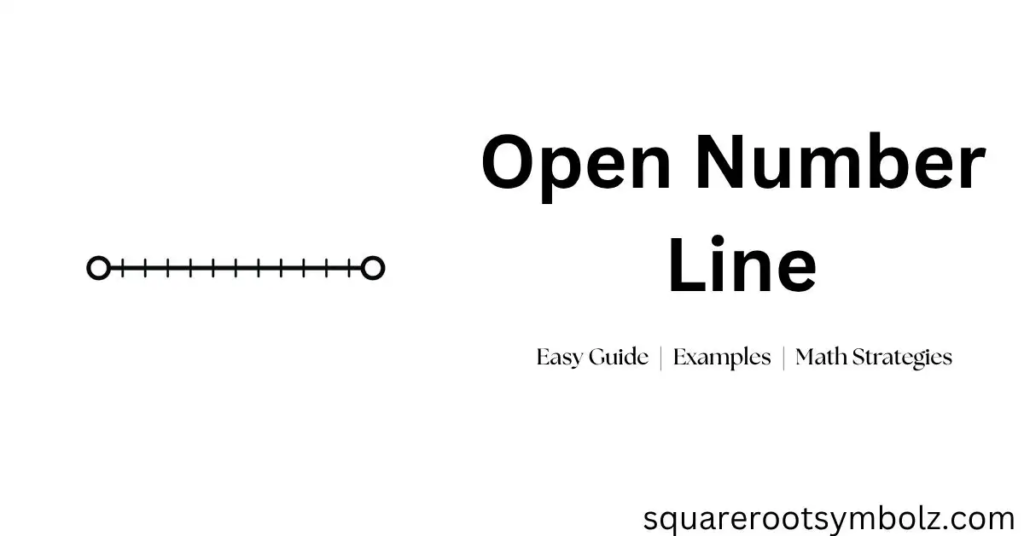
An open number line begins as a blank line without predetermined intervals, tick marks, or labels. Students decide which values deserve attention and create their own landmarks. This flexibility makes the model especially effective for showing mental computation strategies rather than simply recording an answer.
Consider 56 + 28. A student might first jump 4 to reach the friendly number 60, then jump 20 to 80, and finally jump 4 to reach 84. Another student could jump 20 first and then 8. Both methods can be correct because the model allows students to choose an efficient strategy.
Open number line
The key difference between an ordinary number line and an open number line is the amount of structure provided in advance. A traditional line may already contain values and equally spaced marks; an open version leaves those decisions to the learner. Students therefore demonstrate their own understanding of numerical relationships.
Fraction Number Lines
A number line can also represent fractions by dividing the distance between whole numbers into equal parts. For example, the interval from 0 to 1 can be divided into four equal sections to locate 1/4, 2/4, and 3/4. This helps students understand fractions as quantities with specific positions.
This visual approach is especially helpful because fractions can initially feel disconnected from whole-number thinking. A fraction number line shows that 3/4 is not simply “three pieces”; it has a definite magnitude and location between 0 and 1. That connection supports comparison and later fraction operations.
Common Misconceptions
One common misconception is that a number line must always begin at zero or contain every number in sequence. In reality, an open number line can focus on whatever values matter for the problem. Students can select useful landmarks and make larger jumps instead of counting one unit at a time.
Another frequent error involves confusing jumps with marks. When students add by hopping along a line, they may count the locations they land on rather than the spaces they travel. Teachers can correct this by emphasizing that each jump represents a quantity or interval, not simply the next visible mark.
Practice Activities
Open-number-line practice works best when students explain their choices instead of copying a single procedure. For example, give a problem such as 47 + 32 and ask students to show two different strategies. One might add 30 and then 2; another might add 3, 29, or use a convenient benchmark.
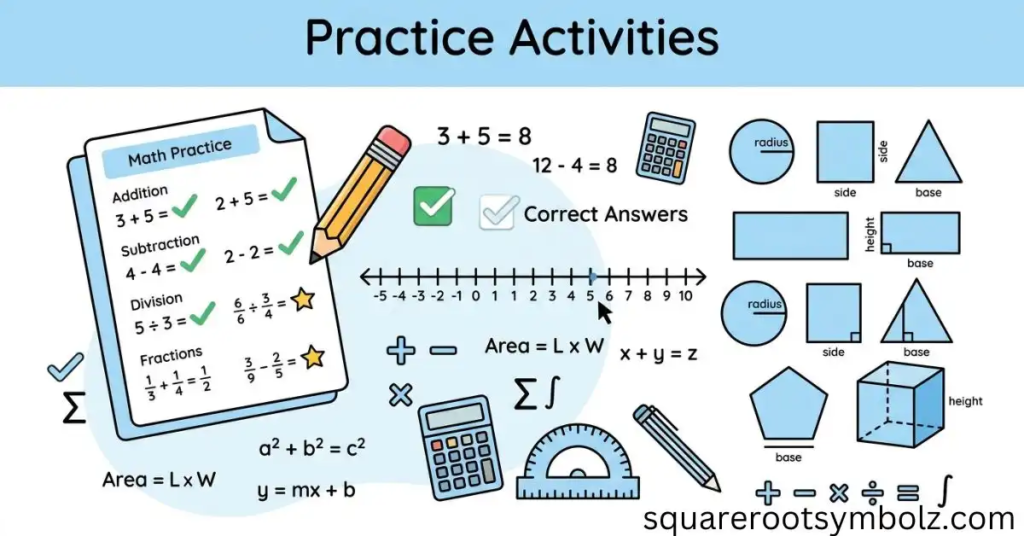
Hands-on activities can make the idea memorable. A floor number line made with tape lets students physically jump forward or backward. Other activities can involve estimating a mystery point, placing fractions, solving two-digit problems, or comparing different jump strategies. The goal is to make mathematical reasoning visible.
Example
Suppose a student needs to solve 198 + 120 using an open number line. Start by marking 198. A natural strategy is to jump 100 to reach 298, then another 20 to reach 318. The final point, 318, represents the answer while the jumps show exactly how the student reasoned. Math4Texas uses a similar locating-and-magnitude context with 198 and 120.
Digital Tools
Digital number-line tools can provide an interactive way to practice placing numbers and representing jumps. Math4Texas links learners to number-line activities for values up to 100 and 1,000, while The Math Learning Center offers a number-line app supporting whole numbers, fractions, decimals, jumps, labels, and custom tick marks.
Conclusion
An open number line turns arithmetic from a hidden calculation into visible mathematical thinking. By choosing useful landmarks and making strategic jumps, students can connect number sense, place value, magnitude, addition, subtraction, and mental math in a way that feels natural rather than mechanical. The real value is not simply reaching the correct answer it is understanding why the strategy works. Whether a student is solving 56 + 28, locating a whole number, comparing values, or working with fractions, the open number line provides a flexible space for reasoning. Used consistently, it can help students become more confident, efficient, and independent problem solvers.
FAQs
Based on the questions and recurring search intent visible across the ranking pages, these are the strongest FAQ targets:
What is an open number line in math?
A blank number line where students choose their own numbers, landmarks, and jumps to represent mathematical thinking.
What is the difference between an open and closed number line?
A closed or labeled number line has predetermined marks and values, while an open number line allows students to create the useful marks themselves.
How do you use an open number line for addition?
Start with the first number, then make strategic forward jumps representing tens, ones, or other convenient quantities until you reach the sum.
How do you use an open number line for subtraction?
Start with the first number and make backward jumps representing the amount being subtracted.
Why do teachers use open number lines?
They help students visualize magnitude, place value, number relationships, and flexible mental-computation strategies instead of relying only on memorized procedures.

I’m the creator of SquareRootSymbolz.com, where I publish easy-to-understand guides on symbols, Unicode characters, Alt codes, keyboard shortcuts, and copy-and-paste text symbols. My goal is to provide accurate, well-researched, and user-friendly content that helps readers quickly find the information they need.