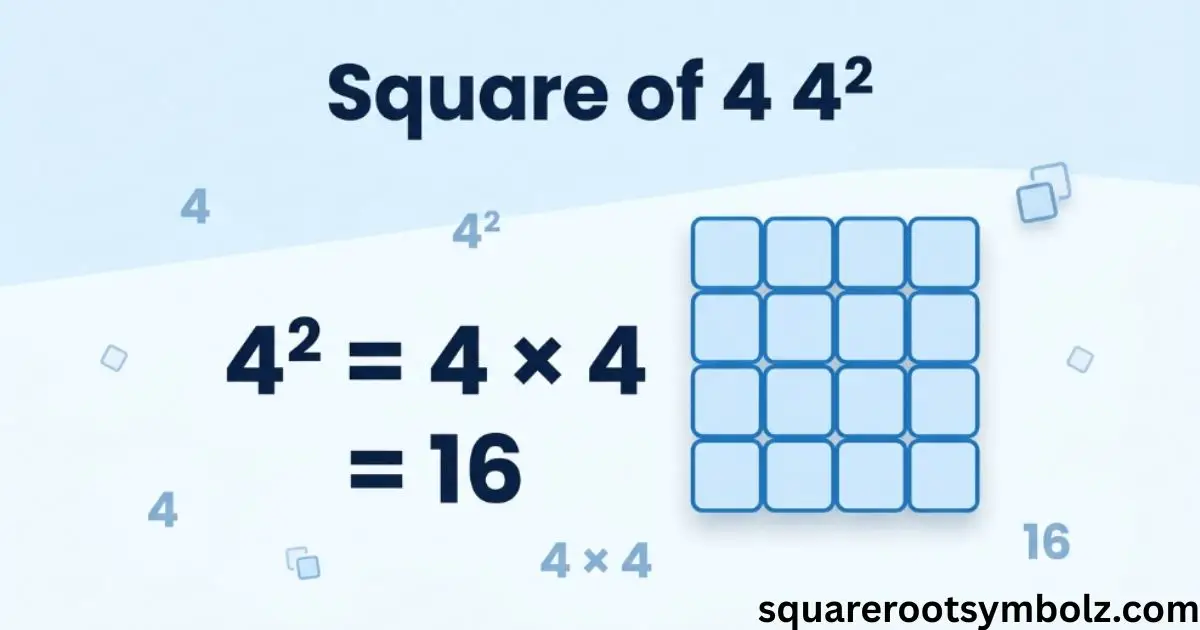
The square of 4 is 16, because multiplying 4 by itself gives 4 × 4 = 16. If you are learning squared numbers, exponents, multiplication, perfect squares, or mathematical notation, this small calculation is an important building block. In mathematics, 4² means that 4 is multiplied by itself, with 4 as the base and 2 as the exponent. That gives 16, which is a perfect square and an even integer. This simple relationship also connects 4 with square roots, powers, and geometry, where a square with a side length of 4 has an area of 16 square units.
When students first see 4², the raised 2 can make the expression look more complicated than it really is. In practice, squaring, multiplication, powers, area, square numbers, and exponents are closely connected. A reliable way to remember the idea is to think, “multiply the number by itself.” Thus, four squares equals sixteen. The same relationship works in reverse through the square root: 4 is the principal square root of 16. Once this connection is clear, similar calculations such as 3² = 9, 5² = 25, and 10² = 100 become much easier to recognize.
What Is the Square of 4
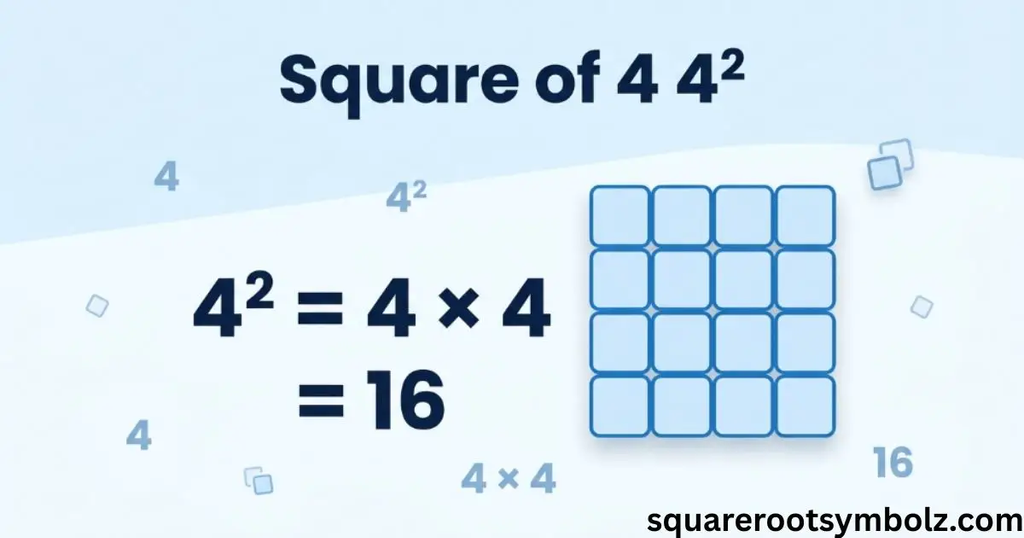
The square of 4 is 16. To square a number, multiply it by itself: 4 × 4 = 16. In exponential notation, the same calculation is written 4² = 16. The number 4 is the base, while the raised 2 is the exponent indicating that the base is used twice in multiplication.
The result, 16, is called a perfect square because it can be written as an integer multiplied by itself: 16 = 4 × 4. Geometrically, a square with side lengths of 4 units has an area of 16 square units. This gives the calculation a useful visual meaning: four rows of four unit squares make sixteen unit squares.
| Expression | Meaning | Result |
| 4 × 4 | 4 multiplied by itself | 16 |
| 4² | 4 squared | 16 |
| √16 | Principal square root of 16 | 4 |
| 2² | 2 squared | 4 |
The relationship between 4² and √16 is especially useful. Squaring 4 produces 16, while taking the principal square root of 16 returns 4. These operations work as inverse processes in this basic case.
How to Calculate the Value of Square of 4
There are several straightforward ways to calculate the square of 4, but they all produce the same answer. You can use direct multiplication, exponential notation, or a calculator. For a simple number such as 4, multiplication is usually the clearest method because it shows exactly what squaring means.
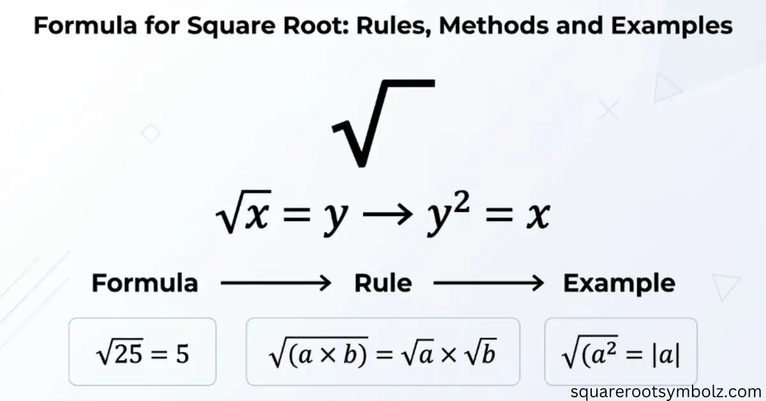
The basic formula is a² = a × a, where a represents the number being squared. Substituting 4 for a gives 4² = 4 × 4 = 16. This formula works for any real number, although the result can be positive, zero, or negative depending on the number being squared and the mathematical context.
By the Multiplication method
Start with the number 4 and multiply it by itself. The calculation is 4 × 4 = 16. Therefore, the product is 16, and 16 is the square of 4. This method is useful because it makes the meaning of squaring completely visible: the same factor, number, product, and multiplication operation appear directly in the calculation.
Using a Formula (a²)
The general formula for the square of a number is a² = a × a. Replace a with 4, and the expression becomes 4² = 4 × 4 = 16. Here, 4 is the base and 2 is the exponent. The exponent does not mean 4 × 2; it tells you to multiply 4 by itself.
By Using a Calculator
A calculator can evaluate 4² almost instantly. Enter 4 and use the square or exponent function, depending on the calculator. You should receive 16. Even when a calculator provides the answer, knowing that 4 × 4 = 16 lets you check whether the result makes sense instead of relying on the device without understanding the calculation.
Solved Examples on Square of 4
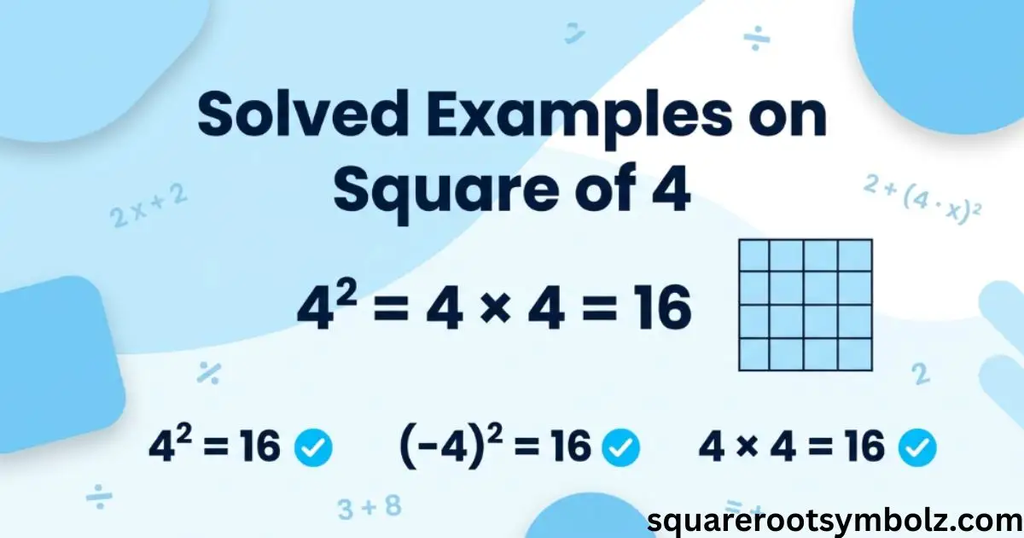
The value 16 appears in more than one type of mathematical problem. Understanding these connections helps you recognize when 4² represents a numerical square, an area calculation, or part of another formula. The following examples build on the same simple relationship and show why learning one basic fact can make several later problems easier.
Problem 1
A square has a side length of 4 centimeters. What is its area?
Use the square-area formula:
Area = side × side
Area = 4 × 4 = 16 cm²
So, the area is 16 square centimeters. This is exactly the geometric meaning of 4²: four units across and four units down create sixteen square units. A similar connection between side length and area is used throughout elementary geometry.
Problem 2
A square has an area of 16 square units. What is its side length?
Work backward using the square root:
√16 = 4
Therefore, each side is 4 units long. This illustrates the inverse relationship between squaring and taking a principal square root: 4² produces 16, while √16 returns 4.
Problem 3
A circle has a radius of 4 meters. Find its area.
Use the circle-area formula:
Area = πr²
Substitute r = 4:
Area = π × 4²
Area = 16π square meters
Using π ≈ 3.14 gives approximately 50.24 square meters. The important point here is that the square of 4 becomes part of a larger geometric formula.
A quick comparison
| Number | Square | Calculation |
| 2 | 4 | 2 × 2 |
| 3 | 9 | 3 × 3 |
| 4 | 16 | 4 × 4 |
| 5 | 25 | 5 × 5 |
| 6 | 36 | 6 × 6 |
The sequence 1, 4, 9, 16, 25, 36 shows how perfect squares develop as whole numbers are multiplied by themselves.
Conclusion
The square of 4 is 16, and the calculation is simply 4 × 4 = 16, or 4² = 16. What looks like a tiny arithmetic fact actually introduces several important mathematical ideas: exponents, multiplication, perfect squares, area, square roots, and algebraic notation.
The easiest way to remember it is to connect the number to a visual square: a shape with 4 units on each side contains 16 square units. Once this relationship feels natural, calculations involving 3², 5², 6², and other square numbers become much easier.
FAQs
What is the square of 4?
The square of 4 is 16 because 4 × 4 = 16. It can also be written as 4² = 16.
What is the square root of 4?
The principal square root of 4 is 2, because 2 × 2 = 4. In an equation such as x² = 4, the two solutions are x = 2 and x = −2. It is important to distinguish the principal square-root symbol from the solutions of a squared equation.
Is 4 a perfect square?
Yes. 4 is a perfect square because it equals 2 × 2, or 2². Similarly, 16 is a perfect square because it equals 4 × 4.
Is 4 a prime number?
No. 4 is a composite number because it has more than two positive factors: 1, 2, and 4. Its factorization is 2 × 2.
What are the first few multiples of 4?
The first few positive multiples of 4 are 4, 8, 12, 16, 20, 24, 28, and 32. Each is obtained by multiplying 4 by a whole number.
What is the square of 3?
The square of 3 is 9, because 3 × 3 = 9. This helps place 4² = 16 in the sequence of consecutive square numbers: 1, 4, 9, 16, 25.
Important Glossaries for Square of 4
Square: The result of multiplying a number by itself. For 4, the square is 16.
Exponent: A small raised number that indicates a power. In 4 2, the 2 is the exponent.
Base: The number being raised to a power. In 4², the base is 4.
Perfect square: An integer that can be expressed as the square of another integer, such as 4, 9, 16, or 25.
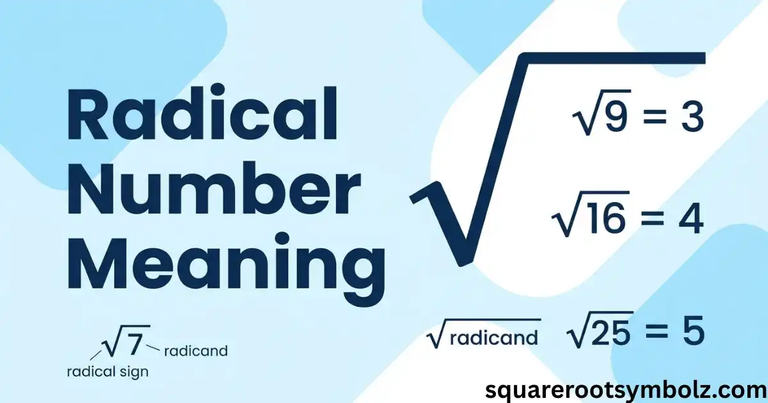
Square root: A number that produces a given value when multiplied by itself. The principal square root of 16 is 4.
Even number: An integer divisible by 2 without a remainder. Because 4 is even, its square, 16, is also even.

I’m the creator of SquareRootSymbolz.com, where I publish easy-to-understand guides on symbols, Unicode characters, Alt codes, keyboard shortcuts, and copy-and-paste text symbols. My goal is to provide accurate, well-researched, and user-friendly content that helps readers quickly find the information they need.