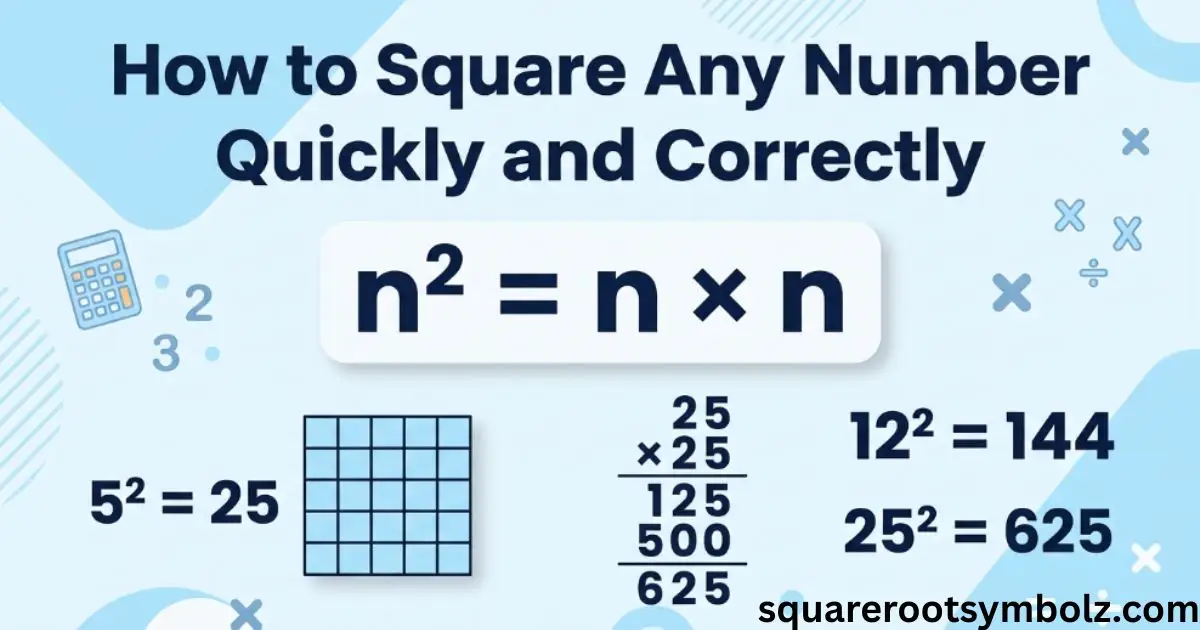
The easiest way to understand any square is to multiply a number by itself. For example, 7² means 7 × 7 = 49. This simple rule connects squaring, square numbers, exponents, multiplication, and perfect squares. If the small ² symbol has ever made a basic calculation feel harder than it should, the idea is actually much simpler: the exponent 2 tells you to use the same number twice in multiplication. From there, you can use ordinary multiplication or faster mental-math methods based on algebraic identities.
When you need to calculate any square without a calculator, the method can change depending on the number. Small values are usually easiest to multiply directly, while numbers near 10, 100, or another convenient base can be handled with a shortcut. As a mathematics explanation should, this guide starts with the basic meaning, then connects it to mental math, algebra, geometry, square roots, and real calculations. The goal is not to memorize a trick blindly, but to understand why the method works.
How to Compute Fast Any Square
Any square A useful way to compute any square quickly is to choose a nearby number that is easier to work with. The identity a² = (a − b)(a + b) + b² turns one difficult multiplication into a simpler product plus a small square. This is especially useful for mental calculation, algebra, multiplication, and numbers close to convenient bases.
For example, to calculate 112², choose 100 as the convenient nearby number. The difference is 12. Then calculate 100 × 124 and add 12²: 12,400 + 144 = 12,544. The method is exact, not an estimate. For everyday work, direct multiplication may still be easier for small numbers, but this identity becomes valuable when the numbers get larger.
How Squaring Works (With Simple Examples)
Squaring means multiplying a number by itself. Thus, 4² means 4 × 4 = 16, while 6² means 6 × 6 = 36. The raised 2 is the exponent, and the number being squared is the base. Once this relationship is clear, expressions such as 15², 20², and 100² become straightforward calculations rather than unfamiliar symbols.
A quick mental check is to ask, “What number am I multiplying by itself?” For 9², the answer is 9 × 9 = 81. For 12², it is 12 × 12 = 144. The important idea is that squaring does not mean multiplying by 2. The exponent tells you how many copies of the base are multiplied together.
Why Squared Numbers Matter in Math
Squared numbers any square appear throughout mathematics because multiplying a quantity by itself naturally describes two-dimensional measurements and many algebraic relationships. You encounter squares in area, the Pythagorean theorem, quadratic equations, physics formulas, and number patterns. The concept starts with simple arithmetic but continues into more advanced mathematics.
There is also a useful growth pattern. If a length doubles, its square becomes four times as large. For example, 3² = 9, while 6² = 36. That relationship matters in geometry and applied mathematics because areas often depend on the square of a length. It explains why squared quantities can grow much faster than the original measurement.
Symbol and Notation for Squared Numbers
The standard mathematical notation for squaring uses a superscript 2. Thus, 8 2 is read as “eight squared” or “eight to the second power.” The 8 is the base, and 2 is the exponent. When superscripts are unavailable, digital systems may use notation such as 8^2, depending on the software or calculator.
You may see the same idea in formulas such as A = s² for the area of a square, a² + b² = c² in the Pythagorean theorem, or ax² + bx + c in a quadratic expression. The notation changes the way the calculation looks, but the meaning of the exponent 2 remains the same: multiply the base by itself.
Common Mistakes Students Make
One common mistake is confusing x² with 2x. They are different operations: 5² = 25, while 2 × 5 = 10. Another frequent error involves negative numbers. The expression (−5)² equals 25, but −5² is interpreted as −(5²), which equals −25 under standard order of operations. Parentheses matter.
Students can also incorrectly square each term separately. For example, (3 + 4)² is not 3² + 4². First calculate 3 + 4 = 7, then square it: 7² = 49. The expression 3² + 4² equals 9 + 16 = 25, which is a different result. Keeping the parentheses visible prevents this mistake.
Real-Life Examples of Squared Numbers
A square with side length 10 feet has an area of 10² = 100 square feet. A circular area uses a related squared quantity in πr². Squared values also occur in the Pythagorean theorem, kinetic-energy formulas, statistics, and measurements. These applications connect area, distance, radius, algebra, and physical quantities.
Imagine measuring a square garden. If one side is 12 feet, multiplying 12 by itself gives 144, so the garden covers 144 square feet. That same idea works for a square floor, tile layout, picture frame, or other square-shaped surface. The practical lesson is simple: when two equal lengths determine an area, squaring naturally appears.
Square vs Square Root (Clear Difference)
Squaring and taking a square root move in opposite directions. Squaring 5 gives 25 because 5 × 5 = 25. The principal square root of 25 is 5 because 5² = 25. This makes square, square root, perfect square, exponent, and inverse operation closely related mathematical concepts.
There is one important notation distinction. √25 means the principal square root, which is 5. But the equation x² = 25 has two real solutions, x = 5 and x = −5, because both numbers square to 25. Understanding this difference prevents a common mistake when moving from basic arithmetic into algebra.
| Operation | Expression | Result |
| Square | 4² | 16 |
| Square root | √16 | 4 |
| Square | (−4)² | 16 |
| Equation | x² = 16 | x = ±4 |
How to Square Any Number (Step-by-Step Guide)
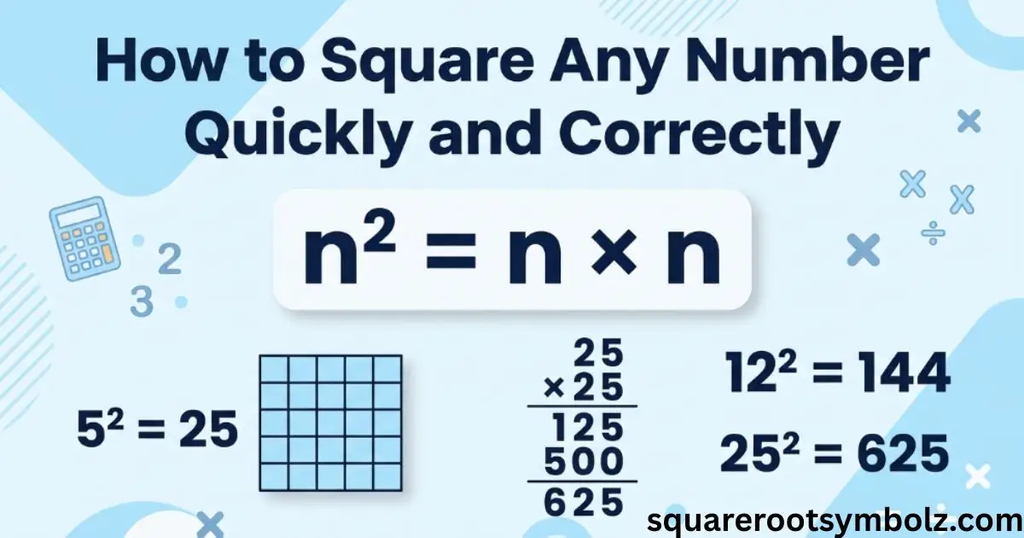
The simplest method for any number is direct multiplication: write the number twice and multiply. For example, 13² becomes 13 × 13 = 169. A calculator can also use an x² button or exponent function. For mental math, special patterns can make certain numbers faster, especially values ending in 5 or numbers close to a convenient base.
For a number close to a round base, use the identity from the exact-match competitor. Suppose you want 98². The nearby base is 100, and the difference is 2. Therefore, 98² = (98 − 2)(98 + 2) + 2² = 96 × 100 + 4 = 9,604. The method works because it comes directly from the difference-of-squares identity.
Squaring Whole Numbers, Decimals, and Negatives
Whole numbers are usually the easiest to square because direct multiplication gives an exact result. Decimal numbers follow the same multiplication rule. For example, 1.5² = 1.5 × 1.5 = 2.25. Fractions are squared by squaring both numerator and denominator, so (3/4)² = 9/16.
Negative numbers follow an equally important rule: a negative multiplied by a negative produces a positive result. Therefore, (−4)² = 16. But remember the notation difference between (−4)² and −4². Parentheses tell the exponent to apply to the negative number itself; without them, standard order of operations applies the exponent first.
Practice Square Numbers in Math
Practice helps turn the idea of any square from a rule you remember into a calculation you can recognize immediately. Start with familiar values such as 2², 3², 4², 5², and 10². Then try larger values and check each answer by multiplying the original number by itself. This builds accuracy before speed.
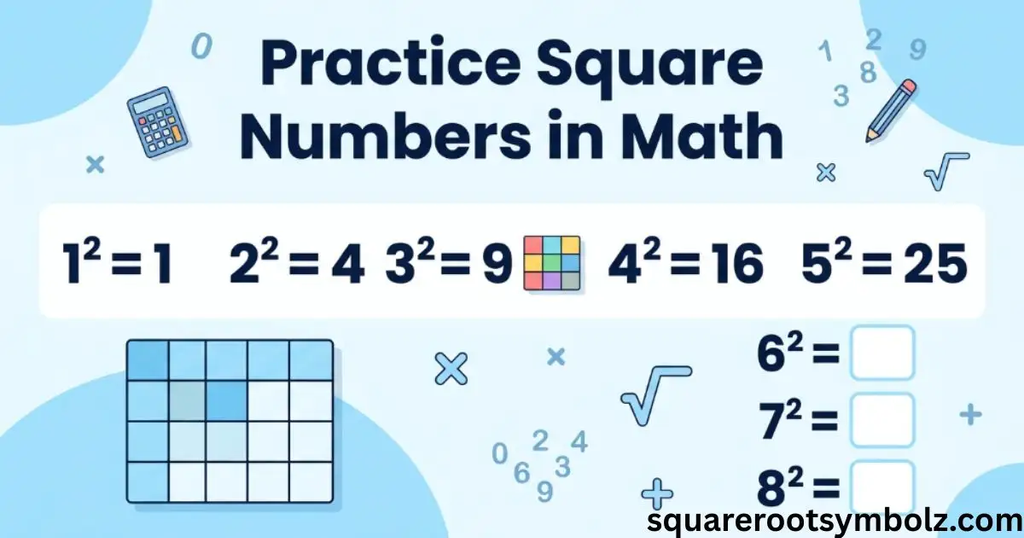
Try these:
| Problem | Answer |
| 3² | 9 |
| 4² | 16 |
| 7² | 49 |
| 9² | 81 |
| 11² | 121 |
| 15² | 225 |
| 20² | 400 |
For a challenge, calculate 24² mentally. One convenient approach is to use 25 as a nearby number: 24² = (25 − 1)² = 625 − 50 + 1 = 576. This illustrates why nearby-number strategies can make mental squaring easier.
Conclusion
The easiest way to understand any square is to remember one rule: square a number by multiplying it by itself. From 4² = 16 to larger mental calculations, the same principle remains unchanged. When a number is awkward to multiply directly, a nearby-base method can reduce the work while preserving an exact answer.
Squaring also connects arithmetic to exponents, perfect squares, area, algebra, square roots, and real-world measurements. Once you understand both the basic multiplication method and the algebra behind faster techniques, you are no longer depending on memorized answers. You understand what the square means and how to calculate it.
FAQs
What does it mean to square a number?
To square a number means to multiply it by itself. For example, 7² = 7 × 7 = 49. The small 2 is the exponent and indicates the second power.
Can every number be squared?
Yes. Any real number can be multiplied by itself. Whole numbers, decimals, fractions, and negative real numbers can all be squared. The result of squaring a real number is always nonnegative.
What is the fastest way to square a number?
It depends on the number. Direct multiplication is simple for small values, while numbers close to 10, 100, or another convenient base can often be handled faster with an algebraic identity.
What is the square of 4?
The square of 4 is 16, because 4 × 4 = 16. It can also be written as 4² = 16.
Can you square a negative number?
Yes. For example, (−6)² = 36 because (−6) × (−6) = 36. A negative number squared is positive.
Is every positive number a square number?
No. A positive integer is a square number only when it can be expressed as an integer multiplied by itself. For example, 16 is a square number because 4 × 4 = 16, while 7 is not a square number.

I’m the creator of SquareRootSymbolz.com, where I publish easy-to-understand guides on symbols, Unicode characters, Alt codes, keyboard shortcuts, and copy-and-paste text symbols. My goal is to provide accurate, well-researched, and user-friendly content that helps readers quickly find the information they need.