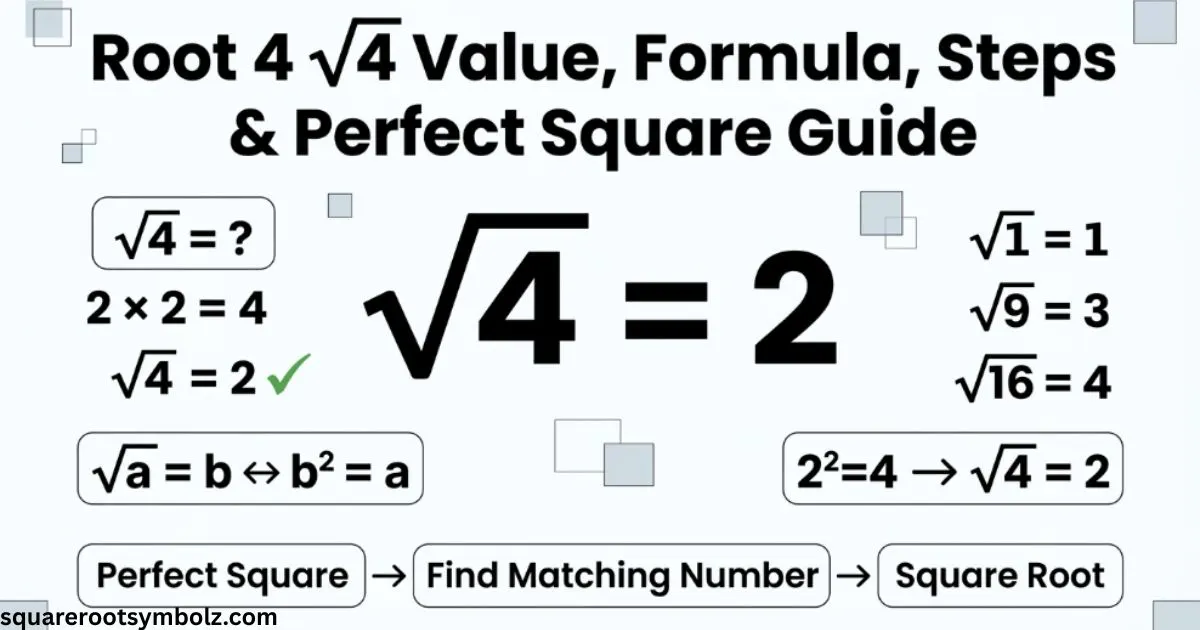
Root 4 equals 2. In radical notation, √4 = 2 because 2 × 2 = 4. The number 4 is a perfect square, so its principal square root is an exact integer rather than a decimal approximation. The important distinction is that √4 means 2, while the equation x² = 4 has two solutions, x = 2 and x = −2.
If you have ever wondered whether the answer should be 2 or ±2, you are not alone. This small distinction causes many mistakes in algebra. Once you understand the radical symbol, principal root, perfect square, rational number, and square-root notation, the idea becomes simple. This guide explains the value of root 4, how to calculate it, why 4 is a perfect square, and where the result appears in real mathematics.
What Is Square Root of 4?
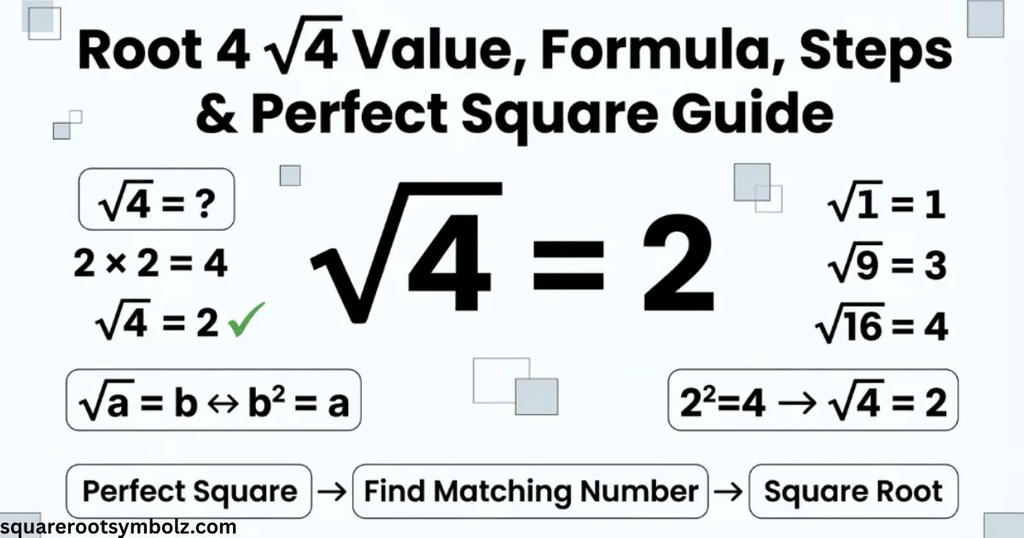
The square root of 4 is the number that produces 4 when multiplied by itself. Since 2 × 2 = 4, the principal square root is 2. Therefore, the basic result is √4 = 2. The number 4 is called a perfect square because its square root is an integer.
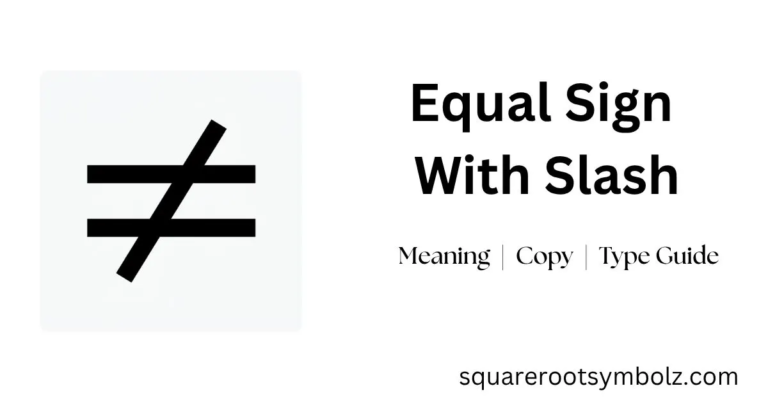
There is an important detail about signs. Both 2 and −2 produce 4 when squared, because 2² = 4 and (−2)² = 4. However, the radical expression √4 specifically represents the nonnegative, or principal, square root. So √4 is 2, not ±2. The ± symbol belongs when solving an equation such as x² = 4.
Key Formula for Square Root of 4
The key formula is:
√4 = 2
You can verify it by reversing the operation. Squaring 2 gives 4:
2² = 2 × 2 = 4
Because 4 is a perfect square, its square root has an exact value. There is no need to round the answer, use a calculator approximation, or leave the result under a radical sign.
Another useful relationship is:
(√4)² = 4
This shows that squaring the principal square root returns the original nonnegative number. In comparison, solving x² = 4 requires both signs because two real numbers square to 4. This distinction between an expression and an equation is one of the most useful ideas to remember.
Square Root Symbol & Notation
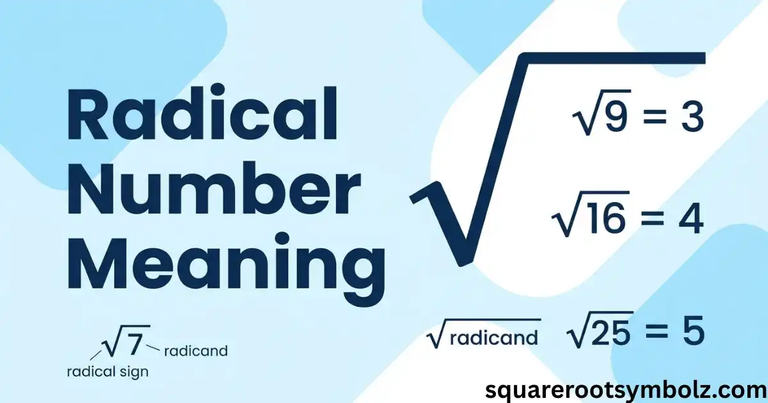
The symbol √ is called the radical symbol or square root symbol. In √4, the number 4 is called the radicand because it appears under the radical. The expression is read as “the square root of four.” This notation is used throughout arithmetic, algebra, geometry, statistics, and science.
The notation also helps distinguish √4 from other expressions. For example, √4 = 2, while −√4 = −2. Meanwhile, (−2)² = 4. These expressions may look closely related, but they represent different operations. Understanding the position of the negative sign prevents many common errors when working with radicals.
Step-by-Step Illustration: How to Calculate Square Root of 4
Start with the number 4 and ask a simple question: What number multiplied by itself equals 4? The answer is 2 because 2 × 2 = 4. Therefore, the principal square root is √4 = 2. This is the quickest method when you recognize 4 as a perfect square.
You can also use prime factorization:
4 = 2 × 2
Therefore:
√4 = √(2 × 2) = 2
The paired factors show why the radical disappears. Each pair of identical prime factors contributes one factor outside the radical. Since 4 consists of a complete pair of 2s, the result is simply 2.
Why Square Roots Can Be Positive or Negative
The phrase “square roots of 4” can refer to two numbers: 2 and −2. Both work because multiplying either number by itself produces 4. However, √4 has only one value: 2. The radical symbol represents the principal square root, which is nonnegative.
Compare these statements:
| Expression | Answer |
| √4 | 2 |
| −√4 | −2 |
| 2² | 4 |
| (−2)² | 4 |
| x² = 4 | x = ±2 |
This is why writing √4 = ±2 is incorrect when the expression is being evaluated by itself. The correct statement is √4 = 2. The ± appears when an equation asks for all values whose square equals 4.
What is a perfect square?
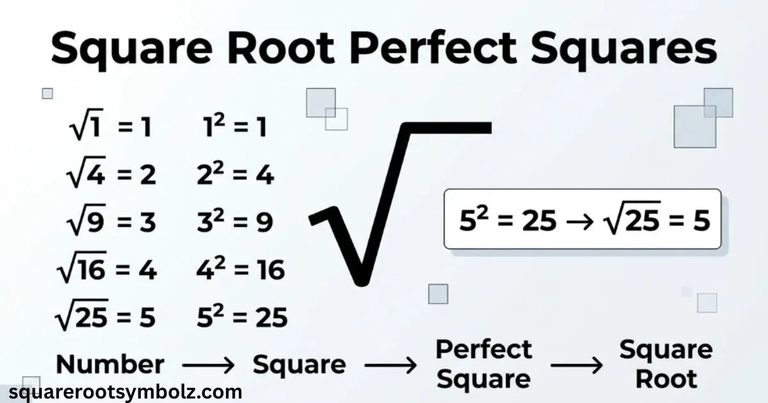
A perfect square is a number that can be written as an integer multiplied by itself. Examples include 1, 4, 9, 16, 25, and 36. Because 4 = 2 × 2 = 2², it is a perfect square. Its square root is therefore an exact whole number: √4 = 2.
Perfect squares are especially useful when estimating other square roots. Since 4 lies between 1 and 9, √3 is between 1 and 2, while √5 is between 2 and 3. Recognizing nearby perfect squares gives you a quick way to estimate a non-perfect square root without immediately reaching for a calculator.
Applications and Examples
The value √4 appears in simple geometry and algebra. For example, a square with an area of 4 square units has a side length of √4 = 2 units. Similarly, solving x² = 4 gives x = 2 or x = −2. These examples show how the same number can behave differently depending on the mathematical context.
Square roots also appear in formulas involving distance, geometry, statistics, and physics. A square root may be used when reversing a squared quantity or finding a length from an area. Calculator.name specifically notes applications involving geometry, the Pythagorean theorem, standard deviation, and physics.
Square root of 40
The relationship between √4 and √40 is useful because 40 contains a perfect-square factor. Since:
40 = 4 × 10
we can write:
√40 = √(4 × 10)
Then:
√40 = √4 × √10
Since √4 = 2:
√40 = 2√10
BYJU’S uses √40 to demonstrate how recognizing a perfect-square factor can simplify a larger radical.
This idea extends to many other numbers. When simplifying a square root, look for factors that are perfect squares. For example, √72 can be rewritten as √(36 × 2), giving 6√2. The key skill is recognizing square factors before attempting a decimal approximation.
Square root of 400
The number 400 provides another easy example because it contains two perfect-square factors:
400 = 4 × 100
Therefore:
√400 = √4 × √100
Since √4 = 2 and √100 = 10:
√400 = 2 × 10 = 20
So the square root of 400 is 20. BYJU’S uses this example to show how multiplying perfect squares can make larger square-root calculations straightforward.
You can verify the result by squaring 20:
20 × 20 = 400
That verification method works for any perfect square. If you believe the square root of a number is a particular integer, multiply that integer by itself. If you get the original number, your result is correct.
Square Root From 1 to 50
Knowing the common perfect squares makes square-root calculations much faster. Here are the exact integer roots among the numbers from 1 through 50:
| Number | Square Root |
| 1 | 1 |
| 4 | 2 |
| 9 | 3 |
| 16 | 4 |
| 25 | 5 |
| 36 | 6 |
| 49 | 7 |
For the non-perfect squares between them, the square roots are irrational decimal values. For example, √2 is approximately 1.414, √3 is approximately 1.732, and √5 is approximately 2.236. BYJU’S provides a broader square-root table from 1 to 50.
The perfect-square pattern is easy to remember: 1² = 1, 2² = 4, 3² = 9, 4² = 16, 5² = 25, 6² = 36, and 7² = 49. Learning these basic squares makes many algebra and geometry problems noticeably faster.
Common square roots
Square roots near 4 help put √4 into context:
| Number | Square Root | Type |
| 1 | 1 | Perfect square |
| 2 | ≈1.4142 | Non-perfect square |
| 3 | ≈1.7321 | Non-perfect square |
| 4 | 2 | Perfect square |
| 5 | ≈2.2361 | Non-perfect square |
| 6 | ≈2.4495 | Non-perfect square |
| 7 | ≈2.6458 | Non-perfect square |
| 9 | 3 | Perfect square |
Calculator.name similarly places √4 between √3 and √5 and identifies 4 as a perfect square.
This comparison also gives a useful estimation rule. Because 4 is a perfect square, √4 lands exactly on an integer. A number immediately below or above 4 usually has a square root that is not an integer. This makes perfect squares easy reference points when estimating radicals.
Understanding the square root of 4
The simplest way to understand √4 is to think backward from multiplication. Ask, “What number times itself equals 4?” The answer is 2. Therefore:
√4 = 2
There is no decimal approximation because 2 is exact. Four is a perfect square, 2 is an integer, and 2 can also be written as the rational number 2/1.
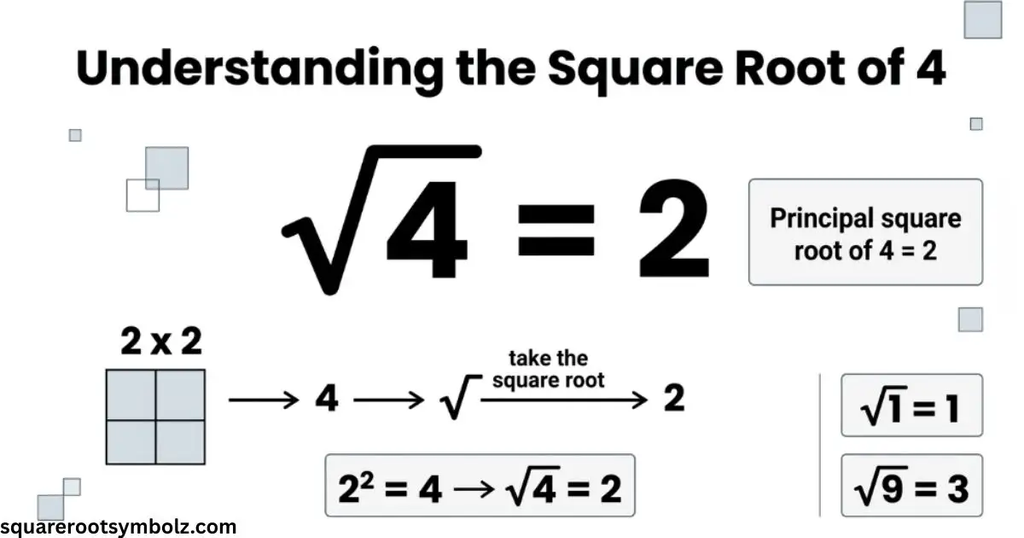
The most important distinction is between the expression √4 and the equation x² = 4. The first has the single value 2. The second has two real solutions, 2 and −2. Remembering that difference prevents one of the most common square-root mistakes.
Quick comparison
| Question | Correct answer |
| What is √4? | 2 |
| What is the square root of 4? | 2 |
| Is 4 a perfect square? | Yes |
| Is √4 rational? | Yes |
| Is √4 an integer? | Yes |
| What is −√4? | −2 |
| What are the solutions to x² = 4? | x = 2, −2 |
| What is 2²? | 4 |
| What is (−2)²? | 4 |
Why √4 is not ±2
The symbol ± is used when solving an equation such as x² = 4 because both 2 and −2 satisfy the equation. But the radical symbol √ specifically denotes the principal, nonnegative square root. Therefore, the expression √4 has the single value 2.
Is √4 rational?
Yes. Since √4 = 2 and 2 can be written as 2/1, the result is a rational number. It is also an integer and a whole number. This makes √4 different from values such as √2 and √3, which are irrational numbers and cannot be expressed as a ratio of two integers.
Is 4 a perfect square?
Yes. Four is a perfect square because:
4 = 2 × 2 = 2²
Its principal square root is the integer 2. Perfect squares are numbers whose square roots are integers, such as 1, 4, 9, 16, 25, and 36.
What is the simplest form of √4?
The simplest form is 2. Because 4 is already a perfect square, there is no radical left after simplification. Writing √4 as 2 is more simplified than leaving the answer as √4.
What is the square of √4?
The square of √4 is 4:
(√4)² = 4
Since √4 = 2, this is also:
2² = 4
The operation of taking a square root and then squaring returns the original nonnegative number.
What is −√4?
The negative sign is outside the radical:
−√4 = −2
This is different from saying √4 = −2. The radical itself gives the principal value 2; placing a negative sign before the radical changes the result to −2.
What are the two square roots of 4?
The two numbers whose squares equal 4 are:
2 and −2
That is because:
2² = 4
and
(−2)² = 4
Therefore, solving x² = 4 gives x = ±2. But √4 itself remains 2.
Can a calculator give a different answer?
For √4, a standard calculator should return exactly 2. If a calculator is set to a different operation, such as the fourth root, cube root, or a negative square-root expression, the result will naturally be different. Always check the radical index and the sign before interpreting a calculator result.
Common mistake to avoid
The most common mistake is writing:
√4 = ±2
The correct statement is:
√4 = 2
If the problem is:
x² = 4
then:
x = ±2
This one distinction is worth remembering because it appears repeatedly in algebra, geometry, standardized tests, and classroom exercises.
Conclusion
Root 4 has a simple exact value: √4 = 2. The number 4 is a perfect square because 2 × 2 = 4, making its principal square root an integer and a rational number.
The key point to remember is the difference between √4 and x² = 4. √4 = 2, while x² = 4 has two solutions, x = 2 and x = −2. Once that distinction is clear, root 4 becomes one of the easiest and most useful perfect-square examples in mathematics.
FAQ Section
What is the root 4 value?
√4 = 2. Since 2 × 2 = 4, the principal square root of 4 is exactly 2.
Is the square root of 4 2 or ±2?
√4 = 2. However, the equation x² = 4 has two solutions: x = 2 and x = −2.
Why is root 4 equal to 2?
Because 2 multiplied by itself equals 4:
2 × 2 = 4
Therefore, √4 = 2.
Is 4 a perfect square?
Yes. 4 is a perfect square because 4 = 2².
Is √4 rational or irrational?
√4 is rational because √4 = 2 and 2 can be written as 2/1.
Is √4 an integer?
Yes. √4 = 2, and 2 is an integer.
What is the simplest form of √4?
The simplest form is 2 because 4 is a perfect square.
What are the two square roots of 4?
The two square roots are 2 and −2 because both numbers squared equal 4.
What is the square of √4?
(√4)² = 4.
What is −√4?
−√4 = −2.

I’m the creator of SquareRootSymbolz.com, where I publish easy-to-understand guides on symbols, Unicode characters, Alt codes, keyboard shortcuts, and copy-and-paste text symbols. My goal is to provide accurate, well-researched, and user-friendly content that helps readers quickly find the information they need.