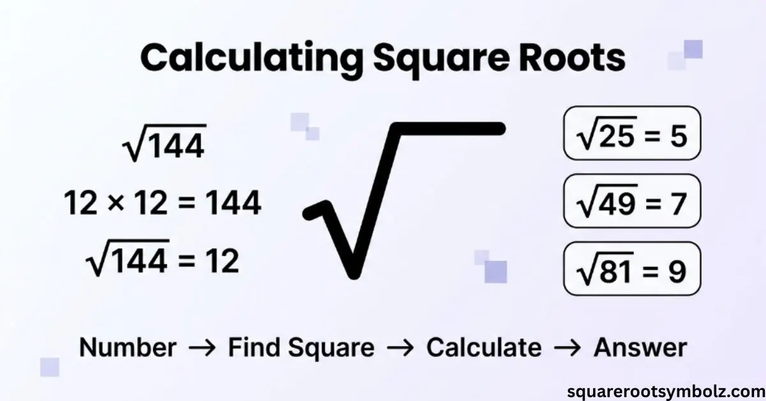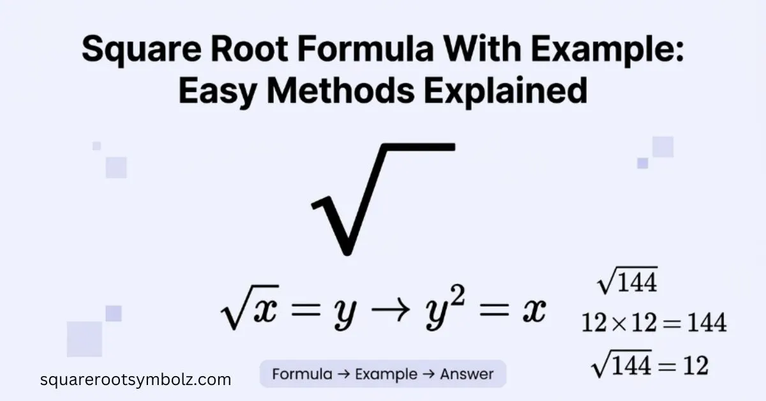
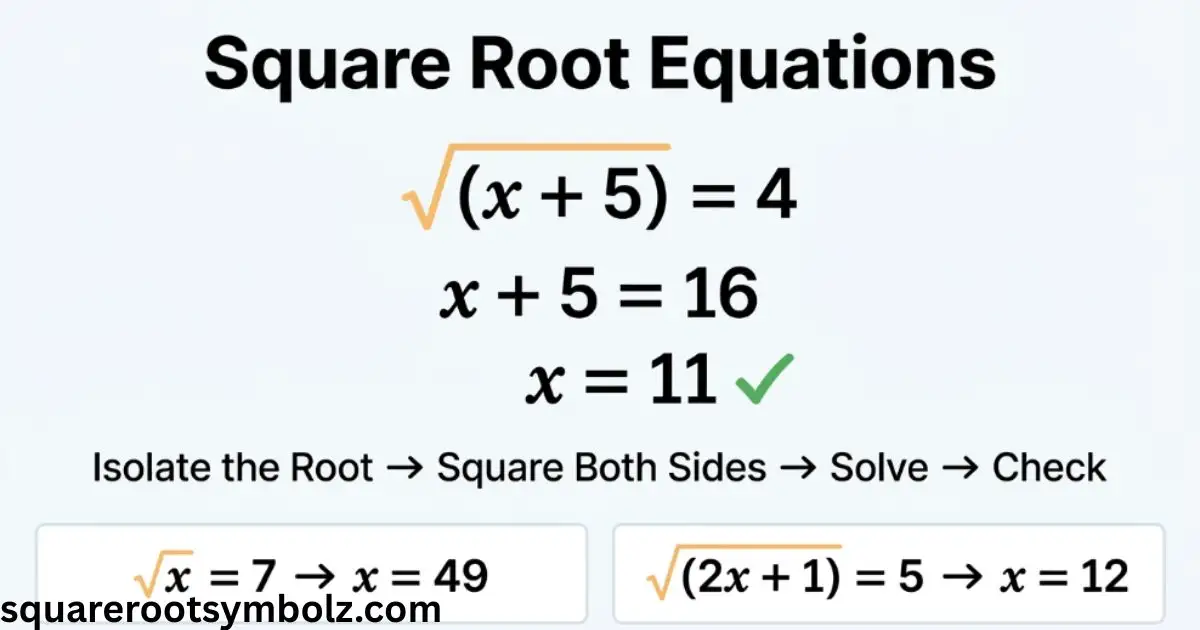
Square root equations are equations that contain a variable inside a square root, such as √(x + 5) = 7. The basic method is to isolate the radical, square both sides, solve the resulting equation, and then check every answer in the original equation. That final check matters because squaring can create an extraneous solution. OpenStax and Khan Academy both emphasize this verification step in their treatments of radical equations.
If these problems have ever produced an answer that looked correct but failed when you substituted it back, you have encountered the main trap. I have found that students understand square root equations much faster when each step has a clear purpose. The examples below show how to handle one solution, two solutions, no solution, and more complicated radicals.
Solving square-root equations
The first thing to recognize is that a square root equation is a type of radical equation. The variable appears inside the radicand, and the goal is to remove the radical without changing the original solution set. The standard approach uses inverse operations, with squaring undoing a square root.
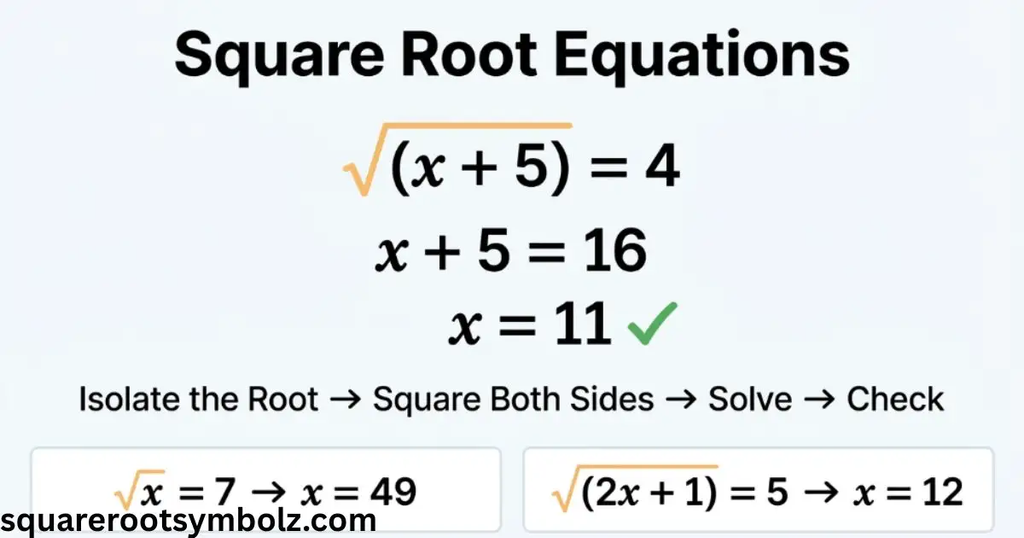
For a simple equation such as √(x + 4) = 6, the radical is already isolated. Square both sides to get x + 4 = 36, then solve x = 32. Finally, substitute 32 into the original equation. Because √36 = 6, the answer checks, so x = 32 is valid.
Practice question 1: Isolating the radical term
Consider √(2x − 7) − 3 = 4. The radical is not isolated because 3 is being subtracted from it. Before squaring, add 3 to both sides. This gives √(2x − 7) = 7. Khan Academy uses this same type of example to demonstrate why isolation comes before squaring.
Step 1: Isolate the radical term.
Start with:
√(2x − 7) − 3 = 4
Add 3 to both sides:
√(2x − 7) = 7
Now the radical stands alone. This is an important checkpoint. If other terms remain beside the radical, squaring at this stage can make the algebra unnecessarily complicated and increase the chance of an error.
The goal is not simply to remove the radical as quickly as possible. You want to transform the equation in a controlled way. Isolating the radical first makes the next operation straightforward and follows the standard procedure used in major algebra textbooks.
Step 2: Take the square of both sides.
Now square both sides:
(√(2x − 7))² = 7²
The square and square root cancel:
2x − 7 = 49
Add 7:
2x = 56
Divide by 2:
x = 28
The important rule is to square the entire left side and the entire right side. Do not square individual terms separately. MathBitsNotebook specifically warns students to square the sides rather than the terms.
For example, if you have 2 + 4 = 6, the correct operation is:
(2 + 4)² = 6²
You should not write:
2² + 4² = 6²
Those expressions are not equivalent.
Step 3: Check for extraneous solutions.
Now substitute x = 28 into the original equation:
√(2(28) − 7) − 3 = 4
√49 − 3 = 4
7 − 3 = 4
4 = 4
The answer works, so x = 28 is a genuine solution. Checking the original equation is especially important for radical equations because squaring can produce values that solve the transformed equation but not the equation you started with.
An extraneous solution is therefore a value that appears during the algebraic process but fails when substituted into the original equation. It is not a solution to the original problem and must be rejected.
Practice question 2: Two possible solutions
Not every square root equation produces only one answer. Consider:
6 + 3x = √(2x + 12) + 2x
First subtract 2x from both sides:
6 + x = √(2x + 12)
Now square both sides:
(6 + x)² = 2x + 12
Expand:
x² + 12x + 36 = 2x + 12
Move everything to one side:
x² + 10x + 24 = 0
Factor:
(x + 6)(x + 4) = 0
This produces two possible values:
x = −6
or
x = −4
Khan Academy uses this example to demonstrate that a square root equation can genuinely have two solutions. Both values must still be checked against the original equation.
Substituting x = −6 gives:
6 + 3(−6) = √(2(−6) + 12) + 2(−6)
−12 = √0 − 12
−12 = −12
So x = −6 works.
For x = −4:
6 + 3(−4) = √(2(−4) + 12) + 2(−4)
−6 = √4 − 8
−6 = 2 − 8
−6 = −6
So x = −4 works too.
Therefore, this equation has two valid solutions:
x = −6 and x = −4
This is an important lesson: squaring does not automatically mean one of the resulting answers must be extraneous. Some equations really do have two valid solutions.
Solve a radical equation.
OpenStax presents a simple four-step strategy for solving radical equations:
- Isolate the radical on one side of the equation.
- Square both sides.
- Solve the new equation.
- Check the answer.
Consider:
√(2x − 1) = 7
The radical is already isolated. Square both sides:
2x − 1 = 49
Add 1:
2x = 50
Divide by 2:
x = 25
Now check:
√(2(25) − 1) = 7
√49 = 7
7 = 7
Therefore, x = 25 is the solution.
This four-step pattern works as a reliable starting point for many basic square root equations. More complicated problems may require you to repeat the isolation and squaring process.
Binomial Squares
Some equations become quadratic after you square a binomial. For example:
√(p − 1) + 1 = p
First isolate the radical:
√(p − 1) = p − 1
Now square both sides:
p − 1 = (p − 1)²
The right side must be expanded carefully:
(p − 1)² = p² − 2p + 1
So:
p − 1 = p² − 2p + 1
Move everything to one side:
0 = p² − 3p + 2
Factor:
0 = (p − 1)(p − 2)
This gives two possible answers:
p = 1
or
p = 2
OpenStax specifically reminds students to use the binomial squares formula when the expression being squared contains two terms.
A common mistake is forgetting the middle term. Remember:
(a + b)² = a² + 2ab + b²
and
(a − b)² = a² − 2ab + b²
Example where BOTH answers check!
The equation above provides a useful example because both algebraic answers work in the original equation.
For p = 1:
√(1 − 1) + 1 = 1
√0 + 1 = 1
1 = 1
For p = 2:
√(2 − 1) + 1 = 2
√1 + 1 = 2
2 = 2
Therefore, both values are legitimate solutions:
p = 1 and p = 2
MathBitsNotebook emphasizes this distinction because students sometimes assume that every equation involving a square root can have only one answer. That is not true. The number of valid solutions depends on the original equation.
Example where ONLY ONE answer checks!
Now consider:
√(r + 4) − r + 2 = 0
Isolate the radical:
√(r + 4) = r − 2
Square both sides:
r + 4 = (r − 2)²
Expand:
r + 4 = r² − 4r + 4
Move everything to one side:
0 = r² − 5r
Factor:
0 = r(r − 5)
The possible values are:
r = 0
or
r = 5
However, checking the original equation reveals that r = 0 does not work, while r = 5 does. Therefore, r = 0 is an extraneous root and the actual solution is:
r = 5
MathBitsNotebook uses this type of example to demonstrate why checking is essential rather than optional.
Example with radicals on BOTH sides!
Consider an equation such as:
√(4z − 3) = √(3z + 2)
Both radicals are already isolated on opposite sides. Square both sides:
4z − 3 = 3z + 2
Subtract 3z:
z − 3 = 2
Add 3:
z = 5
Check the original equation:
√(4(5) − 3) = √(3(5) + 2)
√17 = √17
The answer checks, so:
z = 5
When radicals occur on both sides, squaring can often remove both at the same time. OpenStax includes this type of equation among its worked examples.
The same principle applies when the expressions under the radicals are more complicated. After squaring, simplify carefully and continue solving the resulting equation.
Example with BOTH radicals multiplied by constants!
A coefficient outside a square root must also be included when you square the entire side.
Consider:
3√(3x − 5) − 8 = 4
First isolate the radical:
3√(3x − 5) = 12
Now square both sides:
(3√(3x − 5))² = 12²
The 3 is squared too:
9(3x − 5) = 144
Distribute:
27x − 45 = 144
Add 45:
27x = 189
Divide:
x = 7
Check:
3√(3(7) − 5) − 8
= 3√16 − 8
= 3(4) − 8
= 12 − 8
= 4
Therefore:
x = 7
OpenStax demonstrates this same type of problem and explicitly shows that the coefficient outside the radical must be squared along with the radical expression.
Example involving x² !
Some square root equations contain x² inside the radicand. These problems can become more complicated because squaring may produce a quadratic equation.
For example:
√(7x² + 15x) − 2x = 5 + x
First isolate the radical:
√(7x² + 15x) = 5 + 3x
Square both sides:
7x² + 15x = (5 + 3x)²
Expand:
7x² + 15x = 25 + 30x + 9x²
Move everything to one side:
0 = 2x² + 15x + 25
Factor:
0 = (2x + 5)(x + 5)
This produces possible values:
x = −5/2
or
x = −5
At this point, do not stop. Both values must be checked in the original equation. Khan Academy uses this style of example to show that a square-root equation can lead to a quadratic after squaring.
Why extraneous solutions happen
The source of the problem is easy to understand. Squaring both sides preserves equality when the original two sides are equal, but the reverse implication is not always true.
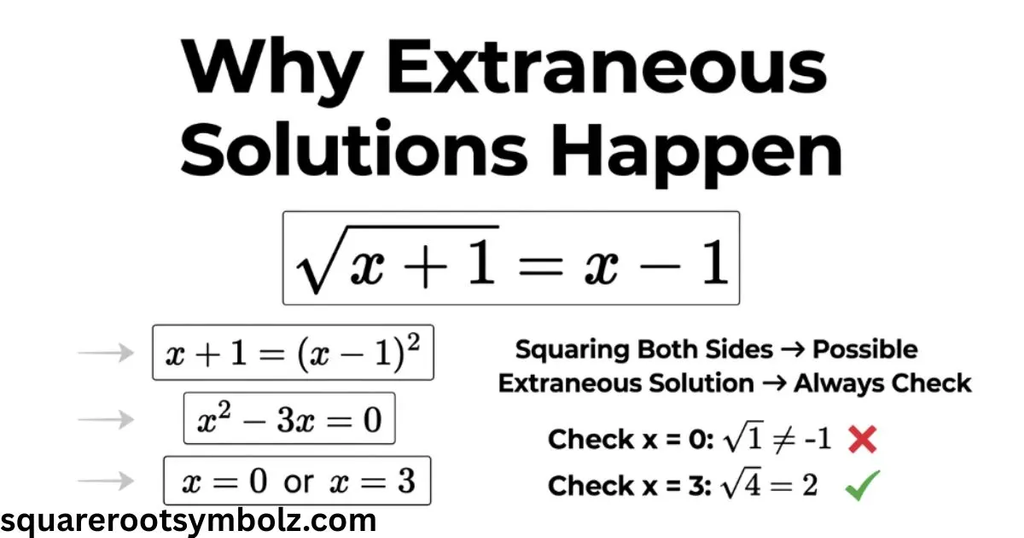
For example:
−3 ≠ 3
But after squaring:
(−3)² = 3²
9 = 9
The squaring process has removed the sign information. That is why an equation created after squaring can contain a value that was not valid in the original equation.
OpenStax explains that a principal square root is always nonnegative. Therefore, an equation such as √x = −3 has no real solution, even though squaring both sides would produce x = 9.
How to avoid common mistakes
The most common error is squaring terms instead of entire sides. Another is squaring before the radical has been isolated. A third is accepting every value produced by the transformed equation without checking it against the original. MathBitsNotebook specifically highlights these mistakes.
A reliable checklist is:
1. Identify the radical.
Find the square root containing the variable.
2. Isolate it.
Move other terms to the opposite side.
3. Square both sides.
Square the entire left side and entire right side.
4. Solve the new equation.
Simplify, factor, or use another appropriate algebra method.
5. Check every candidate.
Substitute each value into the original equation.
6. Reject extraneous values.
Keep only answers that make the original statement true.
This approach may feel slower at first, but it becomes much faster with practice.
When there is no solution
A square root represents the principal, nonnegative root when working with real numbers. Therefore, an equation that isolates a square root and makes it equal to a negative number has no real solution.
For example:
√(9k − 2) + 1 = 0
Subtract 1:
√(9k − 2) = −1
That is impossible over the real numbers because a principal square root cannot be negative. Therefore:
No solution
OpenStax provides this exact type of reasoning and warns that blindly squaring can otherwise produce a misleading algebraic value.
MathBitsNotebook also shows graphically why this happens. If the two sides of the original equation never intersect, there is no real solution. After squaring, the transformed equations can appear to intersect, creating a false candidate.
What if the radical is still present?
Sometimes squaring once does not remove every radical.
For example:
√m + 1 = √(m + 9)
Square both sides:
(√m + 1)² = (√(m + 9))²
Expand:
m + 2√m + 1 = m + 9
Simplify:
2√m = 8
The radical is still present, so isolate it:
√m = 4
Square again:
m = 16
Check the original equation:
√16 + 1 = √25
4 + 1 = 5
5 = 5
Therefore:
m = 16
OpenStax includes examples where the isolation and squaring process must be repeated.
Square root equations and graphs
There is also a useful graphical interpretation. If you have an equation such as √x = 4, you can graph y = √x and y = 4. The solution is the x-coordinate where the two graphs intersect.
For √x = 4, the intersection occurs at x = 16.
This viewpoint is especially helpful for understanding no-solution and extraneous-solution problems. MathBitsNotebook demonstrates that graphing the original two sides can reveal whether an algebraic candidate is actually valid.
Square root equations in applications
Square roots appear in formulas used in geometry and other fields. One simple application involves finding the side length of a square when its area is known.
If the area is A and the side length is s:
A = s²
Taking the square root gives:
s = √A
For a square with an area of 200 square feet:
s = √200
s ≈ 14.1 feet
OpenStax uses a square-patio example to demonstrate how a square root equation can arise naturally from a real-world measurement problem.
This is a good reminder that square root equations are not just classroom exercises. They can appear whenever a formula contains a squared quantity and you need to work backward to find the original measurement.
Quick reference
| Problem type | Main approach |
| One isolated radical | Square both sides |
| Radical plus constant | Isolate radical first |
| Radical on both sides | Square both sides |
| Two possible algebraic answers | Check both |
| Negative value after isolating square root | No real solution |
| Radical remains after squaring | Isolate and square again |
| Binomial gets squared | Use the binomial-square formula |
| Coefficient before radical | Square the coefficient too |
| Candidate fails original equation | Extraneous solution |
The central idea is simple: isolate, square, solve, and check. Most mistakes happen when one of those four steps is skipped or performed incorrectly.
Conclusion
Square root equations become much easier once you stop treating the radical as something mysterious and instead follow a consistent process. Isolate the radical, square both sides, solve the resulting equation, and substitute every candidate back into the original equation.
The final check is the step that separates a possible algebraic answer from a genuine solution. It catches extraneous solutions, confirms valid answers, and helps you recognize when an equation has one solution, two solutions, or no real solution. With enough practice, even equations containing multiple radicals or quadratic expressions become manageable.
FAQ Section
How do you solve square root equations?
Isolate the square root on one side, square both sides, solve the resulting equation, and check every answer in the original equation. Checking is necessary because squaring can introduce extraneous solutions.
Why do you have to check square root equations?
You must check because squaring can create an equation that has additional solutions not present in the original equation. A candidate is valid only if it makes the original equation true.
What is an extraneous solution?
An extraneous solution is a value produced during the algebraic process that does not satisfy the original equation. It commonly appears after both sides of a radical equation are squared.
Can a square root equation have two solutions?
Yes. A square root equation can have two valid solutions. Squaring does not guarantee that one answer will be extraneous. Khan Academy provides an example where both resulting values satisfy the original equation.
Can a square root equation have no solution?
Yes. If a principal square root is isolated and equals a negative real number, there is no real solution because a principal square root cannot be negative.
What is the first step when solving a radical equation?
The first step is to isolate the radical on one side of the equation. This makes it possible to square the complete sides correctly.
What happens if the radical is not isolated?
Squaring before isolation can make the algebra much more complicated and can lead to mistakes. Move constants and other terms first so that the radical stands alone whenever possible.
Can you square individual terms?
No. You should square the entire side of an equation, not each individual term. For example, (a + b)² is not equal to a² + b². MathBitsNotebook specifically highlights this as a common error.
What if there are radicals on both sides?
If both radicals are isolated on opposite sides, you can usually square both sides. After simplifying, check the resulting answer or answers in the original equation. OpenStax includes examples of this type.
How do you know if a square root equation has no solution?
After isolating the radical, if you obtain a statement such as √x = −3, there is no real solution because the principal square root is always nonnegative.

I’m the creator of SquareRootSymbolz.com, where I publish easy-to-understand guides on symbols, Unicode characters, Alt codes, keyboard shortcuts, and copy-and-paste text symbols. My goal is to provide accurate, well-researched, and user-friendly content that helps readers quickly find the information they need.