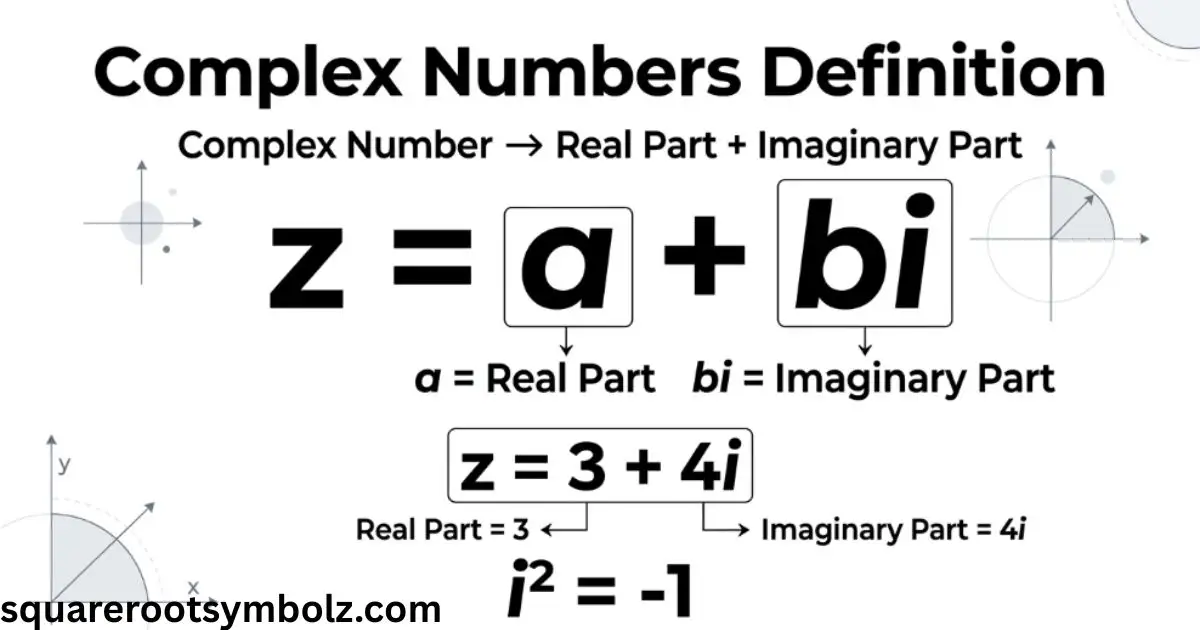
Complex numbers are numbers written using a real part and an imaginary part, usually in the form a + bi. The symbol i represents the imaginary unit, where i² = −1. This system gives us a way to work with square roots of negative numbers and equations that have no real solutions.
If complex numbers first seem strange, that feeling is completely normal. The idea becomes much easier once you connect it to familiar algebra. In this guide, we will move from the imaginary unit and standard form to the complex plane, arithmetic, conjugates, powers, and practical applications, using clear examples along the way.
Defining complex numbers
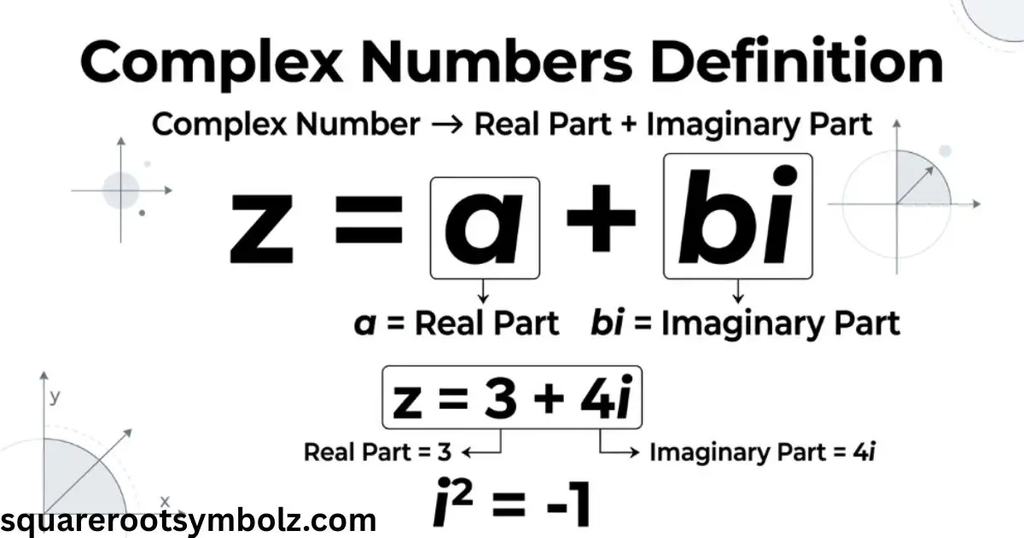
A complex number has the standard form a + bi, where a is the real part, b is the imaginary part, and i is the imaginary unit. For example, 4 + 3i has a real part of 4 and an imaginary part of 3. Both parts are real numbers.
The important idea is that real numbers are included within the complex-number system. A real number such as 7 can be written as 7 + 0i. A purely imaginary number such as 5i can be written as 0 + 5i. So complex numbers form a broader number system rather than a completely separate one.
| Complex number | Real part | Imaginary part | Type |
| 5 + 2i | 5 | 2 | Complex |
| −3 + 7i | −3 | 7 | Complex |
| 8 | 8 | 0 | Real |
| −4i | 0 | −4 | Pure imaginary |
| 0 | 0 | 0 | Real and complex |
The name “complex” does not mean that the number is impossibly complicated. It simply describes a number that can contain both components. Once you learn to separate the real and imaginary parts, most basic calculations follow familiar algebraic rules.
Imaginary and Complex Numbers
The imaginary unit is written as i and is defined by the relationship i² = −1. This gives us a useful way to represent square roots of negative numbers. For example, √(−9) can be written as 3i because √9 is 3 and √(−1) is represented by i.
This becomes important when an equation has no real solution. Consider x² + 1 = 0. Rearranging gives x² = −1. No real number has a square equal to −1, but complex numbers provide the solutions x = i and x = −i. This is one of the main reasons the system was developed.
Powers of i
The powers of i follow a repeating four-step cycle:
| Power | Value |
| i¹ | i |
| i² | −1 |
| i³ | −i |
| i⁴ | 1 |
| i⁵ | i |
After i⁴, the same sequence repeats. This makes large powers much easier to simplify. For example, i²⁰ equals 1 because 20 is divisible by 4. OpenStax demonstrates the same remainder-based strategy for simplifying powers such as i³⁵.
Purely real and purely imaginary numbers
A complex number is purely real when its imaginary part is zero, such as 6 + 0i. It is purely imaginary when its real part is zero, such as 0 + 6i. These cases are still part of the complex-number system.
This classification is useful because it prevents a common misunderstanding: imaginary numbers are not automatically separate from complex numbers. Instead, real numbers and purely imaginary numbers can both be viewed as special cases within the larger complex system.
Complex Plane
A complex number can be represented visually on a two-dimensional graph called the complex plane. The horizontal axis represents the real part, while the vertical axis represents the imaginary part. A number such as 3 + 4i corresponds to the point (3, 4).
This picture makes complex numbers much more intuitive. Instead of trying to imagine an “imaginary” number, you can think of a complex number as a location or vector in a plane. The horizontal movement shows the real component, and the vertical movement shows the imaginary component.
Plotting a complex number
To plot 2 − 3i, first identify the real part, 2, and the imaginary coefficient, −3. Move two units along the real axis and three units downward along the imaginary axis. The resulting point is (2, −3). OpenStax uses this coordinate-based approach for plotting complex numbers.
The complex plane is sometimes called the Argand plane or Argand diagram. These names refer to the same basic graphical idea. It provides a bridge between algebra and geometry and becomes especially useful when studying magnitude, argument, polar form, and rotations.
Adding and Subtracting Complex Numbers
To add or subtract complex numbers, combine the real parts with one another and the imaginary parts with one another. This works much like combining like terms in ordinary algebra. For example, (3 + 4i) + (2 + 5i) becomes 5 + 9i.
Subtraction follows the same principle. For example, (7 + 6i) − (3 + 2i) gives 4 + 4i. The safest method is to keep the real terms together and the imaginary terms together. This simple habit prevents many sign errors.
Addition example
Consider:
(4 + 3i) + (6 − 2i)
Combine the real parts:
4 + 6 = 10
Then combine the imaginary parts:
3i − 2i = i
Therefore:
(4 + 3i) + (6 − 2i) = 10 + i
The result remains in standard form, a + bi.
Subtraction example
Now consider:
(8 + 5i) − (3 + 7i)
Subtract the real parts:
8 − 3 = 5
Subtract the imaginary parts:
5i − 7i = −2i
Therefore:
(8 + 5i) − (3 + 7i) = 5 − 2i
The operation is straightforward once the two components are kept separate.
Multiplying Complex Numbers
Multiplication uses the same distributive property used for binomials. The crucial extra rule is i² = −1. After expanding the expression, replace every occurrence of i² with −1 and then combine the real and imaginary parts.
For two complex numbers, the general multiplication rule is:
(a + bi)(c + di) = (ac − bd) + (ad + bc)i
This formula comes directly from distribution and the fact that i² = −1. It is useful as a shortcut, although expanding with FOIL can be easier when you are learning the process.
Multiplication example
Multiply:
(3 + 2i)(4 − i)
First distribute:
12 − 3i + 8i − 2i²
Because i² = −1:
12 − 3i + 8i + 2
Combine like terms:
14 + 5i
So:
(3 + 2i)(4 − i) = 14 + 5i
OpenStax similarly demonstrates multiplication using distribution or FOIL before simplifying with i² = −1.
Why i² changes the answer
The term i² is where complex-number multiplication differs from ordinary polynomial multiplication. Instead of leaving i² in the answer, replace it with −1. This converts that part of the expression into a real number.
For example:
(2i)(3i) = 6i² = −6
Notice that multiplying two imaginary numbers can produce a real number. That is an important idea and one that often surprises students the first time they see it.
Dividing Complex Numbers
Division is slightly more involved because the final answer is normally written with no imaginary number in the denominator. The standard method is to multiply the numerator and denominator by the complex conjugate of the denominator.
Suppose we want to calculate:
(2 + 3i) / (4 − i)
The conjugate of 4 − i is 4 + i. Multiply both numerator and denominator by 4 + i. The denominator becomes a real number because the imaginary terms cancel.
Division example
Start with:
(2 + 3i) / (4 − i)
Multiply by:
(4 + i) / (4 + i)
The numerator becomes:
(2 + 3i)(4 + i)
= 8 + 2i + 12i + 3i²
= 8 + 14i − 3
= 5 + 14i
The denominator becomes:
(4 − i)(4 + i)
= 16 − i²
= 17
Therefore:
(2 + 3i)/(4 − i) = 5/17 + 14/17 i
This leaves the result in standard form. OpenStax uses the same conjugate-based strategy for complex-number division.
The Complex Conjugate
The complex conjugate of a + bi is a − bi. In other words, keep the real part unchanged and reverse the sign of the imaginary part. The conjugate of 5 + 2i is 5 − 2i, while the conjugate of 5 − 2i is 5 + 2i.
Conjugates are more than a definition to memorize. They are an important computational tool. Multiplying a complex number by its conjugate produces a real number:
(a + bi)(a − bi) = a² + b²
That identity explains why conjugates are so useful when dividing complex numbers.
Conjugate example
Take:
z = 7 − 4i
Its conjugate is:
7 + 4i
Now multiply them:
(7 − 4i)(7 + 4i)
= 49 − 16i²
= 49 + 16
= 65
The imaginary terms disappear. This is the same mechanism used to turn a complex denominator into a real denominator during division.
Conjugates and quadratic solutions
Complex conjugates also appear naturally in quadratic equations with real coefficients. When such an equation has a nonreal complex solution, its conjugate is also a solution. OpenStax explicitly notes this conjugate relationship for quadratic equations with real coefficients.
For example, if a quadratic has the solution 2 + 3i, then 2 − 3i is also a solution. This relationship is useful when checking answers and understanding the structure of polynomial roots.
Simplifying Powers of i
The powers of i repeat every four powers:
i, −1, −i, 1
Then the cycle begins again. This pattern allows you to simplify very large exponents without multiplying i repeatedly. OpenStax demonstrates reducing an exponent by dividing it by 4 and using the remainder.
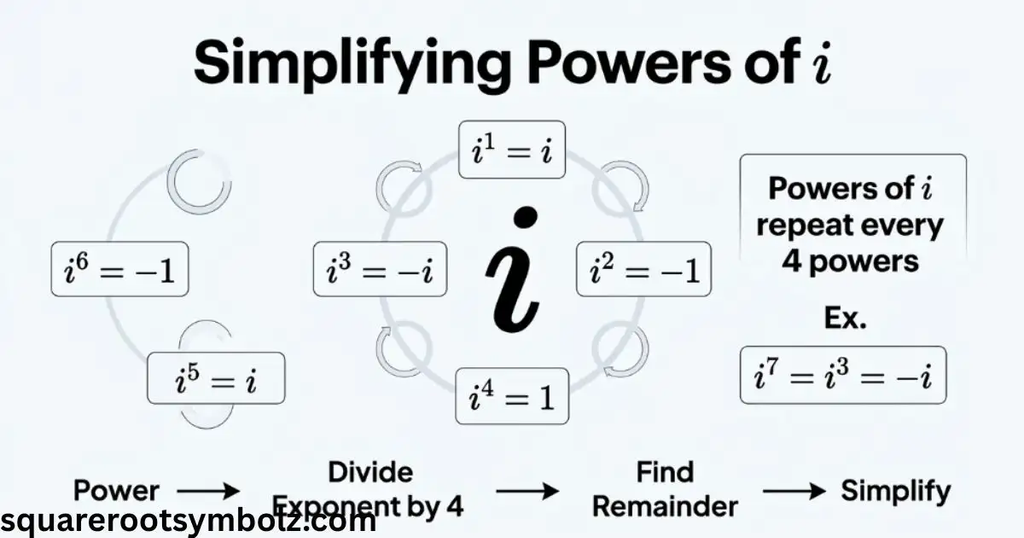
For example, consider i²⁷. Divide 27 by 4:
27 = 4 × 6 + 3
The remainder is 3, so:
i²⁷ = i³ = −i
The method is fast and reliable.
Using the remainder
For any positive integer exponent, divide the exponent by 4. Then use the remainder:
| Remainder | Result |
| 0 | 1 |
| 1 | i |
| 2 | −1 |
| 3 | −i |
For example, i⁴⁸ has a remainder of 0 when 48 is divided by 4, so the answer is 1. Similarly, i⁶² has remainder 2, so the answer is −1.
This technique is much faster than expanding the expression step by step.
Complex numbers and quadratic equations
One of the most important reasons complex numbers matter is that they allow equations with negative discriminants to have solutions within an expanded number system. For example, x² + 4 = 0 leads to x² = −4 and therefore x = ±2i.
This does not mean the original equation suddenly became “wrong.” It means the real-number system was not large enough to contain its solutions. Complex numbers extend the system so these solutions can be represented consistently.
Complex numbers in polar form
A complex number can also be represented using magnitude and angle rather than only its real and imaginary components. This is called polar form. Paul’s Online Notes places polar and exponential form alongside conjugates, modulus, powers, and roots in its complex-number primer.
Polar representation becomes especially useful for multiplication, division, powers, rotations, and engineering calculations. Instead of treating a complex number only as a pair of components, you can interpret it geometrically through its distance from the origin and its angle from the positive real axis.
Real-world uses
Complex numbers are used far beyond classroom algebra. They appear in electrical engineering, signal analysis, physics, mathematics, and other technical fields. Khan Academy specifically identifies applications involving electrical circuits and electronic signals.
Their strength comes from combining magnitude and direction in a compact mathematical form. In engineering, the imaginary component can represent phase relationships, while complex arithmetic makes multiplication, division, oscillation, and frequency analysis easier to express.
Quick reference table
| Concept | Key idea |
| Complex number | a + bi |
| Imaginary unit | i² = −1 |
| Real part | a |
| Imaginary part | b |
| Complex plane | Graph of real and imaginary components |
| Conjugate | a − bi |
| Modulus | Distance from origin |
| Polar form | Magnitude and angle |
| Real number | Complex number with b = 0 |
| Pure imaginary | Complex number with a = 0 |
A useful way to remember the entire topic is to think of complex numbers as an extension of ordinary numbers. The real part behaves normally, while the imaginary part introduces i. Once i² = −1 becomes familiar, the arithmetic follows the same algebraic patterns you already know.
Conclusion
Complex numbers extend the real-number system so mathematical equations involving negative square roots can be represented and solved. A complex number has the form a + bi, with a as the real part, b as the imaginary coefficient, and i as the imaginary unit satisfying i² = −1.
The most important skills are recognizing standard form, separating real and imaginary parts, plotting values on the complex plane, performing arithmetic, using conjugates, and simplifying powers of i. Once these foundations are comfortable, polar form, exponential form, roots, and advanced complex analysis become much easier to understand.
FAQ Section
What are complex numbers?
Complex numbers are numbers that can be written in the form a + bi, where a and b are real numbers and i is the imaginary unit satisfying i² = −1.
What is i in complex numbers?
i is the imaginary unit, defined by i² = −1. It allows square roots of negative numbers to be represented within the complex-number system.
What is the real part of a complex number?
For a complex number a + bi, a is the real part. For example, the real part of 6 − 4i is 6.
What is the imaginary part of a complex number?
In a + bi, b is the imaginary part, while bi is the imaginary term. For 6 − 4i, the imaginary part is −4.
Are all real numbers complex numbers?
Yes. Every real number can be written as a complex number with an imaginary part of zero. For example, 8 can be written as 8 + 0i.
What is the complex plane?
The complex plane is a two-dimensional coordinate system used to represent complex numbers. The horizontal axis represents the real component and the vertical axis represents the imaginary component.
How do you add complex numbers?
Add the real parts together and the imaginary parts together separately. For example, (2 + 3i) + (4 + 5i) = 6 + 8i.
How do you multiply complex numbers?
Use the distributive property or FOIL, then replace i² with −1 and combine the real and imaginary terms.
What is a complex conjugate?
The conjugate of a + bi is a − bi. It changes the sign of the imaginary part while leaving the real part unchanged.
Why are complex numbers useful?
Complex numbers are useful for equations without real solutions and for applications involving electrical circuits, signals, physics, engineering, and advanced mathematics.

I’m the creator of SquareRootSymbolz.com, where I publish easy-to-understand guides on symbols, Unicode characters, Alt codes, keyboard shortcuts, and copy-and-paste text symbols. My goal is to provide accurate, well-researched, and user-friendly content that helps readers quickly find the information they need.