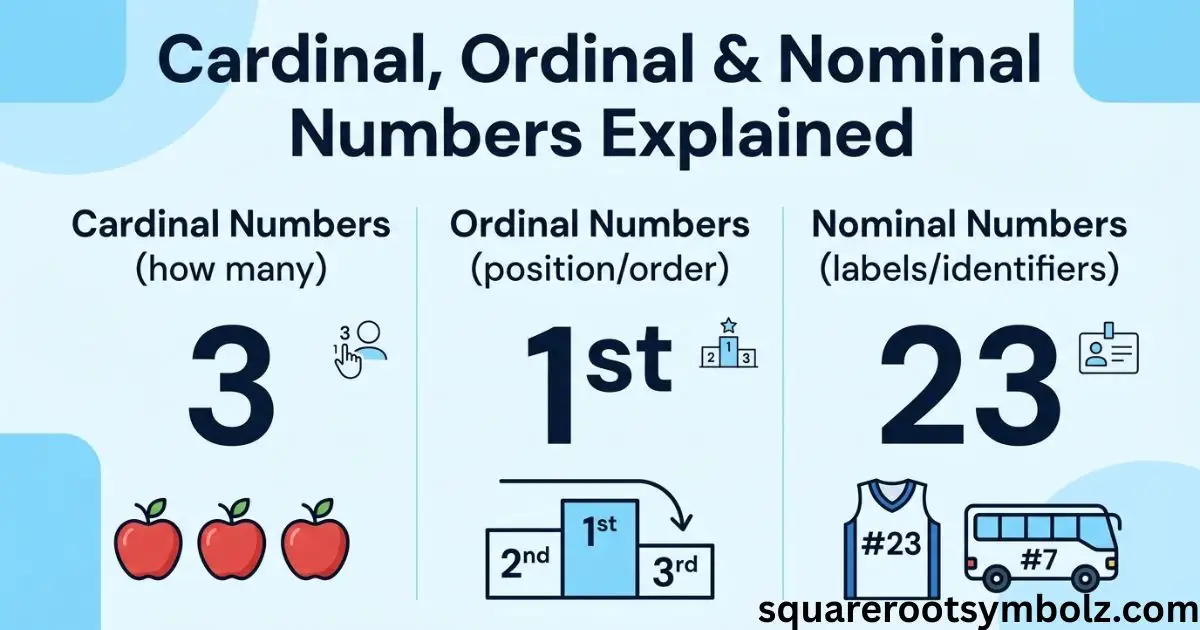
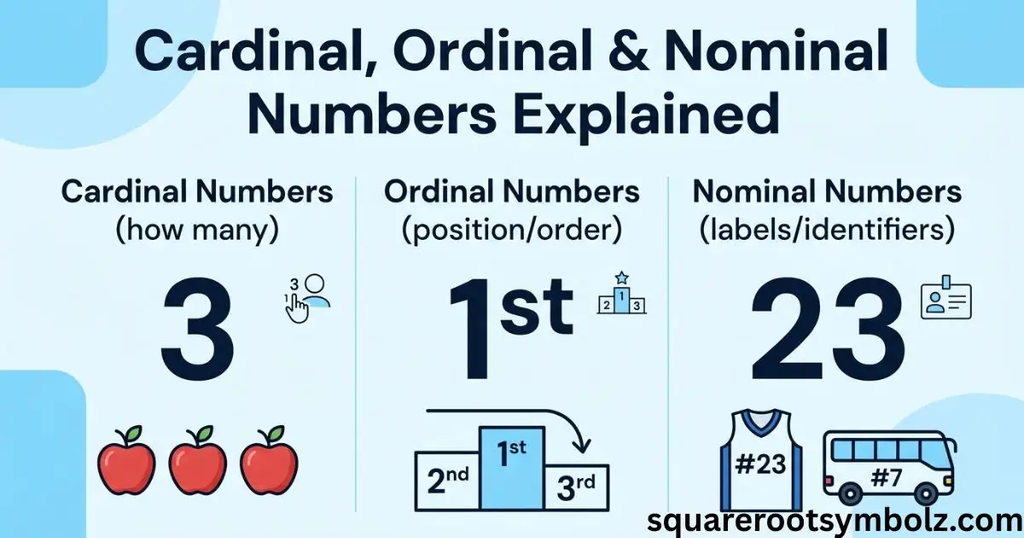
A number used in everyday life can represent a quantity, show a position, or identify something. In mathematics and American English, these functions are commonly described through cardinal, ordinal, and nominal numbers. Understanding the difference makes confusing examples such as “5 apples,” “5th place,” and “Room 5” much easier to read.
When I explain numbers to students, the hardest part is often not the calculation. It is recognizing what the number is doing in the sentence. A number can count objects, describe order, or simply act as a label. Once you identify that purpose, the meaning becomes much clearer and many basic math questions become easier to solve.
Cardinal Numbers
Cardinal number used are used to tell how many or how much of something exists. Examples include 1, 2, 3, 4, and 5 when they represent quantities. In elementary mathematics, these are closely associated with counting numbers, quantity, whole numbers, objects, and groups.
For example, “There are 8 books on the shelf” uses 8 as a cardinal number because it tells us the quantity of books. Similarly, 12 students means a group contains twelve students. The important idea is that the number describes an amount rather than a position, rank, or identifying label.
Cardinal Numbers Examples
Consider number used these simple statements: “There are 4 apples,” “7 students entered the room,” and “10 pencils are on the desk.” The numbers 4, 7, and 10 each express quantity. They answer the basic question how many?, which is the key feature of cardinal use.
Example: here are five coins:
Imagine five coins lying on a table. The number 5 tells you how many coins are present, so it has a cardinal function. The same numeral could have a completely different function elsewhere. For example, “Bus 5” may identify a route rather than count five buses.
Ordinal Numbers
Ordinal number used describe position or order within a sequence. Common examples are first, second, third, fourth, and fifth, often written as 1st, 2nd, 3rd, 4th, and 5th. They tell us where something occurs rather than how many objects exist.
Suppose ten runners finish a race. Saying that Maya finished third identifies her position in the sequence. The word “third” does not tell us that there are three runners. Instead, it tells us where Maya stands relative to the others. That difference separates ordinal use from cardinal use.
Nominal Numbers
A nominal number used as a name, label, or identifier rather than as a quantity or position. Common examples include telephone numbers, ZIP codes, jersey numbers, room numbers, model numbers, and identification numbers. The digits identify something within a particular system.
For example, ZIP code 90210 is not telling you that there are 90,210 objects. Likewise, a jersey marked 23 does not mean the athlete represents a quantity of 23. The number functions as an identifier. This is why arithmetic meaning should not automatically be assigned to every number you see.
Examples:
Consider a soccer player wearing jersey 8, a vehicle with model number 380, and a ZIP code such as 91210. In each case, the digits primarily identify something. They are nominal uses because the numbers work as labels rather than measurements of quantity or sequence.
Quick Test: What type of number is it?
Try these three examples: 6 apples, 2nd place, and Channel 7. The 6 is cardinal because it counts apples. The 2nd is ordinal because it gives a position. Channel 7 is nominal because 7 identifies the channel. The same digits can therefore have different functions.
What are Cardinal Numbers?
Cardinal number used are counting numbers that express quantity. If you ask “How many?” and the answer is a whole-number count, the number is functioning cardinally. Examples include 3 books, 12 chairs, 25 students, and 100 dollars when the number represents an amount.
This idea is closely connected to natural numbers, although terminology can vary by mathematical context. Some definitions include zero among the natural numbers, while elementary counting often begins with 1. The important point is to examine the context instead of assuming that every reference uses exactly the same convention.
Cardinal Numbers Examples
If a classroom contains 24 students, the number 24 tells the size of the group. If a basket contains 6 oranges, the number 6 gives the quantity. These are straightforward cardinal examples because each number answers how many and does not indicate rank or identification.
Cardinal Numbers in Multiples of 10
Numbers such as 10, 20, 30, 40, and 50 can also serve as cardinal numbers when they represent quantities. For example, “The store received 40 boxes” uses 40 to express an amount. The fact that a number is a multiple of ten does not change its cardinal function.
Cardinal Numbers in English
Cardinal numbers appear constantly in ordinary English. We use them when talking about quantities, prices, measurements, ages, distances, scores, and other amounts. Statements such as “three tickets,” “twenty dollars,” and “six miles” all use numbers to communicate measurable or countable information.
This is why understanding number function is useful beyond mathematics class. A number in a sentence can carry different meanings depending on its relationship with nearby words. Reading the complete context helps determine whether it represents an amount, an ordered position, or an identifying label.
Cardinal Numbers of a Set
In set theory, the cardinal number or cardinality of a finite set describes how many elements the set contains. For example, if A = {2, 4, 6, 8}, the set contains four elements, so its cardinality is 4.
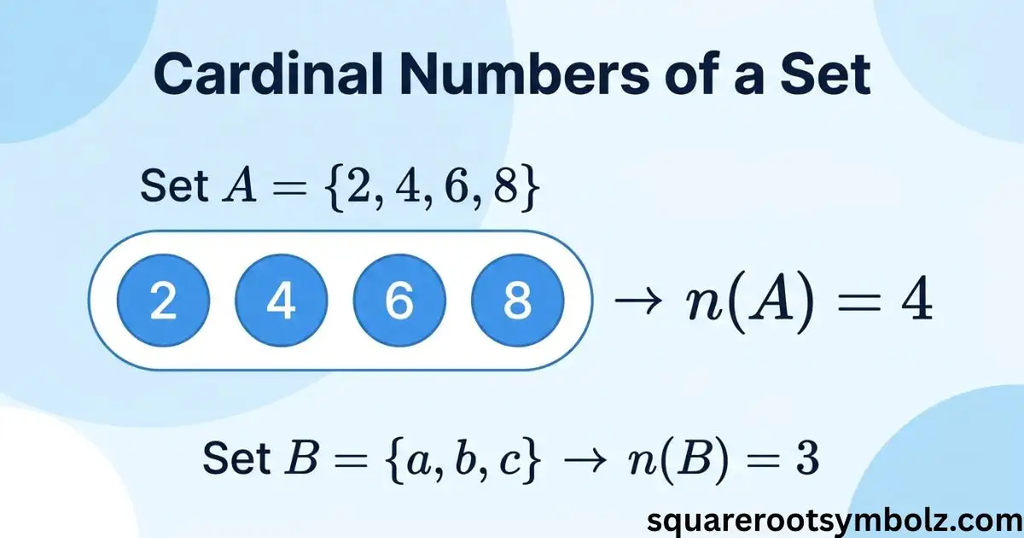
The actual values inside the set are not what cardinality measures. The important question is how many distinct elements are present. This provides a mathematical version of the everyday counting idea and connects basic number usage with the formal concept of sets and elements.
What is Cardinality?
Cardinality means the number of elements in a set or collection. If a box contains seven different books, its collection has cardinality 7. In the same way, a set containing three distinct elements has cardinality 3.
Cardinality becomes especially useful when comparing sets. Two sets can contain completely different objects while having the same cardinality. For example, a set containing three numbers and a set containing three colors both have cardinality 3, even though their elements are unrelated.
Conclusion
The phrase number used becomes much easier to understand when you ask what the number is doing in its context. A cardinal number expresses quantity, an ordinal number shows position or order, and a nominal number identifies something. The distinction is simple but powerful.
Think of three examples: 6 apples, 6th place, and Room 6. The digit is related to the same basic numeral, but its function changes. The first counts, the second gives position, and the third identifies. Learning to recognize that difference builds stronger number sense and makes everyday mathematics easier to interpret.
FAQs
What is a cardinal number? Give example.
A cardinal number tells how many objects or elements are present. For example, in “There are 5 flowers,” the number 5 is cardinal because it expresses the quantity of flowers.
How is a cardinal number different from an ordinal number?
A cardinal number tells how many, while an ordinal number tells where or in what order. For example, 5 students uses 5 cardinally, while 5th place uses 5th ordinally.
What is the nominal number?
A nominal number is a number used mainly as a name or identifier. Examples include a jersey number, telephone number, ZIP code, room number, or model number.
What type of number is used for counting?
Cardinal numbers are used for counting quantities. Examples include 1, 2, 3, 4, and 5 when they represent how many objects or people are present.
Can the same number have different uses?
Yes. The same numeral can serve different functions depending on context. In “8 apples,” 8 represents quantity. In “Room 8,” it identifies a room. In “8th place,” the corresponding ordinal form represents position.
Is a ZIP code a number used for counting?
No. A ZIP code is generally an identifier or label for a geographic postal area. Its digits should not be interpreted as the quantity of something.
Is a jersey number a cardinal number?
Usually, no. When a jersey number identifies a player, it functions nominally. The number does not indicate how many players there are or the player’s rank.
What does a number used for position mean?
A number used for position is functioning ordinally. Examples include first place, second place, third place, and 10th place. These expressions describe order rather than quantity.

I’m the creator of SquareRootSymbolz.com, where I publish easy-to-understand guides on symbols, Unicode characters, Alt codes, keyboard shortcuts, and copy-and-paste text symbols. My goal is to provide accurate, well-researched, and user-friendly content that helps readers quickly find the information they need.