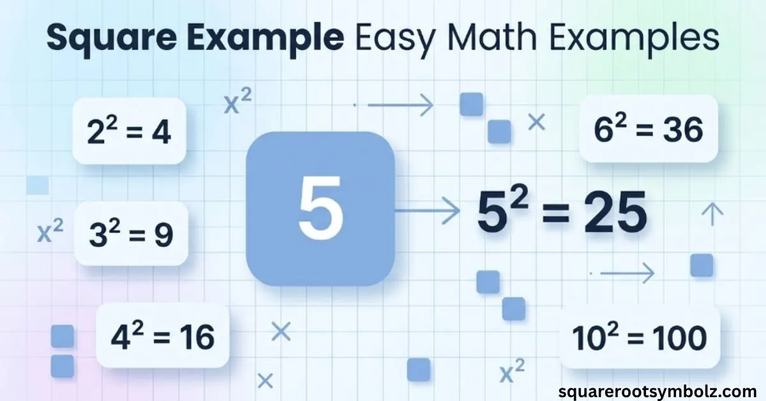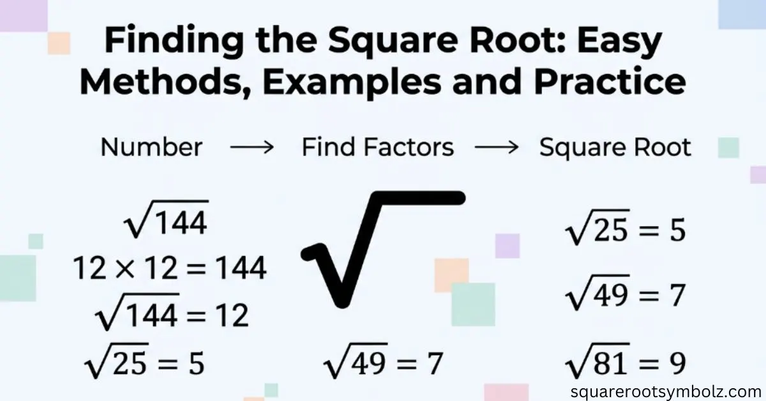
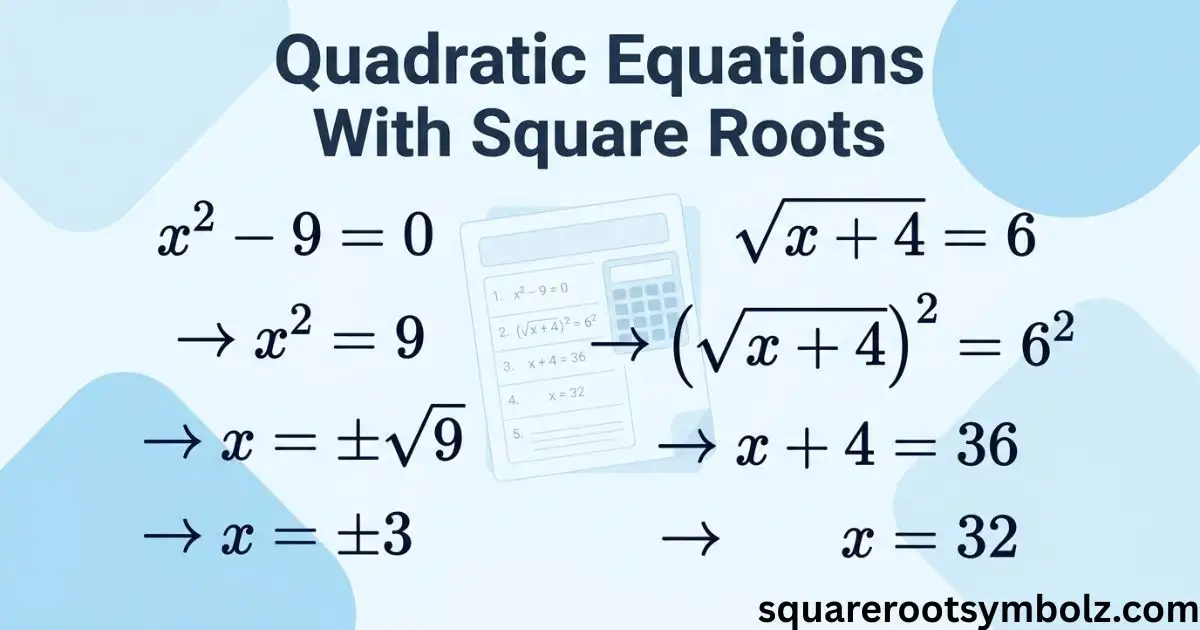
Quadratic equations with square roots are often easiest to solve when the squared variable can be isolated and then undone by taking a square root. For example, x² = 25 gives x = ±5. The key ideas are the Square Root Property, perfect squares, radicals, coefficients, and checking both solutions.
When students first meet these equations, the ± symbol is usually where the confusion begins. In practice, the method is much simpler: isolate the squared expression, take the square root of both sides, simplify the radical, solve for the variable, and check the result. This guide follows that exact reasoning with increasingly challenging examples.
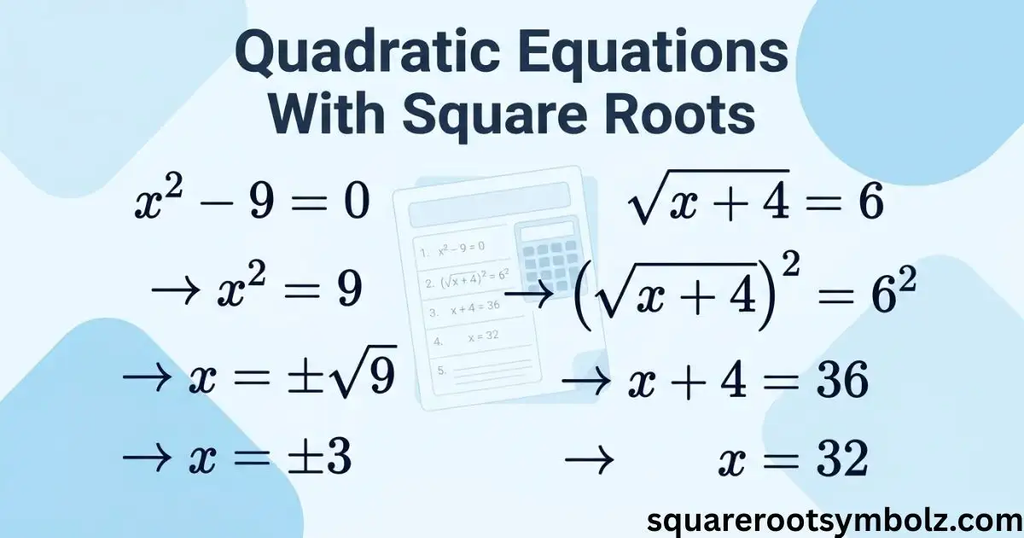
What are quadratic equations?
A quadratic equation is an equation in which the highest power of the variable is 2. Its standard form is ax² + bx + c = 0, where a is not zero. The terms include the quadratic term, linear term, constant, coefficient, variable, and exponent.
For example, x² + 5x + 6 = 0 is quadratic because x² is the highest-power term. However, x² = 25 is also quadratic even though it has no linear x-term. That second structure is especially important because it can often be solved directly using square roots rather than factoring or the quadratic formula.
| Equation | Quadratic? | Useful method |
| x² = 25 | Yes | Square Root Property |
| 3x² = 27 | Yes | Square Root Property |
| (x − 4)² = 16 | Yes | Square Root Property |
| x² + 5x + 6 = 0 | Yes | Often factoring |
| 2x + 7 = 15 | No | Linear method |
A useful habit is to look at the structure before choosing a method. If there is no x-term and the squared expression can be isolated, taking square roots may be the shortest route. Khan Academy specifically highlights quadratics without x-terms as candidates for this approach.
How do I solve quadratic equations using square roots?
To solve quadratic equations using square roots, first isolate the squared expression. Then take the square root of both sides and include ± because a positive number normally has two real square roots. Finally, simplify the radical and solve for the variable if it appears inside a squared binomial.
Consider x² = 49. Taking square roots gives x = ±√49, and √49 = 7. Therefore, the solutions are x = 7 and x = −7. Both work because 7² and (−7)² equal 49. Forgetting the negative solution is one of the most common errors with this method.
Solving quadratics by taking square roots
The method works especially well when the equation has the form ax² = k or a(x − h)² = k. First isolate the squared part and make its coefficient 1. Then apply the Square Root Property, simplify the radical, and solve for the remaining variable.
For example, solve 4x² = 36. Divide by 4 to obtain x² = 9. Take square roots to get x = ±√9, so x = ±3. The complete solution is x = 3 or x = −3. A quick substitution confirms that both values make the original equation true.
When can I solve by taking square roots?
You can solve a quadratic by taking square roots when the equation can be rearranged so that a squared expression stands alone on one side. The simplest form is x² = k. Another useful form is a(x − h)² = k, where the entire binomial is squared.
This method is usually more direct than factoring when the equation has no linear x-term. For example, x² − 12 = 0 becomes x² = 12, immediately revealing x = ±√12. The radical can then be simplified to x = ±2√3.
Solving quadratics by taking square roots: strategy
A good strategy is to inspect the equation before doing calculations. If the squared expression is already isolated, take the square root. If a coefficient remains, divide first. If a constant remains on the same side, move it. This prevents unnecessary factoring and keeps the solution short.
For instance, 5x² + 10 = 55 becomes 5x² = 45, then x² = 9, and finally x = ±3. The important reasoning is not memorizing a trick; it is recognizing that squaring and taking square roots are inverse operations in this setting.
Solve Quadratic Equations of the form ax² = k using the Square Root Property
For an equation of the form ax² = k, first divide both sides by a so the coefficient of x² becomes 1. Then apply the Square Root Property. If the resulting value is a perfect square, the radical simplifies to an integer; otherwise, the exact answer can remain in radical form.
Take 3x² = 108. Divide by 3 to get x² = 36. Taking square roots gives x = ±√36, which simplifies to x = ±6. Therefore, x = 6 and x = −6. This same process works with fractions and larger values, provided the algebraic steps preserve the original equation.
Square Root Property
The Square Root Property states that if x² = k and k is nonnegative, then x = √k or x = −√k. The compact form is x = ±√k. The ± is essential because both positive and negative values produce the same positive square.
For example, x² = 7 gives x = ±√7. Because 7 is not a perfect square, √7 cannot be simplified to an integer. The exact radical form is therefore preferable to replacing it with a rounded decimal. OpenStax uses this distinction throughout its examples.
How to solve a quadratic equation using the square root property
Use four basic steps. First, isolate the quadratic term and make its coefficient 1. Second, apply the Square Root Property. Third, simplify the radical if possible. Fourth, check the solutions in the original equation. This sequence is directly reflected in OpenStax’s procedure.
For example, solve 2x² − 8 = 34. Add 8 to obtain 2x² = 42. Divide by 2, giving x² = 21. Take square roots: x = ±√21. Since 21 has no perfect-square factor other than 1, the exact solutions remain x = √21 and x = −√21.
Solve Quadratic Equations of the form a(x − h)² = k Using the Square Root Property
The same method works when an entire binomial is squared. For an equation such as 4(x − 7)² = 48, first divide by 4 to obtain (x − 7)² = 12. Then take the square root: x − 7 = ±√12. Simplifying gives x − 7 = ±2√3.
Now add 7 to both sides. The result is x = 7 ± 2√3, representing two solutions: 7 + 2√3 and 7 − 2√3. The important point is that the square root is applied to the entire squared expression, not just to one term inside the parentheses.
Example: A shifted quadratic
Consider (x + 3)² = 16. Taking square roots gives x + 3 = ±4. Separate the two possibilities: x + 3 = 4 or x + 3 = −4. Solving each gives x = 1 and x = −7.
This pattern is common in vertex-form equations. The quantity inside the parentheses is treated as one expression. Once its square has been removed, ordinary linear algebra finishes the problem. This makes the method particularly useful when studying parabolas and transformations.
Example: A non-perfect square
Consider (x − 2)² = 11. Taking square roots produces x − 2 = ±√11. Add 2 to both sides to obtain x = 2 ±√11. Since 11 is not a perfect square, the radical is already in simplest exact form.
This example highlights an important distinction: a quadratic does not need to have integer solutions. Its exact solutions can contain irrational radicals. OpenStax demonstrates this same type of problem and keeps the radical rather than forcing an inaccurate decimal approximation.
Extracting Square Roots
Extracting square roots is an alternative method for solving quadratic equations, particularly when the equation has no linear term. The basic idea is to isolate the squared variable and undo the square by taking square roots. The result requires both the positive and negative possibilities.
For example, x² − 4 = 0 can be changed to x² = 4. Taking square roots gives x = ±2. This produces the two solutions −2 and 2. The method is especially convenient when factoring would add unnecessary work.
Example
Solve x² − 50 = 0.
Add 50 to both sides:
x² = 50
Take the square root:
x = ±√50
Simplify the radical:
x = ±5√2
Therefore:
x = 5√2 or x = −5√2
The radical is exact. There is no need to convert √50 to a decimal unless the problem specifically requests an approximation. This example also shows why knowing perfect-square factors is useful when solving quadratic equations.
Solution
Always verify the final values when practical. For x = 5√2, squaring gives (5√2)² = 25 × 2 = 50. For x = −5√2, squaring again gives 50. Both values satisfy x² = 50.
Checking is particularly useful when an equation has several algebraic transformations. It catches sign mistakes, missing ± values, incorrect radical simplification, and arithmetic errors before the final answer is submitted.
Choosing the Right Method
Not every quadratic should be solved with square roots. A useful decision process is to inspect its structure first.
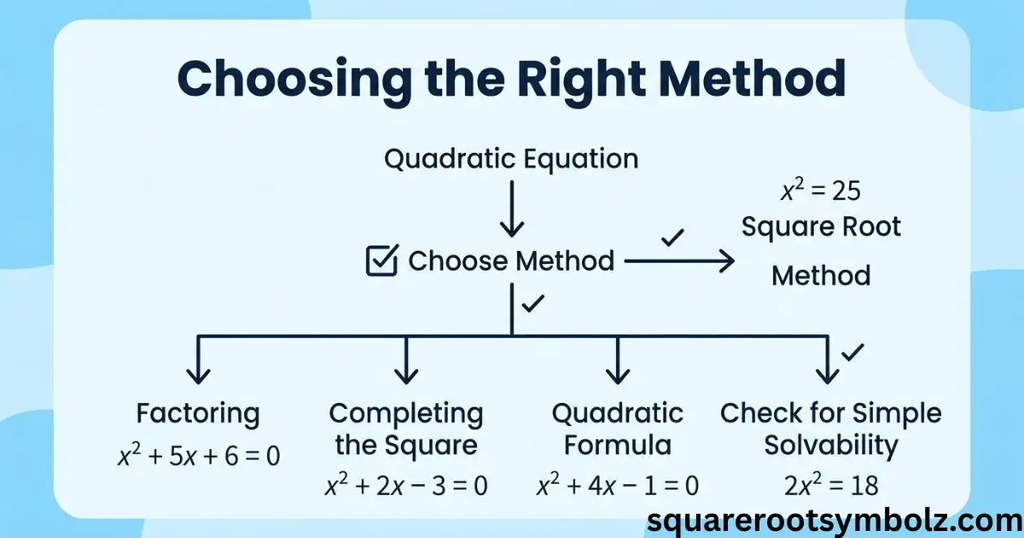
| Equation structure | Natural method |
| x² = k | Square Root Property |
| ax² = k | Square Root Property |
| a(x − h)² = k | Square Root Property |
| Easily factorable quadratic | Factoring |
| Perfect-square trinomial | Factoring or square-root form |
| General ax² + bx + c = 0 | Factoring, completing the square, or quadratic formula |
| Variable under a square root | Radical-equation method |
OpenStax specifically recommends considering factoring, the Square Root Property, completing the square, and the quadratic formula as different tools rather than treating one technique as appropriate for every quadratic.
A useful rule for students is simple: if the squared expression can be isolated cleanly, check whether the Square Root Property will solve the equation faster. If an x-term remains and the expression does not fit a squared-binomial form, another quadratic method may be more appropriate.
Common Mistakes With the Square Root Method
Forgetting ±
If x² = 25, writing only x = 5 gives an incomplete solution. Both 5 and −5 square to 25. The correct solution is x = ±5.
Taking the square root too early
For 3x² = 27, do not immediately write x = ±√27. First divide by 3 to get x² = 9. Then take the square root and obtain x = ±3.
Misreading a squared binomial
For (x − 4)² = 9, the square applies to the entire expression x − 4. The correct next step is x − 4 = ±3, not x − 4 = 3 only.
Rounding too soon
If x = ±√7, the radical is an exact answer. Replacing it immediately with an approximate decimal can lose precision. Keep the radical unless the question asks for a decimal.
Not checking the result
Substituting the answers back into the original equation is a simple way to catch mistakes. This is especially important when an equation has been rearranged several times.
Quadratic Equations With Radical Solutions
A quadratic can have radical solutions even when the original equation contains no radical. For example, x² = 12 produces x = ±√12, which simplifies to x = ±2√3. The radical is not a problem; it is simply the exact form of the solution.
If the constant is a perfect square, the answer may be an integer. If it is not, the answer may remain irrational. For example, x² = 36 gives x = ±6, while x² = 37 gives x = ±√37. Both are legitimate quadratic solutions.
OpenStax’s Algebra 1 material specifically demonstrates equations such as x² = 18 producing x = ±3√2 and (x + 1)² = 18 producing x = −1 ± 3√2.
When Square Roots Produce Complex Solutions
If the isolated squared expression equals a negative number, there are no real solutions. For example, x² = −9 has no real-number solution because squaring a real number cannot produce a negative result.
In the complex number system, however, √−9 can be written as 3i, where i is the imaginary unit and i² = −1. Therefore, x² = −9 has complex solutions x = 3i and x = −3i. OpenStax includes this extension when discussing the Square Root Property.
This distinction matters because a problem may ask specifically for real solutions or may allow complex solutions. Always read the instructions before deciding that “no solution” is the final answer.
Quadratic Equations With Square Roots vs Radical Equations
These two ideas sound similar but are not identical. In the square-root method, the quadratic contains a squared expression that you can isolate, such as x² = 20 or (x − 3)² = 11. Taking square roots then directly produces the solutions.
A radical equation instead contains the variable under a radical, such as √(x + 2) = x. These equations are usually solved by isolating the radical, squaring both sides, solving the resulting equation, and checking every candidate in the original equation. Squaring can introduce an extraneous solution.
That distinction is important for search intent. Someone looking for quadratic equations with square roots may mean “solve a quadratic by taking square roots,” while another reader may mean “solve an equation containing a square root that becomes quadratic.” Both topics belong to the same semantic cluster, but the solving procedures are different.
Conclusion
Quadratic equations with square roots become much easier when you recognize the structure before choosing a method. If you can isolate a squared expression such as x² or (x − h)², the Square Root Property is often the fastest approach.
The essential process is straightforward:
Isolate the squared term → make its coefficient 1 → take square roots → include ± → simplify → solve → check.
Remember that perfect squares often produce integer answers, while non-perfect squares may produce exact radical answers such as √7 or 3√2. If a negative value appears under the square root, determine whether the problem allows complex solutions.
Most importantly, do not confuse this method with solving radical equations. When the variable is actually inside a square root, squaring both sides can create extraneous solutions, so checking the original equation becomes essential.
FAQ Section
How do you solve a quadratic equation using square roots?
First isolate the squared expression and make its coefficient 1. Then take the square root of both sides, use ±, simplify the radical, solve for the variable, and check the solutions.
When can you solve a quadratic by taking square roots?
You can use this method when the equation can be rearranged into a form such as x² = k or a(x − h)² = k. It is especially useful when there is no linear x-term.
Why do you use ± when taking the square root?
Because a positive number generally has two real square roots. For example, both 6 and −6 have a square of 36. Therefore, x² = 36 has x = ±6.
What if the number is not a perfect square?
Leave the answer as an exact radical after simplifying it. For example, x² = 20 gives x = ±√20 = ±2√5.
What if the number under the square root is negative?
There are no real solutions when a real squared expression equals a negative number. If complex numbers are allowed, the negative radicand can be expressed using i.
What is the Square Root Property?
If x² = k and k is nonnegative, then x = √k or x = −√k, commonly written x = ±√k.
What is the difference between a quadratic equation and a radical equation?
A quadratic equation has a variable raised to the second power. A radical equation has a variable inside a root. A radical equation may become quadratic after squaring, and that process can create extraneous solutions.
Do you always get two answers from a quadratic equation?
No. A quadratic can have two real solutions, one real solution, or no real solutions. When using the Square Root Property with a positive value, two real solutions normally occur; when the value is zero, there is one solution.
How do you solve (x − 5)² = 16?
Take the square root of both sides:
x − 5 = ±4
Then solve both cases:
x = 9 or x = 1.
How do you solve 3x² = 48?
Divide by 3:
x² = 16
Take square roots:
x = ±4
So the solutions are 4 and −4.

I’m the creator of SquareRootSymbolz.com, where I publish easy-to-understand guides on symbols, Unicode characters, Alt codes, keyboard shortcuts, and copy-and-paste text symbols. My goal is to provide accurate, well-researched, and user-friendly content that helps readers quickly find the information they need.