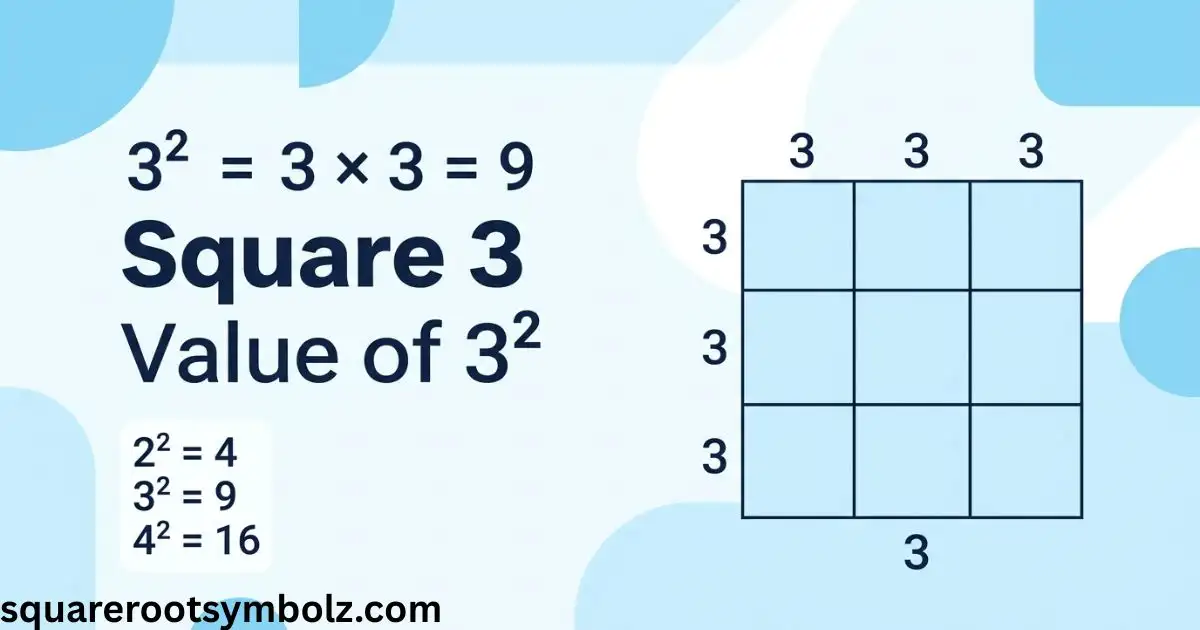
Square 3 means the square of the number 3, and the answer is 9. In other words, 3² means 3 × 3, so 3² = 9. The small 2 is the exponent, while 3 is the base. This simple calculation connects multiplication, powers, perfect squares, algebra, and geometry.
If you have ever paused over a problem asking for square 3, you are not alone. The wording can look more complicated than the calculation itself. The key is to recognize the operation, multiply 3 by itself, and check the result. This guide explains the value, formula, examples, common mistakes, and the important difference between 3² and √3.
What is the Square of 3
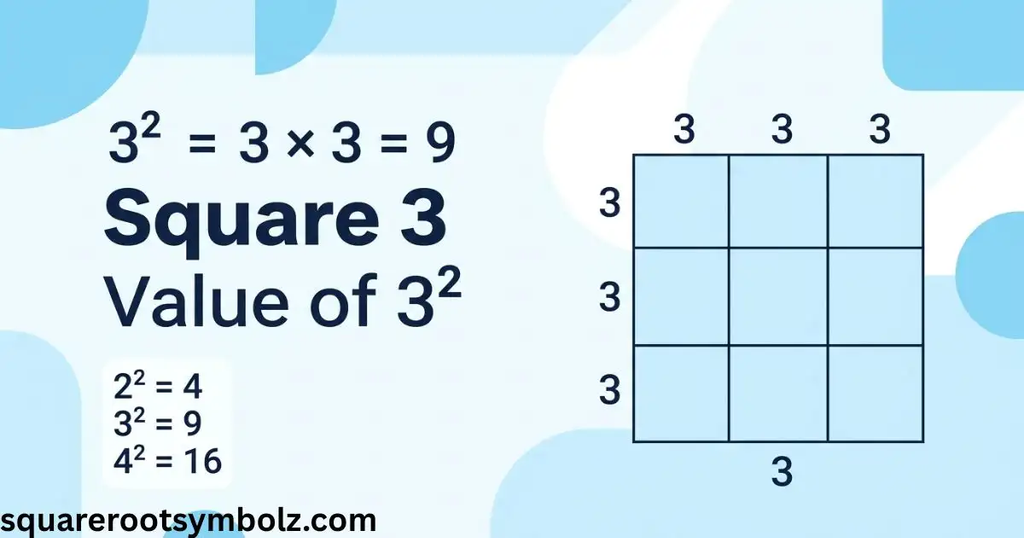
The square of 3 is 9. Squaring a number means multiplying that number by itself. Therefore, 3² means 3 × 3. The number 3 is the base, and the raised 2 is the exponent. The calculation is simple: 3 × 3 = 9.
You can write the same result in several forms. The exponential form is 3², the multiplication form is 3 × 3, and the numerical result is 9. Because 9 is the product of an integer multiplied by itself, 9 is a perfect square. The number 3 is its positive square root.
| Form | Meaning | Result |
| 3² | 3 squared | 9 |
| 3 × 3 | 3 multiplied by itself | 9 |
| 3 + 3 + 3 | Three added three times | 9 |
| √9 | Positive square root of 9 | 3 |
Square of 3
The quickest way to find square 3 is to multiply 3 by itself. Start with the number 3, write it twice as a multiplication problem, and calculate the product. The result is 9. This is the basic meaning of raising a number to the second power.
The formula for squaring a number is a² = a × a. Substituting 3 for a gives 3² = 3 × 3 = 9. The exponent does not mean 3 multiplied by 2. Instead, it tells you how many copies of the base are used in multiplication.
| Calculation | Answer |
| 3² | 9 |
| 3 × 3 | 9 |
| 3 + 3 + 3 | 9 |
| 9 ÷ 3 | 3 |
| √9 | 3 |
What is the square number of 3?
The phrase “square number of 3” can be understood as the number produced when 3 is multiplied by itself. That product is 9. So, the square of 3 is 9, while 3 itself is not a perfect square because its square root is not an integer.
This distinction matters in elementary number theory. A perfect square is an integer that can be written as another integer multiplied by itself. Numbers such as 1, 4, 9, 16, and 25 are examples. Since 3² = 9, the number 9 belongs to this sequence.
| Number | Square | Perfect Square? |
| 1 | 1 | Yes |
| 2 | 4 | Yes |
| 3 | 9 | Yes, as a result |
| 4 | 16 | Yes |
| 5 | 25 | Yes |
Common Mistakes to Avoid When Calculating the Square of 3
A common mistake is confusing a square with a square root. Squaring 3 gives 9, while finding the square root of 3 asks for a number that produces 3 when squared. These are inverse operations, but they do not give the same result.
Another error is treating exponent 2 as a multiplication instruction. The expression 3² does not mean 3 × 2. It means 3 × 3. Parentheses can also matter when negative numbers appear, so careful notation helps prevent incorrect answers.
Mistake 1
Calculation errors can happen when a student rushes or switches digits. For square 3, the safest check is direct multiplication: 3 × 3 = 9. You can verify the result by taking the square root of 9, which returns the positive value 3.
Mistake 2
A formula mistake happens when the exponent is misunderstood. The general square formula is a² = a × a. When a equals 3, the correct substitution is 3 2 = 3 × 3 = 9. The exponent is 2, not an instruction to multiply 3 by 2.
Mistake 3
Confusing square and square root is another frequent problem. The square of 3 is 9, but √3 is approximately 1.732. On the other hand, √9 = 3. Remembering which number is being squared makes these inverse operations much easier to distinguish.
Solved Examples on Square of 3
The value of square 3 also appears in geometry and algebra. For example, a square with a side length of 3 units has an area of 3² = 9 square units. The same calculation appears whenever a formula contains a squared side, radius, variable, or measurement.
A useful habit is to identify what the exponent applies to before calculating. If a problem contains 3², square only the 3. If a formula contains πr² and r = 3, substitute 3 for r and then calculate π × 3².
Problem 1
Find the area of a square with a side length of 3 cm.
The area formula is side × side. Therefore, the area is 3 × 3 = 9. The answer is 9 cm². Here, square 3 represents the area-producing calculation, not the length of the side itself.
Problem 2
A garden is 3 meters long and 3 meters wide. What is its area?
Multiply the length by the width: 3 × 3 = 9. Therefore, the garden has an area of 9 m². This is another practical way to understand why a square number is connected to the geometry of a square.
Problem 3
Find the value of 3².
The exponent tells you to multiply the base by itself:
3² = 3 × 3
Therefore:
3² = 9
This is the direct numerical answer whenever a question asks for square 3.
Problem 4
A circle has a radius of 3 meters. What value does r² have?
Since r = 3, substitute 3 into r²:
r² = 3² = 9
Therefore, the squared radius is 9 m². If calculating the full circle area, the formula would then use π × 9.
Problem 5
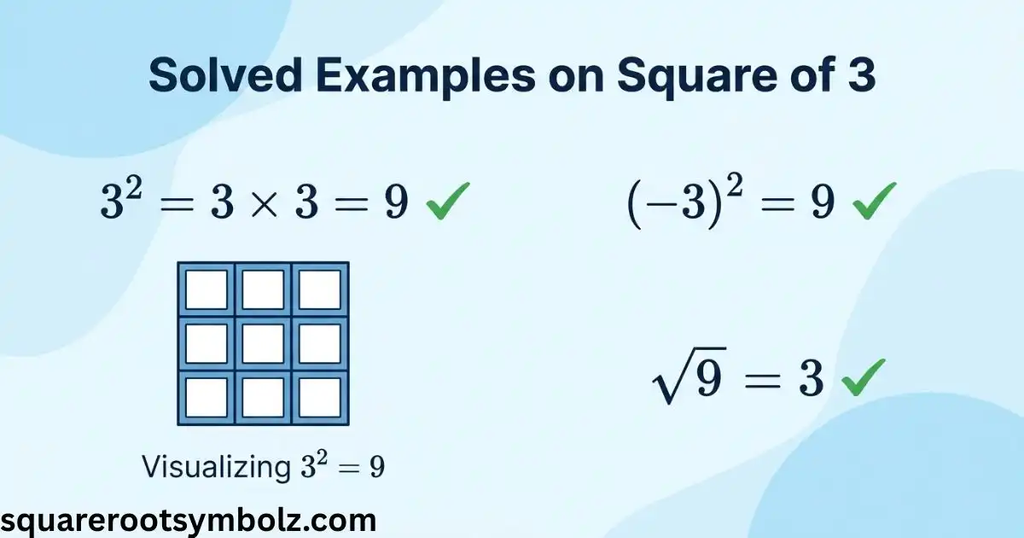
What number has 3 as its positive square root?
The answer is 9 because:
√9 = 3
This is the reverse relationship of square 3. Squaring 3 produces 9, while taking the positive square root of 9 returns 3.
Conclusion
Square 3 has a simple and exact answer: 9. The calculation is 3² = 3 × 3 = 9. Understanding this small example builds a foundation for exponents, perfect squares, algebraic formulas, area calculations, and square roots.
The most important distinction is between 3² and √3. The first asks for the square of 3 and equals 9; the second asks for the square root of 3 and is approximately 1.732. Once that difference is clear, questions involving square 3 become much easier to solve accurately.
FAQs
What is the square of 3?
The square of 3 is 9. To calculate it, multiply 3 by itself: 3 × 3 = 9. In exponential notation, the same calculation is written as 3² = 9.
What is the square root of 3?
The square root of 3 is approximately 1.7320508076. Unlike square 3, which equals 9, √3 is an irrational number and cannot be written exactly as a fraction of two integers.
Is 3 a prime number?
Yes. 3 is a prime number because it has exactly two positive factors: 1 and 3. It is also an odd number because it is not evenly divisible by 2.
What are the first few multiples of 3?
The first few nonnegative multiples of 3 are 0, 3, 6, 9, 12, 15, 18, and 21. Each is obtained by multiplying 3 by a whole number.
What is the square of 4?
The square of 4 is 16 because 4 × 4 = 16. In exponential notation, this is written as 4² = 16. It follows the same square formula used for 3².

I’m the creator of SquareRootSymbolz.com, where I publish easy-to-understand guides on symbols, Unicode characters, Alt codes, keyboard shortcuts, and copy-and-paste text symbols. My goal is to provide accurate, well-researched, and user-friendly content that helps readers quickly find the information they need.