Square root and cube root are inverse operations that help you work backward from squares and cubes. If 6² = 36, then √36 = 6; if 4³ = 64, then ∛64 = 4. These ideas connect perfect squares, perfect cubes, radicals, exponents, area, volume, and algebra in one useful pattern.
When students first meet roots, the symbols can feel confusing, especially when a problem changes from a square, cube, square root, or cube root. The key is to ask what operation produced the number. This guide explains the radical sign, root formulas, common values, calculation methods, and worked examples in a clear way.
What is Square Root and Cube Root?
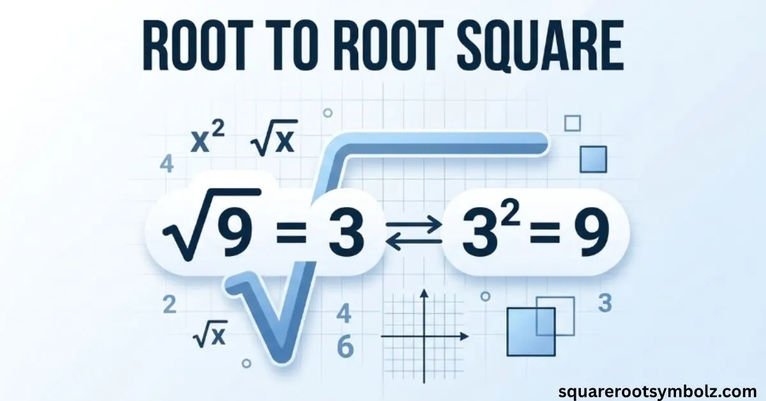
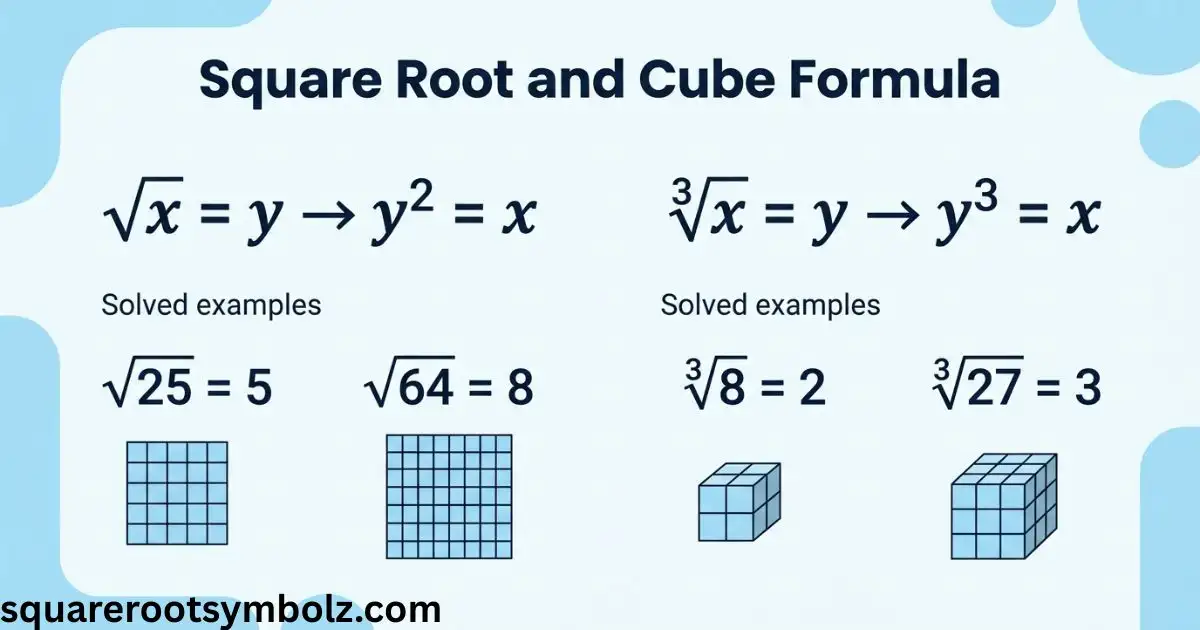
A square root asks which number was multiplied by itself to produce a given value. For example, 7 × 7 = 49, so √49 = 7. A cube root asks which number was multiplied three times, so 3 × 3 × 3 = 27 and ∛27 = 3. These are inverse operations.
The easiest way to remember the difference is to connect each root with its geometry. A square has area = side × side, so the square root can recover its side length. A cube has volume = side × side × side, so the cube root can recover its edge length. This makes the symbols much easier to understand.
| Operation | Meaning | Example |
| Square | Multiply a number by itself | 6² = 36 |
| Cube | Multiply a number three times | 4³ = 64 |
| Square root | Reverse a square | √36 = 6 |
| Cube root | Reverse a cube | ∛64 = 4 |
A useful distinction is that the radical symbol √ normally represents the principal, nonnegative square root. The equation x² = 36, however, has two real solutions: x = 6 and x = −6. Both numbers square to 36, while √36 specifically means 6.
Square Root and Cube Root Symbol
The square root symbol is √, called the radical sign. A cube root uses ∛, which adds a small 3 to the radical. That index tells you that the root is a third root. In ordinary notation, √x means the square root of x, while ∛x means the cube root.
The difference becomes important when reading mathematical expressions. For example, √25 = 5 because 5² = 25, while ∛125 = 5 because 5³ = 125. The symbols may look similar, but their index, exponent relationship, radicand, and resulting operation are different.
| Symbol | Name | Meaning | Example |
| √ | Square root/radical sign | Root with index 2 understood | √81 = 9 |
| ∛ | Cube root | Root with index 3 | ∛125 = 5 |
| ² | Squared | Power of 2 | 9² = 81 |
| ³ | Cubed | Power of 3 | 5³ = 125 |
A common mistake is confusing cube root with “root cubed.” They are not the same operation. The expression ∛27 means the cube root of 27, which is 3. Cubing a root is a different operation. Reading the index before calculating prevents this error.
How to Find Square Root and Cube Root?
For a perfect square, look for a whole number that produces the given value when multiplied by itself. For example, 64 is 8 × 8, so √64 = 8. For a perfect cube, find the number that appears three times as a factor. Since 125 = 5 × 5 × 5, ∛125 = 5.
For larger values, prime factorization provides a reliable method. Square-root factors are grouped in pairs, while cube-root factors are grouped in threes. Factors left outside those complete groups remain under the radical. This method is especially helpful when a number is not immediately recognizable.
Worked method
To find √144, factor 144 as 2 × 2 × 2 × 2 × 3 × 3. Pair the identical factors: (2 × 2), (2 × 2), and (3 × 3). Take one number from each pair: 2 × 2 × 3 = 12. Therefore, √144 = 12.
For ∛216, factor the number as 2 × 2 × 2 × 3 × 3 × 3. Group the factors into triples and take one factor from each group. That gives 2 × 3 = 6, so ∛216 = 6. The pairing and grouping rule is the heart of prime-factorization methods.
For numbers that are not perfect squares or cubes, the answer may not be a whole number. For example, √2 is approximately 1.414, while ∛10 is approximately 2.154. You can estimate these values between nearby perfect squares or perfect cubes, then use a calculator when greater precision is required.
Square Root and Cube Root Table
A reference table makes common root values much easier to recognize. Perfect squares such as 1, 4, 9, 16, and 25 have whole-number square roots. Perfect cubes such as 1, 8, 27, 64, and 125 have whole-number cube roots. Learning these patterns saves time during calculations.
The table below combines common values so you can compare both operations quickly. Notice that the same input can produce very different roots. For example, √16 = 4, but ∛16 is approximately 2.520. The number is unchanged; only the root operation changes.
| Number | Square Root | Cube Root |
| 1 | 1 | 1 |
| 4 | 2 | 1.587 |
| 8 | 2.828 | 2 |
| 9 | 3 | 2.080 |
| 16 | 4 | 2.520 |
| 25 | 5 | 2.924 |
| 27 | 5.196 | 3 |
| 36 | 6 | 3.302 |
| 49 | 7 | 3.659 |
| 64 | 8 | 4 |
| 81 | 9 | 4.327 |
| 100 | 10 | 4.642 |
| 125 | 11.180 | 5 |
| 144 | 12 | 5.241 |
| 216 | 14.697 | 6 |
A useful memory trick is to learn the perfect-square and perfect-cube sequences rather than trying to memorize every decimal root. The perfect squares increase from 1, 4, 9, 16, 25, while perfect cubes begin 1, 8, 27, 64, 125. These anchor values help you estimate nearby roots.
For example, if you need √50, recognize that 49 < 50 < 64. Therefore, √50 must be between 7 and 8. If you need ∛70, recognize that 64 < 70 < 125, so the cube root must be between 4 and 5. This simple bounding technique is useful even without a calculator.
Square Root and Cube Root Formula
The square root can be expressed as a fractional exponent: √x = x^(1/2). The cube root is x^(1/3). These forms show why roots are connected to powers. Squaring and taking a square root reverse each other for appropriate nonnegative values, while cubing and taking a cube root reverse each other across the real numbers.
For a square root, if x² = a, then x is a square root of a. For a cube root, if x³ = a, then x is the cube root of a. The important difference appears with negative values: a negative number has no real square root, but every real number has a real cube root.
| Concept | Formula | Example |
| Square | x² | 7² = 49 |
| Cube | x³ | 4³ = 64 |
| Square root | √x = x^(1/2) | √49 = 7 |
| Cube root | ∛x = x^(1/3) | ∛64 = 4 |
The fractional-exponent form is particularly useful in algebra. For example, 25^(1/2) = 5 and 27^(1/3) = 3. The denominator tells you the root: 2 means square root and 3 means cube root. This relationship extends naturally to fourth roots, fifth roots, and other nth roots.
Another important point concerns negative numbers. √(−9) is not a real number because no real number multiplied by itself produces −9. In contrast, ∛(−8) = −2 because (−2) × (−2) × (−2) = −8. Odd roots preserve the sign of a real number.
Square Root and Cube Root Solved Examples
Consider √36. The number 36 can be written as 6 × 6, so its principal square root is 6. Using prime factorization gives the same result: 36 = (2 × 2)(3 × 3), and one factor from each pair produces 2 × 3 = 6. This is a perfect-square example.
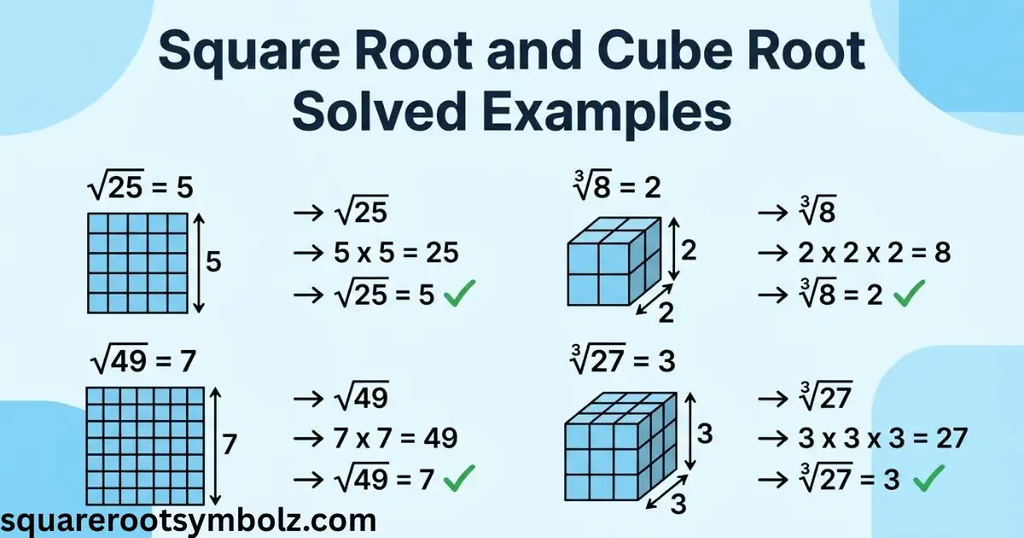
Now consider ∛27. Since 27 = 3 × 3 × 3, the cube root is 3. The same idea works with larger perfect cubes. For example, 2744 = 14 × 14 × 14, so ∛2744 = 14. Recognizing perfect powers can turn a long calculation into a quick mental step.
Example: Find √256
First recognize that 16 × 16 = 256. Therefore:
√256 = 16
You can also use prime factorization. Because 256 = 2⁸, the eight factors of 2 form four pairs. Taking one 2 from each pair gives 2⁴ = 16. Both approaches confirm the same square-root value.
Example: Find ∛512
The number 512 can be written as 8 × 8 × 8. Therefore:
∛512 = 8
Prime factorization gives another route because 512 = 2⁹. The nine factors can be arranged into three groups of three. Taking one factor from each group gives 2 × 2 × 2 = 8.
Example: Find √18
18 is not a perfect square, so its square root is not a whole number. Factor it as 9 × 2:
√18 = √(9 × 2) = 3√2
The exact simplified form is 3√2, while the decimal approximation is about 4.243. This is an important distinction: an irrational root can have an exact radical form even when it does not have a terminating decimal.
Example: Find ∛54
54 contains the perfect cube 27:
∛54 = ∛(27 × 2) = 3∛2
So the cube root can be simplified without becoming a whole number. This is the same basic idea used for square-root simplification: identify a perfect power inside the radicand and move its root outside.
Square Root vs. Cube Root at a Glance
| Feature | Square Root | Cube Root |
| Operation reversed | Squaring | Cubing |
| Index | 2, usually omitted | 3 |
| Symbol | √ | ∛ |
| Example | √64 = 8 | ∛64 = 4 |
| Negative input in real numbers | Not defined | Defined |
| Perfect values | 1, 4, 9, 16, 25 | 1, 8, 27, 64, 125 |
| Geometry connection | Area and side | Volume and edge |
The biggest conceptual difference is the behavior of signs. Squaring removes a negative sign because negative × negative is positive. Cubing preserves the negative sign because three negative factors produce a negative result. Remembering this explains why negative cube roots are real while negative square roots are not.
Conclusion
Square root and cube root become much easier once you see them as inverse operations. A square root reverses a square, while a cube root reverses a cube. The symbols √ and ∛, perfect powers, prime factorization, fractional exponents, and common-value tables all describe the same underlying relationship from different angles.
The most useful habit is to look at the operation before calculating. Ask whether the problem is reversing multiplication by two equal factors or three equal factors. From there, the correct root, formula, sign rule, and calculation method usually become clear.
FAQs
What is the meaning of square and cube root?
A square root reverses squaring, while a cube root reverses cubing. For example, 5² = 25, so √25 = 5. Likewise, 3³ = 27, so ∛27 = 3. The first uses two equal factors, while the second uses three equal factors.
What is the use of cube root in daily life?
Cube roots are useful when a three-dimensional measurement is known but its edge length is needed. For example, if a cube has a volume of 125 cubic units, its edge is ∛125 = 5 units. This connects cube roots directly with volume and geometry.
What is the difference between the square root and cube Root?
A square root reverses a power of two, whereas a cube root reverses a power of three. Square roots of negative numbers are not real, but cube roots of negative real numbers are real. For example, √16 = 4 while ∛(−8) = −2.
How to find square root and cube root easily?
Start by checking whether the number is a familiar perfect square or perfect cube. If it is not, use prime factorization, grouping square-root factors in pairs and cube-root factors in groups of three. For non-perfect values, estimate between nearby perfect powers or use a calculator.
What is the power of the cube root?
A cube root is equivalent to raising a number to the power of 1/3. Thus, ∛x = x^(1/3). The denominator 3 indicates that the operation is a cube root. Similarly, a square root can be written as x^(1/2), showing its connection with fractional exponents.
What is the square root symbol?
The square root symbol is √, known as the radical sign. The number or expression inside it is called the radicand. For example, in √49, the radical sign is √ and 49 is the radicand. The principal square root of 49 is 7.
Do all numbers have square roots?
All positive real numbers have real square roots, but negative real numbers do not have real square roots. Some positive numbers have whole-number roots, such as √49 = 7, while others have irrational roots, such as √2 ≈ 1.414.

I’m the creator of SquareRootSymbolz.com, where I publish easy-to-understand guides on symbols, Unicode characters, Alt codes, keyboard shortcuts, and copy-and-paste text symbols. My goal is to provide accurate, well-researched, and user-friendly content that helps readers quickly find the information they need.